Improving Organisational Efficiency: A Strategic Framework for 2026
Updated: Jun 22
This guide provides a methodical approach to identifying these friction points and implementing the specific ICT strategies required to drive measurable performance. We'll examine a diagnostic framework to locate hidden waste, align your infrastructure with your business goals, and provide a repeatable blueprint for digital transformation. By bridging the gap between technical requirements and broader organisational objectives, you can transform your operations into a source of competitive advantage.
Table of Contents
Defining Organisational Efficiency in the 2026 Business Landscape
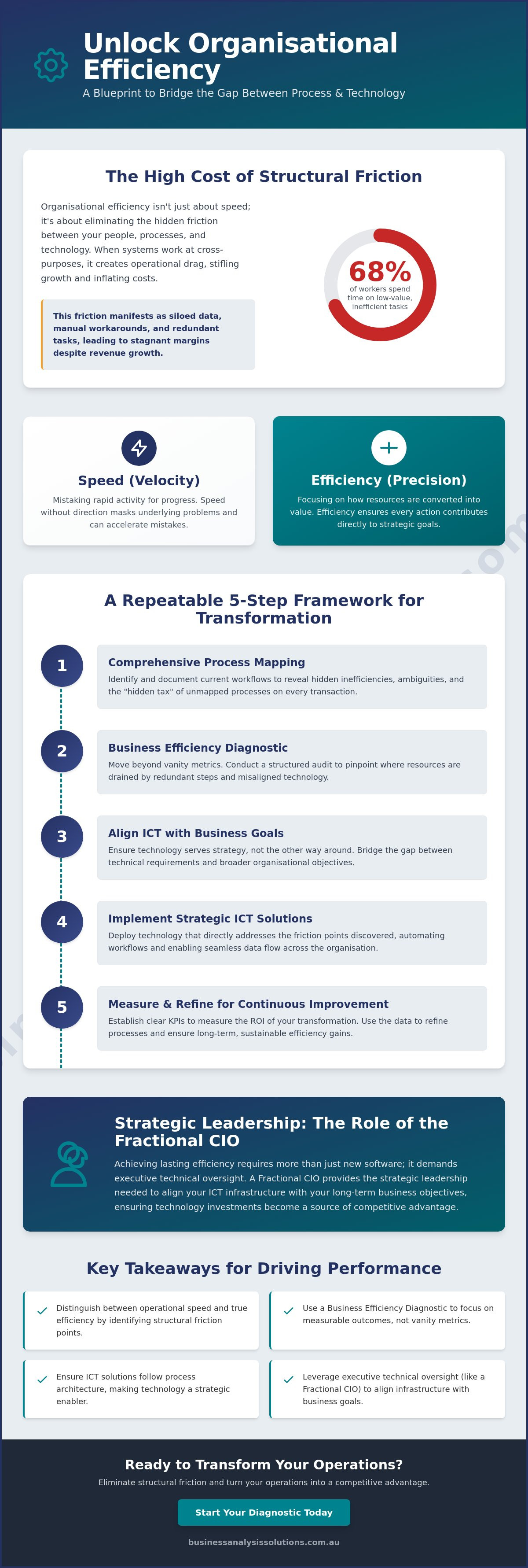
Speed is a metric of velocity, but efficiency is a metric of precision. Many organisations mistake rapid activity for progress, yet true Defining Organisational Efficiency requires a focus on how resources are converted into value. In 2026, the complexity of technical stacks means that activity often masks underlying structural friction. This friction occurs when your systems and your people work at cross-purposes, creating a drag that slows every strategic initiative. It's common to see teams working harder while the business remains stagnant because the underlying machinery is misaligned.
The financial consequences of this friction extend beyond immediate overheads. While rising direct costs are visible on a balance sheet, the opportunity loss from delayed market entry or slow decision-making is often far greater. Improving organisational efficiency isn't just about cutting expenses; it's about reclaiming the capacity to innovate. We've moved past the era of siloed improvements where one department optimises in isolation. The current environment demands integrated ecosystems where data flows seamlessly across functions. Without this integration, your technology stack becomes a burden rather than an enabler, consuming resources without producing proportional revenue growth.
The Relationship Between Process and Performance
Unmapped processes act as a hidden tax on every transaction within the business. When steps are poorly defined, employees must navigate ambiguity, which leads to errors and executive decision fatigue. This lack of clarity forces leaders to intervene in routine tasks, pulling them away from strategic growth. Efficiency is the ratio of strategic output to resource input. Establishing clear process architecture through formal Process Mapping removes the mental load from leadership and ensures that every action taken contributes directly to the bottom line.
Identifying the Efficiency Gap
A failing system often reveals itself through an over-reliance on manual workarounds. If your team is using complex spreadsheets to bridge gaps between expensive software tools, you're experiencing a significant efficiency gap. These workarounds are symptoms of a deeper disconnect between your business goals and your ICT infrastructure. A preliminary Friction Audit can identify where time is being lost to repetitive data entry or redundant approvals. Closing this gap requires bridging the divide between high-level vision and granular execution. It's about ensuring that every technical tool serves a documented business process, creating a repeatable blueprint for success.
Measuring Efficiency: The Diagnostic Approach
Measurement without context is a strategic liability. Leaders often rely on high-level data that obscures operational friction. These vanity metrics might suggest high productivity while ignoring the rising cost of rework or manual intervention. To succeed in improving organisational efficiency, you must look beneath the surface. A structured Business Efficiency Diagnostic identifies where resources are being drained by redundant steps or misaligned technology. This methodical approach ensures you aren't just measuring activity. You're assessing value.
Balancing quantitative data with qualitative process reality is essential. While a ledger shows financial performance, it doesn't reveal the "hidden tax" of inefficient workflows discussed in the previous section. Establishing a clear baseline is the first step before introducing any automation or ICT changes. Without this starting point, it's impossible to measure the ROI of your digital transformation efforts. This alignment is why industry leaders view ICT as a Strategic Lever for Improving Efficiency.
Establishing a baseline isn't a one-time event. It's a foundational requirement for any Digital Transformation Blueprint. Without a clear understanding of your current state, investment in new technology is a gamble. You risk automating an inefficient process, which only serves to make the mistakes happen faster. A methodical diagnostic reveals the "leaks" in your current system, allowing you to patch them before scaling. This ensures your ICT budget is spent on growth, not on fixing structural debt.
Key Performance Indicators (KPIs) for Operational Health
Traditional metrics often focus on resource utilisation, but high utilisation doesn't always equal high performance. If your team is 100% utilised on tasks that don't drive strategic outcomes, you have an efficiency gap. Effective diagnostics focus on specific health indicators:
Cycle Time Analysis: Finding the literal "wait" in the system where work stalls between departments.
Cost-to-Serve: Calculating the total operational expense required to deliver a specific service or product.
Output Quality: Measuring the percentage of "right first time" results to identify hidden rework costs.
The Role of Process Mapping in Diagnostics
Visualisation is the antidote to organisational complexity. Most businesses operate based on a perceived workflow that differs significantly from the daily reality. Implementing professional business process mapping reveals these hidden complexities. It moves the conversation from "how we think it works" to a documented, objective truth. This clarity allows for precise intervention. You can't fix what you can't see.
Understanding your current operational health is the first step toward lasting change. A professional Business Efficiency Diagnostic can uncover the specific bottlenecks holding your team back and provide the data needed for informed decision-making.
ICT as a Strategic Lever for Improving Efficiency
Technology is often misapplied as a primary solution rather than a supporting architecture. For improving organisational efficiency, ICT solutions must follow established process architecture, not lead it. When software is implemented without a clear understanding of the underlying workflow, it often exacerbates existing friction. This creates a fragmented software ecosystem where data becomes siloed and teams resort to "Shadow IT" to bypass cumbersome official systems. Bridging the gap between technical requirements and organisational objectives requires a disciplined approach that prioritises strategic alignment over feature sets.
The risk of fragmented ecosystems is significant. In 2026, data integrity is the currency of operational success. If your CRM doesn't talk to your accounting software, or if manual exports are required to generate reports, your technology stack is a bottleneck. Adhering to efficient leadership principles involves ensuring that every tech investment serves a documented business need. This prevents the accumulation of technical debt and ensures that your infrastructure supports, rather than hinders, growth. It's about building a system where the tools work for the people, not the other way around.
Digital Transformation as an Efficiency Catalyst
System failures often stem from a lack of high-level planning. A comprehensive digital transformation blueprint for business serves as a roadmap to prevent these costly errors. Transitioning from rigid legacy systems to agile, cloud-based architectures allows for greater scalability and real-time data access. This transition is essential for improving organisational efficiency because it ensures that information is available where and when it's needed most. Maintaining data integrity across integrated services is not just a technical requirement; it's a strategic necessity for accurate performance tracking.
Automation vs. Human Capital
Automation implementation should focus on augmenting human potential, not just replacing headcount. High-value human decision-making is the engine of innovation, and it shouldn't be bogged down by repetitive, low-value tasks. Identifying these tasks is critical. By automating routine data entry or simple approvals, you free your team to focus on strategic outcomes. However, the success of any technical project relies heavily on user adoption. If the team finds the new tools unintuitive, they'll revert to manual workarounds. Training and clear communication are as important as the technology itself.
The 5-Step Framework for Improving Organisational Efficiency
Operational excellence is the result of deliberate, sequential action. Random improvements often fail because they lack the structural foundation required to sustain change. To achieve lasting results in improving organisational efficiency, you must follow a logical progression that moves from objective analysis to technical execution. This framework ensures that every investment in technology or process change is grounded in data and aligned with your long-term business objectives.
Implementing this framework requires a shift from reactive problem-solving to proactive system design. The following five steps provide a repeatable blueprint for transformation:
Step 1: Business Efficiency Diagnostic. Conduct an objective audit to identify operational leaks and establish the baseline performance metrics discussed in earlier sections.
Step 2: Process Mapping. Visualise every workflow to find structural friction points where people and systems are misaligned.
Step 3: Digital Strategy Development. Create a roadmap that ensures your ICT infrastructure supports your specific growth targets.
Step 4: ICT and Automation Implementation. Deploy targeted solutions that automate low-value tasks and integrate siloed data streams.
Step 5: Continuous Review. Establish a cycle of data-driven optimisation to ensure systems remain efficient as the business scales.
Developing a Digital Strategy
A strategy isn't a wish list of software; it's a logical plan for technical alignment. You must set clear, measurable goals for every implementation to ensure it delivers a tangible return on investment. Prioritising projects based on their organisational impact prevents the common mistake of over-complicating systems too early. Your digital strategy must also account for future scalability, ensuring that today's solutions don't become tomorrow's legacy bottlenecks. This foresight is what separates market leaders from those struggling with technical debt.
Project Management and Execution
The most sophisticated framework will fail without disciplined execution. Expert project management is the bridge between a strategic vision and operational reality. Managing the human element of change is critical; you must reduce internal resistance by demonstrating early wins through phased rollouts. Incremental implementation reduces risk and allows for adjustments based on real-world feedback. This methodical approach ensures that improving organisational efficiency becomes a permanent feature of your corporate culture rather than a one-off project.
If you're ready to identify the friction points in your own operations, our team can help you navigate this framework. Explore our Business Efficiency Diagnostic to begin your transformation with objective data.
Strategic Leadership: The Role of the Fractional CIO
Many efficiency initiatives stall because they lack high-level technical oversight. Without an executive-level perspective, IT projects often become disconnected from core business goals, leading to the fragmented ecosystems discussed earlier. A Fractional CIO provides this essential leadership on a part-time basis, offering a strategic bridge between operations and technology. This model allows organisations to access high-level expertise without the substantial overhead of a full-time executive hire. By engaging an external partner, leadership teams gain an objective, outside-in perspective that is often necessary to challenge established inefficiencies and drive meaningful change.
Bridging the expertise gap is critical for improving organisational efficiency in a landscape where technology evolves faster than internal capabilities. A Fractional CIO doesn't just manage systems; they align technical architecture with your financial and operational objectives. They ensure that the Digital Transformation Blueprint is executed with precision, preventing the common pitfalls of scope creep and misaligned vendor selection. This strategic oversight provides the calm assurance that complex technical transitions will result in tangible business value.
Expert ICT Consultancy and Advisory
Sustaining Efficiency for the Long Term
True efficiency isn't a project with a completion date; it's a permanent shift in operational culture. Maintaining these gains requires regular health checks and diagnostic updates to ensure that processes haven't drifted back into old habits. As your business scales, your systems must evolve to handle increased complexity without introducing new friction points. Sustaining this momentum involves establishing clear accountability for process performance and ensuring that technology continues to serve the human capital within the organisation. Consistency in review is the only way to ensure improving organisational efficiency remains a continuous outcome rather than a one-off event.
The path to operational excellence begins with an objective assessment of your current state. By following the 5-step framework and leveraging strategic leadership, you can transform your operations from a source of friction into a driver of measurable performance. If you're ready to identify the hidden leaks in your business, the first step is to book a Business Efficiency Diagnostic to secure the data-driven foundation your transformation requires.
Securing Operational Excellence for 2026
Achieving operational excellence requires more than just adopting new tools. It demands a rigorous alignment of your process architecture with your strategic vision. By identifying structural friction through a systematic diagnostic, you can move beyond reactive fixes and build a resilient framework for growth. This methodical approach ensures that your ICT investments deliver measurable value rather than adding technical debt. Improving organisational efficiency is a continuous commitment to precision and performance that relies on data-driven decision-making.
With over 20 years of strategic consultancy experience, Business Analysis & Solutions specializes in bridging the gap between business requirements and ICT infrastructure. Our proven methodology has helped organizations across Australian industries resolve complex operational challenges through logical, end-to-end results. We provide the clarity and direction needed to ensure your technology stack remains an enabler for your workforce rather than a burden on your overheads.
Take the first step toward a friction-free operation today. Request a Business Efficiency Diagnostic from Business Analysis & Solutions to uncover the hidden leaks in your systems and secure a repeatable blueprint for success. You can transform your organisational capacity and achieve lasting stability with the right framework and expert oversight.
Frequently Asked Questions
What is the first step in improving organisational efficiency?
The first step is conducting a comprehensive Business Efficiency Diagnostic to establish an objective baseline of your current operations. You can't fix what you haven't measured; this phase identifies where resources are being misallocated before you invest in any new technology or process changes. It ensures that subsequent actions are based on data rather than assumptions.
How do I measure if my business is actually becoming more efficient?
Efficiency is measured by tracking the ratio of strategic output to resource input over time. Key indicators include reduced cycle times for core processes and a lower cost-to-serve for your primary offerings. If your revenue grows while overheads remain flat or decrease, your efforts in improving organisational efficiency are delivering measurable results.
Can small businesses benefit from a Fractional CIO?
Small and mid-sized enterprises often benefit the most from Fractional CIO services because they face complex technical challenges without the budget for a full-time executive. This model provides the high-level digital strategy needed to scale operations without the financial burden of a permanent hire. It bridges the expertise gap during critical growth phases.
What is the difference between operational and organisational efficiency?
Operational efficiency focuses on the speed and cost of specific tasks or departments in isolation. Organisational efficiency is broader; it refers to the harmony between all systems, people, and processes to achieve high-level strategic goals. It's the difference between performing a single task quickly and ensuring the entire system works toward a unified outcome.
How does process mapping help in reducing business costs?
Process mapping identifies redundant steps and manual workarounds that consume valuable labor hours. By visualising the workflow, you can eliminate the "hidden taxes" on transactions and streamline the path from input to delivery. This clarity reduces the cost of rework and allows for more precise allocation of human capital.
Is automation always the answer to inefficiency?
Automation is a catalyst, not a cure. If you automate a flawed or redundant process, you simply accelerate the rate of failure. You must first optimize the process architecture through improving organisational efficiency frameworks before implementing automation to ensure the technology drives actual performance gains rather than just making mistakes happen faster.
How long does a typical business efficiency diagnostic take?
A typical diagnostic usually takes between two to four weeks depending on the size of the organisation and the complexity of its systems. This timeframe allows for thorough data collection, stakeholder interviews, and the mapping of core processes. The result is a documented evidence base that informs your digital strategy and transformation blueprint.
What are the most common barriers to improving efficiency in 2026?
The most significant barriers include fragmented software ecosystems and a lack of high-level technical oversight. Many businesses struggle with siloed data that makes it impossible to see the real cost of operations. Additionally, internal resistance to changing established manual habits can stall progress if change management isn't integrated into the project.



Comments