Identifying Bottlenecks in Workflows: A Strategic Guide to Operational Efficiency
- jonesaqayalo
- Jun 12
- 11 min read
Updated: Jun 22
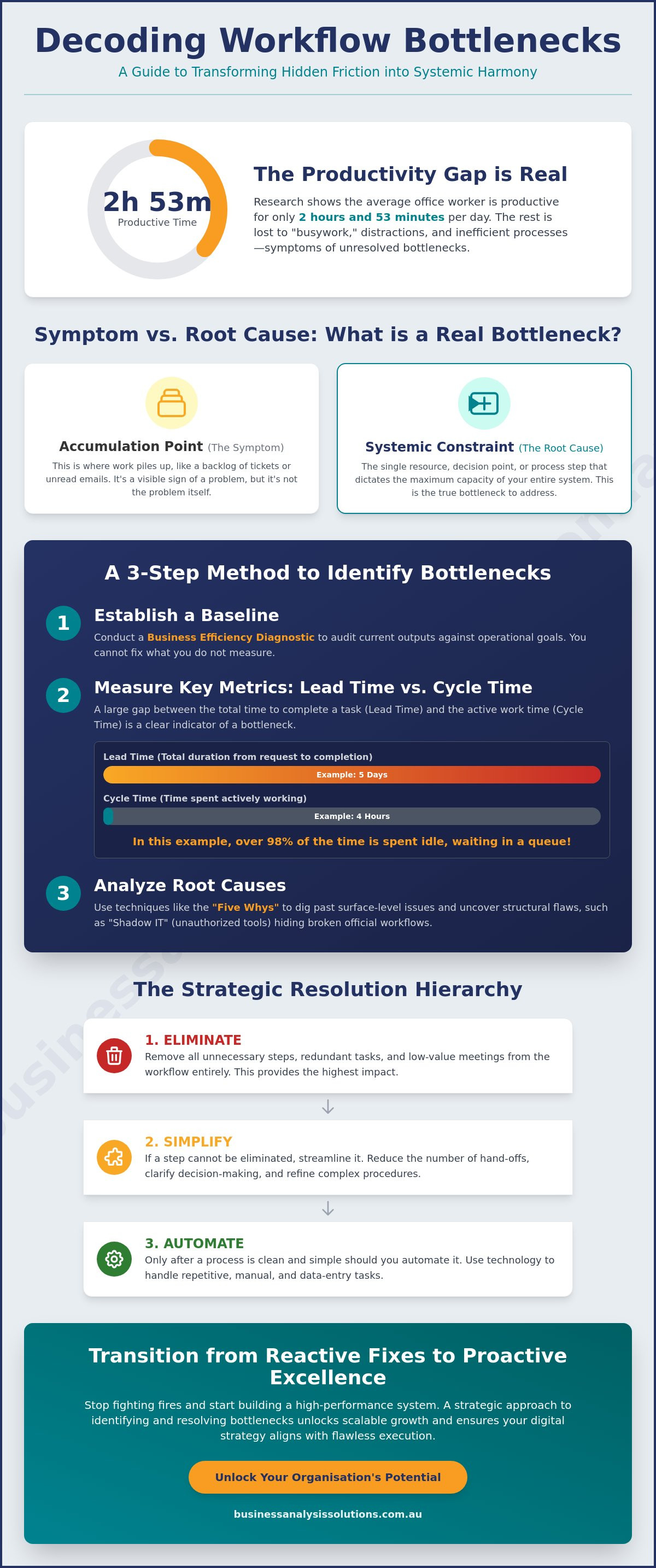
Research from Gitnux confirms that the average office worker remains productive for only 2 hours and 53 minutes each day. This data highlights a profound disconnect between invested resources and actual output. You've likely noticed your team struggling with overwork while project milestones continue to shift; it's a cycle that erodes morale and stalls organizational scaling. Identifying bottlenecks in workflows is the essential first step toward reclaiming this lost time and restoring system harmony.
This guide offers a structured methodology to move beyond reactive fire-fighting. You'll learn to separate deceptive symptoms from the actual root causes of congestion. We provide a roadmap for systemic resolution, focusing on how strategic process mapping and automation implementation can drive measurable gains in operational efficiency. By the end of this article, you'll have the clarity needed to unlock scalable growth and ensure your digital strategy aligns perfectly with your execution.
Table of Contents
What is a Workflow Bottleneck? Understanding Process Congestion
In a high-performance environment, a bottleneck is not merely a delay; it's a systemic constraint that dictates the maximum capacity of your entire operation. Identifying bottlenecks in workflows requires a clinical distinction between where work accumulates and where the system is actually restricted. While an accumulation point might look like a pile of unread emails or a backlog of tickets, the true constraint is often a single resource or process step that cannot process input as fast as it's received. This concept is central to the Theory of Constraints, which posits that any manageable system is limited in achieving its goals by a very small number of constraints.
By 2026, these congestion points have evolved. In physical workflows, they remain visible as logistical stalls. In digital environments, they manifest as "invisible friction," such as API latency, fragmented software silos, or decision-making lag. Research suggests that 53% of an employee's time is currently consumed by "busywork" rather than skilled tasks. When these inefficiencies remain unaddressed, the psychological toll on organizational culture is significant. Continuous overwork without clear progress leads to declining morale and a pervasive sense of futility, as teams realize their effort is being neutralized by systemic flaws rather than lack of talent.
Short-term vs. Long-term Bottlenecks
Short-term bottlenecks are often temporary spikes caused by external factors, such as a seasonal surge in demand or a key staff member taking leave. These are manageable through tactical resource reallocation. Long-term bottlenecks are structural. They represent chronic failures in your ICT solutions or operational strategy. If management treats a structural weakness as a temporary spike, they fall into the "whack-a-mole" trap, where solving one symptom simply causes another to appear elsewhere. True resolution requires a move from reactive fixes to methodical process mapping.
The True Cost of Operational Friction
The financial drain of unresolved congestion extends far beyond missed deadlines. Every hour lost to delayed decision-making or manual task-switching represents a direct hit to your bottom line. Workplace distractions and inefficient communication cost the global economy billions annually, and for the individual firm, this translates to diminished brand reliability and a compromised customer experience. Throughput, in the context of Australian business efficiency, is the rate at which a system processes its total volume of work into completed, value-generating outcomes over a specific period. The process of identifying bottlenecks in workflows must account for these invisible digital friction points that legacy systems often introduce, ensuring that your operational investment yields the highest possible return.
How to Identify Bottlenecks in Workflows: A Methodical Approach
Identifying bottlenecks in workflows isn't a matter of intuition; it requires a structured framework to ensure accuracy. A professional Business Efficiency Diagnostic establishes the necessary baseline by auditing current outputs against operational goals. Without this objective starting point, leadership often targets the most visible delays rather than the most impactful ones. Precision in this phase prevents the misallocation of resources toward symptoms rather than causes.
Quantitative detection centers on two primary metrics: Lead Time and Cycle Time. Lead Time measures the total duration from a work request to its completion, while Cycle Time tracks the time spent actively working on a task. A significant disparity between these two usually signals a bottleneck where work sits idle, waiting for approval or resources. If your team's Lead Time is five days but the Cycle Time is only four hours, the congestion isn't in the execution. It's in the hand-offs. Tracking these metrics provides the data needed to justify strategic changes.
Applying the 'Five Whys' technique helps strip away superficial excuses to reveal structural flaws. For instance, if a project is late, ask why. If the answer is "waiting for data," ask why that data wasn't ready. This often leads to the discovery of 'Shadow IT', where employees use unauthorized tools to bypass official, broken workflows. While these work-arounds might solve a short-term issue, they create data silos and security risks that complicate long-term efficiency. Identifying bottlenecks in workflows must include an audit of these unofficial systems to understand where the official process is failing.
Visualisation through Process Mapping
Effective business process mapping serves as a high-definition x-ray of your operations. By documenting the 'as-is' state, you can visually pinpoint exactly where work piles up. This differs from the 'to-be' state, which represents the optimized future vision. Flowcharts and swimlane diagrams expose hidden hand-off delays that are often missed in verbal reports. These visual tools make the invisible friction of digital workflows tangible for stakeholders, allowing for a shared understanding of the operational reality.
Qualitative Discovery: Staff Feedback Loops
Data tells you where a problem exists, but frontline staff tell you why. Structured interviews often reveal that bottlenecks aren't always technical; they're frequently 'decision bottlenecks' at the leadership level. If a senior manager is the sole authority for minor approvals, they become the systemic constraint. Engaging with those closest to the work identifies the manual work-arounds that have become standard practice. For organisations seeking a deeper audit of these internal dynamics, a formal Business Analysis provides the objective oversight required to resolve these complex dependencies.
Root Cause Analysis: Distinguishing Symptoms from Flaws
Identifying bottlenecks in workflows is ineffective if the resulting data is used to treat symptoms rather than the underlying architectural flaws. A common management error involves increasing headcount to resolve a persistent backlog. If the congestion stems from a flawed process, adding personnel merely increases the cost of the inefficiency without improving throughput. True resolution requires a move away from reactive hiring toward a methodical investigation of why work has stalled. This involves looking beyond the surface level to find the systemic constraints that limit performance.
Legacy ICT systems frequently act as the primary drivers of artificial constraints. These systems were often designed for a previous scale of operation and lack the agility required for modern digital demands. When data cannot flow seamlessly between departments, information silos emerge. These silos force teams to spend excessive time searching for information or waiting for manual updates from other divisions. This friction is rarely a result of employee incompetence; it is a direct consequence of a system architecture that prioritizes isolation over coordination.
Often, these systemic issues begin long before a task reaches the execution stage. Inadequate requirements gathering during the initial project management phases creates a ripple effect of delays. When the objectives and technical constraints aren't clearly defined at the outset, the resulting workflow is built on assumptions. This inevitably leads to mid-process corrections that consume resources and stall momentum. Effective bottleneck analysis must therefore include a review of how projects are conceptualized and authorized.
Technical Debt and System Misalignment
Outdated software environments often necessitate manual data re-entry, a high-risk activity that creates significant processing delays. Technical debt accumulates when short-term ICT solutions are implemented without regard for long-term integration. Strategically implemented business technology acts as the primary conduit for operational flow, either accelerating throughput through seamless integration or throttling it through systemic friction. When systems don't communicate, your staff becomes the "glue" holding the process together, which is a poor use of skilled human capital.
Human Factors: Skills Gaps and Decision Fatigue
Not every constraint is technical. A bottleneck often exists because of a lack of delegated authority, where a single leader must approve every minor decision. This creates a "Hero Culture" trap. In this scenario, the organization relies on one individual to maintain flow, making them a single point of failure. It's essential to distinguish between a genuine skills gap that requires training and a process that's unnecessarily complex. If the workflow requires extraordinary effort to navigate, the problem is the process design, not the people executing it.
Strategic Resolution: Moving Beyond Temporary Fixes
Resolution requires a disciplined adherence to a specific hierarchy: Eliminate, Simplify, and then Automate. Many organizations fail by attempting to automate processes that are fundamentally flawed. If identifying bottlenecks in workflows reveals redundant approval layers or unnecessary data captures, these steps must be removed or streamlined before any technology is applied. Automating an inefficient process merely accelerates the rate of failure. A logical approach ensures that every step in the refined workflow adds direct value to the final output.
For organizations seeking to align their technical infrastructure with long-term objectives, implementing a Digital Transformation Blueprint is essential. This framework prevents the common pitfall of purchasing disconnected software tools that create new silos. Instead, it focuses on system harmony. For rapid, low-code relief, the Microsoft Power Platform offers a pragmatic way to build custom bridges between existing systems, resolving congestion without the extensive lead times of traditional development. When these strategic tools are combined with immediate resource re-allocation, the system regains the capacity needed for growth.
Automation Implementation Best Practices
Successful automation targets high-volume, low-complexity tasks where human intervention adds little value. Statistics from 2026 indicate that companies automating core workflows can achieve an ROI between 30% and 200% within the first year. However, technical implementation is only half the battle. Effective change management is required to ensure staff understand and adopt the new tools. Without this, teams often revert to manual "work-arounds" that re-introduce the very friction you're trying to eliminate. To ensure your technology delivers tangible results, explore our Automation Implementation services to bridge the gap between design and execution.
Process Re-engineering for Scalability
Scaling an operation requires redesigning workflows from first principles rather than simply patching legacy steps. This involves standardizing hand-offs between departments to eliminate the ambiguity that often leads to delays. By defining clear "input-output" expectations for every stage, you create a predictable environment where throughput can be measured accurately. Future-proofing your processes means building in the flexibility to handle increased volumes without a linear increase in operational costs, ensuring that identifying bottlenecks in workflows becomes a tool for proactive expansion rather than reactive repair.
Continuous Improvement: The Role of Strategic Oversight
Optimizing a workflow is never a final destination. As market conditions shift and internal capacity expands, the systemic constraint within your operation will inevitably move. Identifying bottlenecks in workflows must be integrated into the organizational cadence as a recurring audit rather than a one-off project. This cyclical approach ensures that your competitive advantage is sustained through operational agility. It requires a commitment to Business Analysis that treats efficiency as a dynamic variable that must be managed to maintain peak performance.
Establishing robust Key Performance Indicators (KPIs) is critical for monitoring long-term workflow health. While previous sections focused on Lead Time and Cycle Time, sustained oversight also requires monitoring throughput stability and resource utilization rates. These metrics provide the early warning signs of impending congestion. When leadership monitors these indicators, they can make informed decisions about resource allocation before a minor delay escalates into a systemic failure.
Integrating Executive IT Leadership
Strategic oversight often requires a level of technical and business expertise that many organizations don't possess internally. Leveraging Fractional CIO services provides access to high-level ICT strategy and leadership without the overhead of a permanent executive role. A Fractional CIO identifies potential bottlenecks in workflows before they impact the P&L by aligning your technology roadmap with your growth projections. They ensure that your ICT solutions are proactive, bridging the gap between technical requirements and broader business objectives to prevent future congestion.
Next Steps: Commencing Your Efficiency Journey
Moving toward peak performance begins with an objective baseline assessment. Preparing for a professional Business Efficiency Diagnostic involves gathering existing process documentation and identifying the departments where overwork or missed deadlines are most prevalent. From there, defining the scope of your Process Mapping project ensures that the analysis targets the areas of highest impact. This methodical preparation transforms identifying bottlenecks in workflows from a theoretical exercise into a practical engine for scalable growth. Professional analysis is the only reliable path to achieving and maintaining true organizational harmony.
Scaling Through Operational Precision
Mastering the flow of work requires moving from reactive fire-fighting to a disciplined, analytical framework. You've seen that true resolution isn't about increasing headcount but about refining the underlying system architecture and removing technical friction. Identifying bottlenecks in workflows serves as the catalyst for this transformation, allowing you to align your ICT solutions with your broader organizational objectives. This methodical shift ensures that every resource contributes directly to value-generating throughput rather than getting lost in administrative busywork.
Sustaining peak performance requires a partner who understands the complex intersection of technology and strategy. Business Analysis & Solutions brings over 20 years of industry experience to every engagement, offering proven strategic blueprints that bridge the gap between technical requirements and operational success. Our expertise ensures that your digital transformation remains grounded in logic and financial performance. Book a Business Efficiency Diagnostic with Business Analysis & Solutions to secure a clear roadmap for scalable growth and peak performance. Achieving professional system harmony is a logical next step for any leadership team committed to long-term excellence.
Frequently Asked Questions
What is the most common cause of workflow bottlenecks in Australian businesses?
Information silos and legacy ICT systems are the most prevalent causes of congestion in Australian businesses. These disconnected systems force staff to perform manual data re-entry, which creates significant friction. While many assume the issue is a lack of resources, the root cause is often a digital strategy that has failed to keep pace with organizational growth.
How can I tell if a bottleneck is caused by a person or a process?
Distinguishing between human and systemic constraints requires objective data analysis. If multiple team members struggle at the same stage, the issue is likely a flawed process. Conversely, if a single individual is consistently the hold-up despite standardized workflows, it may indicate a skills gap. Identifying bottlenecks in workflows involves looking for patterns rather than isolated incidents to determine if the constraint is structural or personal.
Can automation solve all workflow bottlenecks?
Automation cannot resolve bottlenecks that stem from poor process design or missing logic. In fact, automating a flawed workflow often accelerates errors and creates new downstream congestion. You must first simplify and optimize the manual process before applying technology. Automation is a tool for scaling efficiency, not a remedy for fundamental operational chaos.
How long does a Business Efficiency Diagnostic typically take?
The duration of a Business Efficiency Diagnostic depends on the complexity of your operations and the number of departments involved. A focused engagement typically spans several weeks, moving from initial data collection to the delivery of a strategic roadmap. This timeframe ensures a meticulous analysis of your ICT solutions and process maps to provide actionable, long-term results.
Is process mapping necessary for small businesses with fewer than 20 staff?
Process mapping is essential for small businesses aiming for scalable growth without linear cost increases. Even with fewer than 20 staff, undocumented workflows lead to "Hero Culture," where critical knowledge is trapped in individual heads. Mapping these processes early creates a blueprint for future hires and ensures that the organization remains resilient as it expands.
What tools are best for identifying bottlenecks in a remote work environment?
Remote environments benefit from digital project management platforms like Asana, monday.com, or Jira, which offer visual transparency. By June 2026, AI-driven features in these tools can identify potential stalls by analyzing task durations in real-time. These platforms provide the data-driven visibility required for identifying bottlenecks in workflows when physical observation is not possible.
How do I calculate the ROI of fixing a specific workflow bottleneck?
Calculating ROI involves measuring the difference in throughput before and after the resolution. Multiply the hours saved per month by the average hourly rate of the employees involved, then subtract the cost of the resolution implementation. Beyond direct labor savings, consider the financial impact of improved customer retention and reduced project lead times on your overall bottom line.
What is the difference between a bottleneck and a backlog?
A backlog is a cumulative volume of uncompleted work, whereas a bottleneck is the specific constraint causing that accumulation. You can clear a backlog through temporary overtime, but if the bottleneck remains, the work will simply pile up again. Resolving the bottleneck increases the system's total capacity, whereas managing a backlog only addresses the immediate symptom.



Comments