ICT Project Management Services: A Strategic Guide to Successful Delivery in 2026
- jonesaqayalo
- Apr 26
- 11 min read
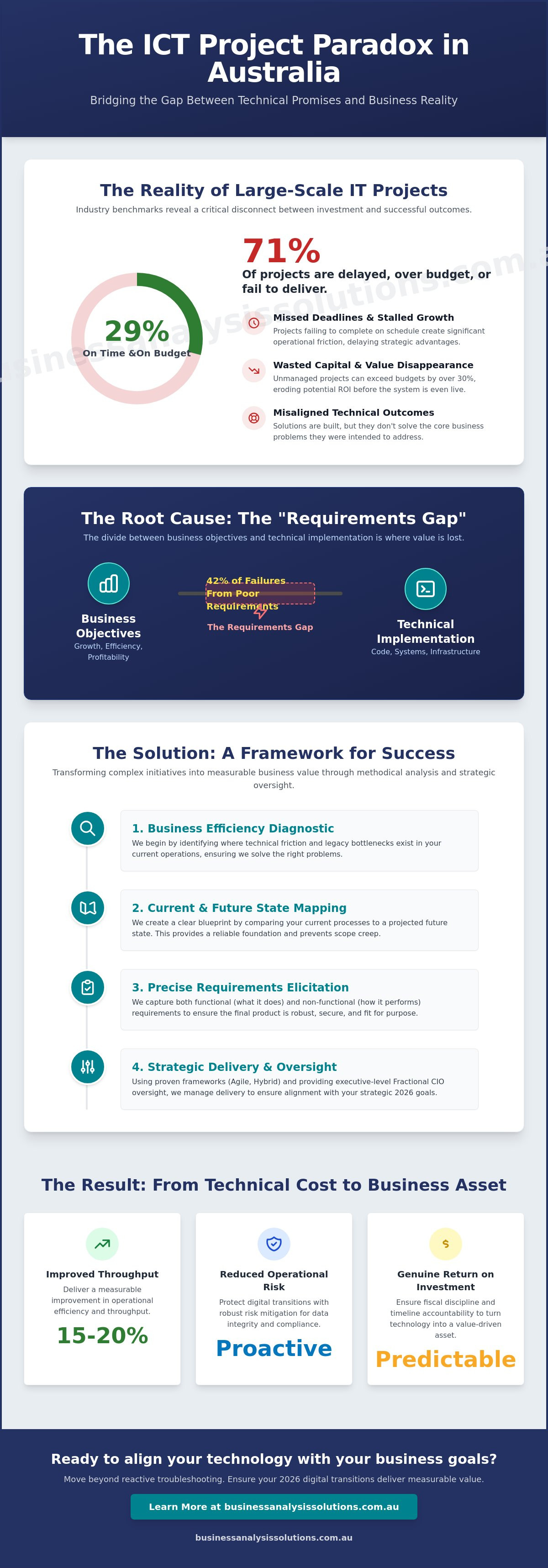
Did you know that only 29% of large-scale IT projects in Australia are completed on time and within budget, according to recent industry benchmarks? For many leaders, the reality of digital transformation is often a cycle of missed deadlines and technical outcomes that fail to solve actual business problems. You likely recognize that the gap between a vendor's technical promise and your operational reality is where most project value disappears. This lack of alignment doesn't just waste capital; it creates significant operational friction that can stall growth for years.
By engaging professional ICT project management services, you move beyond reactive troubleshooting toward a model of strategic oversight and logical precision. This guide demonstrates how methodical analysis and disciplined stakeholder engagement transform complex technical initiatives into measurable business value. We'll provide a clear framework to reduce operational risk during your 2026 digital transitions, ensuring every new system integrates seamlessly with your existing processes and delivers a genuine return on investment. You'll learn how to maintain control over complex vendor implementations while keeping your strategic objectives at the forefront of every technical decision.
Key Takeaways
Identify the critical distinction between routine IT maintenance and strategic initiatives to ensure your technical investments function as genuine drivers of organizational growth.
Learn how to eliminate the "Requirement Gap" in Australian implementations by grounding every project in a comprehensive business efficiency diagnostic and precise state mapping.
Discover how professional ICT project management services utilize structured frameworks to bridge the divide between complex technical requirements and core business objectives.
Evaluate the most effective delivery methodologies, including Agile and Hybrid models, to determine which framework best suits your project’s unique scale and operational complexity.
Understand the value of Fractional CIO oversight in providing executive-level strategic direction and maintaining high-level alignment throughout the business transformation lifecycle.
Table of Contents Defining ICT Project Management Services as a Strategic Business Driver The Intersection of Business Analysis and ICT Project Delivery Why ICT Projects Fail: Addressing the Requirements Gap Evaluating ICT Project Management Frameworks for Your Organisation Strategic ICT Oversight: The Business Analysis & Solutions Approach
Defining ICT Project Management Services as a Strategic Business Driver
Organizations frequently conflate routine IT support with strategic project delivery. This distinction is critical for Australian firms aiming to maintain a competitive edge. While basic IT tasks focus on maintaining existing infrastructure, ICT project management services are designed to transform business operations through structured, goal-oriented initiatives. By 2026, the shift from reactive troubleshooting to proactive delivery will be non-negotiable for leaders who value operational stability.
The 2024 Australian Bureau of Statistics data indicates that 94% of businesses now rely on integrated digital solutions, yet many struggle to align these tools with commercial outcomes. Strategic ICT management applies established project management principles to ensure that technology investments aren't just functional but also profitable. Engaging an independent consultancy provides the objective oversight required to manage complex stakeholder expectations. It removes the internal biases that often lead to scope creep or misaligned priorities.
The Core Components of Modern ICT Services
Effective delivery begins with strategic planning and rigorous feasibility assessments. We don't just ask if a technology works; we determine if it's the right fit for your specific Australian market conditions. Requirements elicitation is equally vital. It involves deep consultation to ensure the technical scope reflects actual operational needs. Finally, robust risk mitigation frameworks protect your digital transitions from unforeseen disruptions, ensuring data integrity and compliance with local privacy regulations.
Strategic alignment with 2026 growth targets
Comprehensive requirements elicitation to prevent technical debt
Proactive risk identification in cloud and hybrid environments
Structured stakeholder engagement across all business units
Beyond Technical Implementation: Delivering ROI
Project management safeguards your technology investment by enforcing fiscal discipline and timeline accountability. Without this structure, research suggests that unmanaged projects can exceed budgets by over 30% due to inefficient resource allocation. ICT project management is the bridge between technical capability and business objectives. By aligning every project milestone with tangible business performance indicators, such as a 12% increase in process efficiency or a measurable reduction in system downtime, we ensure that the technology serves the business, not the other way around. This methodical approach turns complex digital transitions into predictable, value-driven assets.
The Intersection of Business Analysis and ICT Project Delivery
Every high-performing ICT project starts long before the first line of code is written or hardware is procured. It begins with a comprehensive business efficiency diagnostic. In the Australian tech sector, 2024 data indicated that 42% of project failures stemmed from poorly defined requirements or a lack of alignment with business goals. By prioritising a diagnostic phase, organisations identify exactly where technical friction exists. This methodical approach ensures that ICT project management services deliver more than just a functional system; they deliver a measurable 15% to 20% improvement in operational throughput.
Mapping the current state against a projected future state creates the only reliable foundation for project scope. Without this comparison, scope creep becomes inevitable as stakeholders discover missing functionalities mid-cycle. Process mapping serves as the preventative measure here. It uncovers manual workarounds and legacy bottlenecks that software alone won't fix. We focus on ensuring that the technical solution solves the actual operational problem, rather than simply digitising an inefficient manual process.
Requirements Elicitation: The Blueprint for Success
Capturing functional and non-functional requirements requires more than a simple wishlist. It's about precision. Functional requirements define what the system does, while non-functional requirements define how it performs, covering security, scalability, and latency. A robust digital transformation blueprint for business acts as the guiding framework during this phase. It prevents the expensive "feature bloat" that often plagues large-scale implementations. By establishing these parameters early, we protect the project budget and ensure the final delivery matches the executive vision for 2026 and beyond.
Bridging the Communication Gap
Technical teams and executive boards often speak different languages. One focuses on API integrations and microservices, while the other prioritises ROI and market share. Effective ICT project management services act as the translator. We convert technical jargon into actionable business intelligence that allows directors to make informed decisions. This clarity is vital when managing the relationship between internal teams and external technology vendors. It's common for vendors to push "out of the box" features that don't fit local Australian regulatory requirements. Maintaining a centralised source of truth for all project documentation ensures that every stakeholder remains accountable.
Success in complex delivery requires a partner who understands that technical precision must serve commercial logic. If you're planning a major system overhaul, engaging professional business analysis solutions early can reduce your delivery risk by up to 30%.
Why ICT Projects Fail: Addressing the Requirements Gap
Australian ICT implementations frequently encounter friction because the initial requirements are treated as a static checklist rather than a dynamic business blueprint. This creates the "Requirement Gap," where the final technical delivery functions perfectly according to specification but fails to solve the user's actual pain points. Modern ICT project management services must prioritize deep-dive elicitation and stakeholder alignment to bridge this divide. When the solution doesn't match the problem, the resulting technical debt can take years to remediate.
Complexity kills momentum. Many Australian enterprises still rely on legacy systems that are over a decade old, and integrating these "monoliths" with cloud-native platforms is often underestimated. Without a structured audit of existing dependencies, technical hurdles appear mid-delivery. This leads to scope creep that can balloon budgets by 40% or more. Furthermore, poor change management remains a critical failure point. If user adoption rates stay below 60%, the return on investment effectively vanishes, regardless of how sophisticated the software is.
Misalignment between executive vision and frontline operational needs.
Technical specifications that ignore local Australian regulatory or compliance frameworks.
Lack of a dedicated transition plan that accounts for staff training and cultural shifts.
The Hidden Risks of Poor Planning
Financial implications of mid-project technical pivots are severe. In the Australian market, a significant shift in architecture halfway through a deployment can cost an enterprise upwards of A$200,000 in lost developer hours and redundant licensing fees. Operational downtime is another major risk; unmanaged deployments can lead to service outages that damage brand reputation and customer trust. Vendor-led management often overlooks internal business process nuances because their primary incentive is rapid product deployment rather than long-term operational integration.
Mitigating Risk Through Methodical Oversight
Successful delivery requires robust project management controls established from day one. Utilizing professional ICT project management services allows for the implementation of Independent Verification and Validation (IV&V). This provides an objective lens on project health, ensuring that progress isn't just reported, but verified against tangible benchmarks. Establishing clear escalation paths ensures that technical roadblocks are addressed by decision-makers before they evolve into project-ending crises. This methodical approach transforms ICT from a risky cost center into a predictable engine for business growth.
Evaluating ICT Project Management Frameworks for Your Organisation
Selecting a framework isn't a matter of following industry trends; it requires a logical assessment of the project's risk profile and technical requirements. While 71% of organisations now use Agile in some capacity according to the Project Management Institute, the rigid compliance needs of Australian government and financial sectors often necessitate a more structured approach. Professional ICT project management services provide the expertise to match these methodologies to specific business outcomes.
Selecting the Right Management Approach
Agile prioritises speed and iterative feedback, making it ideal for software development where requirements shift. Waterfall remains the standard for infrastructure projects with fixed dependencies, such as physical data centre migrations. Most modern business technology upgrades benefit from a Hybrid model. This approach applies Waterfall's rigorous planning to procurement and budgeting while using Agile sprints for implementation. This ensures that scalability is built into the architecture from the start.
Automation now handles up to 45% of repetitive project tasks like status reporting and resource allocation. For Australian entities, delivery must also integrate the Australian Signals Directorate (ASD) Essential 8. This isn't a post-launch checklist; it's a core delivery requirement. Integrating patch management and multi-factor authentication into the project workflow ensures compliance from day one. It's a pragmatic way to mitigate risk before the first line of code is deployed.
Agile: Best for high-uncertainty software projects.
Waterfall: Essential for fixed-scope infrastructure and hardware rollouts.
Hybrid: The preferred choice for complex enterprise integrations.
Essential 8: Mandatory security benchmarks for Australian project delivery.
The Importance of Vendor Neutrality
Effective ICT project management services rely on objective decision-making. Vendor-affiliated consultants may push specific software stacks that don't align with your long-term scalability. An independent partner evaluates solutions based on process mapping and functional requirements rather than marketing promises. This objectivity is critical when managing multiple vendors within a single project framework.
A neutral consultant acts as a central point of authority. They ensure that a cloud provider, a hardware vendor, and a security firm all work toward a single cohesive goal. This prevents siloed delivery and ensures that the final solution integrates seamlessly with existing legacy systems. It's about finding the right fit for the business, not the easiest path for the vendor.
Strategic ICT Oversight: The Business Analysis & Solutions Approach
Business Analysis Solutions leverages over 20 years of experience in Australian business transformation to provide clarity in complex technical environments. We recognize that mid-sized Australian enterprises often lack the budget for a full-time Chief Information Officer, yet they face the same digital pressures as global corporations. Our Fractional CIO services bridge this gap. You gain executive-level guidance and strategic oversight at a fraction of the cost of a permanent hire. This ensures your ICT project management services are aligned with your commercial objectives from day one.
Our approach moves beyond the surface level of technical implementation. We focus on the logical integration of systems that drive measurable results. By acting as a seasoned partner, we untangle organizational complexities and replace them with structured, scalable processes. We don't just manage projects; we manage the strategic evolution of your business infrastructure.
Our Methodical Delivery Process
We follow a three-step framework designed to eliminate ambiguity and ensure every technical decision serves a business purpose.
Step 1: The Business Efficiency Diagnostic. We evaluate your current systems against industry benchmarks. This isn't a surface-level scan; it's a deep dive into how data flows through your organization to identify hidden bottlenecks.
Step 2: Strategic Blueprinting and Roadmap Development. We translate technical requirements into a commercial roadmap. This phase ensures that every dollar spent on technology facilitates a specific operational outcome.
Step 3: Rigorous Project Execution and Vendor Management. Our experts oversee the deployment of ICT project management services to ensure vendors meet their contractual obligations. We act as your advocate, preventing scope creep and ensuring technical specifications meet your standards.
Partnering for Sustainable Growth
Success isn't defined by a "go-live" date. It's measured by long-term business efficiency over the following 36 months. We conduct post-implementation reviews to ensure the solution delivers the expected ROI and remains adaptable to market shifts. Our team prioritizes knowledge transfer, ensuring your internal staff is fully equipped to manage and optimize new ICT solutions independently. This reduces long-term reliance on external providers and builds internal capability.
We provide the meticulous, objective oversight needed to turn technology into a competitive advantage. Contact us to discuss your upcoming project requirements and secure your delivery schedule for 2026. Let's ensure your next ICT investment is a catalyst for growth rather than a source of complexity.
Securing Strategic Outcomes for Your 2026 ICT Roadmap
Successful delivery in 2026 requires more than technical proficiency; it demands a rigorous alignment between architectural requirements and organizational objectives. You shouldn't overlook the requirements gap, which the Standish Group identifies as a primary factor in the 66% of projects that fail to meet all objectives. Our methodology relies on over 20 years of experience in business analysis and ICT consultancy to ensure every milestone delivers measurable value. We provide independent, vendor-neutral advice focused entirely on your ROI. Integrating professional ICT project management services into your strategy transforms technology from a cost center into a primary driver of growth. It's about precision and a structured approach to untangling organizational complexities. We've helped numerous partners bridge the technical divide, ensuring their investments yield tangible results without vendor bias. Your next initiative deserves this level of analytical rigor and professional oversight.
We're ready to help you navigate your next complex delivery with confidence and clarity.
Frequently Asked Questions
What is the difference between IT support and ICT project management services?
IT support focuses on maintaining existing infrastructure and resolving day-to-day technical issues, whereas ICT project management services drive the implementation of new technology and strategic change. While a support desk manages tickets for current users, a project manager oversees the end-to-end delivery of new systems. This distinction is critical for 2026, as 70% of digital transformations fail due to a lack of structured project governance rather than technical failure.
How much do ICT project management services typically cost in Australia?
In the Australian market, ICT project management services typically range from A$1,200 to A$1,800 per day for senior consultants, according to 2024 Hays Salary Guide data. For fixed-term engagements, mid-level project managers in Sydney and Melbourne command annual salaries between A$140,000 and A$180,000 plus superannuation. These costs vary based on project complexity and the specific technical domain, such as cybersecurity or cloud migration, which often command a 15% premium.
Why do I need a project manager if I already have a software vendor?
An independent project manager represents your business interests, while a software vendor's project manager focuses primarily on delivering their specific product. You need an internal advocate to manage cross-functional dependencies, oversee stakeholder engagement, and ensure the vendor meets their contractual obligations. Without this oversight, businesses often face scope creep, with 45% of large IT projects exceeding their initial budget due to poor vendor integration and lack of internal alignment.
Can ICT project management help with business automation implementation?
ICT project management services are essential for business automation because they provide the framework for process mapping and requirements elicitation. Successful automation requires more than just software; it demands a thorough analysis of current workflows to identify bottlenecks. By applying a structured methodology, project managers ensure that automation tools deliver a measurable return on investment, often reducing manual processing time by 30% or more within the first 12 months of operation.
What qualifications should I look for in an ICT project consultant?
How does business analysis improve the success rate of ICT projects?
Business analysis improves project success rates by ensuring that technical solutions solve actual business problems rather than just meeting technical specifications. Research from the International Institute of Business Analysis (IIBA) indicates that projects with high-quality requirements management are 57% more likely to meet their original goals. By conducting thorough stakeholder engagement and process modeling, business analysts eliminate ambiguity and reduce the risk of costly rework during the final development phase.
What is the role of a Fractional CIO in project management?
A Fractional CIO provides executive-level strategic guidance and oversight for project portfolios without the cost of a full-time C-suite executive. They bridge the gap between technical requirements and business objectives, ensuring that every ICT project aligns with the long-term corporate strategy. This role is particularly effective for mid-sized Australian firms that need high-level governance to manage complex vendor relationships and digital roadmaps on a flexible, part-time basis for approximately 2 to 4 days per month.
How long does a typical ICT transformation project take to complete?
A typical ICT transformation project takes between 6 and 18 months to complete, depending on the scope and organizational complexity. Small-scale migrations or software implementations may conclude within 3 to 6 months, while enterprise-wide ERP upgrades often extend beyond a year. Data from the 2023 Standish Group Chaos Report suggests that projects exceeding 12 months face higher risks, making phased delivery and clear milestones essential for maintaining momentum and achieving results.



Comments