How to Reduce Operational Overheads: A Strategic Framework for 2026
What if the software tools you implemented to drive productivity are actually the primary drivers of your shrinking margins? Many leadership teams find that despite heavy investment in digital transformation, expected efficiencies remain elusive. Instead, they face bloated manual processes and escalating ICT subscription costs from shadow IT. It's likely you recognize that arbitrary budget cuts are a reactive measure that often degrades service quality and employee morale. With the prime rate at 6.75% and persistent inflation impacting margins, you need a more precise, logical method for how to reduce operational overheads that preserves your core competitive advantage.
This article provides a strategic framework for 2026 to help you identify structural waste and implement systemic efficiencies. We'll demonstrate how to lower overheads without sacrificing organizational performance by aligning technology with verified business processes. We will examine the path toward a leaner business structure through targeted business analysis and digital strategy. It's an approach that ensures your technology investments deliver a clear return while creating a sustainable cost reduction that persists long after the initial audit.
Key Takeaways
Identify hidden structural waste through a professional Business Efficiency Diagnostic and process mapping to reveal redundant steps in your existing value chain.
Discover how to reduce operational overheads by prioritizing strategic automation over tactical budget cuts that often compromise long-term organizational performance.
Apply a 5-step Digital Transformation Blueprint to establish baseline metrics and redesign workflows before implementing new technology solutions.
Leverage the expertise of a Fractional CIO to bridge the gap between technical requirements and executive strategy without the expense of a full-time leadership salary.
Table of Contents
The True Nature of Operational Overheads in 2026
In the Australian market, the traditional understanding of business costs is undergoing a necessary evolution. To understand Operational Overheads Defined in a modern context, leadership must look beyond the static figures found on a balance sheet. While rent and utilities remain present, 2026 overheads are increasingly comprised of digital subscriptions and the labor hours lost to systemic inefficiencies. These costs often escape scrutiny because they're woven into the daily rhythm of the organization, masquerading as the necessary price of doing business. With the prime rate at 6.75% as of May 2026, the cost of capital makes inefficient spending even more damaging to the bottom line.
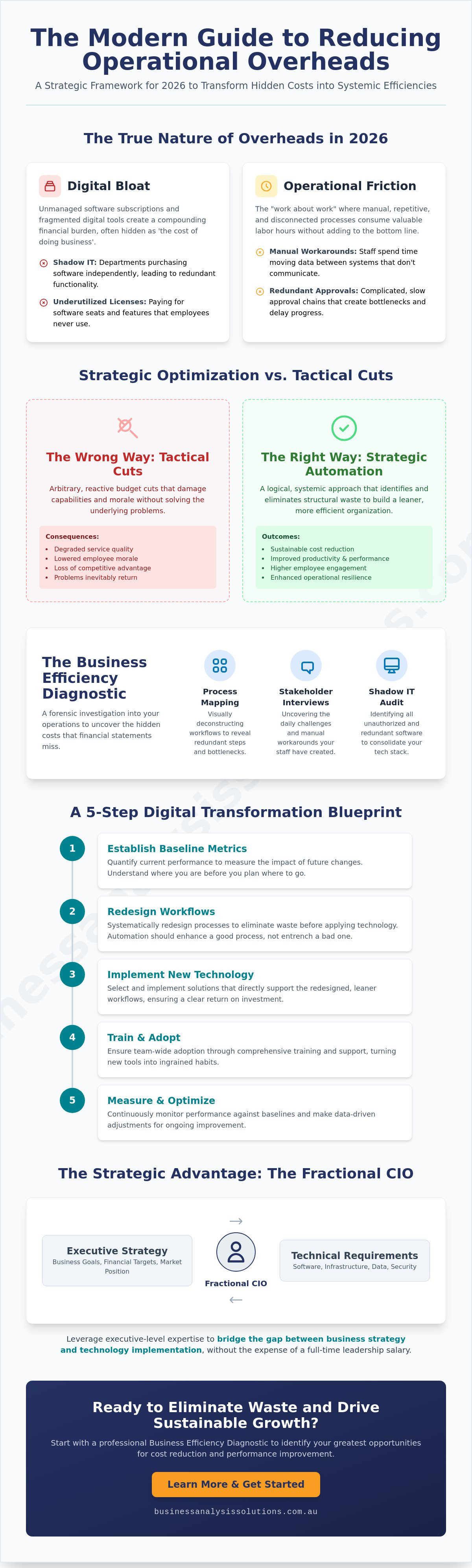
Digital bloat represents a primary challenge for modern enterprises. Unmanaged SaaS platforms, often referred to as shadow IT, create a compounding financial burden that lacks clear oversight. When individual departments procure software independently, the result is a fragmented digital ecosystem characterized by redundant features and underutilized licenses. This lack of coordination doesn't just inflate ICT spend; it creates an invisible drain where inefficient workflows are accepted as standard operating procedure. Learning how to reduce operational overheads requires a shift from viewing expenses as fixed obligations to treating them as variables that can be optimized through logical intervention. It's about distinguishing between the costs that drive value and those that simply sustain friction.
Fixed vs. Variable Overheads: A Strategic View
The transition toward hybrid work models has fundamentally altered the ratio between physical and digital infrastructure. While physical office footprints may have shrunk, the costs associated with maintaining a distributed workforce have risen. For organizations looking to optimize the procurement of physical essentials, you can learn more about how Mega Office Supplies helps streamline these overheads. Traditional accounting methods frequently overlook the process-related waste that occurs when digital tools aren't properly integrated. A strategic view recognizes that while a software license might be a fixed monthly cost, the time employees spend navigating that software is a variable expense that fluctuates based on system harmony. Effective Business Analysis identifies these discrepancies, moving the focus from simple line-item reduction to comprehensive process optimization.
The Cost of Operational Friction
Operational friction occurs when manual data entry, disconnected silos, and redundant approval loops consume resources without adding value. This "work about work" accounts for a significant portion of the $1 trillion lost annually to voluntary turnover in the U.S., a trend mirrored globally as employees seek more efficient environments. When data must be manually moved from one platform to another, the risk of error increases alongside the labor cost. These inefficiencies are often hidden within standard payroll expenses, making them difficult to quantify without a professional Business Efficiency Diagnostic. Operational friction is the primary target for 2026 cost reduction.
Conducting a Business Efficiency Diagnostic to Find Waste
Financial statements reveal the symptoms of inefficiency, but they rarely diagnose the cause. While a profit and loss statement shows total expenditure, it fails to explain why specific workflows require excessive labor or why software costs continue to climb. A professional Business Efficiency Diagnostic serves as a forensic investigation into these hidden costs. This methodology moves beyond surface-level accounting to analyze the logic of your operations. By conducting structured stakeholder interviews, we uncover the operational bottlenecks that staff encounter daily. These interviews often reveal that employees have developed manual workarounds for broken systems, which inadvertently increase the time spent on routine tasks.
Identifying Shadow IT is a critical component of this audit. In many organizations, departments procure specialized software without central oversight, leading to unauthorized spend that inflates ICT budgets. This fragmentation creates data silos and redundant functionality. A rigorous diagnostic identifies these overlaps, allowing leadership to consolidate tools and eliminate unused licenses. It's a foundational step in how to reduce operational overheads while maintaining system integrity. By resolving these discrepancies, you ensure that every dollar spent on technology directly supports your organizational objectives.
The Power of Process Mapping
Visualizing your workflow is essential for spotting the duplication of effort that remains invisible in a spreadsheet. Through Process Mapping, you can trace the path of a transaction or project from start to finish. This visualization highlights where steps are repeated unnecessarily or where information handovers fail. Mapping identifies exactly where high-impact automation can replace manual intervention. It transforms abstract operational challenges into a clear, actionable roadmap for improvement.
Auditing Your Digital Strategy
The utility of your current ICT stack must be evaluated against your broader organizational goals. Many businesses pay for premium features they never use or maintain overlapping software functions across different teams. Implementing a digital transformation blueprint for business ensures that every technology investment serves a specific strategic purpose. This audit process provides the clarity needed to prune unnecessary digital infrastructure. If you're unsure where to begin, a professional Business Analysis can provide the objective perspective required to eliminate waste effectively.
Strategic Automation vs. Tactical Cost Cutting
Tactical cost cutting, such as reducing headcount or office space, often yields immediate savings but creates long-term structural weakness. It's a reactive approach that can compromise your ability to scale and maintain service standards. Conversely, strategic automation addresses the root cause of high costs by removing the labor-intensive friction identified during your process mapping. This represents a fundamental shift in how to reduce operational overheads. By utilizing the Microsoft Power Platform, organizations can replace expensive, disconnected bespoke tools with integrated solutions that leverage their existing infrastructure. This approach ensures that your Digital Strategy remains grounded in practical financial performance.
Many leaders mistakenly believe that advanced automation is reserved for enterprise-level organizations with massive budgets. Logic suggests otherwise. Streamlining a single core process, such as automated invoice reconciliation or project onboarding, can save upwards of 20% in man-hours. These gains are accessible to any business willing to move from manual intervention to system-led resolution. It's not about replacing people; it's about reallocating their expertise to high-value tasks while the system handles the repetitive volume. This transition creates a more agile business structure that is resilient to market fluctuations.
When to Automate vs. When to Eliminate
Deciding which processes to target requires a methodical framework. Not every inefficient step warrants an automation budget; some should simply be eliminated to remove unnecessary complexity. The 'Rule of Three' provides a practical guideline: if a human performs a task three times in a similar fashion, it's a prime candidate for automation. This ensures that resources are focused on high-frequency friction points. Reducing overheads through business technology integration allows you to build a cohesive environment where data flows without manual friction.
Maximising Existing Tools (Microsoft Copilot & Power BI)
Maximizing existing tools like Microsoft Copilot and Power BI is often the most cost-effective path to efficiency. Copilot reduces the administrative overhead associated with drafting documentation and managing communications. Meanwhile, Power BI transforms raw data into automated dashboards, eliminating the need for manual reporting cycles. When decisions are data-driven and dashboards update in real-time, you prevent the costly operational detours caused by lagging or inaccurate information. This level of system harmony ensures that your technology investments deliver a clear ROI rather than becoming another line-item expense.
A 5-Step Digital Transformation Blueprint for Leaner Operations
Transitioning from a diagnostic phase to active execution requires a disciplined sequence that prevents the common pitfall of "technology for technology's sake." A Digital Transformation Blueprint provides the necessary structure to ensure that every adjustment to your operating model is grounded in logic and measurable value. This framework moves beyond surface-level changes, focusing on the deep structural alignment needed to maintain long-term agility. By following a methodical path, leadership can avoid the fragmented implementation that often leads to increased digital bloat.
Step 1: Baseline Audit. Establish current state metrics to understand exactly where resources are currently allocated. This is the foundational step in how to reduce operational overheads, as it provides the objective data required to justify future investments. Without a clear starting point, it's impossible to quantify the success of your efficiency initiatives.
Step 2: Process Redesign. This phase involves eliminating redundant steps identified during your initial mapping. It's critical to refine the workflow before applying any technology. Automating a broken or inefficient process only accelerates the generation of waste, compounding the original problem rather than resolving it.
Step 3: Tool Selection. Select ICT Solutions that align with specific business needs identified in your redesign. Logic should dictate procurement, ensuring that new tools integrate seamlessly with your existing infrastructure to prevent the creation of new data silos.
Step 4: Pilot Implementation. Testing automation in a controlled environment allows you to identify edge cases and refine the logic before a full organizational rollout. This reduces the risk of widespread operational disruption.
Step 5: Scaling & Monitoring. Once the pilot is successful, the solution is scaled across the organization. Continuous monitoring is essential to ensure that the projected cost savings are actually sustained over time.
Establishing Your Baseline Metrics
Achieving sustainable business efficiency requires a data-first approach. Key performance indicators (KPIs) should focus on "Time to Value" for new operational changes, measuring the interval between implementation and the realization of tangible savings. Metrics such as labor hours per transaction or software utilization rates provide the clarity needed to make objective adjustments. When these figures are tracked through automated dashboards, leadership gains real-time visibility into the health of the operation.
Change Management and Adoption
Structural changes often meet internal resistance, which can stall even the most logical efficiency projects. Effective Project Management is essential to bridge the gap between technical implementation and staff adoption. Employees must be trained to use new efficiencies effectively, or the organization risks reverting to manual, high-cost habits. Clear communication regarding the "why" behind the change helps to align the team with broader organizational objectives. If you're ready to move from diagnostic to action, our Digital Transformation Blueprint offers a methodical path to optimized performance.
The Fractional CIO: Executive Leadership as an Efficiency Tool
High-level ICT strategy is frequently the missing link in sustainable cost management. While accounting services track the results of spending, they don't possess the technical depth to optimize the systems driving those expenses. A Fractional CIO bridges this gap, providing the executive expertise required to align technical requirements with broader business objectives. This role is instrumental in determining how to reduce operational overheads by ensuring that every digital asset serves a specific, measurable purpose. By engaging leadership on a fractional basis, organizations access seasoned guidance without the prohibitive salary and benefit costs associated with a full-time executive hire.
Organizations often find themselves trapped in a cycle of reactive spending because they lack a dedicated technical strategist. A Fractional CIO provides the necessary logic to break this cycle. They don't just manage IT; they manage the value that technology provides to the business. This oversight is critical for maintaining financial discipline in an environment where digital costs can easily spiral out of control. By focusing on resolution rather than just maintenance, this leadership model ensures that technology remains a tool for progress rather than a source of persistent friction.
Vendor management is another area where executive-level technical expertise pays dividends. A Fractional CIO analyzes service level agreements and software contracts with an eye for technical redundancy. They identify where multiple vendors are providing overlapping services and lead the consolidation process. This methodical approach ensures system harmony, where every component of the ICT stack works in concert to support the organizational mission. It transforms the digital environment from a collection of costs into a streamlined engine for efficiency.
Strategic ICT Project Management
ICT projects often fail to deliver expected savings because they lack consistent executive oversight. Without a strategic anchor, technical implementations can drift away from their original efficiency goals. Fractional CIO services Australia provide the Project Management discipline needed to drive national business growth through technical precision. Strategic leadership prevents 'technology bloat' by mandating that every new implementation solves a verified operational bottleneck.
The Path Forward: From Diagnosis to Resolution
The transition to a leaner business model is a methodical journey that starts with objective data and ends with system-led resolution. From the initial diagnostic to the implementation of automated workflows, the focus remains on eliminating waste while preserving performance. Business Analysis & Solutions specializes in delivering these tangible results, ensuring that your 2026 strategy is grounded in operational reality. If you're ready to identify the structural waste within your organization, you can Request a Business Efficiency Diagnostic to begin the process of professional optimization.
Securing Sustainable Efficiency in 2026
Sustaining a leaner business model requires moving beyond reactive budget cuts toward a structured integration of process and technology. By identifying the invisible drain of operational friction and implementing executive-level ICT oversight, leadership can transform overheads from a burden into a managed variable. This transition ensures that every digital asset and workflow directly contributes to the bottom line rather than eroding it through unmanaged bloat. Understanding how to reduce operational overheads is ultimately a matter of achieving process clarity and system harmony across the entire organization.
Business Analysis & Solutions brings over 20 years of industry experience to these complex challenges. We're specialists in bridging the gap between technical requirements and broader organizational objectives through our proven Digital Transformation Blueprint framework. This methodical approach provides the clarity needed to resolve structural inefficiencies and deliver tangible, long-term results. Book a Strategic Consultation with Business Analysis & Solutions to begin your transition toward a more agile, high-performance operating model. With a disciplined framework in place, your organization can achieve a sustainable cost structure that supports your strategic growth objectives.
Frequently Asked Questions
What is the difference between operational costs and overheads?
Operational costs represent the total expenditure required to maintain business functions, while overheads are the specific indirect expenses not linked to a particular unit of production. Rent, utilities, and administrative salaries are typical overheads. In contrast, operational costs encompass both these overheads and the direct costs of goods sold. Understanding this distinction is vital for accurate financial performance analysis and strategic planning.
How can automation specifically reduce my monthly overheads?
Automation lowers monthly overheads by replacing manual, repetitive tasks with standardized digital workflows. This reduces the labor hours required for administrative functions like data entry and reconciliation. By implementing how to reduce operational overheads through tools like the Microsoft Power Platform, organizations can also consolidate expensive, fragmented software into a single, integrated environment that leverages existing licenses.
Is it possible to reduce overheads without laying off staff?
Reducing overheads is frequently achieved by optimizing workflows rather than decreasing headcount. By eliminating redundant steps and "work about work," your existing team can focus on revenue-generating activities. This approach improves organizational capacity and employee morale, as staff are freed from the frustration of inefficient, manual processes. It allows the business to scale volume without a corresponding increase in labor costs.
How do I identify which processes are costing my business the most?
Identifying high-cost processes requires a methodical application of Process Mapping to visualize every stage of your value chain. This technique exposes the "invisible drain" where time is lost to manual handovers or duplicated effort. Once these friction points are mapped, you can quantify the labor costs associated with each step to prioritize your optimization efforts based on the highest potential return.
What are the most common 'hidden' overheads in 2026?
The most frequent hidden overheads in 2026 include shadow IT and the "digital bloat" caused by unmanaged SaaS subscriptions. Many organizations pay for overlapping software features across different departments without centralized oversight. Additionally, the time employees spend navigating disconnected data silos represents a significant, yet often unrecorded, variable expense that diminishes overall profitability and slows down decision-making cycles.
How long does it typically take to see ROI from a digital transformation?
ROI from a digital transformation is typically realized in stages, with initial efficiency gains often appearing within three to six months of a pilot implementation. The "Time to Value" depends on the complexity of the processes being optimized and the speed of staff adoption. A structured Digital Transformation Blueprint ensures that these gains are measurable, documented, and sustained over the long term.
Can a Fractional CIO help a small business reduce costs?
A Fractional CIO provides small to medium enterprises with the executive-level technical strategy needed to prevent costly technology detours. They offer the specialized expertise of a veteran leader at a fraction of the cost of a full-time hire. This role is essential for leading vendor negotiations, ensuring system harmony, and bridging the gap between technical requirements and business objectives.
What is a Business Efficiency Diagnostic?
A Business Efficiency Diagnostic is a comprehensive forensic audit designed to uncover structural waste within an organization. It utilizes stakeholder interviews and process analysis to provide a clear roadmap for how to reduce operational overheads. This diagnostic ensures that any subsequent technology investments are grounded in logical, data-driven requirements rather than reactive spending on unproven tools.



Comments