How to Map a Business Process: A Strategic Framework for 2026
- jonesaqayalo
- Jun 7
- 11 min read
Updated: Jun 22
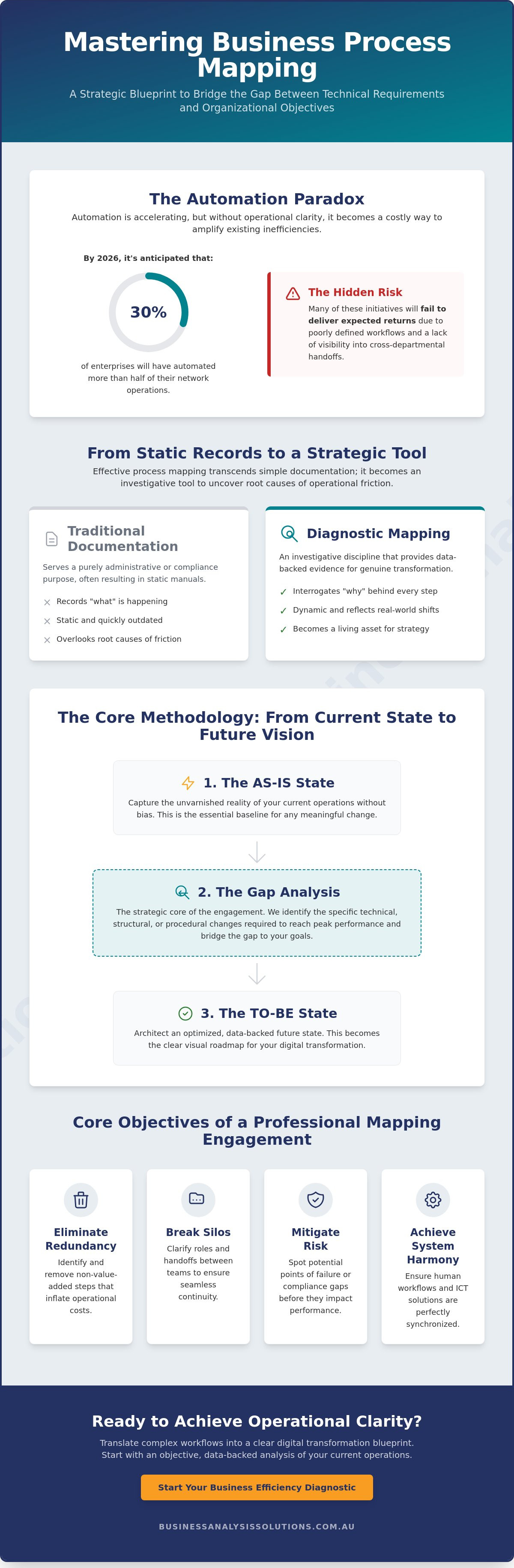
By 2026, it's anticipated that 30% of enterprises will have automated more than half of their network operations; however, many of these initiatives will fail to deliver expected returns due to poorly defined workflows. When you lack visibility into cross-departmental handoffs, automation often becomes a costly way to accelerate existing inefficiencies. You likely recognize that inconsistent output quality and the struggle to justify technology investments stem from a fundamental lack of operational clarity. Learning how to map a business process is no longer just a documentation task. It is a strategic diagnostic tool used to bridge the gap between technical requirements and organizational objectives.
In this guide, you'll master a methodical approach to process mapping that identifies hidden bottlenecks and drives genuine transformation. We'll provide a framework to build a clear visual roadmap of your operations, moving from current-state analysis to future-state optimization. You'll gain the data-backed evidence required to support a robust digital transformation blueprint and ensure long-term system harmony across your organization.
Table of Contents
Understanding Business Process Mapping as a Strategic Asset
Business process mapping is far more than a collection of visual flowcharts; it is a rigorous, analytical discipline designed to establish a definitive source of truth for organizational coordination. Leaders often operate under the assumption that their teams follow established protocols, but the reality is frequently fragmented. These "invisible" processes carry a high hidden cost. When handoffs are undocumented and informal, errors compound, and operational drag increases. Without a clear map, it's impossible to pinpoint exactly where value is being lost or where friction originates.
Mastering how to map a business process effectively allows an organization to see its operations as they actually function, rather than how they were designed in the past. This visibility is the essential first step toward achieving long-term business efficiency. By exposing the gap between theory and practice, mapping provides the objective data necessary to justify strategic changes and technical investments. It moves the conversation from anecdotal evidence to empirical analysis.
The Distinction Between Documentation and Diagnostic Mapping
Traditional documentation often serves a purely administrative or compliance purpose. It records a sequence of events for the sake of having a record, often resulting in static manuals that gather dust. Diagnostic mapping, however, is an investigative tool. By 2026 standards, static diagrams are insufficient for complex organizations. Professional engagements now prioritize the integration of execution-level data to reflect dynamic shifts in the operational environment. A skilled analyst doesn't just record "what" is happening; they interrogate the "why" behind every step. This interpretation uncovers the root causes of friction that simple documentation would overlook.
Core Objectives of a Professional Mapping Engagement
A strategic mapping initiative seeks to achieve specific, measurable outcomes that align with broader corporate goals. It serves as the foundational baseline for any digital transformation blueprint. Without this baseline, technology investments often fail because they automate flawed logic. A professional engagement focuses on several critical objectives:
Eliminating redundancy: Identifying non-value-added steps that inflate operational costs without benefiting the end client.
Breaking departmental silos: Clarifying roles and handoffs between teams to ensure seamless continuity across the value chain.
Risk mitigation: Spotting potential points of failure or compliance gaps before they impact financial performance.
System harmony: Ensuring that human workflows and ICT solutions are perfectly synchronized to drive output quality.
When you understand how to map a business process with this level of depth, the map becomes a living asset. It provides the clarity required to navigate complex organizational challenges with calm assurance and logical precision.
The Methodology: AS-IS vs. TO-BE Frameworks
The methodology of professional process mapping is built on a binary framework: the AS-IS and the TO-BE. Mastering how to map a business process requires an uncompromising look at current operations before attempting to architect a future state. Many organizations falter by rushing toward a solution without fully diagnosing the problem. This oversight often leads to failed ICT solutions because the new system is built on top of misunderstood or broken workflows. Without a clear understanding of the present, any strategic change is merely guesswork.
The transition between these two states is facilitated by a rigorous Gap Analysis. This is the strategic core of the engagement where we identify the specific technical, structural, or procedural changes required to reach peak performance. It's a logical bridge that ensures every modification is purposeful and data-backed. If you're looking for an objective starting point, a business efficiency diagnostic can help clarify where these gaps are most detrimental to your bottom line.
Capturing the AS-IS State Without Bias
The AS-IS state represents the unvarnished reality of your current operations. To capture this accurately, analysts must move beyond high-level interviews and engage in direct observation. Employees often develop "shadow processes" to navigate around system limitations. These workarounds are rarely documented but are essential to daily output. Validating your map with those who execute the work ensures the model reflects reality rather than management's perception. For practical context on this phase, reviewing Process Mapping Steps and Examples can help align your team on the level of detail required for professional documentation.
Designing the TO-BE State for Future Growth
Once the current state is defined, the focus shifts to the TO-BE state. This phase is not about incremental tweaks; it's about applying "First Principles" thinking to rebuild the process for maximum scalability. We strip away historical baggage to focus on the most direct path to a strategic outcome. This is where automation implementation becomes a primary driver of value. By designing with automation in mind, you ensure the new process is governed, efficient, and aligned with your organizational objectives. This methodical approach ensures that the resulting workflow is not just a diagram, but a functional blueprint for growth.
When you understand how to map a business process through this dual-state lens, you move from passive observation to active organizational design. You establish a foundation where technical requirements and business objectives are perfectly synchronized.
Choosing the Right Mapping Technique for Your Objective
Selecting an inappropriate notation can obscure critical insights or alienate key stakeholders. When determining how to map a business process, the choice of technique must be dictated by the specific objective of the engagement. A high-level flowchart might suffice for an executive summary, but it will fail to provide the detail required for a complex system integration. IBM's guide to process mapping categorizes these tools based on their ability to expose different layers of organizational complexity, from basic workflows to intricate value chains.
Value Stream Mapping (VSM) is particularly effective when the goal is to identify and eliminate waste within service delivery. It provides a lean perspective, highlighting delays and non-value-added time that standard flowcharts often miss. By visualizing the flow of both materials and information from the supplier to the customer, VSM exposes bottlenecks that are structural rather than behavioral. For a comprehensive diagnostic, you must select a format that balances technical precision with executive readability to ensure buy-in at every level of the hierarchy.
SIPOC: High-Level Strategic Scoping
The SIPOC (Suppliers, Inputs, Process, Outputs, Customers) diagram serves as the essential first step for any project management engagement. It establishes firm boundaries, preventing scope creep before the team dives into more detailed mapping. By defining these five core elements early, you ensure that all stakeholders agree on the process's start and end points. This clarity is vital for maintaining project momentum and ensuring that the subsequent analysis remains focused on the primary problem. It's a tool of consensus that simplifies complex environments into manageable components.
BPMN 2.0: The Gold Standard for Technical Integration
When the objective is to define functional requirements for new ICT solutions or prepare for automation, Business Process Model and Notation (BPMN) 2.0 is the required standard. It provides a highly specialized vocabulary that allows analysts to describe complex logic, such as parallel tasks, error handling, and message flows. Symbols like gateways and events provide a level of granularity that simple arrows cannot match. Understanding how to map a business process using BPMN 2.0 is essential for bridging the communication gap between business leaders and technical teams. It ensures that the technical execution remains perfectly aligned with the strategic vision, reducing the risk of costly rework during the development phase.
Ultimately, the effectiveness of the map depends on its utility. A professional analyst selects the notation that offers the most direct path to resolution, ensuring that the resulting visual is both a reliable technical document and a persuasive strategic asset. This precision builds the trust necessary to move from observation to implementation.
The 5-Step Execution Roadmap for Effective Mapping
Execution is where strategic intent meets operational reality. While selecting the correct notation is critical, the success of the initiative depends on a disciplined approach to data collection and stakeholder engagement. When you determine how to map a business process, you aren't just drawing shapes; you're facilitating a cultural shift toward transparency. This roadmap provides a structured sequence to ensure the resulting map is both accurate and actionable.
Step 1: Define Scope and Objectives. Clearly articulate the problem you're solving. Without firm boundaries, the mapping exercise can quickly spiral into unnecessary complexity.
Step 2: Information Gathering. Conduct interviews and observation sessions with Subject Matter Experts (SMEs) to capture the granular details of daily operations.
Step 3: Draft the Map. Translate tribal knowledge into a logical visual format, ensuring every decision point and handoff is represented.
Step 4: Validation and Stress Testing. Review the draft with the people who perform the work to ensure it survives real-world scenarios.
Step 5: Analysis and Recommendation. Evaluate the validated map to identify inefficiencies and develop a concrete action plan for improvement.
Following this sequence ensures that no critical detail is overlooked. If your organization requires an objective external perspective to guide this journey, our professional process mapping services provide the technical expertise and facilitation skills necessary to deliver end-to-end results.
Facilitating the Discovery Workshop
The discovery workshop is often where conflicting perspectives on how a process "should" work come to light. An analyst's role is to navigate these disagreements with objective neutrality. While digital tools are essential for the final output, many seasoned professionals prefer "Wall Mapping" with physical markers and sticky notes for real-time collaboration. This tactile approach encourages participation and makes it easier to identify handoff points where information or accountability is frequently lost. These gaps are often the primary source of operational friction and must be documented with precision.
Validating for Accuracy and Completeness
A map is only useful if it represents the brutal reality of the workflow. The "Walkthrough" technique is the most effective way to ensure accuracy. This involves following a single transaction or item from the initial trigger to final completion, observing every interaction along the way. You must intentionally look for edge cases and exceptions rather than just documenting the "happy path" where everything goes right. Capturing how the team handles errors provides the data needed for robust system design. Finally, securing formal sign-off from process owners establishes the accountability required for the next phase of transformation.
When you master how to map a business process through this rigorous facilitation and validation process, you create a reliable foundation for change. You move beyond simple diagrams to create a strategic asset that can withstand the technical and political complexities of a 2026 business environment.
Leveraging Process Maps for Automation and Transformation
Process maps provide the empirical evidence required to move from theoretical observation to technical execution. Understanding how to map a business process is the prerequisite for any high-stakes automation initiative. By visualizing every step, you can identify high-volume, rule-based tasks that are prime candidates for Robotic Process Automation (RPA). This precision prevents the common mistake of automating a flawed workflow, which only serves to institutionalize inefficiency. Instead, the map acts as a technical specification for automation implementation, ensuring that every digital worker contributes to a measurable strategic outcome.
For organizations navigating complex transitions, the role of a Fractional CIO is often vital. This strategic partner uses process maps to bridge the gap between business objectives and technical delivery, overseeing the entire transformation lifecycle. Once the map is validated, it naturally evolves into a broader Business Efficiency Diagnostic. This diagnostic provides the financial and operational insights needed to prioritize investments that deliver the highest tangible ROI. Mastering how to map a business process ensures that every step of your digital journey is grounded in logic rather than assumption.
The Link Between Mapping and ICT Success
Software cannot fix a broken process; it only accelerates the chaos. Many ICT failures occur because the organization attempted to mold its unique requirements into a generic vendor solution. A detailed process map allows you to evaluate software against your actual business needs rather than marketing promises. This pre-project analysis reduces implementation risks and ensures that the final solution integrates seamlessly with existing human workflows, maintaining system harmony across the enterprise. It provides the clarity needed to demand technical solutions that serve organizational goals.
Next Steps: From Visualisation to Optimisation
Architecting a Future of Operational Harmony
Mastering the discipline of how to map a business process is the first step toward resolving complex organizational challenges with logical precision. By establishing a clear AS-IS state and architecting a precise TO-BE framework, you create a reliable blueprint for growth. This methodical approach ensures that technical requirements are perfectly synchronized with your broader organizational objectives, reducing the risk of failed technology investments. Whether you're preparing for automation or seeking to eliminate departmental silos, the clarity provided by professional mapping is indispensable.
With over 20 years of industry experience in strategic analysis, we specialize in bridging the gap between technical requirements and organizational goals. Our outcome-driven ICT consultancy is designed to provide the direction you need to achieve sustained system harmony. To begin your journey toward peak performance, request a Business Efficiency Diagnostic to identify your operational bottlenecks. We look forward to helping you transform your current workflows into a strategic asset for the future.
Frequently Asked Questions
What is the difference between a process map and a flowchart?
A flowchart typically illustrates a simple sequence of steps, whereas a process map provides a comprehensive analytical view of organizational coordination. While flowcharts focus on the basic sequence of events, process maps define the who, the how, and the where by identifying specific roles, handoffs, and resource requirements. This level of detail is essential for diagnosing systemic bottlenecks and ensuring long-term operational efficiency.
How long does it typically take to map a core business process?
The timeline for a professional engagement typically spans two to four weeks depending on the complexity of the workflow and the availability of subject matter experts. This duration reflects the time required to learn how to map a business process accurately within a specific context, including discovery workshops and rigorous validation walkthroughs. Rushing this phase often leads to inaccurate documentation that fails to capture the subtle nuances of daily operations.
Which tools are best for professional process mapping in 2026?
Professional mapping in 2026 requires tools that support BPMN 2.0 standards and offer robust collaboration features. Industry-standard platforms such as Lucidchart, Microsoft Visio, and SAP Signavio remain preferred for their technical precision and ability to handle complex logic. The most effective environments now integrate AI-driven analytics to bridge the gap between static diagrams and live execution data, providing a dynamic view of system performance.
How do I handle employees who are resistant to having their processes mapped?
Resistance is often rooted in the fear that mapping is a precursor to downsizing or micromanagement. To mitigate this, leadership must frame the initiative as an effort to resolve broken systems rather than evaluate individual performance. Involving employees directly in the discovery phase allows them to voice their frustrations and contribute to the solution, which fosters a sense of agency and professional competence throughout the transition.
Can process mapping help with regulatory compliance and auditing?
Process mapping is a fundamental requirement for maintaining regulatory compliance and ensuring audit readiness. By establishing a documented source of truth, organizations can demonstrate that their operations align with international standards and legal mandates. These maps serve as a reliable reference for auditors, proving that controls are consistently applied and that accountability is clearly defined across all departmental silos, reducing risk and financial liability.
Should we map every process in the business at once?
Attempting to map every organizational process simultaneously often leads to project fatigue and diluted results. A more logical approach involves prioritizing high-impact or high-risk workflows that directly influence financial performance or customer satisfaction. Starting with a targeted scope allows the team to deliver tangible value quickly, building the momentum required to expand the initiative across the broader enterprise in a systematic, manageable sequence.
What is the most common mistake made during the mapping phase?
The most frequent error is documenting the ideal workflow instead of the brutal reality of current operations. When you determine how to map a business process, you must resist the urge to ignore workarounds and exceptions created by staff. Bypassing these nuances creates a disconnect between the map and the actual work, leading to technical solutions that fail to address the root causes of inefficiency and operational friction.
How does process mapping support a Digital Transformation Blueprint?
Process mapping serves as the bedrock for a Digital Transformation Blueprint by identifying specific candidates for automation and technical integration. It provides the empirical data required to define functional requirements for new ICT solutions. Without this baseline, digital initiatives often lack the necessary direction, resulting in technology investments that automate flawed logic and fail to deliver a measurable return on investment for the organization.



Comments