How to Improve Team Productivity with Technology: A Strategic 2026 Framework
Updated: Jul 15
How can focus efficiency drop to a three-year low of 60% when 80% of your employees are already using AI tools? This data highlights a growing productivity paradox where the sheer volume of software often hinders rather than helps. Many leaders search for how to improve team productivity with technology only to find that adding more platforms increases digital friction and destroys the single source of truth required for effective project management.
It's frustrating to watch high-value employee time disappear into manual data entry and administrative overhead. Whether you are streamlining digital workflows or organizing physical office assets with resources from DymoOnline, you understand that simply licensing new tools isn't a solution if those tools don't communicate. This article provides a strategic framework to move beyond tool sprawl and toward a structured digital strategy that delivers measurable results. We'll explore how process mapping and intentional ICT solutions can reduce friction, align your technology ecosystem with business goals, and finally turn your digital investments into tangible operational efficiency.
Table of Contents
The Productivity-Technology Paradox: Why More Tools Often Mean Less Work
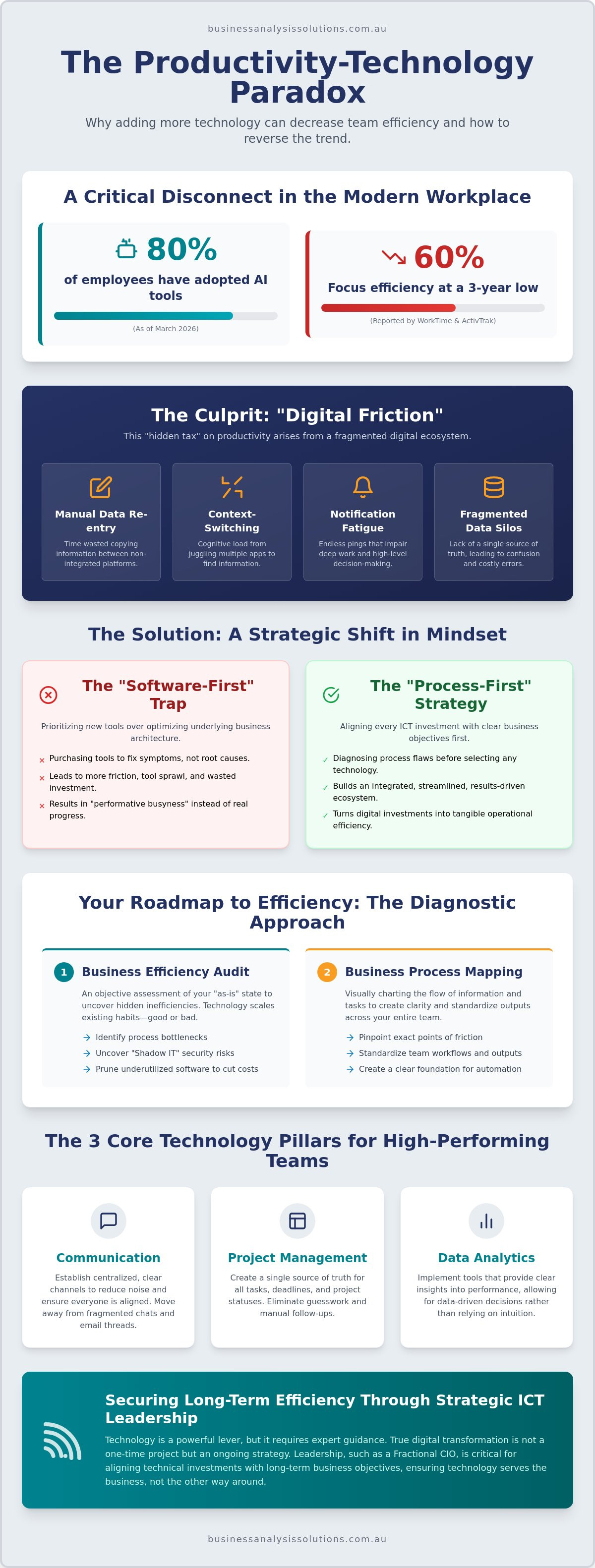
A significant disconnect has emerged in the modern workplace. While 80% of employees have adopted AI tools as of March 2026, focus efficiency has simultaneously dropped to a three-year low of 60%. This data, reported by WorkTime and ActivTrak, highlights a critical paradox. Increased access to digital tools does not automatically correlate with higher output. Instead, the accumulation of disparate platforms often creates a facade of progress while eroding actual output. When leaders investigate how to improve team productivity with technology, they frequently encounter the "software-first" trap. This approach prioritizes the acquisition of new applications over the optimization of the underlying business architecture, almost inevitably leading to ICT project failure.
True organisational productivity differs fundamentally from individual efficiency. A single employee might use generative AI to save 2.2 hours per week, but if that saved time is consumed by navigating disconnected data silos, the net gain to the business is zero. Achieving systemic harmony requires a sophisticated understanding of business technology. This involves viewing digital tools not as isolated fixes, but as integrated components of a broader strategic framework designed to facilitate coordination and clarity.
The Cost of Digital Friction
Digital friction manifests as the "hidden tax" on every project. It includes the hours lost to manual data re-entry between platforms and the constant context-switching required to find information across fragmented communication channels. This fragmentation does more than just waste time; it creates notification fatigue that impairs high-level decision-making. When a team must monitor seven or more AI tools just to stay updated, the cognitive load prevents the deep work necessary for complex problem-solving. This environment replaces meaningful progress with "performative busyness," where teams are active but lack direction.
Moving from Tactical Fixes to Strategic Solutions
Purchasing a tool to address a symptom, such as poor communication, rarely resolves the underlying process flaw. If a team lacks a clear reporting structure, adding a new messaging app only accelerates the delivery of confusing information. Transitioning from simply "using tech" to genuine digital transformation requires aligning every ICT investment with long-term business objectives. This process begins by identifying the structural bottlenecks that hinder performance. By focusing on how to improve team productivity with technology through the lens of strategic integration, leadership can move away from reactive tactical fixes and toward a streamlined, results-driven ecosystem.
The Diagnostic Approach: Auditing Your Current Workflow
Effective digital strategy begins with an objective assessment of current operations. Many organizations fail to see that technology scales existing habits; it doesn't correct them. If you multiply an inefficient process, you simply generate more waste at a faster rate. To understand how to improve team productivity with technology, you must first conduct a formal business efficiency audit. This diagnostic phase involves mapping the "as-is" state of your workflows to identify the specific bottlenecks that delay project delivery and drain resources.
The audit often reveals the presence of shadow IT. This phenomenon occurs when employees use unapproved personal platforms to circumvent cumbersome official workflows. While these workarounds might solve an immediate problem for an individual, they create security risks and fragmented data silos for the organization. Evaluating tool utilization rates allows leadership to prune underutilized software and consolidate these rogue tools. This reduction in software sprawl lowers licensing costs and restores operational oversight. For those ready to move beyond guesswork, a structured business efficiency diagnostic provides the roadmap necessary for sustainable progress.
The Power of Process Mapping
Visualizing information flow is essential for standardizing team outputs. Through business process mapping, leaders can pinpoint exactly where friction occurs during departmental handovers. This visualization creates a clear distinction between steps that require human judgment and those ripe for automation. Organizations that skip this step often automate the wrong tasks, which merely accelerates the creation of errors. A well-mapped process ensures that every team member understands their role in the sequence, reducing the need for constant clarification and status meetings.
Establishing a Single Source of Truth
Efficiency collapses without a central data repository that serves all departments. A unified data strategy ensures that every team member works from the same information, significantly reducing the "search time" that consumes a large portion of the workday. This centralized approach is a fundamental pillar of how to improve team productivity with technology, as it ensures data integrity across all integrated ICT solutions. When everyone accesses the same live data, the risk of version-control errors and miscommunication disappears. This creates a stable foundation for high-level coordination and strategic growth.
Core Technology Pillars for High-Performing Teams
To achieve measurable efficiency, an organization must categorize its digital tools by strategic impact rather than just functional utility. A coherent technology stack rests on three foundational pillars:
Communication: Facilitating clear, documented knowledge transfer across departments.
Project Management: Tracking dependencies, milestones, and individual accountability.
Data Analytics: Providing objective visibility into real-time operational performance.
Many leaders struggle with how to improve team productivity with technology because they prioritize isolated features over integration capability. In a high-performing ecosystem, the value of a platform is defined by its ability to exchange data seamlessly with other systems. This connectivity eliminates the manual silos that traditionally slow down operational momentum. When data flows automatically between these pillars, the administrative burden on your staff drops significantly.
The evolution of collaboration has moved beyond the reactive nature of email toward asynchronous work environments. These systems allow teams to contribute to projects on their own schedule, reducing the need for constant, disruptive synchronization. It's a shift that respects the focus required for deep work. For organizations with unique requirements, leveraging the Microsoft Power Platform enables the creation of custom business logic. This approach provides the benefits of tailored automation without the high costs and risks associated with custom software development. It transforms the technology stack from a collection of apps into a unified engine for growth.
Project Management and Accountability
Moving from basic task lists to formal project management frameworks is essential for scaling operations. These frameworks provide the structure needed to track complex dependencies and milestones accurately. When you automate status updates within these platforms, you eliminate the "meeting about the meeting." This frees up significant blocks of time for high-value work that directly impacts the bottom line. Clear visualization of team capacity and load also allows managers to reassign tasks before burnout occurs. It ensures a steady and predictable delivery rhythm that protects both the project timeline and the team's well-being.
Data-Driven Decision Making
By utilizing tools like Power BI, leadership can access real-time dashboards that reflect the current health of the business. Systemic harmony depends on the ability to turn raw operational data into actionable insights. This visibility improves team agility, allowing for rapid response times when KPIs deviate from targets. It's one of the most effective ways to understand how to improve team productivity with technology, as it highlights exactly where processes are failing. When technology tracks these metrics automatically, it removes the bias and delay of manual reporting. This shift ensures that every strategic decision is rooted in objective performance data rather than intuition.
Implementing Automation and AI Without Disrupting Workflow
Successful implementation is where strategy meets reality. While many organizations rush to adopt the latest features, a structured approach ensures that new tools enhance rather than hinder existing operations. A digital transformation blueprint provides the necessary roadmap for phased rollouts, allowing teams to adapt to changes without sacrificing current output. This methodical progression starts by identifying "low-hanging fruit." These are high-volume, low-complexity tasks, such as invoice processing or meeting scheduling, where automation delivers immediate ROI. By targeting these areas first, you demonstrate the value of the initiative and build internal momentum for more complex changes.
In the 2026 landscape, Generative AI and Microsoft Copilot have moved from experimental tools to core components of administrative efficiency. With AI adoption reaching 80% of employees this year, the question of how to improve team productivity with technology has shifted from "if" we should use AI to "how" we govern it. Integration must include a strict focus on security compliance, specifically aligning with Essential 8 standards to protect organizational data. Without these guardrails, the efficiency gains from AI are offset by the risks of data leakage and intellectual property exposure. If your organization is ready to move beyond manual bottlenecks, a professional automation implementation strategy can bridge the gap between technical potential and operational reality.
The Blueprint for Automation Success
A successful rollout begins with a defined objective. You must determine if the primary goal is time-saving, error reduction, or long-term scalability. This clarity informs your choice of stack, whether you rely on native integrations within the Microsoft ecosystem or utilize third-party middleware to connect legacy systems. User Acceptance Testing (UAT) serves as the final gate in this process. By involving the team in the testing phase, you ensure the technology actually solves the problems identified during the process mapping stage. Their feedback is the most reliable indicator of whether the new workflow will be sustained or abandoned.
AI as a Productivity Co-Pilot
Practical applications of AI now extend into meeting transcription, document drafting, and complex data cleaning. These tools act as a force multiplier for staff, allowing them to focus on high-level analysis rather than rote preparation. However, maximizing this output requires a commitment to training. Teams must learn to prompt effectively to generate accurate, high-quality results. Establishing clear guardrails is equally important to ensure that sensitive business logic remains within secure environments. When deployed with these considerations, AI becomes a seamless extension of the team's capabilities, driving how to improve team productivity with technology toward new benchmarks of efficiency.
Securing Long-Term Efficiency Through Strategic ICT Leadership
Technology strategy is no longer a peripheral concern handled solely by technical support teams. It is a core leadership function that dictates the pace of organizational growth. Understanding how to improve team productivity with technology requires an executive perspective that bridges the gap between technical requirements and business outcomes. Without this high-level alignment, ICT investments often become expensive liabilities rather than assets. Maintaining system harmony demands a proactive approach, where regular reviews ensure that your digital ecosystem continues to support your evolving business goals.
For many SMEs, the challenge lies in accessing this level of expertise without the financial burden of a full-time executive. This is where Fractional CIO services provide a critical advantage. These services offer the strategic oversight necessary to mitigate risks in large-scale ICT investments while ensuring that every tool serves a specific operational purpose. By integrating seasoned advisory into your leadership structure, you move from reactive troubleshooting to a culture of continuous improvement and high digital literacy. This ensures that your technical infrastructure scales as your business grows.
The Value of On-Demand Strategic Advisory
Strategic advisory ensures that technology decisions are driven by logic and financial performance rather than marketing trends. A Fractional CIO acts as an analytical collaborator, helping you navigate complex vendor landscapes and security requirements. This oversight is vital for protecting intellectual property and maintaining compliance with evolving regulations, such as the EU AI Act taking effect in August 2026. By providing a clear direction, this role ensures that your team remains focused on high-value activities rather than struggling with mismatched systems that don't talk to each other.
Next Steps: From Diagnostic to Implementation
The journey toward a streamlined technology ecosystem begins with an objective assessment. Conducting your first efficiency diagnostic allows you to identify the most critical bottlenecks in your current workflow. Once these are identified, you can prioritize your digital transformation roadmap based on the potential for measurable ROI. This structured approach removes the ambiguity often associated with digital change. If you are ready to define your 2026 digital strategy and resolve your most complex organizational challenges, request a consultation to begin your diagnostic process. This is the most direct path to discovering how to improve team productivity with technology through a methodical and results-driven framework.
Transform Your Digital Strategy into Operational Performance
Establishing a high-performing digital ecosystem requires moving beyond the reactive acquisition of software. You've seen that true efficiency stems from rigorous process mapping and the integration of core technology pillars. By prioritizing a single source of truth and automating high-volume tasks through a structured blueprint, you eliminate the digital friction that currently stalls your progress. Understanding how to improve team productivity with technology is a continuous process of alignment between your technical infrastructure and your broader organizational objectives.
With over 20 years of industry experience in ICT strategy, we specialize in bridging the gap between technical requirements and business goals. Our expertise in the Microsoft Power Platform and strategic automation ensures that your digital transformation delivers measurable results. To move from diagnostic to implementation with confidence, Book a Business Efficiency Diagnostic with our expert consultants today. It's time to replace fragmented workflows with a unified system that drives sustainable growth.
Frequently Asked Questions
What is the most effective technology for team productivity in 2026?
The most effective technology for team productivity in 2026 is an integrated ecosystem that combines communication, project management, and data analytics into a single source of truth. Solutions like the Microsoft Power Platform and Copilot lead this shift by allowing organizations to build custom logic without expensive custom development. This systemic approach is the primary way to understand how to improve team productivity with technology, as it removes the friction of switching between disconnected applications.
How do I know if my business needs a Digital Transformation Blueprint?
Your business requires a Digital Transformation Blueprint if you're experiencing digital friction, fragmented data silos, or a heavy reliance on manual workarounds. These symptoms indicate that your current technical infrastructure no longer supports your operational goals. A blueprint provides a structured roadmap to align your ICT investments with long-term business objectives, ensuring that new tools solve specific process flaws rather than just adding more noise to the workflow.
Can technology replace the need for manual process mapping?
No, technology cannot replace the need for manual process mapping. Mapping is the essential precursor to any technical implementation because it identifies how work actually flows through your organization. If you attempt to automate an inefficient or broken process, you simply accelerate the production of errors. Technology should only be used to scale a process that has already been optimized and standardized through careful analysis.
How much should a business invest in productivity technology?
Investment levels should be determined by the potential for measurable ROI identified during a business efficiency diagnostic. Rather than following generic industry averages, you should focus on the cost of your current inefficiencies, such as hours lost to manual data entry or administrative overhead. This approach ensures that your technology spend is a strategic investment in growth rather than a recurring operational expense without a clear return.
What are the risks of implementing new technology without a strategy?
Implementing technology without a clear strategy often results in "tool sprawl," where multiple platforms perform redundant functions and create data silos. This lack of coordination leads to notification fatigue and erodes team focus. Uncoordinated rollouts often bypass critical security compliance, exposing the organization to data breaches and intellectual property risks. A strategic framework is necessary to ensure system harmony and long-term stability.
How can a Fractional CIO help improve our team productivity?
A Fractional CIO provides the executive-level oversight required to align your technical roadmap with your business strategy. This role is instrumental in helping you understand how to improve team productivity with technology by auditing your current stack and identifying high-impact automation opportunities. They bridge the gap between technical requirements and financial performance, ensuring that your ICT solutions deliver tangible value without the cost of a full-time executive.
Does automation always lead to better team efficiency?
Automation only leads to better team efficiency when it's applied to high-volume, low-complexity tasks within an optimized workflow. If the underlying process is flawed, automation can actually decrease efficiency by creating bottlenecks elsewhere in the system. Success depends on identifying the right tasks and ensuring that every automated step is supported by clear business logic and rigorous user acceptance testing.
What is the Essential 8 and why does it matter for productivity tools?
The Essential 8 is a series of baseline cybersecurity strategies developed by the Australian Signals Directorate to protect organizations against various threats. It matters for productivity tools because these platforms often handle sensitive corporate data and intellectual property. Aligning your ICT solutions with this framework ensures that your efficiency gains aren't compromised by security vulnerabilities or data breaches that could disrupt your entire operation.



Comments