How to Improve Business Process Flow: A Strategic Framework for 2026
Updated: Apr 22
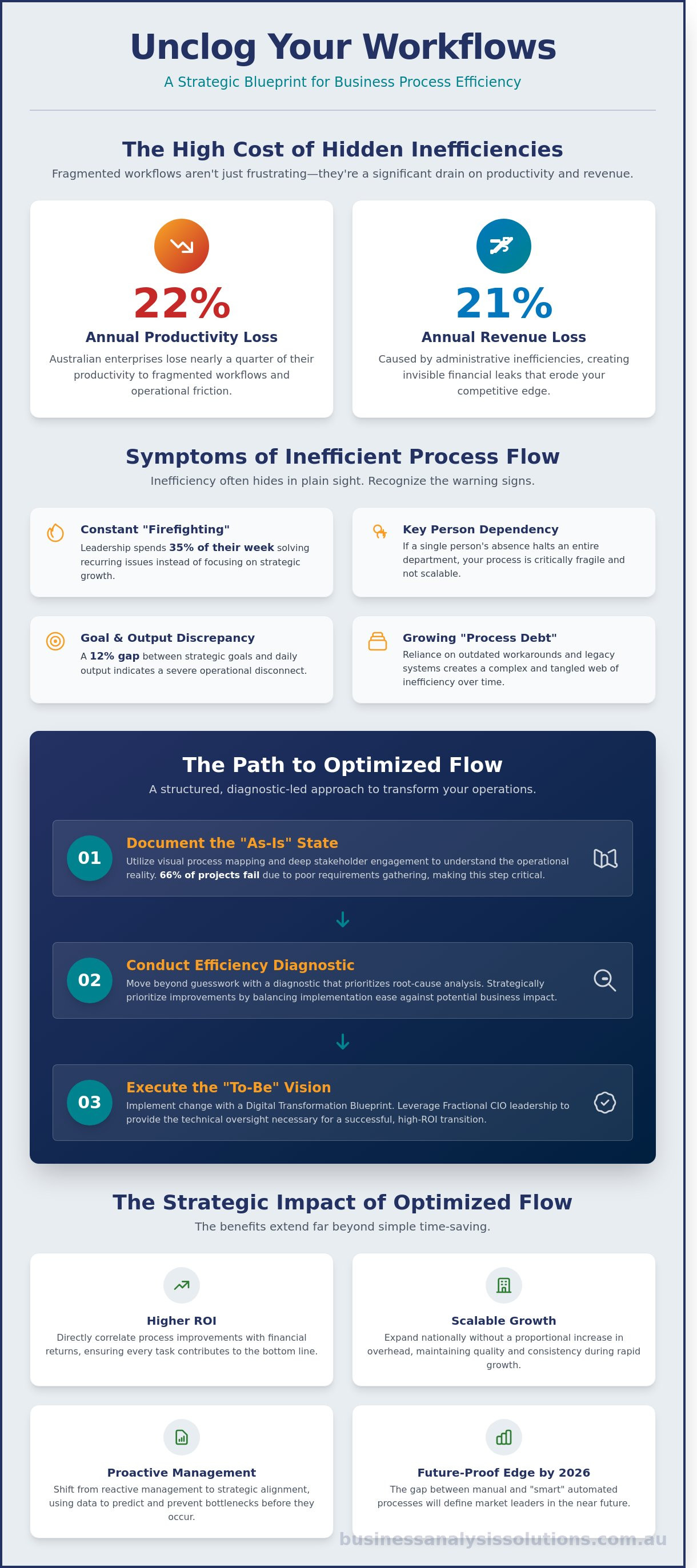
Recent industry benchmarks for 2024 indicate that Australian enterprises lose an average of 22% in annual productivity due to fragmented workflows and operational friction. When your team is trapped in silos or buried under redundant manual tasks, the true cost isn't just time; it's the erosion of your competitive edge. Mastering how to improve business process flow is no longer a secondary administrative task. It's a strategic necessity for any leader aiming to scale operations by 2026. You've likely felt the frustration of a lack of visibility into end-to-end workflows, where bottlenecks remain hidden until they impact the bottom line.
This guide provides a methodical, diagnostic-led approach to identifying those hidden inefficiencies. You'll discover a clear roadmap for transformation that prioritises logic and precision over temporary fixes. By applying these professional business analysis standards, you can secure a higher ROI through automation and build a scalable foundation for growth. We'll move from the high-level vision of stakeholder engagement to the granular details of process mapping, ensuring your technical requirements finally match your business objectives.
Key Takeaways
Identify the invisible costs of "clogged" workflows, such as employee burnout and lost revenue, by redefining your process flow as a logical sequence for value delivery.
Utilise visual process mapping and deep stakeholder engagement to establish a reliable "As-Is" state, ensuring your documentation reflects operational reality.
Discover how to improve business process flow through a structured Business Efficiency Diagnostic that prioritises root-cause analysis over premature software implementation.
Apply a strategic framework to prioritise operational improvements by balancing ease of implementation against potential impact on your organisational goals.
Execute your "To-Be" vision with a Digital Transformation Blueprint and learn how Fractional CIO leadership provides the technical oversight necessary for a successful transition.
Table of Contents What is Business Process Flow and Why Does it Stagnate? The Foundation of Flow: Process Mapping and Stakeholder Engagement Moving Beyond Guesswork: The Role of a Business Efficiency Diagnostic A Strategic Framework: How to Improve Your Business Process Flow Executing Change: From Mapping to a Digital Transformation Blueprint
What is Business Process Flow and Why Does it Stagnate?
Business process flow isn't just a diagram on a wall. It's the logical sequence of tasks that transforms raw inputs into tangible customer value. When these sequences are optimised, an organisation operates with precision and clarity. However, many Australian firms struggle with "clogged" flows that create invisible financial leaks. According to data from 2024 industry reports, administrative inefficiencies can cost businesses up to 21% of their annual revenue. These costs manifest through employee burnout and delayed project delivery. Learning how to improve business process flow requires identifying these friction points before they become systemic failures.
A primary driver of stagnation is "Process Debt." This occurs when teams rely on outdated workarounds to bypass rigid legacy systems. While a temporary fix might save ten minutes today, the cumulative effect of these shortcuts creates a complex web of inefficiency. In a modern enterprise, you must distinguish between manual workflows, which rely on human intervention, and automated sequences that execute tasks without oversight. By 2026, the gap between these two will define market leaders. When considering how to improve business process flow, you must address the underlying Process Debt that prevents your team from performing at their peak.
Symptoms of Inefficient Process Flow
Inefficiency often hides in plain sight. One common symptom is "firefighting," where leadership spends 35% of their week solving recurring issues instead of focusing on growth. You might also notice a heavy reliance on specific individuals. If a single person's absence halts a department, your process is fragile. High error rates and a 12% discrepancy between strategic goals and daily output are clear indicators that your operational flow is compromised. These bottlenecks don't just slow down work; they erode trust between departments and frustrate your high performers.
The Strategic Impact of Operational Efficiency
Optimised flow isn't just a technical requirement; it's a financial lever. Improving your business efficiency directly correlates with higher ROI. For organisations scaling across Australia, consistency is vital to maintain quality during rapid expansion. The 2026 market environment demands "smarter" processes that leverage data to predict bottlenecks before they occur. It's about moving from reactive management to proactive strategic alignment. This shift ensures that every task performed contributes directly to the bottom line, allowing the business to scale nationally without a proportional increase in overhead costs.
The Foundation of Flow: Process Mapping and Stakeholder Engagement
To understand how to improve business process flow, you must first document the "As-Is" state with clinical precision. A process map is only as reliable as the stakeholder data that informs it; without accurate input, you're simply drawing a fiction. This stage requires rigorous requirements elicitation to identify hidden bottlenecks that often evade high-level oversight. According to a 2024 report by the Standish Group, 66% of projects fail or are challenged due to poor requirements gathering. Bridging the gap between technical requirements and business objectives ensures that any subsequent automation or redesign remains aligned with the organisation's commercial goals.
Effective elicitation involves translating operational pain points into technical specifications. This ensures that the IT department isn't building a solution for a problem the business doesn't actually have. In a 2023 study of Australian financial services, 55% of process inefficiencies were found to be caused by "shadow IT" systems that stakeholders used because the official process was too slow. Identifying these gaps early prevents the digitisation of already broken workflows.
Identifying Key Stakeholders
Successful analysis moves beyond the C-suite to engage the process owners on the ground. These are the individuals who navigate the workarounds and manual interventions that don't appear in official manuals. Using unbiased, semi-structured interviews allows you to uncover how work actually gets done. In the Australian manufacturing sector, engaging frontline staff has been shown to reduce resistance to change by 40% when the personal benefits, such as reduced administrative burden, are clearly communicated. Supporting this transition with formal qualifications from Axiom College ensures that employees possess the foundational knowledge required for modern operational excellence. Managing resistance isn't about persuasion; it's about demonstrating that the new flow solves their specific daily frustrations.
Visualising the Workflow
You must distinguish between high-level functional maps and granular, task-level flows. While a high-level view provides strategic context, task-level detail is necessary to spot redundancies. Using standard notation like BPMN 2.0 ensures clarity across the entire organisation; it removes the ambiguity that leads to costly errors. Process mapping is the clinical observation of business logic before intervention. If you're struggling to document these complexities, seeking professional business analysis solutions can provide the objective perspective needed to untangle your operations. Clear visualisation serves as the single source of truth for all subsequent optimisations.
Standard Notation: Use BPMN 2.0 to ensure all departments speak the same visual language.
Unbiased Interviews: Ask open-ended questions to avoid leading stakeholders toward "ideal" rather than "actual" answers.
Gap Analysis: Compare the documented map against business objectives to find where the flow breaks down.
Moving Beyond Guesswork: The Role of a Business Efficiency Diagnostic
Many Australian organisations attempt to fix operational bottlenecks by purchasing new software before they've identified the root cause of the friction. This tech-first approach is a primary reason why approximately 70% of digital transformation projects fail to meet their original objectives. A Business Efficiency Diagnostic replaces this impulsive guesswork with a structured, logic-driven audit of current operations. It's a methodical evaluation that determines exactly where friction exists and which changes will yield the highest return on investment. Truly understanding how to improve business process flow starts with objective data, not a software sales demo.
Investing in a formal assessment prevents the "sunk cost" trap of expensive ICT project failures. When a firm spends A$50,000 on a platform that doesn't fit its workflow, the cost isn't just the license fee; it's the lost productivity and staff frustration that follows. A diagnostic ensures that every dollar spent on improvement is backed by a clear business case. It provides the clarity needed to stop wasting resources on symptoms and start addressing the underlying systemic issues.
What a Diagnostic Assessment Uncovers
A professional diagnostic reveals the hidden inefficiencies that standard reporting often misses. It identifies redundant software licenses where departments pay for overlapping features, often saving organisations between 15% and 30% in annual ICT spend. We frequently detect "shadow IT," which occurs when teams use unapproved tools like personal messaging apps or external spreadsheets to bypass broken internal processes. The diagnostic also quantifies the cost of "swivel-chair" workflows. These are manual tasks where staff must re-key the same data into multiple systems, a practice that introduces human error and drains billable hours.
Strategic Alignment and ROI
A diagnostic ensures that every process change supports the broader business technology strategy. It moves the conversation from vague complaints to measurable baselines. By capturing current cycle times and error rates, you create a benchmark to track the success of future improvements. This data-driven foundation allows for a seamless transition from diagnostic findings to a strategic roadmap. Instead of guessing how to improve business process flow, leadership can prioritise high-impact interventions that offer the fastest path to a positive return on investment. This structured approach builds the confidence needed to drive meaningful organisational change.
A Strategic Framework: How to Improve Your Business Process Flow
Moving from analysis to implementation requires a structured "To-Be" vision. This blueprint isn't a guess; it's a design based on diagnostic data and 2026 strategic goals. When determining how to improve business process flow, we prioritise every proposed change using a matrix that weighs ease of implementation against potential impact. This ensures your team doesn't waste resources on low-value tasks. By focusing on high-impact, low-effort "quick wins" first, you build the momentum necessary for larger structural shifts.
Step 1: Simplify and Standardise
Efficiency starts with subtraction. You can't fix a broken process by simply digitising it; you'll just end up with a faster, more expensive broken process. Whether you are an Australian corporation or a specialized service provider like Cabinet refinishing Denver, the key is to identify steps that add no value and remove them immediately. Once the process is lean, we develop Standard Operating Procedures (SOPs) that meet three specific criteria:
Accessibility: Documents must be available at the point of use, not buried in a legacy file server.
Actionability: Steps must use active verbs and clear logic gates.
Scalability: Procedures must ensure a client in Brisbane receives the same quality of service as one in Perth.
Step 2: Leverage Automation and ICT Solutions
We integrate automation where manual intervention creates bottlenecks or data entry errors. In the current Australian market, 68% of mid-sized firms are now utilising low-code solutions to bridge gaps between legacy systems and cloud platforms. These tools allow for rapid deployment without overhauling your entire IT stack. Success in this phase depends heavily on professional project management to drive user adoption and technical alignment. Without a disciplined approach to change, even the most advanced ICT tools won't deliver a tangible return on investment.
Step 3: Monitor, Measure, and Refine
A process flow is never truly finished. We establish real-time KPIs to monitor performance, targeting specific metrics such as a 20% reduction in cycle time within the first six months of implementation. Feedback loops from both staff and customers provide the qualitative data needed to tweak the system. We recommend scheduling regular process health checks every 90 days to prevent stagnation. This continuous improvement loop ensures your operations remain agile enough to handle market shifts or new regulatory requirements. This is the most reliable way to understand how to improve business process flow over the long term.
Ready to untangle your organisational complexities? Consult with our business analysis experts to build a high-performance framework for your firm.
Executing Change: From Mapping to a Digital Transformation Blueprint
Understanding how to improve business process flow requires moving beyond static diagrams into active execution. Mapping identifies bottlenecks, but a strategic blueprint implements the cure. We adopt a vendor-neutral stance, ensuring technology serves the process rather than forcing your business to adapt to rigid software limitations. This objective approach protects your capital by avoiding "shiny object syndrome" during tech procurement. It's about finding the right tool for the specific job, not the most expensive one on the market.
The Digital Transformation Blueprint
A formal digital transformation blueprint acts as your master plan for ICT and process integration. It's the bridge between current state inefficiencies and 2026 operational standards. This document reduces risk during large-scale organisational change by outlining dependencies and resource requirements clearly. It ensures long-term scalability, allowing your infrastructure to grow as your revenue targets increase. Research indicates that businesses without a documented blueprint face up to 30% higher integration costs due to fragmented legacy systems.
Executive Leadership with Fractional CIO Services
Mid-sized Australian organisations often lack the budget for a full-time C-suite technology officer, yet they face enterprise-level complexities. Our Fractional CIO services provide high-level IT leadership without the full-time executive salary. We bridge the gap between technical teams and executive boards, translating complex requirements into clear business outcomes. Executive oversight ensures process improvements are not just tactical, but transformative.
Successful execution relies on a structured, methodical approach that prioritises clarity over complexity. When you partner with Business Analysis & Solutions, you gain access to a team that values precision and logical alignment. We focus on the following pillars to ensure your transition is seamless:
Stakeholder Engagement: Ensuring every level of the business understands the "why" behind the change.
Requirements Elicitation: Defining exactly what your systems need to do before a single line of code is written or a license is purchased.
Strategic Alignment: Verifying that every process change moves you closer to your 2026 financial and operational goals.
Business Analysis & Solutions provides the end-to-end expertise required for operational excellence. We don't just hand over a report; we partner with you to deliver the final result. If you're ready to master how to improve business process flow through logical, data-driven strategies, our team is prepared to lead the transition. We provide the clarity and direction needed to untangle organisational complexities and drive tangible value.
Securing Your Competitive Advantage Through Operational Excellence
Achieving peak performance in 2026 requires more than minor adjustments. It demands a rigorous commitment to process mapping and active stakeholder engagement to ensure every department moves in unison. By replacing intuition with a structured framework, you'll eliminate the bottlenecks that stifle growth and erode profit margins. Mastering how to improve business process flow is the definitive path to bridging the gap between your current ICT capabilities and your long-term commercial objectives.
Business Analysis Solutions offers over 20 years of specialized experience across the Australian landscape. We're a boutique consultancy focused on delivering executive-level strategic blueprints that provide clarity in complex environments. Our methodology doesn't just identify problems; it creates a logical path to resolution that aligns your technical infrastructure with your business goals. It's a pragmatic approach to driving measurable results through precision and logic.
Request a Business Efficiency Diagnostic from our expert consultants to secure your organization's future. Your journey toward a more streamlined, profitable operation starts with a single, data-driven step.
Frequently Asked Questions
What is the first step in improving a business process flow?
The first step in how to improve business process flow is conducting a comprehensive audit of your current state. You can't optimize what you haven't measured; therefore, you must engage stakeholders to map every touchpoint in the existing workflow. According to the 2023 IBISWorld report on Management Consulting in Australia, firms that prioritise initial process documentation see a 15 percent higher efficiency gain during implementation. This baseline allows for precise requirements elicitation.
How long does it typically take to see results from process improvement?
Most Australian organisations observe tangible results within 90 to 180 days of implementation. While minor bottlenecks might clear in 30 days, systemic shifts require a full quarterly cycle to yield reliable data. A 2024 study by the Australian Institute of Management found that 62 percent of successful process overhauls reached their primary ROI targets at the 6 month mark. This timeline accounts for staff training and the stabilization of new operational rhythms.
Can we improve our process flow without buying new software?
You can absolutely improve your process flow without investing in new software platforms. Efficiency often stems from eliminating redundant steps or reallocating resources rather than adding technical layers. Many Australian businesses find that 20 to 30 percent of process delays are caused by poor communication protocols or unclear decision rights. Strategic alignment of existing personnel and refining manual handovers often delivers a higher return on investment than a premature A$50,000 software license.
What is the difference between process mapping and process improvement?
Process mapping is the visual documentation of a workflow, while process improvement is the active application of changes to increase output. Think of mapping as the diagnostic phase where you identify 10 specific friction points. Improvement is the strategic intervention that solves those issues. Mapping provides the data, but improvement delivers the A$100,000 in annual cost savings through streamlined operations and reduced error rates across the organisation.
How do I know if my business needs a professional efficiency diagnostic?
Your business needs a professional efficiency diagnostic if your operational costs have increased by more than 10 percent year on year without a corresponding rise in revenue. Other indicators include a 15 percent or higher error rate in service delivery or persistent missed deadlines. An objective analysis from an external partner removes internal bias. It ensures that your strategic framework for 2026 is built on verified performance data rather than departmental assumptions.
What role does automation play in business process flow?
Automation acts as a force multiplier for a well defined business process flow. It shouldn't be used to "fix" a broken process; it's meant to accelerate an efficient one. By 2026, Gartner predicts that 40 percent of enterprise tasks will be automated. In the Australian market, automating repetitive data entry can save a mid sized firm up to 25 hours per week. This allows your team to focus on high value stakeholder engagement.
How do we ensure employees actually follow the new process flows?
Employee adherence is secured through early stakeholder engagement and clear performance metrics. If staff don't understand the reason behind a change, compliance drops by 40 percent according to industry benchmarks. We recommend linking the new process flows to specific KPIs and providing structured training sessions. When employees see that the new system saves them 2 hours of administrative work daily, they're much more likely to adopt the change permanently.
Is it better to improve one process at a time or the whole system at once?
It's more effective to improve one high impact process at a time to ensure stability and measurable success. Attempting a total system overhaul simultaneously often leads to operational paralysis and a 50 percent higher failure rate. By focusing on a single pilot process, you can refine your methodology and demonstrate a clear win to the board. This phased approach builds the internal momentum needed for broader organisational transformation across the Australian landscape.



Comments