How to Identify Processes for Automation: A Strategic 2026 Framework
- jonesaqayalo
- May 10
- 12 min read
Automation success is determined by the precision of your diagnostic phase, not the sophistication of the software you purchase. With the global robotic process automation market projected to reach $35.27 billion in 2026, the pressure to digitize is immense, yet many leaders remain paralyzed by the risk of investing in "shelfware." Learning how to identify processes for automation requires a shift from chasing technology trends to conducting rigorous process mapping. You've likely felt the operational friction of manual workflows and the lack of clarity that often stalls a digital strategy before it begins.
We'll bridge the gap between technical requirements and business objectives by providing a methodical framework to master the identification of high-impact automation opportunities. This article outlines a strategic approach to building a defensible list of candidates, ensuring your technology selection drives measurable organizational efficiency. We'll move from high-level strategic alignment to the granular details of agentic AI orchestration and the impact of the FASB ASU 2025-06 accounting standards on your internal-use software capitalization.
Key Takeaways
Shift your perspective from technical implementation to a strategic diagnostic exercise that prevents the automation of flawed workflows.
Master how to identify processes for automation by applying the four pillars of suitability: volume, standardization, stability, and logic-density.
Utilize "As-Is" process mapping to establish a clear baseline of current operations and expose hidden inefficiencies.
Implement a quantitative ranking system to prioritize high-impact workflows based on projected ROI and the true cost of inaction.
Bridge the gap between planning and results by leveraging a Business Efficiency Diagnostic to ensure objective, third-party validation.
Table of Contents
The Strategic Imperative: Why Identification Precedes Implementation
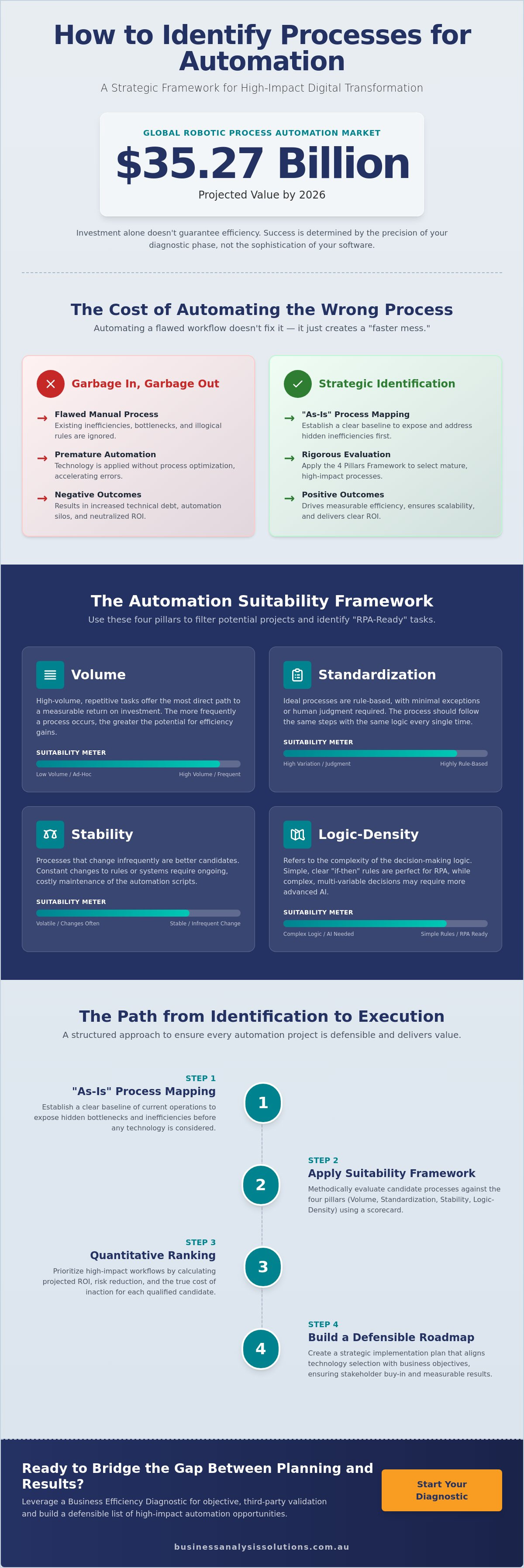
The decision to automate is often treated as a technical procurement exercise, yet the most successful initiatives treat it as a strategic diagnostic. In 2026, the global robotic process automation market is projected to reach USD 35.27 billion, reflecting a significant capital shift toward digital labor. However, investment alone doesn't guarantee efficiency. Learning how to identify processes for automation requires a methodical evaluation of existing workflows to ensure the technology serves the business, not the other way around. Without this rigor, organizations risk the "GIGO" principle: Garbage In, Garbage Out. Automating a fundamentally flawed workflow doesn't fix the underlying logic; it simply accelerates the rate at which errors occur.
Professional business analysis serves as the gatekeeper in this process. By focusing on Business Process Automation as a discipline, leaders can align technical capabilities with broader organizational objectives. This ensures that every automated task contributes directly to high-level goals like reduced operational friction or improved compliance. It's about moving from a collection of tools to a cohesive system where requirements elicitation and strategic alignment dictate the roadmap. This disciplined approach prevents the common pitfall of "shelfware," where expensive licenses sit idle because the underlying processes were never ready for the transition.
The Cost of Automating the Wrong Process
Automating an inefficient process creates a "faster mess." When manual bottlenecks are digitized without optimization, they often form automation silos that impede cross-departmental data flow. These silos create a long-term maintenance burden, as technical teams must constantly patch scripts to accommodate illogical business rules. Research from 2024 indicates the RPA market generated $3.8 billion in revenue, an 18% increase year-over-year, yet firms that skipped the diagnostic phase often found their ROI neutralized by increased technical debt and error-handling costs. Precision in the identification phase is the only way to avoid these hidden operational taxes.
Shifting from Reactive to Proactive Digital Strategy
Many organizations start by targeting "low-hanging fruit," such as simple data entry. While these provide quick wins, a proactive approach focuses on high-impact strategic improvements that transform core operations. A digital transformation blueprint for business provides the necessary context to move beyond reactive fixes. This framework ensures that stakeholder engagement occurs early, securing buy-in before a single line of code is written. By understanding how to identify processes for automation through a proactive lens, you ensure that every implementation is defensible, scalable, and directly linked to your bottom line. This methodical transition turns automation from a series of experiments into a reliable engine for growth.
The Automation Suitability Framework: Four Pillars of Identification
Success in digital transformation depends on the criteria used to filter potential projects. Determining how to identify processes for automation requires a move away from gut feeling toward a structured Suitability Scorecard. This scorecard evaluates a workflow's maturity before a single dollar is committed to implementation. We categorize every candidate through four core pillars: volume, standardisation, stability, and logic-density. This methodical filter separates "RPA-ready" tasks, which are repetitive and rule-bound, from those requiring "Intelligent Automation" to handle semi-structured data or complex variables. A comprehensive overview of business process automation confirms that applying these rigorous standards is the prerequisite for achieving the 24.20% compound annual growth rate projected for the industry through 2035.
Criteria 1 & 2: Volume and Frequency vs. Standardisation
High-volume, repetitive tasks offer the most direct path to a measurable return on investment. If a team spends 40 hours a week on manual data entry, the potential for efficiency gains is clear. However, volume alone isn't enough; the process must be standardised. Process Standardisation is the elimination of subjective decision-making in a workflow. If a task requires a staff member to "use their best judgment" based on unwritten rules, it's not ready for code. We look for workflows where the rules are consistent and exceptions are rare. When you're assessing how to identify processes for automation, prioritize those where the path from input to output is identical every time. A formal Business Efficiency Diagnostic can help categorize these workflows before capital is committed.
Criteria 3 & 4: Stability and Rule-Based Logic
Stability is the often-overlooked pillar of automation success. Automating a "fluid" process that changes every quarter creates a high maintenance burden that can quickly erode your ROI. We focus on workflows that have remained consistent for at least six months, ensuring the automation logic doesn't become obsolete before it's fully deployed. Logic-density refers to the presence of rule-based logic and structured data. Successful execution relies on "if-then" scenarios that a machine can follow without ambiguity. While human intuition is valuable for strategy, it's a liability for basic automation. By identifying processes that rely on structured inputs, like spreadsheets or database fields, you ensure the digital agents have the clear instructions they need to perform without constant human intervention.
Leveraging Process Mapping to Uncover Hidden Inefficiencies
Process mapping is the foundational layer of any strategic guide to business efficiency. It moves the project from abstract strategy into the realm of operational reality. To truly understand how to identify processes for automation, you must first visualize the existing workflow with absolute precision. This begins with the "As-Is" process map, which captures the current state of operations. It's common to find that the documented procedure and the actual daily execution are two different things. By documenting every step, decision point, and stakeholder interaction, we expose the "invisible" bottlenecks that cause friction.
The goal of this diagnostic phase isn't just to document for the sake of documentation. It's to define the "To-Be" state. Replicating a manual process in a digital environment is a missed opportunity. Instead, we design for automation by optimizing the workflow to remove unnecessary steps that only existed to accommodate human limitations. This transition requires deep stakeholder engagement and requirements elicitation to ensure the new process meets both technical capabilities and business objectives. It's a methodical approach that ensures the final solution is as logical as it is efficient.
Visualising the Workflow: Tools and Techniques
Precision is paramount, which is why we utilize BPMN (Business Process Model and Notation) for technical clarity. This standardized language ensures that every stakeholder, from the department head to the implementation team, shares a single source of truth. However, technical diagrams are only as good as the data behind them. "Walking the floor" remains a critical technique; observing staff as they interact with legacy systems often reveals "shadow" workflows or manual workarounds that aren't captured in management reports. These insights are then distilled into a functional requirements document that serves as the blueprint for the next phase of the digital journey.
Identifying the "Automation Gap"
The most lucrative automation candidates often hide in the hand-offs between departments. When data moves from one silo to another, it's frequently subject to manual transcription or delay. By analyzing these gaps on your process map, you can spot high-impact opportunities that a surface-level scan would miss. We look for manual data entry points where structured data is already available in another system. Identifying these gaps allows us to predict the downstream impact of automation, ensuring that a change in one department doesn't create a new bottleneck in another. Mastering how to identify processes for automation means seeing the business as a series of connected data flows rather than isolated tasks.
A Quantitative Approach: Prioritising Processes by ROI and Risk
Precision in process mapping must be validated by cold, hard data. Understanding how to identify processes for automation requires a transition from qualitative observation to quantitative validation. This ensures that organizational resources are allocated to workflows that provide the highest return on investment while minimizing exposure to operational risk. We don't just look for what can be automated; we calculate what should be automated based on a defensible prioritization matrix. This mathematical rigor prevents the common error of pursuing technically impressive projects that offer negligible business value.
The "Cost of Inaction" is a critical metric in this phase. If the global RPA market is expanding at a compound annual growth rate of 24.20% through 2035, standing still is equivalent to falling behind. For every month a high-volume, manual process remains unautomated, the business incurs an "operational tax" in the form of lost productivity and avoidable errors. By quantifying this drag, we create a sense of urgency that is rooted in financial logic rather than marketing hype.
Step-by-Step Prioritisation Matrix
We utilize a 5-step methodology to rank automation candidates, ensuring that the most impactful projects rise to the top of the roadmap:
Step 1: Estimate potential time savings. Calculate the minutes saved per transaction and multiply by the monthly volume. For example, saving 10 minutes on 1,000 monthly invoices recovers 166 hours of capacity.
Step 2: Calculate the cost of human error. Industry data suggests manual data entry error rates sit between 1% and 5%. Quantify the staff time required to remediate these mistakes.
Step 3: Assess technical complexity. Evaluate the number of system integrations and the stability of the underlying software. High complexity with low volume is a recipe for poor ROI.
Step 4: Map against strategic goals. Does this automation support a broader digital transformation blueprint or improve customer experience?
Step 5: Factor in "Soft ROI." Account for improved employee satisfaction and reduced burnout, which directly impact retention and recruitment costs.
Evaluating Technical and Organisational Risk
Every automation initiative introduces new variables into the corporate ecosystem. In the Australian professional context, we must align all digital agents with the "Essential 8" cybersecurity framework to ensure data integrity and system resilience. It's not enough to automate; you must secure the automated workflow against unauthorized access and logic manipulation. Managing the human element is equally vital. Automation changes the nature of work, and without clear communication, it can trigger cultural resistance. Integrating expert ICT project management ensures that these technical and organizational risks are mitigated before they impact the bottom line.
To ensure your prioritisation is based on objective data rather than internal assumptions, consider a professional Business Efficiency Diagnostic to validate your automation roadmap.
Moving from Identification to Execution: The Role of Strategic ICT Consultancy
Identification provides the roadmap, but execution requires a bridge between technical capability and business objectives. Many organizations stall at the transition point because they lack the executive-level oversight to turn a list of candidates into a functioning ecosystem. This is where fractional CIO services offer a decisive advantage. By providing strategic leadership on a flexible basis, a fractional CIO ensures that your automation efforts remain aligned with your digital strategy, preventing the accumulation of a "Frankenstack" of disconnected tools. They provide the quiet confidence needed to navigate the shift from manual workflows to a streamlined, digital-first environment.
A seasoned consultant doesn't just look at the software; they look at the organizational architecture. They understand that how to identify processes for automation is a continuous cycle of refinement, not a one-off project. This vendor-neutral approach is essential in a market where 2026 trends like agentic AI can easily lead to over-investment in unnecessary complexity. True value lies in selecting the right tool for the specific logic-density of your workflow, rather than following a vendor's pre-packaged script. This methodical focus ensures that every dollar spent on automation implementation contributes directly to measurable organizational efficiency.
The Business Efficiency Diagnostic
A professional Business Efficiency Diagnostic serves as the formal entry point for this journey. It provides the objective, third-party perspective necessary to challenge the status quo. Internal teams often suffer from "institutional blindness," overlooking inefficiencies because they've become part of the daily routine. A diagnostic assessment uses structured requirements elicitation to uncover these hidden opportunities, moving your business from a collection of ideas to a funded, defensible roadmap. It's the difference between guessing where to start and having a clear, data-driven plan for your digital transformation.
Executing the Automation Roadmap
Execution is where the precision of your earlier process mapping pays dividends. With a clear "To-Be" state defined, project management becomes an exercise in delivering on a promise. It's about maintaining momentum and ensuring that the automation implementation achieves the specific ROI targets identified in your suitability scorecard. Because business environments are dynamic, the framework for how to identify processes for automation must be revisited regularly to account for new operational friction or emerging technology capabilities. Contact Business Analysis & Solutions for a strategic diagnostic today to begin untangling your organizational complexities with a structured, methodical approach.
Securing Your Competitive Advantage Through Methodical Automation
Success in the digital landscape of 2026 requires more than just capital; it demands analytical precision. By applying the four pillars of suitability and conducting rigorous process mapping, you move from reactive troubleshooting to a proactive digital strategy. Mastering how to identify processes for automation ensures every technical implementation is anchored in logic and delivers a measurable return on investment. This structured approach eliminates the risk of "shelfware" and transforms manual bottlenecks into streamlined assets.
With 20+ years of industry experience, Business Analysis & Solutions specializes in bridging the gap between technical requirements and business objectives. Our logic-first methodology provides the clarity needed to untangle organizational complexities and drive sustainable progress. It's time to replace ambiguity with a defensible roadmap for growth. Optimise your operations with a Business Efficiency Diagnostic to validate your candidates and secure your firm's operational future. Your transition to a high-efficiency model is within reach when guided by seasoned expertise.
Frequently Asked Questions
What are the first signs that a process is ready for automation?
High-volume, repetitive manual tasks and rule-based decision paths are the primary indicators. Look for workflows where staff spend over 10 hours per week on manual data entry or transcription. These "swivel-chair" activities, where data moves manually between systems, signal high suitability. Identifying these triggers early prevents the operational friction caused by manual bottlenecks and allows for a more focused digital transformation.
Can small businesses benefit from process automation identification?
Yes, small businesses benefit by scaling operations without a proportional increase in headcount. With the RPA market projected to reach $35.27 billion in 2026, smaller firms use these tools to compete with larger enterprises. A formal diagnostic ensures they invest in high-impact workflows rather than generic software, maximizing their limited capital and driving measurable organizational efficiency through a structured, logic-first approach.
How do I calculate the ROI of an automation project before starting?
Calculate the time saved per transaction multiplied by the annual frequency and the labor rate. You must also include the cost of human error, which typically ranges from 1% to 5% in manual processes. Subtract the projected implementation and annual maintenance costs from these savings. This quantitative approach ensures your automation roadmap is grounded in financial logic rather than optimistic estimates.
What is the difference between task automation and process automation?
Task automation targets a single, discrete action, whereas process automation manages a series of connected activities to reach a business goal. A task might be an automated email response. Process automation is the end-to-end orchestration of receiving an order, checking inventory, processing payment, and updating the CRM. Mastering how to identify processes for automation requires looking at these holistic end-to-end workflows.
Should I automate my most complex processes first?
No, you should prioritize high-volume, low-complexity workflows to ensure a rapid return on investment. Automating your most complex processes first increases the risk of project failure and logic errors. By starting with standardized, rule-based tasks, you build institutional confidence and technical stability. This methodical approach allows you to tackle more intricate "Intelligent Automation" candidates as your process maturity grows over time.
What role does a Business Analyst play in identifying automation opportunities?
A Business Analyst provides the methodical diagnostic necessary to separate viable candidates from technical debt. They use stakeholder engagement and process mapping to determine how to identify processes for automation that align with strategic goals. Their role is to ensure the business doesn't automate a flawed process, which would only accelerate the rate of operational errors and increase long-term maintenance costs.
How often should we review our processes for new automation potential?
Review your business processes at least every six months to stay aligned with technological advancements. A process that was unsuitable for automation in 2024 might become a prime candidate for agentic AI by late 2026. Regular assessments ensure your digital transformation blueprint remains current and that you don't miss new opportunities to reduce operational friction as your business scales and matures.
What are the risks of identifying processes for automation without professional help?
The most significant risks include investing in "shelfware" and automating broken workflows. Without a professional diagnostic, organizations often create automation silos that impede data flow across departments. Professional guidance ensures compliance with Australian standards like the "Essential 8" and provides a vendor-neutral perspective. This prevents the costly mistake of selecting technology based on marketing hype rather than actual business requirements.



Comments