How to Create a Digital Strategy in 2026: A Strategic Framework for Business Efficiency
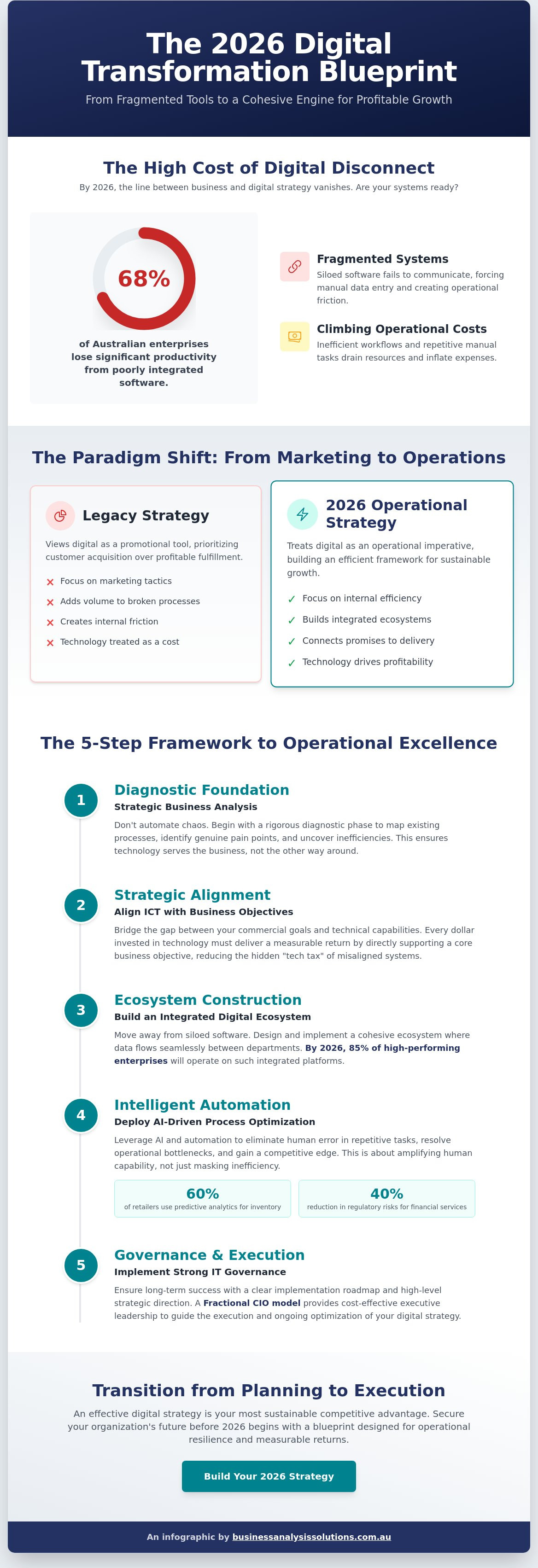
By 2026, the distinction between a business strategy and a digital strategy will have effectively vanished. Research indicates that 68% of Australian enterprises currently lose significant productivity because their software systems fail to integrate with core workflows. If you're struggling to understand how to create a digital strategy 2026 that actually drives profit, you're likely caught in the common trap of equating digital marketing with true digital transformation.
It's frustrating to manage fragmented systems that don't talk to each other while operational costs continue to climb. You want a clear path that turns these digital tools into a cohesive engine for growth. This article provides a structured framework to master the transition from tactical tools to an operationally sound digital ecosystem. We'll outline the exact steps to achieve strategic alignment between your business goals and your technology stack, ensuring every A$1 spent on digital infrastructure delivers a measurable return through automation and improved efficiency.
Key Takeaways
Redefine digital strategy as an operational imperative rather than a promotional tool to ensure resilience in the 2026 high-automation landscape.
Understand why strategic business analysis is the mandatory diagnostic phase for identifying and rectifying process inefficiencies before technical scaling.
Master how to create a digital strategy 2026 through a structured 5-step blueprint that aligns ICT investments with core business objectives.
Solve executive leadership challenges by leveraging a Fractional CIO model to provide cost-effective, high-level IT governance and strategic direction.
Transition from planning to execution with a clear implementation roadmap designed to secure your organisation's competitive position before 2026 begins.
Table of Contents The 2026 Digital Landscape: Moving Beyond Marketing Fluff The Foundation: Why Business Analysis Precedes Strategy A 5-Step Framework for Your 2026 Digital Transformation Blueprint Implementation and Governance: The Fractional CIO Model Executing Your 2026 Digital Strategy: Next Steps for Success
The 2026 Digital Landscape: Moving Beyond Marketing Fluff
By 2026, the distinction between a business plan and a digital plan has vanished. Organizations that treat their Digital Strategy as a secondary marketing concern are finding themselves decoupled from the pace of the Australian market. A modern strategy serves as an operational imperative. It's the structural framework that dictates how a firm survives in a high-automation environment where efficiency is the only sustainable moat.
Traditional marketing-first approaches are failing. These legacy models prioritize customer acquisition through transactional digital interactions but ignore the internal friction those transactions create. In 2026, success depends on relationship-driven, integrated systems that connect front-end promises to back-end delivery. Learning how to create a digital strategy 2026 requires focusing on three core pillars: robust ICT infrastructure, rigorous data governance, and end-to-end process automation. Without these, marketing efforts are simply adding more volume to a broken machine.
Operational vs. Marketing Digital Strategy
Operational digital strategy focuses on internal efficiency-driving systems rather than just customer-facing tactics. While marketing tactics might drive a lead, it's the operational system that ensures the lead is processed, fulfilled, and retained profitably. Many Australian firms struggle because they lack a digital transformation blueprint for business to bridge the gap between their technical capabilities and commercial goals.
Strategic alignment is the priority here. If your technology stack doesn't directly support your business objectives, it's a liability. By 2026, 85% of high-performing Australian enterprises have moved away from siloed software solutions. They've replaced them with integrated ecosystems where data flows seamlessly between departments. This shift reduces the "tech tax" that many businesses pay in the form of manual data entry and fragmented communication.
The Role of AI and Automation in 2026
AI has moved past the novelty phase of generating marketing copy. In 2026, the focus is on AI-driven process optimization. This involves deploying intelligent agents that monitor workflows to identify and resolve operational bottlenecks before they impact the bottom line. Automation implementation is no longer about replacing staff; it's about eliminating human error in repetitive tasks that drain resources.
AI-driven business efficiency is the primary competitive advantage in 2026.
Predictive analytics now manage inventory levels for 60% of Australian mid-market retailers.
Automated compliance monitoring has reduced regulatory risks for financial services by 40% compared to 2023 levels.
When you evaluate how to create a digital strategy 2026, you must look at how automation reduces the distance between a problem and its solution. Precision in these systems ensures that your business remains agile enough to pivot when market conditions shift. It's about creating a lean, responsive organization that uses technology to amplify human capability rather than just masking inefficiency.
The Foundation: Why Business Analysis Precedes Strategy
Building a digital roadmap on top of inefficient processes is a recipe for expensive failure. Technology acts as a force multiplier; if your underlying workflows are fragmented, digitisation will simply accelerate your path to operational chaos. This is why understanding how to create a digital strategy 2026 begins with a rigorous diagnostic phase rather than a software procurement list. Strategic clarity is the only way to ensure that technology serves the business, not the other way around.
Strategic business analysis serves as this diagnostic layer. It ensures that every technological investment aligns with actual commercial objectives rather than fleeting trends. Engaging a strategic business analysis consultancy allows organisations to bridge the gap between high-level vision and granular execution. By facilitating deep stakeholder engagement, leaders can identify the genuine pain points that cause friction in daily operations. This bottom-up approach ensures the strategy addresses real-world bottlenecks that executive-level views might overlook.
Process Mapping: Visualising the Current State
Process mapping is the primary tool for identifying redundancies and hidden inefficiencies. Without a visual representation of how work flows, leaders often succumb to the digitisation of bad habits. Industry research suggests that up to 30% of business revenue is lost to process inefficiencies annually. Mapping the current state reveals where manual workarounds have replaced standard procedures. This clarity allows for a clean transition to a future-state digital vision, ensuring that new systems simplify the workload.
Requirements Elicitation and Management
Formal requirements documents are the backbone of successful software and ICT selection. Without them, Australian businesses risk the proliferation of shadow IT, where departments adopt fragmented tools independently. A structured methodology for gathering functional and non-functional requirements is essential when determining how to create a digital strategy 2026 that delivers ROI. Functional requirements define what the system must do, such as automating payroll under Fair Work standards, while non-functional requirements focus on scalability and security. Centralising these needs through professional business analysis services prevents the wastage associated with mismatched software choices.
A 5-Step Framework for Your 2026 Digital Transformation Blueprint
Executing a successful digital transformation requires a shift from reactive technology adoption to a structured, lifecycle-based approach. Understanding how to create a digital strategy 2026 involves more than just selecting software; it requires a logical progression from identifying inefficiencies to securing a return on investment. This five-step framework provides a repeatable methodology for Australian businesses seeking operational excellence.
Step 1: Conduct a comprehensive business efficiency diagnostic. You can't improve what you haven't measured. Establish a quantitative baseline of current performance to identify where time and capital are being wasted.
Step 2: Define strategic ICT goals. Align your technology roadmap with core business objectives. If your goal is a 20% increase in service delivery speed, your ICT targets must reflect that specific outcome.
Step 3: Map digital solutions to operational bottlenecks. Use the findings from your initial business analysis to match specific technologies to the points of friction in your current workflows.
Step 4: Prioritise implementation. Rank projects based on their projected ROI, technical complexity, and your team's readiness to adopt new tools. Focus on high-impact, low-complexity changes first.
Step 5: Establish a governance framework. Create a system for continuous monitoring and iterative improvement. Digital strategies aren't static; they require regular audits to ensure they remain aligned with market shifts.
The Business Efficiency Diagnostic
A diagnostic assessment is the foundation of any logical digital strategy. This phase involves deep-dive data analysis, structured staff interviews, and rigorous system audits to uncover hidden redundancies. It's common to find that 30% of administrative tasks in Australian SMEs are still manual and prone to human error. By following a strategic guide to business efficiency, leaders can distinguish between "quick wins" like simple automation and long-term strategic shifts that require deeper capital investment. This phase ensures your 2026 roadmap is built on evidence rather than assumptions.
Selecting ICT Solutions That Scale
By 2026, the era of isolated "point solutions" has ended. Modern businesses now favour integrated ecosystems, such as the Microsoft Power Platform, which allow for seamless data flow across the entire organisation. When deciding how to create a digital strategy 2026, the "build vs. buy" debate must be viewed through the lens of interoperability. Buying off-the-shelf software is often faster, but custom-built modules within a scalable ecosystem provide a competitive edge. Prioritising data centralisation is vital for understanding business technology and ensuring that your systems can grow alongside your revenue without requiring a total overhaul every three years.
Implementation and Governance: The Fractional CIO Model
The most frequent objection business leaders raise when learning how to create a digital strategy 2026 is a perceived lack of internal leadership. They often feel they don't have the executive capacity to oversee complex technological shifts. This is where fractional CIO services provide a pragmatic solution. Instead of hiring a full-time executive at a cost that can exceed A$280,000 annually, businesses access high-level expertise on a part-time basis. This model delivers executive-level IT guidance without the overhead of a permanent C-suite salary.
It's vital to distinguish between a technical helpdesk and strategic technology leadership. A helpdesk focuses on uptime, hardware repairs, and troubleshooting. Conversely, a Fractional CIO focuses on strategic alignment and vendor landscape management. They evaluate whether a specific software vendor's roadmap aligns with your business goals for the next three years. This prevents the "app sprawl" that currently leads to a 30% waste in software licensing costs for many Australian SMEs. They ensure every technical decision serves a broader commercial objective.
Project Management and Execution
Expert project management acts as the primary engine for digital transformation. Without structured oversight, approximately 70% of digital initiatives fail to meet their original objectives. A dedicated project manager mitigates risks during automation implementation by identifying process bottlenecks before they halt production. They also lead change management efforts. If staff don't adopt the new tools, the strategy fails. Clear communication and structured training schedules ensure the workforce transitions smoothly to new digital workflows without losing productivity.
Measuring ROI and Strategic Success
Success in a digital strategy isn't a feeling; it's a measurable metric. When determining how to create a digital strategy 2026, the governance model must include clear key performance indicators (KPIs). These include efficiency gains, such as a 20% reduction in manual data entry, and improved data accuracy across departments. Reporting these figures to board-level stakeholders requires a shift from technical jargon to financial outcomes. A "Review and Refine" cycle is essential; this ensures the strategy remains a living document that adapts to market shifts or new regulatory requirements every quarter.
Executing Your 2026 Digital Strategy: Next Steps for Success
A digital blueprint is only as effective as the precision of its execution. Transitioning from a high-level business analysis to a fully integrated operational model requires a disciplined approach. To understand how to create a digital strategy 2026 that drives genuine business efficiency, you must accept that the most effective time to start is now. Waiting until January 2026 to begin implementation often leads to rushed deployments and significant technical debt. Successful Australian firms typically initiate their implementation cycles at least six months ahead of the new calendar year to ensure systems are stable and staff are trained.
Analysis paralysis remains a significant barrier for approximately 35% of mid-sized enterprises. This stagnation occurs when stakeholders become overwhelmed by the volume of data or the perceived complexity of ICT requirements. You can overcome this by breaking the overarching strategy into manageable, high-priority workstreams. The focus should shift from attempting to solve every organizational problem simultaneously to executing the most critical strategic alignments first. This methodical approach ensures that progress is measurable and that resources aren't spread too thin across competing priorities.
The 90-Day Digital Strategy Kickoff
A structured 90-day plan bridges the gap between diagnostic results and long-term transformation. The first 30 days focus on intensive stakeholder engagement and finalising requirements elicitation to ensure every department's needs are documented. By day 60, the focus moves to rigorous process mapping and selecting specific technology vendors that meet Australian data sovereignty and compliance standards. The final 30 days involve launching a pilot project, such as an automated reporting workflow or a refined CRM integration, to secure early wins. These initial successes demonstrate tangible value to the board and build the momentum necessary for larger-scale shifts. It's vital to seek an external, objective analysis at this stage to ensure internal bias doesn't overlook entrenched process inefficiencies.
Partnering for Strategic Growth
Business Analysis & Solutions provides the end-to-end framework required to navigate this transformation without the typical friction of internal restructuring. With over 20 years of experience in the ICT sector, we've refined a methodology that aligns technical requirements with core business objectives. We don't just provide surface-level advice; we deliver the clarity and direction needed to untangle complex organizational structures. Our approach ensures that your 2026 digital strategy is rooted in logic and designed for measurable efficiency. If you're ready to move beyond the planning phase and start seeing results, contact us for a Business Efficiency Diagnostic to identify your immediate opportunities for optimization.
Securing Your Competitive Advantage Through Strategic Architecture
Mastering how to create a digital strategy 2026 requires a fundamental shift from chasing software trends to prioritising rigorous business analysis. Industry data indicates that 70% of digital transformations fall short because technical requirements aren't aligned with core business objectives. We've spent over 20 years providing ICT consultancy to Australian organisations, ensuring every technological investment serves a specific, measurable purpose. It's not just about the tools; it's about the logical framework that governs them.
Our national team specialises in bridging the gap between complex technical systems and your strategic goals. By following a structured 5-step blueprint and leveraging governance models like the Fractional CIO, you'll eliminate the ambiguity that stalls progress. We're committed to delivering clarity and efficiency through a methodical approach that's been refined over two decades of professional service. Don't leave your digital evolution to chance when an evidence-based roadmap is within reach.
Book Your Business Efficiency Diagnostic Today
Your journey toward a more efficient, integrated future begins with a single, well-analysed step.
Frequently Asked Questions
What is the difference between a digital strategy and digital transformation?
A digital strategy is a targeted plan that defines how technology will improve specific business outcomes, while digital transformation is the broader cultural and operational overhaul of the entire organisation. Think of the strategy as the architectural blueprint and transformation as the actual construction and ongoing habitation of the building. In 2026, successful Australian firms treat the strategy as a modular component that informs the continuous evolution of their core business model.
How much does it cost to develop a digital strategy in 2026?
Investment for a comprehensive digital strategy in Australia typically ranges from A$30,000 for smaller enterprises to over A$200,000 for complex mid-market organisations. These figures reflect current market rates for specialist business analysis and strategic planning services. Costs fluctuate based on the depth of process mapping required and the number of stakeholder groups involved in the requirements elicitation phase. It's a capital investment that prioritises long-term operational efficiency over short-term savings.
Do small businesses really need a digital transformation blueprint?
Small businesses require a digital transformation blueprint to prevent the fragmented technology adoption that leads to expensive operational silos. Data from industry reports suggests that approximately 70% of digital initiatives fail to meet their objectives when they lack a structured framework. A clear roadmap ensures that every dollar of capital expenditure aligns with specific efficiency gains. It provides a logical sequence for growth that prevents the business from outgrowing its technical infrastructure too quickly.
What is a Fractional CIO and how do they help with digital strategy?
A Fractional CIO is an experienced executive who provides strategic technology leadership on a part-time or contract basis to organisations that don't require a full-time hire. They bridge the gap between technical requirements and business objectives by providing high-level oversight and objective governance. This role is critical for how to create a digital strategy 2026 because they bring cross-industry experience to the strategic alignment process. They ensure technology decisions are driven by logic rather than vendor marketing.
How long does it take to see results from a new digital strategy?
Organisations generally observe initial efficiency gains within three to six months of implementation, while full strategic outcomes typically materialise over 12 to 18 months. This timeline accounts for the necessary stages of stakeholder engagement, system integration, and staff training. Rapid prototyping of specific modules can often deliver measurable improvements in process speed within the first 90 days of the project lifecycle. Patience is required to ensure the new systems are fully embedded into the corporate culture.
What are the biggest risks of implementing a digital strategy without business analysis?
The primary risks include significant technical debt and a total lack of strategic alignment between new tools and actual business needs. Without rigorous business analysis, companies often invest in software that solves the wrong problems or creates additional manual workarounds. This misalignment results in a 40% decrease in projected productivity gains according to historical project audits from the International Institute of Business Analysis. It's a costly mistake that often leads to total project abandonment after 12 months.
Can we create a digital strategy using only internal staff?
Internal teams possess deep institutional knowledge, but they often lack the objective distance and specialised frameworks required for a modern digital strategy. Internal staff are frequently constrained by existing cultural biases and their daily operational responsibilities. Engaging an analytical partner provides the methodology needed to challenge status quo processes and identify hidden inefficiencies. It's difficult for internal stakeholders to objectively critique the very processes they've spent years managing and maintaining.



Comments