How to Convince Your Boss We Need a Digital Strategy: A Strategic Business Case for 2026
- jonesaqayalo
- Jun 14
- 11 min read
Updated: Jun 23
By 2026, global digital transformation spending is projected to hit $3.4 trillion, yet many leadership teams still treat these initiatives as optional upgrades rather than operational imperatives. You likely see the daily cost of manual errors and fragmented data, but articulating the risk of inaction is a different challenge altogether. Learning how to convince my boss we need a digital strategy starts with moving beyond technical jargon to focus on system harmony and financial performance.
We understand that resistance from upper management often stems from a lack of clarity regarding long-term ROI. This guide provides a professional framework to bridge the gap between technical requirements and organizational objectives. You'll learn how to validate operational risks and present a structured roadmap that moves leadership from hesitation to investment. We'll outline the steps to secure approval for a strategic diagnostic and align your technology with measurable business outcomes. This methodical approach ensures your proposal is grounded in logic rather than just a request for new tools.
Table of Contents
Understanding the High Cost of Digital Inertia in 2026
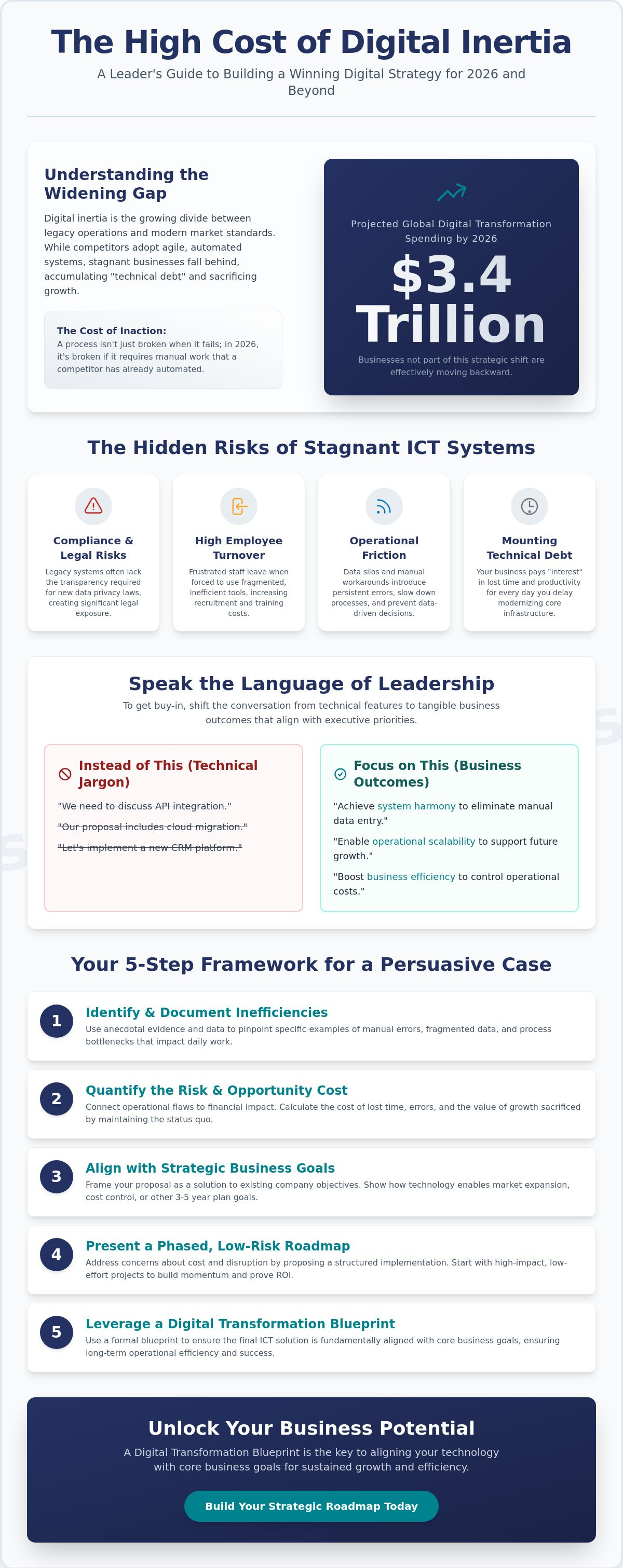
Digital inertia is the widening gap between legacy operations and modern market standards. It occurs when an organization remains tethered to outdated methods while competitors adopt agile, integrated systems. By 2026, the global digital transformation market is projected to reach $3.4 trillion. If your business isn't part of that strategic shift, you're effectively moving backward. Many leaders rely on the "if it isn't broken, don't fix it" philosophy, but this logic is flawed in a high-speed economy. In 2026, a process is broken if it requires manual data entry that a competitor has already automated.
When exploring how to convince my boss we need a digital strategy, you must highlight that a comprehensive Digital Strategy is an operational necessity, not a marketing luxury. The invisible costs of doing nothing are substantial. Frustrated employees often leave when forced to use fragmented tools, leading to high turnover and recruitment costs. Research indicates that only 35% of companies worldwide achieve their transformation goals, often because they lack a structured approach. Data silos create a lack of transparency, forcing teams to rely on manual workarounds that introduce persistent errors and operational friction.
The Hidden Risks of Stagnant ICT Systems
Outdated systems are a liability. With new state-level data privacy laws taking effect in January 2026 in Indiana, Kentucky, and Rhode Island, legacy systems often lack the transparency features required for compliance. Beyond legal risks, poor business technology directly impacts employee productivity. We call this "technical debt." It's the ongoing interest your business pays in lost time and effort because you haven't invested in modernizing your core infrastructure. In 2026, enterprise-wide implementation of AI technologies has doubled, meaning stagnant systems are falling twice as far behind every year.
Opportunity Cost: What Your Business is Missing
The real danger of digital inertia is what you lose to more agile competitors. Manual workflows cannot match the speed of automated processes. When your internal systems don't communicate, you lose the ability to generate data-driven insights that inform strategic decisions. Opportunity cost is the measurable value of the growth and efficiency sacrificed by choosing to maintain the status quo. While you wait to modernize, your competitors are using modular AI agents to reshape their operating models. This creates a strategic differentiator that is difficult to replicate without a foundational roadmap in place.
Translating Digital Strategy into Executive Language
Executive leadership rarely prioritizes technology for its own sake. When you're determining how to convince my boss we need a digital strategy, the most effective approach is to stop pitching features and start presenting outcomes. Technical terms often create a barrier to understanding. Instead of discussing API integration, speak about system harmony and the reduction of manual data entry. Rather than cloud migration, focus on operational scalability and the ability to support growth without increasing physical infrastructure costs. This shift in vocabulary signals that you understand the broader organizational context.
Your digital roadmap shouldn't exist in a vacuum. It must be explicitly linked to the company's established 3-5 year business plan. If the board's goal is market expansion, demonstrate how automated workflows facilitate rapid onboarding in new regions. If the goal is cost control, position business efficiency as the primary metric for success. By aligning your proposal with existing strategic objectives, you transform a technical request into a business solution that leadership is already incentivized to support.
The Language of ROI and Financial Performance
Bosses view investment through the lens of risk and return. Presenting a digital strategy as a cost-reduction exercise over time is a powerful motivator. You should clarify whether the investment falls under capital expenditure (CapEx) for one-time assets or operational expenditure (OpEx) for ongoing services. Most modern organizations prefer the predictability of OpEx models. In these presentations, use efficiency as a direct proxy for profitability. A reduction in manual processing time doesn't just save hours; it increases the net margin on every transaction your company processes.
Aligning ICT with Organisational Objectives
A successful case relies on the foundations of a successful digital strategy, which prioritize organizational goals over specific software choices. Technology serves as the backbone for modern project management, providing the visibility executives need to make informed decisions. Beyond data, consider the human element. Fragmented systems are a primary driver of employee frustration. Framing your strategy as a tool for staff retention and executive-level clarity makes the case far more persuasive than a list of software requirements. If you need assistance structuring this argument, a professional business analysis can help quantify these operational gains.
5 Steps to Building a Persuasive Case for Digital Transformation
Building a case requires more than a simple request; it demands a structured methodology that mirrors a professional consulting engagement. If you are researching how to convince my boss we need a digital strategy, you must move from abstract concepts to concrete evidence. Leadership responds to data that highlights current inefficiencies and provides a clear path toward resolution. Understanding the economic essentials of digital strategy is vital for framing the financial impact of your proposal. By following a methodical five-step process, you can transform a technical suggestion into a compelling business case.
Step 1 & 2: Evidence Gathering and Proof of Concept
The first step involves auditing current pain points through internal interviews. Conduct these discussions with a focus on problem-solving rather than criticism to avoid causing alarm among the team. Gather anecdotal evidence of manual workarounds and data silos. Once you've identified the friction points, select a pilot project. This "low-hanging fruit" should be a process that is highly visible to leadership but carries low implementation risk. Successfully automating a single, high-friction task provides a tangible proof of concept. Use this to quantify "waste" in your current business processes, showing exactly how many hours are lost to preventable manual errors.
Step 3, 4 & 5: Benchmarking and Proposal
After establishing internal evidence, look outward. Research competitor benchmarks to highlight the "efficiency gap" between your operations and industry standards. In Australia, various industry reports provide adoption data that can serve as a baseline for your comparison. This external validation proves that your request isn't just about new tools; it's about maintaining market relevance.
When you're ready to structure the "Ask," focus on a strategic diagnostic rather than just a new software subscription. Explain that a tactical purchase won't solve systemic issues. Instead, propose a formal digital transformation blueprint for business as the first milestone. This approach demonstrates that you value precision and long-term system harmony over quick, uncoordinated fixes. Presenting the proposal as a phased, methodical roadmap reduces the perceived risk and gives leadership a clear sequence of events to approve. This strategy ensures that every technical investment is fundamentally aligned with the company's broader operational goals.
Addressing Executive Objections: Risk, Cost, and Implementation
Anticipating executive resistance is a critical part of your preparation. Most leaders view digital strategy through the lens of risk and capital preservation. When you are refining how to convince my boss we need a digital strategy, you must be prepared to pivot the conversation from "cost" to "value protection." Rebut the "too expensive" objection by highlighting the escalating cost of maintenance and manual errors. In 2026, organizations are finding that only 27% of digital investments show a return within six months. This data point shouldn't discourage investment; instead, it should be used to justify the need for a long-term, methodical approach rather than a series of reactive, short-term fixes.
Fear of disruption is often the largest hurdle to overcome. You can address the "too disruptive" concern by proposing a phased implementation plan. Use process mapping to identify current bottlenecks and demonstrate how a digital strategy will resolve them without halting daily operations. By visualizing the transition as a sequence of controlled improvements, you replace ambiguity with a predictable roadmap. This logical structure suggests that complex organizational challenges are best resolved through a structured, professional framework rather than a sudden, high-risk overhaul.
Mitigating Change Fatigue and Disruption
Change management is essential for ensuring that a digital strategy is adopted successfully by the team. It is vital to frame "digital" not as a replacement for personnel, but as a tool for empowering people. Explain that automating repetitive tasks allows the team to focus on high-value activities that drive profitability. Proposing a Business Efficiency Diagnostic as a non-invasive first step provides leadership with a low-risk entry point. This diagnostic identifies specific friction points and validates operational risks without requiring an immediate, full-scale financial commitment.
Closing the Skills Gap with External Expertise
The global talent shortage remains a significant barrier to progress. With up to 90% of organizations expected to face IT talent gaps in 2026, internal teams are often too overstretched to lead high-level strategic planning. You can neutralize concerns about a "lack of expertise" by introducing the concept of a Fractional CIO. This model provides executive-level ICT guidance and a specialized, third-party perspective without the cost of a full-time executive salary. If you need to provide the board with hard data on your current operational state, a Business Efficiency Diagnostic is the most effective way to quantify the need for change.
Leveraging a Digital Transformation Blueprint for Strategic Success
Professional process mapping is a critical element of this blueprint. By documenting every workflow, you can identify hidden bottlenecks and mitigate the risk of project failure before any capital is committed. This level of precision is essential in 2026, as organizations face increasingly complex regulatory environments and higher expectations for operational speed. A well-constructed blueprint provides the transparency leadership needs to feel confident in the transition, replacing the uncertainty of change with a methodical, results-driven plan.
What a Professional Blueprint Includes
A comprehensive blueprint begins with a rigorous current state analysis contrasted against a clearly defined future state vision. It provides a prioritized list of automation and ICT improvements, ensuring that the most impactful changes are addressed first. Crucially, it includes detailed budgetary estimates and a realistic timeline for implementation. This level of granular detail allows executives to manage financial performance and resource allocation with total clarity, reducing the perceived risk of the investment.
The First Step: Booking a Business Efficiency Diagnostic
For most leaders, a diagnostic is the most logical starting point because it provides objective proof of the need for change. It delivers the hard data required to justify larger strategic investments by quantifying the specific cost of manual errors and process friction. Instead of making subjective claims about "outdated systems," you can present verified evidence of operational waste. This objective approach builds trust and positions you as a collaborator focused on finding the most effective solution for the company's bottom line. Book a Business Efficiency Diagnostic to build your case with facts and transition your organization from digital hesitation to strategic investment.
Securing Your Organizational Future Through Strategic Alignment
Transitioning from manual processes to a unified operating model is no longer a luxury for 2026; it is a prerequisite for market relevance. By translating technical requirements into the executive language of financial performance and system harmony, you move the conversation from "expenditure" to "strategic investment." Learning how to convince my boss we need a digital strategy effectively involves presenting a methodical roadmap that prioritizes operational efficiency over mere software acquisition. This approach ensures that every technological shift is grounded in logic and measurable value.
With over 20 years of industry experience in business analysis, we specialize in bridging the gap between technical ICT solutions and broader organizational objectives. Our team delivers tailored Digital Transformation Blueprints that serve as a definitive source of truth for your organizational evolution. To begin this process with objective data, request a Business Efficiency Diagnostic to professionally validate your digital strategy needs. Taking this first step provides the logical foundation required to transform your operations and ensure long term success. You are now equipped to lead this change with precision and professional confidence.
Frequently Asked Questions
How do I start the conversation about digital strategy with my boss?
Start the conversation by identifying a specific operational bottleneck that directly impacts the bottom line. Presenting a clear example of how manual processes lead to errors or delays is the most effective way to open a dialogue about how to convince my boss we need a digital strategy. Avoid technical jargon and focus on how a structured approach can resolve recurring friction points and improve financial performance.
What is the difference between a digital strategy and an IT plan?
An IT plan focuses on the maintenance of hardware and existing infrastructure, whereas a digital strategy is a broader roadmap for business evolution. A digital strategy aligns technology with organizational objectives to drive efficiency and growth. It prioritizes business outcomes like system harmony and scalability rather than just maintaining technical systems.
How much does a digital transformation blueprint typically cost?
The cost of a digital transformation blueprint depends on the complexity of your organizational coordination and the scope of the required process mapping. While costs vary across the industry, the investment should be viewed as a strategic capital allocation designed to reduce long term operational waste. A tailored blueprint provides a definitive roadmap that prevents the high cost of uncoordinated technology purchases.
Can a small business benefit from a digital strategy, or is it only for large corps?
Small businesses often see the greatest benefits from a digital strategy because their size allows for more rapid implementation and cultural alignment. Organizations with fewer than 100 employees are 2.7 times more likely to report successful digital transformations than large enterprises. A focused strategy allows smaller firms to compete effectively by maximizing their operational agility and reducing manual overhead.
What are the first signs that our current digital approach is failing?
The most common signs of a failing approach include fragmented data across legacy systems and a high reliance on manual workarounds. When staff members spend more time managing system errors than performing high value tasks, your current infrastructure has become a liability. These inefficiencies indicate a widening gap between your operations and 2026 market standards.
How do I handle a boss who is technophobic or resistant to change?
Address resistance by shifting the focus from the technology itself to risk mitigation and financial performance. A resistant leader is often more concerned with stability than innovation, so frame the strategy as a method to protect the business from external threats. Demonstrating how a digital strategy reduces manual errors and ensures compliance with new 2026 data privacy laws provides a logical case for change.
Should we hire a full-time CIO or use a Fractional CIO for our strategy?
A Fractional CIO is often the most effective choice for developing a strategy because it provides executive level expertise without the full time salary commitment. This model allows businesses to access specialized ICT guidance for high level planning and project management. It bridges the talent gap by providing an objective, third party perspective on organizational coordination.
How long does it take to see ROI from a new digital strategy?
Realizing a return on investment typically follows a phased timeline rather than an immediate result. While some organizations expect rapid returns, 2026 research indicates that only 27% of businesses see a measurable ROI within the first six months. A successful strategy focuses on durable operating models that deliver cumulative value through increased efficiency and system harmony over time.



Comments