How to Conduct a Business Process Review for Digital Transformation in 2026
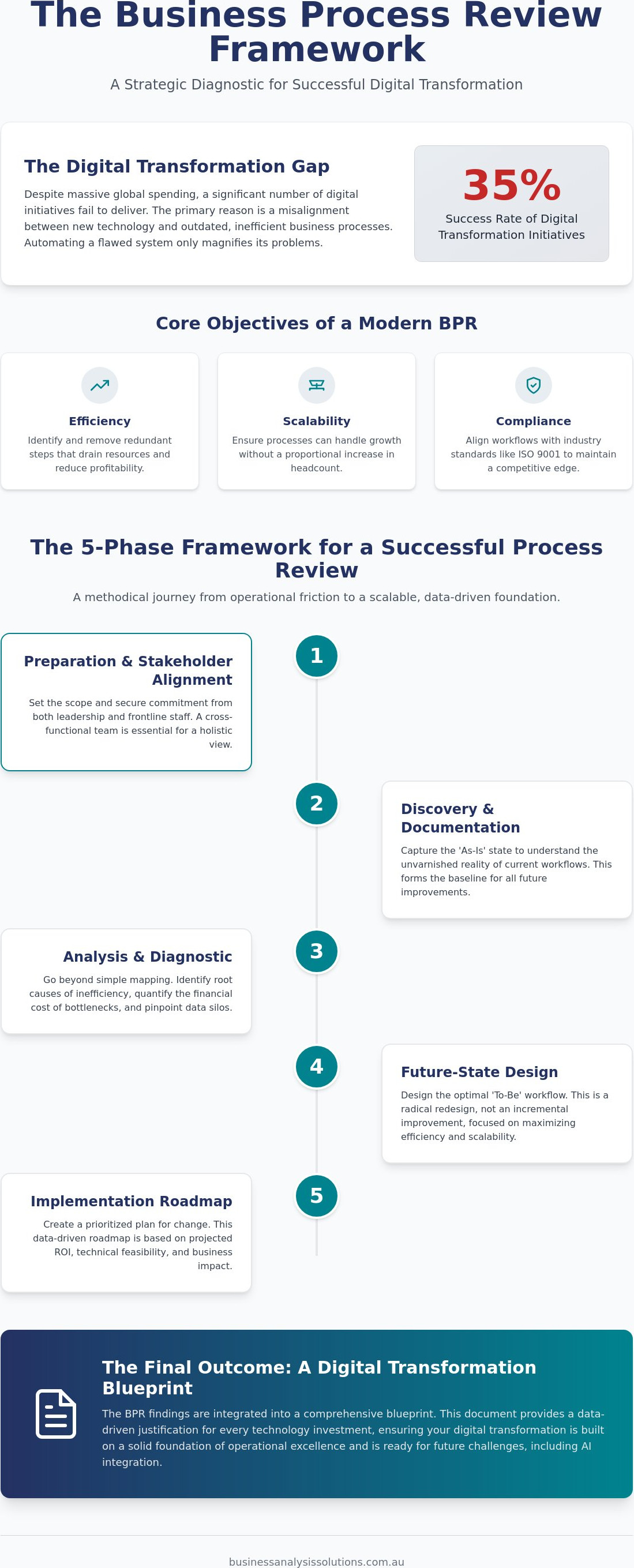
Despite global spending on digital transformation projected to reach $3.4 trillion by 2026, only 35% of these initiatives actually achieve their intended success. This significant gap often stems from a failure to align new technology with existing operational realities. Conducting a rigorous business process review for digital transformation is the most effective way to ensure your investment doesn't simply automate an inefficient system. In a competitive Australian market where high operational costs and legacy manual processes continue to squeeze margins, a logical diagnostic approach is a prerequisite for sustainable growth.
You likely recognise the friction caused by siloed data and the frustration of double-handling information across outdated platforms. It's a common challenge that creates uncertainty about which technologies actually solve specific problems. This article provides a methodical 5-phase framework designed to identify these bottlenecks and build a scalable foundation for your organisation. We will examine how to move from subjective observations to a data-driven roadmap that reduces manual effort and provides clear justification for every technology investment.
Table of Contents
Defining the Business Process Review (BPR) in a Modern Context
A business process review is a systematic, logical examination of your organisation's workflows designed to enhance quality, reduce friction, and improve overall efficiency. It goes beyond simple observation; it's a strategic diagnostic that uncovers the financial and operational risks hidden within your daily routines. In 2026, a business process review for digital transformation is no longer optional. It's the prerequisite for any technology investment that aims to deliver a genuine return on investment in the Australian market.
Many leaders confuse BPR with simple process mapping. While mapping is a valuable tool for visualisation, it only describes what is happening. BPR is the strategy that asks why it's happening and how it can be fundamentally improved. This distinction is rooted in the concept of Business process re-engineering, which advocates for the radical redesign of core business processes to achieve dramatic improvements in productivity and cycle times. Without this strategic layer, you risk simply digitising existing inefficiencies.
As we move through 2026, the primary driver for these reviews is AI-readiness. Artificial intelligence now accounts for over 28% of all digital spending, yet AI cannot function effectively on top of broken, manual workflows. Processes that are merely "good enough" act as silent killers of organisational profitability. They create invisible waste through data silos and redundant manual handling that erode margins over time. A rigorous business process review for digital transformation identifies these leakages before they are baked into new software systems.
The Core Objectives: Efficiency, Scalability, and Compliance
The primary goal of a modern BPR is to ensure your internal coordination is as lean as possible. This involves three critical pillars:
Efficiency: Identifying and removing redundant steps that drain human capital and financial resources. Every minute spent on double-handling data is a direct hit to your bottom line.
Scalability: Ensuring that as your business grows, your processes can handle increased volume without requiring a proportional increase in headcount.
Compliance: Aligning internal workflows with international standards, such as the ISO 9001:2026 update, to maintain a competitive edge in regulated industries.
When is Your Organisation Ready for a Review?
Recognising the signals for a review is essential for proactive management. Friction points, such as consistent delays in project delivery or high error rates in manual data entry, are clear indicators of systemic failure. Rapid growth often exposes the limitations of legacy processes that worked for a smaller team but fail under modern pressure. If you're preparing for a digital transformation blueprint for business, the review must be your first step. It provides the evidence-based insights needed to select the correct ICT solutions rather than guessing which tools might solve your problems.
The 5-Phase Framework for a Successful Process Review
Executing a business process review for digital transformation requires a structured, logical approach that bridges the gap between high-level strategy and granular operations. This isn't a casual audit; it's a methodical diagnostic designed to ensure that every technology investment serves a specific organisational objective. By following a five-phase framework, leaders can move from operational friction to a scalable, data-driven foundation.
Phase 1: Preparation and Stakeholder Alignment. Setting the scope and securing commitment from both leadership and frontline staff.
Phase 2: Discovery and Documentation. Capturing the 'As-Is' state to understand the honest reality of current workflows.
Phase 3: Analysis and Diagnostic. Identifying root causes of inefficiency and quantifying the cost of bottlenecks.
Phase 4: Future-State Design. Mapping the 'To-Be' optimised workflow without being limited by legacy constraints.
Phase 5: Implementation Roadmap. Creating a prioritised plan for change based on projected ROI and technical feasibility.
Phase 1 & 2: Setting the Foundation
The success of any review depends on the quality of the team involved. You need a cross-functional group that represents all organisational levels, from the executives who define the vision to the specialists who execute the daily tasks. Effective discovery isn't limited to reading old manuals. It involves interviews, direct observation, and data mining to see how work actually happens. A quantitative review of BPM research confirms that aligning these discovery efforts with broader business goals is a primary driver of project success. You must avoid the 'idealised process trap' by documenting the workarounds and manual fixes that staff use to bypass broken systems.
Phase 3: The Diagnostic Deep-Dive
Once you've documented the current state, you must apply a business efficiency lens to evaluate performance. This phase is where you identify waste in the context of Lean or Six Sigma principles, such as over-processing or unnecessary motion. It's critical to quantify the cost of inaction for every identified bottleneck. For example, if a manual data entry error costs A$75 in remedial labour and occurs 20 times a week, that represents an annual operational leak of A$78,000. These figures provide the objective justification needed for technology investment. If your team lacks the internal capacity to perform this level of scrutiny, a professional Business Efficiency Diagnostic can provide the clarity required to move forward with confidence.
Phase 4 & 5: Designing the Future and Mapping the Path
Designing the 'To-Be' state is about creating an optimal workflow that leverages modern ICT solutions. This isn't just about software; it's about reorganising how people and systems interact to deliver value. The final implementation roadmap then organises these changes into a logical sequence. We prioritise high-impact, low-complexity wins first to build momentum and prove the value of the business process review for digital transformation to the wider organisation. This ensures that the transition is steady, predictable, and firmly grounded in financial logic.
Analyzing the Gap: Moving from 'As-Is' to 'To-Be' States
The transition from current operational friction to a future-state digital harmony requires an uncompromising look at your existing workflows. This phase of the business process review for digital transformation focuses on the distance between your 'As-Is' state and your 'To-Be' vision. Without a clear understanding of this gap, technology investments often become expensive patches rather than transformative solutions. We begin by documenting the honest, unvarnished reality of current operations, including every manual workaround and spreadsheet-based silo that currently exists.
Once the current state is mapped, we design the 'To-Be' state. This is a logical exercise that defines what an optimal workflow looks like when freed from legacy technical constraints. The gap analysis then identifies the specific technological or structural changes required to move from the current reality to the future vision. Automation plays a critical role here, but it must be applied strategically to bridge efficiency gaps rather than simply speeding up a flawed process. It's about ensuring that every step in the new workflow adds measurable value to the organisation.
Identifying High-Impact Bottlenecks
Pinpointing where to focus your efforts is essential for a high ROI. We look specifically for handoff points between departments where data integrity is frequently lost or where double-handling occurs. Every manual step must be evaluated for its 'human-in-the-loop' necessity. If a task requires subjective professional judgement, it remains manual; if it involves repetitive data movement, it's a candidate for redesign. Prioritising these fixes based on an effort-to-impact ratio ensures that the most significant drains on human capital are addressed first. This logical prioritisation prevents the project from becoming bogged down in low-value micro-optimisations.
Designing for Automation Implementation
A fundamental rule of digital strategy is that you cannot automate a broken process. Following the 'garbage in, garbage out' principle, automating an inefficient workflow only results in faster inefficiency. During the design phase, we select processes that are ripe for Robotic Process Automation (RPA) or sophisticated workflow automation based on their stability and volume. It is vital that these new designs align with modern business technology standards to ensure long-term compatibility and security. By grounding the design in professional industry standards, you create a scalable foundation that supports the broader business process review for digital transformation objectives. This approach ensures that your technical requirements are driven by operational needs, not the other way around.
Critical Success Factors and Common Hurdles
Success in a business process review for digital transformation isn't guaranteed by software alone. It requires a rigorous focus on the environmental factors that either support or sabotage change. Securing executive buy-in is the most critical hurdle. If leadership views the review as a secondary IT task rather than a top-down strategic priority, the initiative will lack the authority needed to break down departmental silos. Change must be driven from the board level to ensure cross-departmental cooperation.
Data integrity represents another significant challenge. A review is only as effective as the metrics it analyses. If your baseline data is inaccurate or anecdotal, the resulting roadmap will be flawed. Leaders must ensure they're working with unvarnished operational facts rather than "best guess" estimates. Similarly, managing scope creep is essential for maintaining momentum. You must keep the review focused on high-value outcomes that directly impact your bottom line rather than getting lost in minor procedural adjustments that offer little ROI.
Overcoming Culture-Based Resistance
The human element often presents the most deep-seated resistance to change. Staff may perceive a business process review for digital transformation as a threat to their job security or a critique of their past performance. Overcoming this requires clear, transparent communication of the "Why" behind the project. When you frame the review as a tool for empowerment that removes tedious manual handling, you transform resistance into collaboration. Upskilling should be a core component of your implementation roadmap to ensure the team feels capable of operating within the new, optimised environment.
The Necessity of Professional Objectivity
Internal teams are often too close to their daily routines to see their own blind spots. They've lived with workarounds for so long that they no longer recognise them as inefficiencies. A professional consultancy provides the unbiased perspective needed to challenge the status quo without the baggage of internal politics. Leveraging 20+ years of cross-industry experience allows an external partner to identify non-obvious solutions that an internal team might miss. This objectivity ensures the diagnostic remains focused on logical outcomes and strategic performance.
To ensure your organisation's review is grounded in objective reality and professional standards, consider engaging an expert for a Business Efficiency Diagnostic.
Integrating BPR into Your Digital Transformation Roadmap
A business process review for digital transformation is the cornerstone of any successful modernisation programme. It's the diagnostic phase that ensures your Digital Transformation Blueprint is grounded in operational reality rather than technical aspiration. By identifying exactly where processes fail, you provide the necessary evidence to justify specific ICT solutions. This prevents the common mistake of purchasing software because of market trends rather than actual business needs. Every technical requirement must be a direct response to an identified operational friction point.
Viewing the review as a standalone task is a strategic error. Instead, it must be the first step in a logical sequence that moves from discovery to implementation. This approach ensures that your organisation isn't just buying tools, but is instead building a scalable foundation for future growth. In a competitive Australian market, this level of precision is what separates high-performing organisations from those that struggle with failed technology adoptions.
From Diagnostic to Blueprint
Findings from the review translate directly into technical specifications for automation. For instance, if the diagnostic identifies a high rate of manual reconciliation errors in accounts receivable, the technical requirement becomes a specific automated validation layer within your new ERP. This logical progression allows you to build a multi-year technology roadmap where every investment is prioritised by its ability to resolve a documented bottleneck. It ensures system harmony across your entire organisational architecture, preventing the creation of new digital silos that often occur when software is implemented in a vacuum.
Sustaining Efficiency with Strategic Leadership
Transitioning from a diagnostic to a fully implemented 'To-Be' state requires consistent, high-level oversight. This is where Fractional CIO services provide immense value for organisations that need expert guidance without the cost of a full-time executive. A strategic leader ensures that technology remains aligned with broader business objectives throughout the implementation phase. They help establish Key Performance Indicators (KPIs) to monitor the success of new workflows, ensuring that the promised efficiencies actually materialise in your financial performance.
Ultimately, a business process review for digital transformation is a cycle, not a one-time event. As market conditions evolve and your organisation grows, new friction points will inevitably emerge. Establishing a culture of process excellence means treating your workflows as living assets that require regular calibration. Efficiency is a moving target; staying ahead requires a commitment to continuous improvement and a willingness to re-examine your processes as your digital capabilities expand.
Securing Your Digital Future through Operational Excellence
Operational excellence in 2026 isn't achieved by chance. It's the result of a deliberate, methodical approach to understanding how your organisation functions at its core. By executing a business process review for digital transformation, you move beyond the uncertainty of manual legacy systems and build a roadmap grounded in financial logic. This structured framework identifies bottlenecks and ensures that every new technology investment serves a specific, documented purpose.
Bridging the gap between technical requirements and broader organisational objectives requires professional objectivity. With 20+ years of industry experience, our team specialises in using a logic-driven diagnostic framework to resolve complex coordination challenges. We provide the clarity and direction needed to achieve tangible value from your ICT solutions. If you're ready to eliminate operational friction and build a scalable foundation for growth, the path forward is clear.
Book a Business Efficiency Diagnostic with our expert consultants today. Taking this professional step ensures your digital journey is both predictable and profitable. Your organisation deserves a strategy that prioritises precision over guesswork.
Frequently Asked Questions
How long does a typical business process review take to complete?
A typical business process review generally takes between four and twelve weeks to complete. The exact timeframe depends on the organisational scope and the number of departments included in the diagnostic. A focused review of a single department might conclude within a month, whereas an enterprise-wide analysis requires more extensive documentation. This duration ensures we capture a representative sample of operational data and stakeholder feedback without rushing the analysis phase.
What is the difference between business process review and business process reengineering?
A business process review is an analytical diagnostic, while reengineering involves the radical redesign of those processes. The review identifies inefficiencies and documents the current state to understand where friction exists. Reengineering uses those findings to discard outdated methods and build entirely new workflows from the ground up. Think of the review as the strategic audit and reengineering as the structural transformation required to restore organisational health.
Do we need to pause our operations during a process review?
You don't need to pause your operations during the review process. Data collection occurs through structured interviews, direct observation, and non-intrusive data mining of existing systems. Professional analysts work in the background to ensure daily productivity remains unaffected. This approach allows the team to observe how work actually happens in a live environment rather than relying on an idealised version of events that doesn't reflect reality.
How much does a professional business process review cost?
The cost of a professional business process review for digital transformation varies based on the complexity of your systems and the depth of the required analysis. Most consultancies in the Australian market use either a fixed-fee project model or an hourly rate structure. While the total investment depends on the size of the organisation, the cost is typically justified by identifying significant operational waste and preventing the high price of failed technology implementations.
What are the most common signs that my business needs a process review?
Common indicators include frequent double-handling of data, rising operational costs without a corresponding increase in output, and persistent data silos. If staff are using complex spreadsheets to bypass your primary systems, it's a clear sign of systemic failure. A business process review for digital transformation is also essential if you're experiencing high error rates or if your current workflows can't scale to meet your 2026 growth targets.
Can we conduct a business process review internally without consultants?
While you can conduct a review internally, internal teams often miss blind spots due to their familiarity with existing workarounds. Employees might also feel hesitant to be completely honest about inefficiencies if they fear it reflects poorly on their department. An external partner provides an objective, logical perspective and brings cross-industry benchmarks that an internal team simply wouldn't possess, ensuring the final roadmap is grounded in professional standards.
What tools are used for business process mapping and review in 2026?
In 2026, we utilise process mining software and AI-driven documentation tools to capture workflows with high precision. These technologies allow for evidence-based analysis by extracting data directly from your event logs to see where delays occur. We also use cloud-based BPM platforms to facilitate real-time collaboration between stakeholders. These tools move beyond static diagrams to create dynamic models that can be tested and simulated before any technical implementation begins.
How do we measure the ROI of a business process review?
ROI is measured by comparing pre-review benchmarks against the performance metrics of the optimised 'To-Be' state. Key indicators include the reduction in manual labour hours, decreased error remediation costs, and improved cycle times for core business activities. By quantifying the financial impact of these improvements, you can provide a data-driven justification for the review and ensure that every subsequent technology investment delivers a measurable return on capital.



Comments