How to Conduct a Business Process Review: A Strategic Guide to Operational Efficiency
- jonesaqayalo
- Jun 29
- 12 min read
A business process review isn't a simple technical audit; it's a strategic diagnostic that bridges the gap between daily operations and long-term organizational objectives. If you've ever felt that your team's working harder just to maintain the status quo while operational bottlenecks cause delays and data double-handling, you aren't alone. Learning how to conduct a business process review is the first step toward reclaiming visibility into how work actually gets done. It's frustrating when high error rates persist despite having the right people in place, but these issues are usually symptoms of a fragmented system rather than individual performance.
You'll master a methodical framework for evaluating and optimizing your internal workflows to drive measurable organizational performance. By following this guide, you'll gain a clear roadmap for improvement that reduces operational costs and aligns your technology with your business objectives. We'll explore the transition from subjective analysis to evidence-based process mining, ensuring your operations meet the latest standards like the upcoming ISO 9001:2026 revisions and the 2026 COSO guidance on enterprise risk management. This approach provides the clarity and direction needed to transform complex organizational challenges into streamlined, high-performance systems.
Table of Contents
The Strategic Necessity of a Business Process Review
A Business Process Review (BPR) serves as a methodical evaluation of workflows to ensure they remain aligned with organizational goals. It isn't a casual observation of daily tasks; it's a rigorous analysis of how value moves through a business. Understanding how to conduct a business process review is essential for leaders who want to move beyond surface-level observations to achieve genuine operational excellence. Historically, this concept is rooted in Business process re-engineering, which emphasizes the fundamental rethinking of operations to achieve dramatic improvements in performance metrics like cost, quality, and speed.
This evaluation acts as the essential foundation for any digital transformation blueprint for business. Without a clear understanding of current workflows, implementing new technology often digitizes existing inefficiencies rather than solving them. The primary objective is to eliminate waste while simultaneously increasing output quality. By isolating non-value-add activities, organizations create a leaner operational model that supports sustainable growth and better resource allocation.
Many organizations fall into the trap of "symptom-fixing," where they address isolated delays with temporary workarounds or additional headcount. This reactive approach lacks the depth of a formal business efficiency diagnostic. A comprehensive review provides the data-driven insights needed to resolve the root causes of friction, ensuring that improvements are structural and permanent. It shifts the focus from fire-fighting to strategic management.
When to Initiate a Process Diagnostic
Timing is critical for maintaining a competitive edge. Leaders should trigger a diagnostic when key performance indicators (KPIs) begin to stagnate or decline despite increased effort. Another red flag is the frequent occurrence of hand-off errors between departments, which suggests that communication protocols are failing. Additionally, if you're preparing to scale or implement new ICT solutions, knowing how to conduct a business process review ensures your infrastructure supports your future state rather than hindering it.
The ROI of Procedural Clarity
The return on investment for procedural clarity is often found in the reduction of "hidden" costs. Data double-handling and redundant approvals consume significant resources that don't always appear on a balance sheet but directly erode profitability. Beyond financial metrics, a structured review improves employee morale by removing the friction that causes daily frustration. It establishes the precise logic required for successful automation implementation, ensuring that your systems work in harmony with your people to deliver consistent, high-quality results.
The Anatomy of a Process: What You Are Reviewing
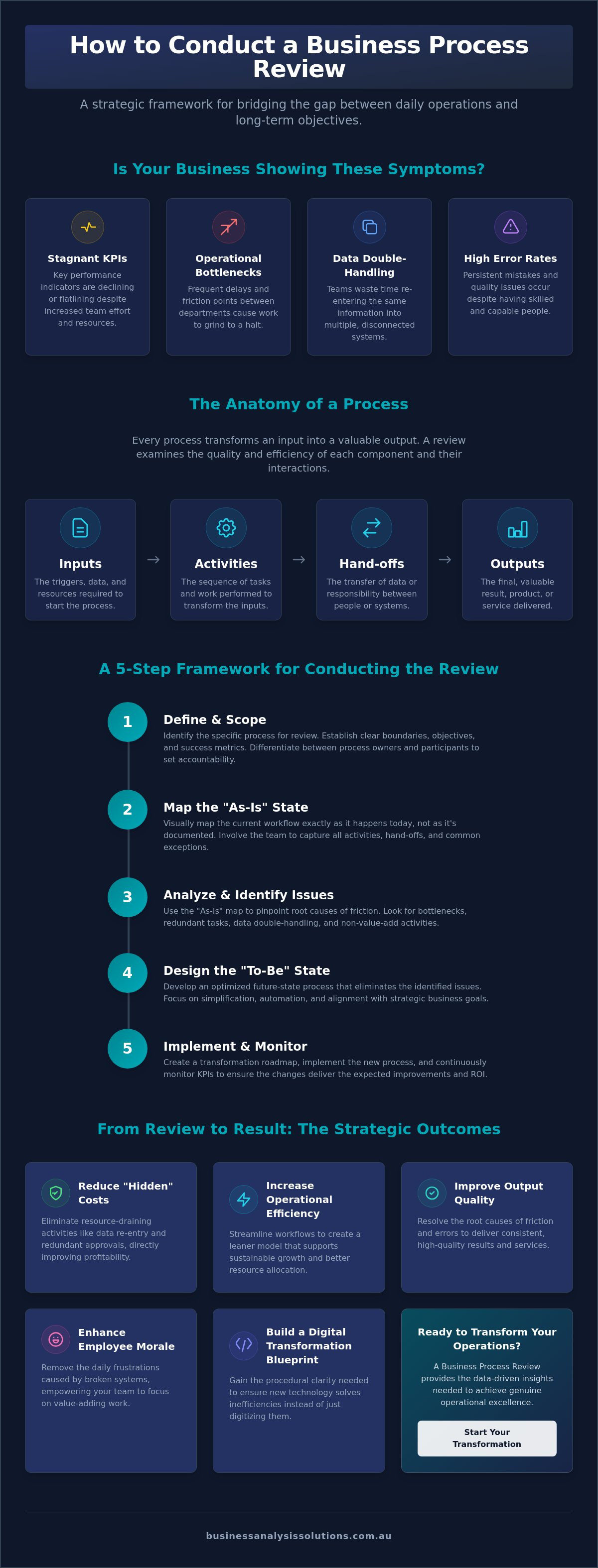
A process is a sequence of related tasks that transform a specific input into a valuable output. To understand how to conduct a business process review, you must first deconstruct these workflows into their constituent parts. Every process consists of four primary components: inputs (the triggers or data required), activities (the actual work performed), hand-offs (the transfer of responsibility), and outputs (the final result). While many organizations focus solely on activities, the real value of a review lies in examining how these elements interact. If the inputs are low quality, the activities will always struggle to produce a high-quality output.
Visualizing these interactions through business process mapping provides the necessary transparency to identify structural flaws. This visual language exposes "exceptions"—those non-standard requests that derail standard workflows. If your team spends a significant portion of their time managing edge cases, your process isn't just inefficient; it's broken. By following established 13 strategies to review and improve business processes, you can ensure these exceptions are either standardized or eliminated to maintain operational flow.
Identifying Roles and Responsibilities
A successful review distinguishes between Process Owners, who are accountable for the end-to-end outcome, and Process Participants, who execute specific tasks. We use RACI charts (Responsible, Accountable, Consulted, Informed) to clarify these distinctions. This exercise often uncovers "shadow roles" where staff perform undocumented tasks outside their job descriptions to compensate for system gaps. High personnel turnover frequently exacerbates these issues, as tribal knowledge vanishes and leaves the process unstable. If you're seeing these symptoms, a professional business efficiency diagnostic can help formalize these roles and secure your operational knowledge.
Analyzing Hand-off Points and Bottlenecks
A hand-off occurs whenever information or a task moves between different people, departments, or software systems. These are the most common points of failure in any workflow. Miscommunication or data loss during a hand-off creates delays that ripple through the entire organization. Identifying bottleneck steps is equally critical. These are the stages where the volume of work exceeds the capacity to process it, effectively dictating the speed of the entire operation. When you learn how to conduct a business process review, your goal is to synchronize these hand-offs and widen bottlenecks to ensure a smooth, predictable flow of work across the entire enterprise.
Mapping the "As-Is" vs. the "To-Be" State
The core of any operational transformation lies in the transition from the current reality to a future vision. Documenting the "As-Is" state requires an unvarnished look at how work currently flows through the organization, including every bottleneck and manual workaround. This phase isn't about how the process appears in an outdated manual; it's about the messy, lived reality of the staff. Once this foundation is established, we design the "To-Be" state, which represents the optimal workflow aligned with your strategic goals. Learning how to conduct a business process review effectively means mastering the "Gap Analysis," the analytical bridge that identifies exactly what must change to move from the current state to the desired one.
This transition must remain grounded in project management reality. It's easy to design an idealistic "To-Be" model that looks perfect on paper but fails during implementation because it ignores resource constraints or cultural resistance. By applying proven strategies for reviewing business processes, leaders can ensure their future-state designs are both ambitious and achievable. This disciplined approach prevents the common pitfall of over-engineering solutions that the organization lacks the capacity to maintain.
The "As-Is" Discovery Process
Discovery requires a multi-faceted approach to data gathering. We utilize system logs for objective timing, but human observation and interviews remain indispensable. It's vital to interview the personnel actually executing the tasks rather than just their managers. Frontline staff often reveal "unofficial" steps—shadow processes they've created to bypass broken systems or bridge gaps in software functionality. Documenting these workarounds is essential; they often highlight the exact areas where your current infrastructure is failing. This level of detail ensures that your understanding of how to conduct a business process review is based on evidence rather than assumptions.
Designing the "To-Be" Framework
Designing the future state involves prioritizing improvements based on an effort-versus-impact matrix. High-impact, low-effort changes should be addressed immediately to build momentum. The new framework must incorporate modern business technology that automates redundant tasks and provides real-time visibility. However, technology is only one component. The design must also ensure continued compliance with evolving industry standards, such as the ISO 9001:2026 revisions scheduled for publication in September 2026. A robust "To-Be" state balances technical efficiency with the rigorous risk management and ethical standards expected in a modern professional environment.
A 5-Step Framework for Conducting the Review
Executing a successful operational audit requires a disciplined sequence of events. When organizations understand how to conduct a business process review, they move from chaotic firefighting to a structured environment of continuous improvement. This framework ensures that every effort is linked to a specific, measurable outcome. It prevents the common mistake of jumping straight into software solutions before the underlying logic of the workflow is sound.
Step 1: Define Scope and Objectives. We establish clear boundaries to prevent the scope creep that often stalls major initiatives. This ensures the review stays focused on high-impact areas.
Step 2: Stakeholder Engagement and Discovery. Building trust with the team ensures they feel safe sharing where the system actually fails. This transparency is vital for gathering accurate data.
Step 3: Analysis and Identification of Inefficiencies. This is the diagnostic phase where we isolate the root causes of delays, such as redundant approvals or manual data entry.
Step 4: Redesign and Validation. New workflows are designed and testing the new process on paper allows for validation without the risk of immediate system downtime.
Step 5: Roadmap and Implementation Planning. Turning the review into action requires a sequenced plan that balances technical requirements with organizational capacity.
Establishing the Review Scope
Precision at the start of the project saves significant resources later. We distinguish between critical processes, which directly impact revenue or customer experience, and supporting processes that facilitate internal administration. Setting measurable success criteria, such as a 20% reduction in cycle time or a 15% decrease in error rates, provides a clear benchmark for performance. Securing executive buy-in before the discovery phase begins is a prerequisite for success; without leadership support, the necessary changes won't have the authority to take root. If you aren't sure where to begin, a professional Business Efficiency Diagnostic can help identify which workflows offer the highest return on investment.
Stakeholder Engagement Strategies
Resistance to change is a natural response to a process review, but it's often rooted in a fear of being blamed for existing inefficiencies. Overcoming this requires transparent communication that frames the review as an effort to improve the system, not to critique the individuals. We conduct workshops that encourage honest feedback by focusing on the friction points that make staff's jobs harder. Discovery workshops are the primary tool for capturing tacit knowledge and understanding the nuanced reality of how tasks are performed. By involving stakeholders early, you don't just gather better data; you build the advocacy needed for the eventual implementation phase. This collaborative approach ensures that the "To-Be" state is something the team actually wants to use.
From Review to Result: Implementing the Transformation
The transition from analysis to action is the most critical phase of operational optimization. While knowing how to conduct a business process review provides the necessary insights, the actual value is locked within the implementation. This stage converts theoretical models into functional workflows that deliver tangible results. It requires a disciplined approach to change management, ensuring that new processes are adopted across the organization without disrupting core service delivery. Implementation isn't merely the end of a project; it's the start of a more efficient operational era.
A comprehensive review serves as the primary data source for a Digital Transformation Blueprint. This strategic document outlines the sequence of technology investments and process changes required over a multi-year horizon. By grounding the blueprint in the findings of the review, leaders ensure that every ICT investment directly supports an optimized workflow. This prevents the common error of deploying technology in search of a problem. Instead, it facilitates a targeted automation implementation that eliminates manual redundancies and improves data accuracy across the enterprise.
It's vital to remember that a process review is a cycle of continuous improvement rather than a one-off event. As market conditions shift and organizational goals evolve, the "To-Be" state of today will eventually become the "As-Is" state of tomorrow. Maintaining this momentum requires a commitment to regular audits and a culture that values operational precision. Mastering how to conduct a business process review as a repeatable discipline ensures your organization remains agile and resilient in the face of technical or regulatory changes.
Integrating Technology Solutions
Effective implementation prioritizes software that fits the process, rather than forcing your team to adapt to a tool's limitations. During system migrations, maintaining data integrity is paramount to ensure that the logic established during the review isn't compromised by poor information quality. New tools should also be selected based on their ability to provide the analytics needed for future reviews. This creates a feedback loop of performance data that allows for real-time verification of financial data and control effectiveness, aligning with the 2026 trends toward continuous monitoring.
The Role of Executive ICT Leadership
Complex organizational changes often require a level of strategic oversight that internal teams might lack. A Fractional CIO provides this high-level leadership, bridging the gap between technical requirements and broader business objectives. This role ensures that the implementation remains aligned with the original vision and that technical hurdles don't derail the strategic outcome. By providing an objective perspective, an executive ICT leader helps maintain the momentum needed to turn a process review into a permanent competitive advantage. They ensure that the shift from documentation-heavy programs to agile, decision-led practices is successful and sustainable.
Achieving Sustainable Operational Excellence
Transitioning from reactive symptom-fixing to a proactive, evidence-based culture is the primary benefit of a formal review. By deconstructing workflows into inputs, activities, and hand-offs, you gain the visibility required to eliminate structural waste. Mastering how to conduct a business process review ensures that your organization remains aligned with both technical requirements and broader business objectives. This methodical approach transforms complex organizational challenges into a clear roadmap for improvement, reducing costs while increasing output quality.
A structured review serves as the essential foundation for any long-term digital strategy. To ensure your transformation is grounded in logic and performance, Book a Business Efficiency Diagnostic with our expert consultants. With over 20 years of industry experience, we specialize in bridging the gap between technical and business requirements through our proven Digital Transformation Blueprint methodology. Your operations can become a source of competitive advantage when you treat process optimization as a continuous journey of refinement.
Frequently Asked Questions
How long does a typical business process review take to complete?
A typical review usually requires between four and twelve weeks to complete depending on the organizational scope. A single department workflow might be resolved in a month, whereas an enterprise-wide diagnostic often spans a full quarter. This timeline includes the initial discovery phase, stakeholder workshops, and the final delivery of a transformation roadmap. The complexity of your current systems and the availability of key stakeholders are the primary factors that dictate the total duration.
What is the difference between a business process review and a business process audit?
A business process review focuses on optimization and efficiency while an audit prioritizes compliance and adherence to existing standards. While an audit verifies that the team is following the current rules, the review questions whether those rules are still effective. The review is a strategic tool for driving performance, whereas the audit is a tactical measure for ensuring risk management and regulatory alignment. Both are essential for maintaining a high-performance operational environment.
Can we conduct a business process review internally or should we hire a consultant?
Organizations can conduct reviews internally, but hiring an external consultant provides the objectivity needed to challenge established norms. Internal teams often struggle to identify shadow processes because they're too close to daily operations. A professional consultant brings a structured framework for how to conduct a business process review, ensuring that the final recommendations are based on industry standards rather than internal politics. This external perspective is vital for uncovering hidden inefficiencies.
How do we measure the success of a business process review?
Success is measured through specific, quantifiable key performance indicators established during the scoping phase. Common metrics include a reduction in process cycle time, lower error rates, and decreased operational costs per transaction. We also evaluate the alignment between technology and business objectives, ensuring that the new workflows have successfully eliminated previous bottlenecks and data double-handling issues identified during the diagnostic. These metrics provide a clear baseline for future performance monitoring.
Which processes should we prioritise for review first?
Prioritize high-volume processes that directly impact customer experience or revenue generation. Workflows with known high error rates or those that consume significant manual resources also offer a high return on investment. By focusing on these critical areas first, you can demonstrate immediate value and build the organizational momentum required for more complex initiatives. This targeted approach ensures that your resources are allocated to the areas with the greatest strategic impact.
What are the most common mistakes made during a process review?
The most frequent errors include allowing scope creep to expand the project beyond manageable boundaries and failing to engage frontline staff during discovery. If you only interview managers, you'll miss the unofficial workarounds that define the actual workflow. Another common mistake is designing a "To-Be" state that is too complex for the organization to maintain without excessive technical support. Precision and inclusivity are the best defenses against these common pitfalls.
How often should a business conduct a process review?
Most organizations should perform a major review every two to three years or whenever a significant strategic shift occurs. However, smaller tactical reviews should happen more frequently as part of a continuous improvement cycle. Regular audits ensure that your operations remain resilient against market shifts and that your how to conduct a business process review methodology stays current with evolving standards like ISO 9001. This consistency prevents the gradual accumulation of operational waste.
Does a process review always lead to new software purchases?
A process review doesn't always necessitate new software; it often reveals that existing tools are being underutilized or used incorrectly. Many efficiencies are found by simply realigning human tasks or removing redundant approval steps. While technology is a powerful enabler, the primary goal is to optimize the underlying logic of the workflow before considering any additional automation or ICT investments. The review ensures that your current infrastructure is performing at its maximum capacity.



Comments