How Digital Transformation Improves Business Efficiency: The 2026 Strategic Framework
- jonesaqayalo
- May 31
- 12 min read
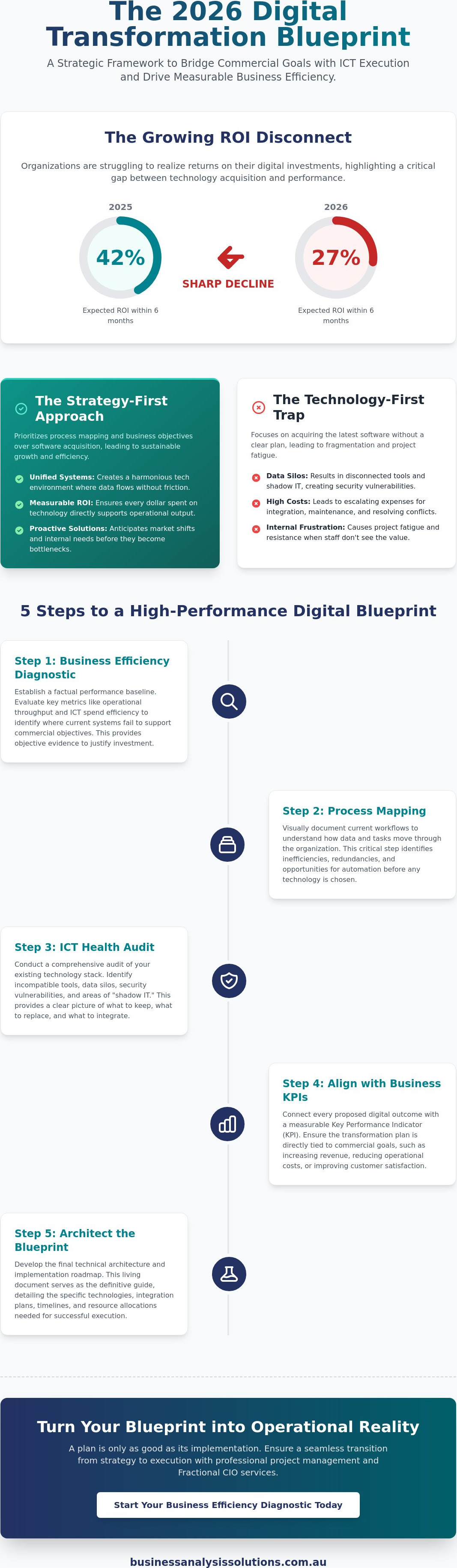
In 2026, only 27% of organisations expect to see a return on their digital transformation investment within six months, according to TEKsystems. This sharp decline from 42% in 2025 highlights a growing disconnect between technology acquisition and actual performance. You've likely experienced the friction caused by fragmented tech stacks that fail to communicate, leading to high costs and internal frustration. It's a common challenge when ICT solutions are deployed without a clear roadmap. Understanding how digital transformation improves business efficiency requires moving beyond the hype of agentic automation and focusing on system harmony.
We agree that a digital strategy should deliver measurable value rather than just adding complexity. You'll discover a methodical framework designed to eliminate operational friction and drive tangible results through a diagnostic-led approach. This article provides a clear roadmap for your 2026 ICT investments, moving from high-level process mapping to granular automation implementation. We'll explore how to bridge the gap between business objectives and technical execution to ensure your digital transformation blueprint is both scalable and effective for the Australian market.
Key Takeaways
Understand how a Digital Transformation Blueprint serves as the essential bridge between your commercial objectives and ICT execution in the 2026 landscape.
Discover the role of a Business Efficiency Diagnostic in establishing a factual performance baseline before committing to significant technology investments.
Learn how digital transformation improves business efficiency by adopting a strategy-first approach that prioritises process mapping over software acquisition.
Identify the five critical steps for auditing ICT health and aligning digital outcomes with measurable Australian market KPIs.
Explore how Fractional CIO services and professional project management ensure a seamless transition from strategic planning to operational reality.
Table of Contents
What is a Digital Transformation Blueprint in 2026?
A digital transformation blueprint is a technical architecture that aligns your commercial goals with specific ICT execution. It isn't a static document or a simple wishlist of new software. Instead, it's a strategic framework that ensures every dollar spent on technology directly supports operational output. To understand What is Digital Transformation? in a modern context, one must move beyond the idea of simple digitisation. In 2026, the focus has shifted toward creating a unified environment where data flows without friction across the entire organisation.
This structured approach is central to how digital transformation improves business efficiency. While many organisations previously focused on basic cloud migration, the 2026 standard demands AI-readiness and deep data harmony. A results-driven digital transformation blueprint for business moves away from reactive troubleshooting. It prioritises proactive strategic technology solutions that anticipate market shifts and internal needs before they become bottlenecks.
The Evolution of Digital Strategy
Legacy digital plans often failed because they were siloed and rigid. Modern blueprints are agile; they accommodate rapid AI advancements by building modular systems rather than monolithic ones. We've moved from purchasing disconnected software to architecting integrated ecosystems. This coordination ensures that your business analysis and process mapping efforts aren't wasted on incompatible tools. A blueprint is a living document that serves as the definitive guide for organisational coordination.
Why Businesses Fail Without a Blueprint
The financial risks of uncoordinated technology procurement are significant. Without a structured plan, organisations often fall victim to shadow IT, where individual departments purchase software that doesn't integrate with the core stack. This creates data silos and security vulnerabilities that are costly to resolve. Research from Integrate.io indicates that by 2026, 90% of organisations will face IT skills shortages, making efficient resource allocation and system harmony even more critical.
A lack of structure leads to project fatigue. When stakeholders don't see a clear connection between a new tool and their daily workflow, resistance grows. A blueprint acts as the primary tool for mitigating ICT project failure by providing the clarity needed to keep teams aligned. By establishing a factual baseline through a Business Efficiency Diagnostic, you can avoid the high costs of failed IT projects and ensure your ICT solutions deliver a measurable return on investment.
Core Components of an Effective Digital Blueprint
Moving from concept to execution requires a granular focus on the structural elements that sustain performance. A blueprint's efficacy relies on its ability to harmonise technical requirements with operational reality. This begins with a robust data architecture that establishes one version of truth across the organisation, eliminating the conflicting reports that plague fragmented environments. In the Australian regulatory environment of 2026, security and compliance are not merely defensive measures; they are non-negotiable pillars that ensure system integrity and protect commercial reputation. A unified architecture prevents the emergence of shadow IT by providing a centralised framework for all ICT solutions, ensuring every department operates from the same reliable dataset.
The Business Efficiency Diagnostic
Credible initiatives begin with data, not assumptions. A Business Efficiency Diagnostic serves as the prerequisite step for any strategic shift. It establishes a factual baseline by evaluating key performance indicators such as operational throughput and ICT spend efficiency. This diagnostic phase uncovers precisely how digital transformation improves business efficiency by highlighting where current systems fail to support commercial objectives. It provides the objective evidence needed to justify investment in business efficiency, ensuring that every subsequent action is rooted in logic rather than trend-chasing. For those ready to move beyond fragmented systems, a professional Business Efficiency Diagnostic offers the clarity required to begin.
Process Mapping and Automation Alignment
Technology applied to a broken process only accelerates failure. This is why process mapping is an essential component of a professional blueprint. By documenting current-state workflows, we identify hidden bottlenecks that hinder productivity and inflate operational costs. This clarity allows for the identification of high-ROI tasks suitable for initial automation implementation. When processes are streamlined before technology is introduced, the transition to automated systems is seamless and predictable. This methodical sequence is fundamentally how digital transformation improves business efficiency in a sustainable way. Organisations that skip this step often find themselves managing a digitised version of their original inefficiencies, leading to project fatigue and wasted capital.
Successful implementation requires a clear link between streamlined processes and the tools chosen to manage them. By focusing on automation alignment during the mapping phase, leadership can ensure that ICT investments solve specific, identified friction points. This approach prioritises the resolution of complex organisational challenges through a structured, methodical approach that delivers tangible value across the entire enterprise.
Strategy-First vs. Technology-First Approaches
Executives often question the necessity of a dedicated strategy phase, citing a preference for immediate software deployment. This technology-first approach assumes that modern tools possess inherent problem-solving capabilities. In reality, purchasing software to fix operational friction without a clear roadmap often compounds existing issues. A strategy-first approach is the primary method for ensuring how digital transformation improves business efficiency. It moves the focus from what you're buying to why you're changing, ensuring that every ICT solution is fit-for-purpose and commercially aligned.
While the initial investment in a Digital Strategy might seem like an additional expense, it significantly lowers the Total Cost of Ownership (TCO). By identifying redundancies and ensuring system harmony from the outset, organisations avoid the high costs of failed IT projects and the need for expensive post-implementation fixes. Investing in high-level business technology requires a disciplined focus on outcomes rather than features. This logical sequence ensures that capital is allocated to solutions that drive measurable performance improvements.
The Technology-First Trap
Feature-rich software often goes underutilised because it lacks a strategic framework to guide its application. When organisations fall into the technology-first trap, they frequently succumb to the sunk cost fallacy, continuing to fund legacy ICT systems that no longer serve their needs. It's a common scenario where the business adapts to the limitations of the software rather than the software enabling the business. Technology must serve the business objectives; it should never dictate them. Without this distinction, digital initiatives become a series of expensive experiments rather than a cohesive strategy for growth.
Building for Scalability and Agility
A strategy-first blueprint provides the foundation for long-term scalability. It allows for the seamless adoption of emerging technologies, such as Microsoft Copilot or agentic automation, because the underlying data architecture is already optimised. By maintaining vendor-neutrality during the blueprinting phase, leadership ensures they aren't locked into proprietary ecosystems that may become obsolete. This flexibility is essential for maintaining a competitive edge in the Australian market. Aligning ICT investment with long-term commercial goals ensures that your digital infrastructure remains an asset rather than a liability. This methodical coordination is exactly how digital transformation improves business efficiency, providing the agility needed to pivot as market conditions evolve.
Developing a Digital Transformation Blueprint: 5 Steps
The transition from strategic theory to operational reality requires a repeatable, five-step process. Each stage builds upon the previous one to ensure the final Digital Transformation Blueprint is both actionable and resilient. This structured approach is the definitive method for how digital transformation improves business efficiency, as it removes the ambiguity that often plagues large-scale ICT investments. By following a logical sequence, leadership can ensure that capital is allocated to the highest-impact areas first.
Step 1: The Discovery Phase
The foundation of a successful blueprint is an objective assessment of your current environment. Engaging external eyes during this audit is vital for identifying blind spots that internal teams may overlook. We focus on uncovering technical debt, which represents the implied cost of future rework caused by choosing an easy solution now instead of a better approach that takes longer. By interviewing stakeholders across different departments, we gain a comprehensive view of how data actually moves through the organisation, rather than how it's assumed to move. This discovery phase ensures the subsequent roadmap is built on facts rather than assumptions.
Step 2: Defining Your Digital Vision & Strategic Objectives
Once the current landscape is understood, the next critical step is to articulate a clear digital vision. This involves aligning digital outcomes with commercial KPIs, ensuring technology serves specific business objectives. Leadership must define what success looks like in 2026 and beyond, setting measurable strategic objectives that guide all subsequent decisions. This step clarifies precisely how digital transformation improves business efficiency by establishing a clear target state, preventing investments from becoming disconnected from core organisational goals.
Step 3: Conducting a Comprehensive Gap Analysis & Solution Design
With a clear vision in place, a comprehensive gap analysis identifies the specific distance between your current state (from Step 1) and your 2026 objectives (from Step 2). This phase pinpoints where current capabilities fall short. From these identified gaps, specific ICT solutions and initiatives are designed, outlining high-level requirements for new systems, processes, and technologies needed to bridge discrepancies. This analytical approach ensures every proposed solution directly addresses a defined need, providing a clear target for each project.
Step 4: Prioritising Your Roadmap
Once the gap analysis is complete and solutions are designed, initiatives must be organised into a logical sequence. This involves balancing immediate operational needs with the long-term vision. We categorise ICT initiatives based on their potential ROI and technical complexity to ensure the roadmap is sustainable:
Quick Wins: Low-complexity automation implementation that delivers immediate time savings and builds project momentum.
Strategic Foundations: Essential ICT solutions, like data centralisation, that enable future scalability and system harmony.
Operational Optimisation: Deep process mapping to resolve complex, cross-departmental friction and reduce overheads.
Innovation Projects: High-value AI integration that provides a competitive edge in the Australian market.
Balancing budget constraints with the need for systemic change requires a disciplined approach to roadmap construction. By prioritising projects by impact and technical dependency, leadership can demonstrate progress to stakeholders while building the infrastructure necessary for 2026 and beyond. This methodical prioritisation is exactly how digital transformation improves business efficiency over the long term.
Step 5: Establishing Governance & Execution Frameworks
The final step in developing your Digital Transformation Blueprint is to establish a robust governance and execution framework. This sets the rules for implementation, defining accountability, roles, responsibilities, and performance metrics for all initiatives. A clear governance structure ensures projects stay on track, resources are optimally allocated, and outcomes are continuously monitored against strategic objectives. This ensures the blueprint remains a living document that guides organisational coordination and adaptation. Robust governance ensures the sustained impact of how digital transformation improves business efficiency. For leadership teams seeking to initiate this process, our Digital Transformation Blueprint services at Business Analysis & Solutions provide the structured guidance needed to achieve measurable results.
Implementation: From Blueprint to Operational Reality
A strategic blueprint only provides value when it's translated into functional operations. Moving from the planning phase to execution requires disciplined project management that understands the specific nuances of ICT integration. This stage is often where the most significant friction occurs, as internal teams struggle to balance daily responsibilities with the demands of systemic change. Professional oversight ensures that the original vision isn't compromised during the technical rollout. This disciplined transition is fundamentally how digital transformation improves business efficiency, as it turns high-level objectives into measurable operational gains across the entire enterprise.
The Role of the Fractional CIO
Complex blueprints require executive oversight to maintain momentum and ensure technical decisions align with commercial goals. For many Australian SMEs, hiring a full-time executive is financially impractical. Fractional CIO services offer a logical alternative, providing on-demand leadership that ensures the transformation remains a priority. These professionals act as a bridge, translating technical requirements into a language the boardroom understands. They provide the objective distance needed to resolve roadblocks and keep the project on track without the high overhead of a permanent hire. This model allows businesses to access senior strategic expertise exactly when it's needed most.
Ensuring Long-Term System Harmony
System harmony isn't a one-time achievement; it's a continuous state that requires regular maintenance and assessment. Iterative reviews are essential to ensure the blueprint stays relevant as Australian market conditions and regulations shift. Measuring the ROI of your transformation against the original diagnostic baseline allows leadership to validate their investment and identify areas for further optimisation. In the 2026 landscape, this includes monitoring how well AI agents are performing and ensuring data remains compliant with evolving privacy standards. Post-implementation support focuses on continuous process improvement, ensuring that gains in productivity aren't lost to technical debt or process decay over time.
Business Analysis & Solutions serves as the analytical collaborator needed to bridge the gap between strategic vision and tangible results. We provide the expertise required to manage the granular details of automation implementation and system coordination. Our approach ensures that your ICT solutions are not just installed, but fully integrated into your workflow. If you're ready to move beyond fragmented technology and establish a clear roadmap for 2026, we invite you to book a Business Efficiency Diagnostic. Let's begin the journey of transforming your operational friction into a scalable, efficient future that delivers a clear return on investment.
Architecting Your Operational Future
Successful organisational coordination in 2026 depends on a shift from reactive technology adoption to proactive strategic planning. By prioritising a diagnostic-led approach, leadership ensures that every ICT investment resolves specific friction points rather than adding to existing complexity. This methodical framework is fundamentally how digital transformation improves business efficiency, providing a clear path from identified bottlenecks to scalable automation implementation. Bridging the gap between commercial goals and technical execution requires more than just new tools; it requires a disciplined roadmap.
With over 20 years of industry experience, Business Analysis & Solutions specialises in aligning technical requirements with broader commercial objectives. Our specialised Business Efficiency Diagnostics provide the factual baseline required to justify investment and drive system harmony. We offer the precision needed to turn complex organisational challenges into predictable, high-performance outcomes. Don't let fragmented systems hinder your progress. You can Request a Digital Transformation Blueprint for Your Business to begin architecting a more resilient and efficient operational reality. We're ready to help you achieve measurable results.
Frequently Asked Questions
What is the difference between a digital strategy and a digital transformation blueprint?
A digital strategy defines your high-level commercial objectives and the role technology plays in achieving them. In contrast, a digital transformation blueprint is the granular technical roadmap that dictates exactly how to implement those goals. The strategy identifies the commercial "why", while the blueprint provides the architectural "how" to ensure system harmony across your organisation.
How long does it typically take to develop a digital transformation blueprint?
Developing a comprehensive blueprint usually requires four to twelve weeks depending on the complexity of your current environment. This timeframe allows for a deep discovery phase, stakeholder interviews, and thorough process mapping. Smaller Australian organisations with fewer legacy systems may complete the process faster, while enterprises with fragmented tech stacks require the full duration to ensure accuracy.
Does my business need to be a certain size to benefit from a digital blueprint?
Any organisation managing complex workflows or multiple software platforms benefits from a structured plan. While larger enterprises often have significant technical debt, SMEs find that a blueprint prevents expensive procurement errors and ensures scalability. Business size is less important than the desire to eliminate operational friction and align ICT solutions with commercial growth.
How often should a digital transformation blueprint be updated?
You should review and update your blueprint annually or whenever major market shifts occur. In 2026, rapid advancements in agentic automation and new international privacy regulations require more frequent tactical adjustments. Regular reviews ensure your technology remains fit-for-purpose and compliant with evolving Australian standards, preventing your digital infrastructure from becoming obsolete or insecure.
Can we develop a blueprint internally without external consultants?
Internal teams often lack the objective distance and specialised diagnostic tools required to identify deep-seated inefficiencies. External consultants provide a factual baseline and cross-industry experience that prevents internal biases from influencing the final roadmap. This objectivity is vital to how digital transformation improves business efficiency, as it ensures the plan is based on data rather than internal politics.
What are the most common reasons digital transformation blueprints fail during execution?
Blueprints typically fail when there is a lack of executive oversight or when technology is applied to broken processes. If you automate an inefficient workflow, you simply accelerate the rate of failure. Success requires disciplined project management and a commitment to resolving the underlying process issues identified during the mapping phase before any new software is deployed.
How does a digital blueprint help with cybersecurity and risk management?
A blueprint maps every data touchpoint and system integration, allowing you to identify and resolve security vulnerabilities before they are exploited. By architecting a unified environment, you reduce the surface area for cyberattacks and ensure that compliance is a core pillar of your infrastructure. This proactive approach is essential for meeting the heightened data protection standards expected in 2026.
What is the expected ROI of a professionally developed digital blueprint?
ROI is realised through increased operational throughput, reduced software licensing redundancies, and the elimination of manual workarounds. A professional blueprint demonstrates how digital transformation improves business efficiency by lowering the total cost of ownership for your ICT stack. Most organisations see measurable performance gains as soon as the initial high-impact automation projects are completed.



Comments