Fractional IT Director Services: Strategic Technology Leadership for Australian Businesses
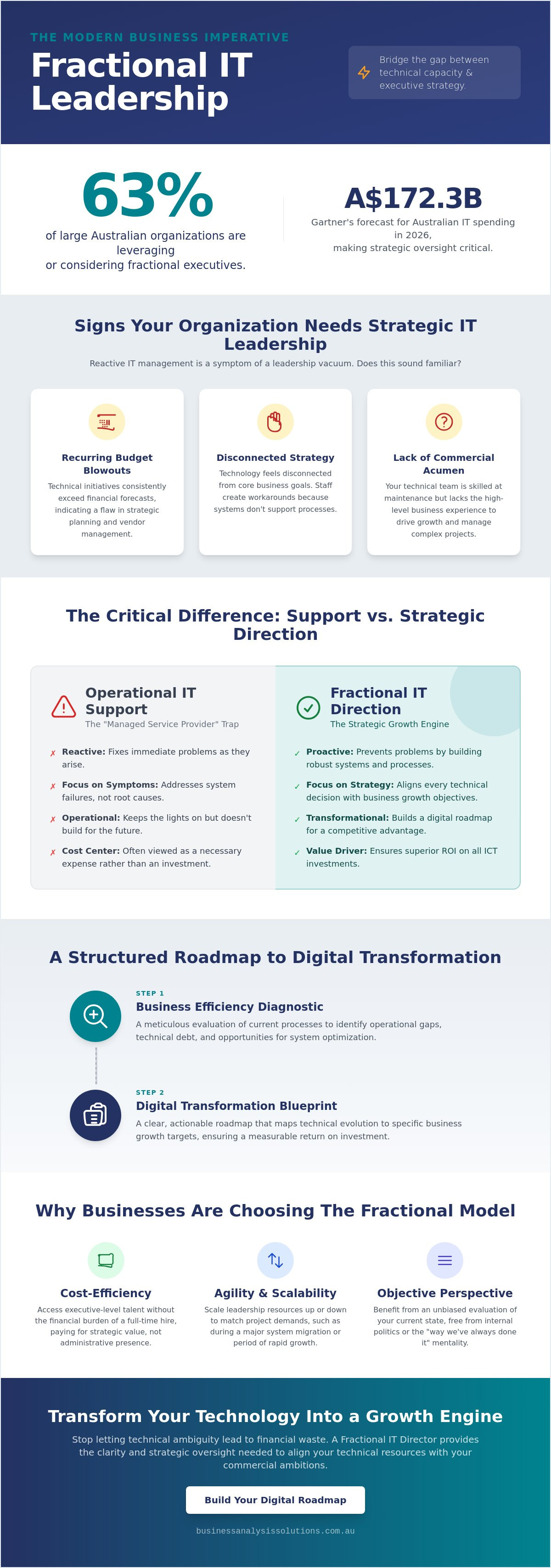
Did you know that 63% of large Australian organizations are now leveraging or considering fractional executives to navigate increasingly complex operational environments? It's a common frustration for leadership teams when IT projects consistently exceed their budgets or when technology strategy feels entirely disconnected from core business objectives. You likely recognize the risk of relying on technical staff who, while capable in their niche, lack the commercial acumen required to drive high-level growth. This is where fractional IT director services provide a strategic solution by bridging the gap between technical capacity and executive strategy.
We understand that technical ambiguity often leads to financial waste. This article demonstrates how fractional leadership transforms technical operations into a engine for measurable business growth. You'll learn how a structured approach to leadership provides a clear digital roadmap, improves operational efficiency, and ensures a superior ROI on your ICT investments. With Gartner forecasting Australian IT spending to reach A$172.3 billion in 2026, the need for precise, results-driven oversight is critical for maintaining a competitive edge. This guide provides the clarity needed to align your technical resources with your commercial ambitions.
Key Takeaways
Understand how fractional IT director services align your ICT infrastructure with overarching commercial objectives to ensure every technical investment supports business growth.
Identify the critical signs of reactive IT management, such as recurring budget blowouts and project delays, that indicate a need for high-level strategic oversight.
Distinguish between operational IT support that fixes immediate problems and strategic direction that prevents them by breaking free from the traditional Managed Service Provider trap.
Discover a structured roadmap for digital transformation, beginning with a Business Efficiency Diagnostic to identify operational gaps and build a robust Digital Transformation Blueprint.
Learn how to leverage professional business analysis and digital strategy to bridge the gap between complex technical requirements and tangible organizational results.
Table of Contents
What are Fractional IT Director Services?
The fractional model provides a structured framework for businesses to access high-level technical leadership without the financial burden of a full-time executive hire. Unlike traditional consultancies that often offer advice from a distance, fractional IT director services integrate an experienced leader into the organizational structure on a part-time, flexible basis. This leader assumes accountability for technical outcomes while ensuring that every ICT decision serves a specific commercial purpose. It's a model built on pragmatism and professional competence, designed to bridge the gap between technical operations and executive strategy.
In 2026, this approach has become a strategic imperative for Australian mid-market firms. As national IT spending is forecasted by Gartner to reach A$172.3 billion this year, the risk of unmanaged technical debt is too high to ignore. While a CIO typically focuses on high-level governance and long-term vision, the IT Director role is more focused on implementation. They ensure that the infrastructure, teams, and processes actually deliver on the strategic promises made at the board level. With job postings for fractional roles increasing by 35% over the last two years, the shift toward this agile leadership model is well underway.
The Strategic Scope of a Fractional IT Director
A fractional director moves an organization from reactive fire-fighting to proactive system harmony. This begins with the development of a Digital Transformation Blueprint, a document that maps technical evolution to specific business growth targets. Their scope includes managing complex vendor relationships and ICT procurement strategies to ensure software choices are driven by functionality rather than marketing pressure. Critically, they oversee data security and compliance with Australian standards, such as the Essential Eight and the new mandatory disclosure requirements for automated decision-making systems effective December 10, 2026.
Why Businesses are Moving Away from Full-Time IT Executives
Cost-efficiency: Organizations now prioritize paying for strategic value rather than administrative presence. With the superannuation guarantee at 12% as of July 1, 2025, the total cost of employment for a full-time executive is a significant overhead.
Agility: The fractional model allows leadership resources to be scaled up during a major system migration or scaled down once a project stabilizes.
Objective perspective: An external leader brings a meticulous, unbiased evaluation of current processes. They aren't entrenched in internal office politics or restricted by the "way we've always done it" mentality.
This shift reflects a broader trend toward human-centered leadership. By focusing on the growth and empowerment of existing technical staff through senior mentorship, a fractional director builds internal capability while maintaining a lean executive structure. It's a methodical approach to solving complex organizational challenges through specialized expertise.
Signs Your Organisation Requires Strategic IT Leadership
Identifying the threshold where standard technical support fails to meet commercial needs is a critical leadership skill. Many Australian businesses operate under the illusion that functional IT support is the same as strategic leadership. This misconception often leads to technology decisions being made reactively rather than strategically. When a business only invests in its systems during a crisis or in response to a competitor's move, it loses the ability to innovate. This reactive posture is a primary indicator that your organization requires the specialized oversight provided by fractional IT director services.
Recurring ICT project delays and budget blowouts aren't just administrative hurdles; they're symptoms of a leadership vacuum. If your technical initiatives consistently fail to meet deadlines or exceed financial forecasts, the issue likely lies in the planning phase. Most internal technical teams excel at maintenance but lack the commercial experience to manage complex implementations. This creates a "Technology Gap" where your software no longer supports your business processes, forcing staff to work around the systems meant to empower them. Without a digital transformation blueprint for business, organizations stay trapped in a cycle of expensive, ineffective technical patches.
The Cost of a "Keeping the Lights On" Mentality
A stagnant technology stack erodes competitive advantage faster than most executives realize. In the Australian market, technical debt accumulates when ageing ICT systems are patched rather than optimized. This "business as usual" approach is the biggest threat to growth because it consumes resources that should be dedicated to innovation. Relying on legacy systems creates hidden risks, from security vulnerabilities to an inability to integrate with modern AI-driven tools. A 2026 survey of Australian tech leaders revealed that 47% now identify driving operational efficiencies as their greatest opportunity, a goal that's impossible to reach with outdated infrastructure.
Evaluating Your Current ICT Maturity
To assess your position, look at the daily output of your technical team. Are they focused on closing support tickets or driving organizational transformation? High-level maturity requires that leadership teams trust the data coming out of their systems. If you're making decisions based on intuition because your reports are unreliable, your systems are failing you. We define ICT maturity as the alignment of system output with business goals. If your current trajectory doesn't reflect this alignment, it's time to consider a professional Business Efficiency Diagnostic to identify the specific gaps in your strategy.
IT Support vs. Fractional IT Direction: The Critical Difference
A common strategic error in Australian mid-market firms is the conflation of technical support with strategic leadership. Managed Service Providers (MSPs) are essential for maintaining uptime and resolving immediate hardware or software failures. However, their primary objective is operational stability, not necessarily organizational growth. Professional fractional IT director services occupy a different functional space, focusing on how technical infrastructure can be leveraged to increase profitability and operational efficiency. Support fixes problems; strategy prevents them from occurring while identifying opportunities for system harmony.
This distinction is most visible in vendor management. An MSP is a vendor, which often creates an inherent conflict of interest when they are asked to provide high-level strategic advice. They may recommend solutions that align with their own service capabilities rather than the most efficient option for your specific business model. A fractional director provides independent oversight, acting as your internal advocate to hold technical vendors accountable. They ensure that every ICT investment is scrutinized for its ability to deliver a tangible return, rather than just adding another layer of complexity to your stack.
Why an MSP is Not an IT Director
MSPs prioritize the "green light" on a dashboard, ensuring systems remain online and functional. While this is vital, it doesn't address whether those systems are actually the right ones for your evolving business goals. A director focuses on ROI and process management. They provide vendor-neutral advice during ICT procurement, ensuring you aren't locked into proprietary systems that limit your future agility. By maintaining this professional distance from the service providers, they can objectively evaluate performance and drive the necessary changes to optimize your technical environment.
Integrating Leadership with Technical Teams
Bridging the communication gap between the server room and the boardroom is a core competency of effective leadership. Technical staff often struggle to articulate the commercial impact of their requirements, leading to executive hesitation. A fractional director translates complex technical jargon into actionable business insights that leadership can use to make informed decisions. Beyond communication, they mentor internal IT staff to improve professional standards and ensure project management excellence. This structured approach ensures that ICT initiatives are delivered on time and within budget, moving the team from a reactive support role to a proactive contributor to organizational success.
The Roadmap to Effective ICT Implementation
Successful technology integration is never the result of chance; it's the outcome of a methodical, four-phase engagement. This structured approach ensures that technical capacity is directly proportional to organizational requirements. By utilizing fractional IT director services, businesses move through these stages with the precision required to avoid common implementation pitfalls. The process begins by establishing a baseline of current performance before moving toward a future-state architecture.
Phase 1: The Diagnostic. We conduct a Business Efficiency Diagnostic to identify hidden gaps in your current infrastructure.
Phase 2: The Blueprint. We develop a Digital Transformation Blueprint that aligns every technical initiative with a specific commercial goal.
Phase 3: Execution. Our team provides high-level Project Management to oversee the deployment of new ICT solutions.
Phase 4: Governance. We establish ongoing risk management and performance monitoring to ensure long-term system harmony.
Conducting a Business Efficiency Diagnostic
The diagnostic phase is a rigorous audit of your existing technology stack and operational workflows. We use process mapping to identify bottlenecks where manual workarounds are slowing down production or where data silos prevent informed decision-making. By auditing your existing technology stacks for both cost and performance, we can pinpoint redundancies that drain your budget without adding value. Our experience shows that a comprehensive diagnostic typically identifies an average of 20% in wasted ICT spend through underutilized licenses and inefficient vendor contracts. If you want to reclaim this capital and optimize your operations, consider scheduling a Business Efficiency Diagnostic to reset your technical foundations.
Risk Management and Cybersecurity Governance
In the current Australian regulatory environment, governance is a leadership responsibility that shouldn't be outsourced to a general helpdesk. We prioritize the implementation of the Essential 8 framework, the baseline cybersecurity standard recommended by the Australian Signals Directorate. This isn't just about software; it's about developing robust disaster recovery and business continuity plans that protect your organization from significant operational disruption. We also ensure your systems comply with evolving national data privacy regulations, including the mandatory disclosure requirements for automated decision-making systems. This methodical approach to risk transforms cybersecurity from a technical burden into a fundamental pillar of organizational trust.
Driving Organisational Change with Business Analysis & Solutions
At Business Analysis & Solutions, our methodology is defined by a commitment to bridging the gap between technical requirements and tangible business results. We don't view technology as an end in itself; it's a tool for organizational coordination and performance. By leveraging 20 years of experience in strategic business analysis, we help Australian firms move beyond the limitations of standard technical support. Our fractional IT director services ensure that your ICT infrastructure evolves in lockstep with your commercial ambitions, creating a leaner, more efficient, and technology-empowered organization.
The transition to strategic leadership provides executive-level ICT oversight that mid-market firms often lack. This is particularly relevant as organizations face increasing pressure to integrate AI and automated decision-making while maintaining strict regulatory compliance. Our fractional CIO services offer the high-level guidance necessary to navigate these complexities without the overhead of a full-time executive hire. The ultimate outcome is a technical environment characterized by system harmony and measurable ROI.
A Methodical Approach to ICT Excellence
We prioritize process mapping before software selection. It's a fundamental principle of our practice: you cannot automate an inefficient process and expect a productive result. By documenting workflows first, we identify exactly where technology can drive the most value. This logical sequence ensures that any automation implementation or system upgrade is rooted in operational reality. Our commitment to practical, end-to-end results means we don't just deliver a report; we oversee the execution of the strategy to ensure the identified efficiencies are actually realized.
Next Steps for Your Business
Initiating a consultation for fractional IT leadership is a straightforward process focused on identifying your specific pressure points. In the first 90 days of an engagement, you can expect a rigorous audit of your current technical stack, the delivery of a Digital Transformation Blueprint, and the establishment of a governance framework. This initial period is designed to stabilize your ICT environment and set the stage for long-term growth. We move from high-level vision to granular details with a steady, predictable rhythm that builds trust and delivers clarity.
If your organization is ready to move beyond reactive IT management and toward a structured, strategic approach, we're ready to collaborate. Book a Strategic Consultation with Business Analysis & Solutions today to align your technology with your business goals.
Securing Your Digital Future through Strategic Leadership
Aligning technical capacity with commercial goals is no longer an optional luxury for Australian businesses; it's a prerequisite for sustained profitability. We've explored how moving beyond the "keeping the lights on" mentality allows organizations to reclaim wasted ICT spend and secure their operations against evolving regulatory threats. Professional fractional IT director services provide the necessary bridge between technical requirements and executive vision, ensuring every system migration or software procurement serves a clear strategic purpose.
With over 20 years of industry experience and deep expertise in Australian compliance standards, Business Analysis & Solutions provides the methodical oversight required to achieve system harmony. Our proven Business Efficiency Diagnostic framework offers a structured starting point for identifying operational redundancies and building a robust digital roadmap. This transition from reactive support to proactive direction creates a stable foundation for innovation and growth.
Take the next step in your organizational evolution. Optimise your ICT strategy with a Fractional IT Director and transform your technology into a measurable driver of business success. We're ready to help you navigate the complexities of modern digital leadership with clarity and precision.
Frequently Asked Questions
What exactly does a fractional IT director do on a daily basis?
A fractional IT director manages the intersection of technical operations and commercial strategy. They don't perform helpdesk tasks; instead, they focus on vendor management, overseeing the execution of a Digital Transformation Blueprint, and ensuring that ICT solutions are delivering the expected ROI. Their time is spent attending leadership meetings, auditing system performance, and providing the professional oversight necessary to prevent technical debt from accumulating.
How much does a fractional IT director cost compared to a full-time hire?
The cost is significantly lower because you're only paying for a portion of an executive's time. By utilizing this model, businesses avoid the 12% superannuation guarantee required for employees as of July 1, 2025, along with payroll tax and other full-time benefits. This allows an organization to access 20 years of senior leadership experience at a fraction of the total employment cost of a permanent hire.
Can a fractional IT director work alongside my existing MSP?
Yes, they act as the strategic layer that holds your Managed Service Provider (MSP) accountable. While the MSP focuses on uptime and support tickets, the director ensures their technical output aligns with your broader business goals. This independent oversight is critical for avoiding the conflict of interest that occurs when a service provider is also your primary strategic advisor.
How many days per month does a fractional IT director typically work?
Engagement levels typically range from two to eight days per month depending on your organizational complexity. For many Australian mid-market firms, one day per week provides sufficient momentum to drive digital strategy and manage ongoing ICT projects. This flexibility allows you to scale the leadership resource up during major transformations or down once systems reach a state of harmony.
Is fractional IT leadership suitable for small businesses or just large firms?
It's highly suitable for scaling businesses that have outgrown basic technical support but aren't yet ready for a full-time executive. Fractional IT director services allow these firms to implement high-level process mapping and automation early. This builds a stable foundation for growth that prevents the expensive "Technology Gap" often seen in rapidly expanding companies.
How do you measure the ROI of fractional IT director services?
ROI is measured through measurable improvements in operational efficiency and the reduction of wasted technical spend. A successful engagement often identifies underutilized licenses or redundant systems during the initial Business Efficiency Diagnostic. These direct savings, combined with the successful delivery of ICT projects on time and within budget, provide a clear financial justification for the service.
What is the difference between a fractional CIO and a fractional IT director?
A CIO typically focuses on high-level governance and long-term vision, while an IT director is more implementation-focused. While both roles are strategic, the director ensures that the Digital Transformation Blueprint is translated into operational reality. They take a more active role in project management and the day-to-day coordination of technical resources to ensure business results are achieved.
Do I need to sign a long-term contract for fractional services?
Most engagements operate on a flexible retainer model that prioritizes agility over rigid long-term commitments. This allows you to access specialized expertise for specific projects or periods of change without the risk of permanent overhead. It's a pragmatic approach to leadership that focuses on finding the most effective solution for your current organizational challenges.



Comments