Fractional CIO for Startups in Australia: A 2026 Strategic Guide to Scalable Growth
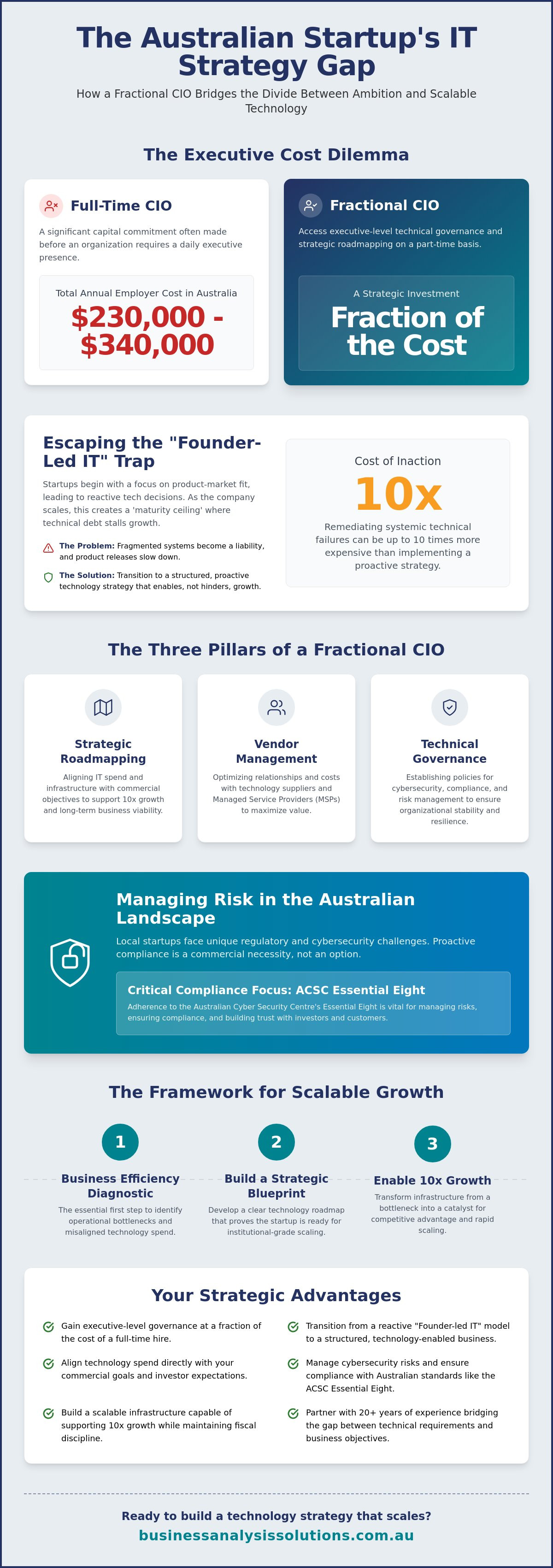
Did you know that the total employer cost for a full-time CIO in Australia now ranges between $230,000 and $340,000 per year? For many founders, this represents a prohibitive capital commitment that often arrives before the organization truly needs a daily executive presence. You've likely felt the frustration of technical debt stalling your product roadmap or the anxiety of ensuring your cybersecurity posture meets evolving Australian standards. It's a common challenge where technical complexity begins to outpace your internal capacity to manage it effectively.
By integrating a fractional CIO for startups Australia, you can secure the high-level strategic oversight necessary to align your IT spend with your commercial objectives. This article demonstrates how to transition from reactive troubleshooting to a proactive technology strategy that optimizes your operational costs. We'll explore the methodology for building a scalable infrastructure capable of supporting 10x growth while maintaining the fiscal discipline your board expects in 2026.
Table of Contents
The Strategic Gap in the Australian Startup Ecosystem
Australian startups typically begin with a hyper-focus on product-market fit. This initial velocity is essential, yet it often forces founders into an unsustainable "Founder-led IT" model. In this phase, technology decisions are made reactively to solve immediate engineering hurdles rather than to support long-term organizational stability. As the company grows, these fragmented systems become a significant liability. The transition from building a standalone product to running a technology-enabled business requires a shift in perspective that many leadership teams aren't equipped to manage alone.
Technical debt is the silent killer of scalability. It isn't merely about poorly written code; it encompasses the lack of alignment between IT expenditure and business objectives. When technical debt accumulates, product releases slow down, and the cost of maintaining legacy choices begins to cannibalize the budget for new innovation. This is where the distinction between tactical IT support and strategic technology leadership becomes critical. While a helpdesk fixes a broken laptop, a fractional CIO for startups Australia ensures that every dollar spent on technology directly facilitates the next stage of growth.
Recognising the 'Maturity Ceiling'
You've likely reached a maturity ceiling when your internal teams spend more time managing infrastructure issues than developing new features. This shift is a clear indicator that your current technical management structure is no longer fit for purpose. Reactive IT management carries a heavy price; industry data suggests that remediating systemic technical failures after they occur can be up to 10x more expensive than implementing a proactive strategy. Understanding What is a Fractional CIO? helps founders see that executive-level oversight can bridge the gap between software development and broader business operations without the overhead of a full-time hire.
The Australian Context: Scaling in a Competitive Landscape
The Australian market presents unique challenges, particularly regarding regulatory compliance and cybersecurity. Local startups are increasingly targeted by sophisticated threats, making adherence to the ACSC Essential Eight a commercial necessity rather than an option. Strategic ICT solutions allow businesses to meet these requirements while remaining agile enough to pivot. Venture capital expectations in 2026 have also shifted. Investors now look for a clear technology roadmap and a Business Efficiency Diagnostic to prove that the startup is ready for institutional-grade scaling. Aligning your technology with these national growth objectives provides a distinct competitive edge, ensuring that your infrastructure is a catalyst for 10x growth rather than a bottleneck.
What is a Fractional CIO for Startups?
Engaging a fractional CIO for startups Australia introduces an executive-level professional who provides high-level technology leadership on a part-time, recurring basis. This model allows a startup to access veteran expertise for specific strategic outcomes without the $230,000 to $340,000 annual employer cost of a permanent executive. It's a pragmatic approach to leadership that prioritizes results over presence. This role focuses on three primary pillars: roadmap creation, vendor management, and technical governance.
Startups often confuse this role with a Lead Developer or a Managed Service Provider (MSP). A Lead Developer is primarily responsible for the code and product architecture. An MSP focuses on infrastructure maintenance and technical support. In contrast, the fractional CIO operates at the board level. They ensure that technical decisions support financial performance and long-term business viability. They don't just build the product; they build the technology-enabled organization. This distinction is vital for founders who need to move beyond tactical fixes toward systemic harmony.
Fractional CIO vs. Virtual CIO (vCIO)
While the terms are often used interchangeably, the distinction is significant for a scaling business. A vCIO is typically a representative from an MSP who provides periodic advisory sessions as part of a service contract. This is often focused on keeping the lights on. A fractional CIO acts as a strategic partner embedded within your leadership team. They understand organizational coordination and prioritize business value over simple ticket resolution. They are responsible for the why and when of technology investments, not just the how.
The Executive Mandate: What You Are Actually Buying
Securing this service provides access to over 20 years of industry experience. Research shows that 82.8% of fractional leaders in the APAC region possess 15 or more years of domain expertise. This level of seniority allows for independent, vendor-agnostic advice. It prevents technology lock-in by ensuring that ICT solutions are selected based on merit rather than pre-existing partnerships. This objective oversight extends to internal teams and external providers, ensuring that your technical roadmap remains achievable. If you need to evaluate your current setup, beginning with Fractional CIO Services can provide the clarity required for sustainable growth.
The Framework for Success: Diagnostics and Blueprints
A structured approach is the only way to ensure technology investments yield a measurable return. For a fractional CIO for startups Australia, the engagement begins not with implementation, but with a rigorous assessment of the existing environment. This logical sequence ensures that every subsequent action is grounded in objective data rather than assumptions. It's a methodical process that moves from identifying current inefficiencies to designing a future-state architecture that supports rapid scaling.
Process mapping plays a central role in this foundation. It allows the leadership team to visualize operational bottlenecks that are often invisible during daily operations. When you map a workflow from end to end, you can see exactly where manual handovers or outdated systems are slowing down your velocity. This clarity is essential for identifying which processes are ripe for automation and which require a complete structural overhaul to achieve system harmony.
Phase 1: The Business Efficiency Diagnostic
Every successful engagement must start with a Business Efficiency Diagnostic. This process analyzes your current ICT infrastructure against your three-year growth projections. It identifies "shadow IT" where teams have adopted unsanctioned tools, leading to security risks and redundant software subscriptions. By evaluating the alignment between technical requirements and organizational objectives, we find immediate cost-saving opportunities that can be reinvested into strategic growth initiatives.
Phase 2: The Digital Transformation Blueprint
Once the diagnostic is complete, the findings are codified into a digital transformation blueprint. This document serves as a 12-24 month technology roadmap tailored specifically for startup velocity. It prioritizes automation implementation to reduce manual overhead, allowing your team to focus on high-value innovation. A fractional CIO for startups Australia understands that without this blueprint, digital initiatives often lack the cohesion needed for 10x growth. We also establish a budget that balances the need for cutting-edge innovation with fiscal responsibility.
Setting measurable KPIs is the final component of this framework. These metrics track technology ROI and ensure the infrastructure remains stable as the business expands. Key performance indicators typically include:
Technical Debt Ratio: Tracking the time spent on maintaining old systems versus developing new features.
SaaS Optimization: Reducing the percentage of budget spent on redundant or underutilized software subscriptions.
Operational Velocity: Measuring the reduction in time required to complete core business processes following automation.
Compliance Maturity: Achieving specific milestones in the ACSC Essential Eight framework.
Managing Risk and Compliance in the Australian Startup Landscape
In 2026, Australian startups are no longer viewed by cybercriminals as secondary targets. They're recognized as high-value repositories of intellectual property and concentrated customer data. A fractional CIO for startups Australia plays a pivotal role in shifting the organizational mindset from reactive patching to proactive technical governance. This involves more than just selecting software; it requires a methodical implementation of the Australian Cyber Security Centre (ACSC) Essential Eight framework. By systematically addressing application control, patch management, and multi-factor authentication, a startup builds a resilient foundation that protects its most critical assets.
Compliance with the Australian Privacy Act and data sovereignty requirements is another area where executive oversight is non-negotiable. As local regulations tighten, simply hosting data in the cloud isn't sufficient. You must ensure that your data residency and access controls align with specific Australian legal standards. This level of precision is essential for maintaining trust with enterprise clients and avoiding the significant financial penalties associated with non-compliance. Our Fractional CIO Services provide the expert guidance needed to navigate these complex regulatory environments with confidence.
Building a Culture of Technical Governance
Establishing robust policies to protect intellectual property is a core responsibility of the fractional CIO. This includes regular auditing of ICT solutions to ensure system integrity and prevent unauthorized access. For cloud-native startups, a disaster recovery plan must be more than a document on a shared drive. It must be a tested, functional process that ensures business continuity in the event of a breach. Strategic leadership ensures that these governance measures are integrated into the daily workflow rather than treated as a separate, burdensome administrative task.
Preparing for Investment: The Due Diligence Checklist
Venture capitalists in Series A and Series B rounds now scrutinize a startup's technology stack with the same intensity as its financial statements. They look for evidence of scalability, security, and operational efficiency. A fractional CIO provides the quiet confidence that investors require during technical due diligence. By documenting processes and presenting a clear digital strategy, you demonstrate that your infrastructure is ready for institutional-grade growth. This preparation includes:
Infrastructure Scalability: Proof that the technology stack can handle a 10x increase in user load without systemic failure.
Governance Documentation: Clear records of security audits and compliance certifications against Australian standards.
Vendor Management: A consolidated list of third-party dependencies with associated risk assessments.
Technical Debt Management: A transparent roadmap for resolving legacy issues identified in previous diagnostics.
Choosing the Right Fractional CIO Partner in Australia
Selecting a fractional CIO for startups Australia requires looking beyond technical certifications. In a high-stakes startup environment, seniority provides the perspective needed to navigate rapid scaling without systemic failure. Research indicates that 82.8% of fractional leaders in the APAC region possess 15 or more years of domain experience. This level of expertise is essential for bridging the gap between technical requirements and business strategy. You aren't just hiring a consultant; you're securing a seasoned architect of organizational change who understands how to align technology with your financial performance.
A successful partnership relies on regional professional directness. This straightforward communication style ensures that complex technical challenges are addressed without unnecessary hyperbole. It's about finding a collaborator who prioritizes resolution and outcomes over flashy features. This pragmatic approach ensures that fractional CIO services in Australia deliver tangible value. By maintaining a focus on clarity and reliability, a fractional CIO provides the quiet confidence your leadership team needs to make informed, data-driven decisions.
The Analytical Collaborator: Beyond the Tech
A fractional CIO must act as an analytical collaborator who facilitates cross-departmental coordination. Their role isn't confined to the IT department; they work across engineering, finance, and operations to ensure system harmony. This methodical approach allows for the resolution of deep-seated organizational challenges through structured problem-solving rather than ad-hoc fixes. By focusing on outcomes, they ensure that every ICT solution implemented serves a specific business objective and contributes to long-term stability.
Next Steps: From Strategy to Implementation
Initiating a professional consulting engagement for your startup begins with defining a clear scope of work. The first 90 days of a fractional engagement are typically focused on stabilizing the existing environment and establishing a roadmap for future growth. The process starts with a comprehensive efficiency diagnostic to identify immediate risks, such as technical debt or compliance gaps. This structured initiation ensures the partnership moves quickly from high-level vision toward granular, actionable results. Taking this first step allows you to optimize your IT operational costs while building an infrastructure capable of supporting 10x growth.
Architecting a Resilient Future for Your Startup
Transitioning from a founder-led IT model to a technology-enabled business requires more than just better software. It demands a deliberate alignment of technical infrastructure with commercial objectives. By engaging a fractional CIO for startups Australia, you gain the executive oversight necessary to resolve technical debt and implement the ACSC Essential Eight frameworks. This strategic partnership ensures that your organization remains compliant and attractive to venture capital investors during Series A and B funding rounds.
Our boutique, logic-driven consultancy leverages over 20 years of industry experience to deliver tangible results. We utilize a proven methodology that moves systematically from a comprehensive Business Efficiency Diagnostic to a Digital Transformation Blueprint and final implementation. This structured approach eliminates ambiguity and optimizes your IT operational costs. If you're ready to move from reactive troubleshooting to proactive leadership, Book a Strategic Fractional CIO Consultation today. Establishing a scalable foundation now will ensure your infrastructure remains a catalyst for growth throughout 2026 and beyond.
Frequently Asked Questions
What is the difference between a Fractional CIO and a CTO in a startup?
A CTO primarily directs product engineering and external innovation, whereas a fractional CIO for startups Australia focuses on internal operational efficiency and organizational coordination. While the CTO builds the product you sell, the CIO builds the technology-enabled organization that supports it. This distinction ensures that your internal systems, from financial reporting to project management, remain as robust and scalable as the customer-facing software itself.
How many hours a month does a Fractional CIO typically work for a startup?
Most engagements range between 16 and 40 hours per month, depending on the current maturity of your ICT infrastructure. This time is dedicated to high-level strategic oversight rather than daily troubleshooting. The focus remains on delivering specific outcomes like roadmap creation or vendor management. This model provides the necessary executive presence at a fraction of the cost of a full-time hire, allowing for greater fiscal discipline.
Can a Fractional CIO help our startup prepare for a Series A funding round?
A fractional CIO provides the technical governance and quiet confidence that venture capitalists look for during due diligence. They prepare your startup for Series A or B rounds by documenting scalable processes and demonstrating a clear technology roadmap. By proving that your infrastructure can handle a 10x increase in load, they mitigate the risks that often cause investors to hesitate during the final stages of a deal.
Does a Fractional CIO manage our existing outsourced development team?
They manage outsourced teams by providing strategic direction and technical governance rather than daily task management. The CIO ensures that your external partners adhere to your internal standards for security and documentation. This oversight prevents vendor lock-in and ensures that technical decisions are driven by your business objectives rather than the convenience of the service provider. It creates a unified technical strategy across all teams.
Is a Fractional CIO the same as an IT consultant?
An IT consultant is typically hired for a specific, time-limited project, whereas a fractional CIO is an embedded member of your leadership team. The CIO holds an ongoing executive mandate and is accountable for the long-term resolution of organizational challenges. While a consultant might implement a single software solution, a CIO manages the entire technical ecosystem and its alignment with your broader financial performance.
What are the common signs that my Australian startup needs a Fractional CIO?
Signs include technical debt that consistently delays product releases or a noticeable lack of alignment between IT spend and commercial milestones. If you're experiencing anxiety regarding cybersecurity compliance with Australian standards, it's likely time for executive oversight. You might also notice that your internal teams are spending more time maintaining legacy systems than developing new features, indicating that you've reached a technical maturity ceiling.
How does a Fractional CIO approach cybersecurity for small startups?
Cybersecurity is approached as a continuous risk management program rather than a one-off software installation. A fractional CIO for startups Australia prioritizes the implementation of the ACSC Essential Eight to establish a resilient security posture. This includes managing data sovereignty to comply with the Australian Privacy Act. They ensure that even small teams have the governance structures in place to protect intellectual property and customer data from evolving threats.
What is the typical ROI for engaging a Fractional CIO?
ROI is realized through the optimization of IT operational costs and the reduction of technical debt. By eliminating redundant SaaS subscriptions and automating manual workflows, startups can redirect capital toward innovation. Additionally, the long-term value of having an infrastructure that supports rapid scaling without systemic failure far outweighs the cost of the engagement. It provides a stable foundation for sustainable growth and increased company valuation.



The article highlights a critical shift in how startups in Australia can manage their technical resources. Engaging a fractional CIO for startups Australia addresses the growing challenge of technical debt and aligns IT strategy with business goals. As startups face increasing scrutiny from investors, the need for a strategic approach becomes evident. This method not only enhances operational efficiency but also positions firms for sustainable growth amidst evolving market demands. However, the reliance on external expertise raises long-term questions about internal capabilities and knowledge retention in the startup ecosystem. Investing in a fractional CIO can be a double-edged sword. In the current landscape, where technical debt is a persistent issue, startups like Bitstarz might find that this strategic partnership is…
The discussion around engaging a fractional CIO for startups presents a compelling solution to the pervasive issue of technical debt. As highlighted, the mounting costs linked to maintaining outdated systems can hinder growth. When considering governance in the realm of cybersecurity, tools like Pay ID https://gooroo.io/ can enhance transactional security but also raise concerns about compliance and integration. The balance between innovation and operational integrity is crucial for sustained success.
The article offers a comprehensive analysis of the role of a fractional CIO for startups Australia, emphasizing the importance of aligning technology with business strategy. I find the concept of technical debt particularly illuminating, as it highlights how poor management can hinder growth. Addressing The Pokies https://inhabitants-tv.org/ of operational inefficiencies proactively can indeed foster a more robust organizational structure, enabling scalability and compliance in a challenging environment.
The challenges discussed in this article highlight how crucial it is for startups to address technical debt early on. The situation becomes dire when companies rely on a "Founder-led IT" model without strategic oversight. A fractional CIO for startups Australia can provide much-needed expertise, ensuring that investments align with growth objectives. The concept of Royal Reels https://financedistrict.co.nz/ as a flexible strategy comes to mind, as it emphasizes iterative improvement and responsiveness in technology management.
A closer look shows that the interpretations show no exaggeration and remain grounded. Data integrity is preserved throughout the analysis. The website adds depth and nuance to the issues raised here. Churn dynamics are analysed through Australian platform behavioural signals.