Evaluating Business Processes for Automation: A Strategic 2026 Framework
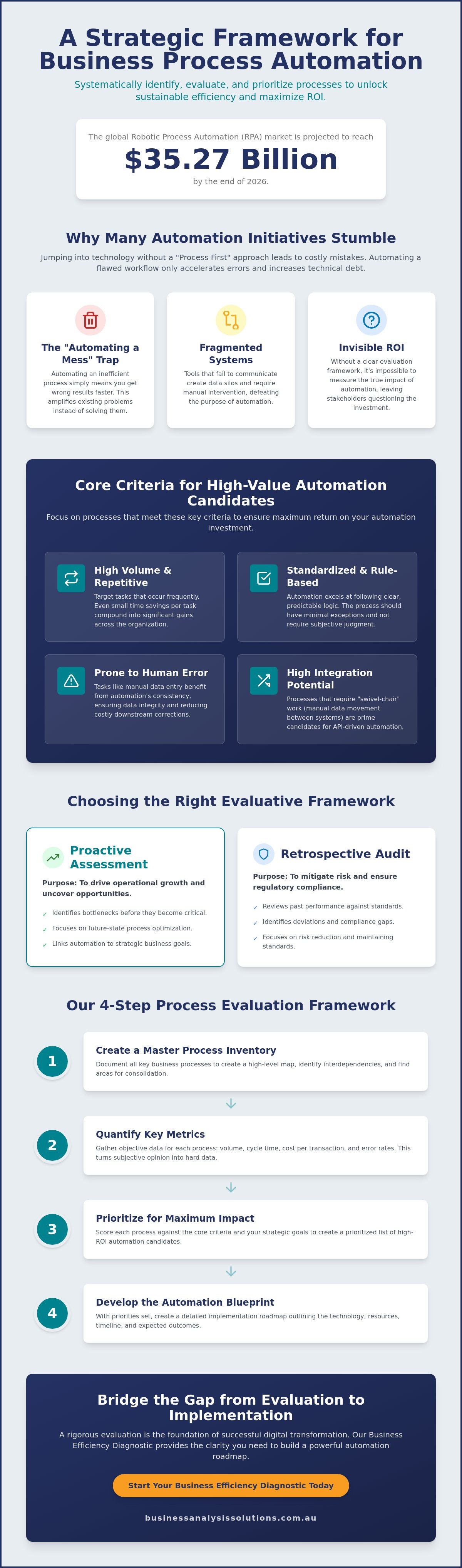
By the end of 2026, the global Robotic Process Automation market will reach $35.27 billion, yet many organizations still struggle with fragmented systems and invisible ROI. You've likely seen high-profile digital projects stall because they focused on the technology rather than the underlying workflow. Evaluating business processes for automation requires more than just identifying repetitive tasks; it demands a rigorous, logic-driven assessment of how each change impacts your broader organizational goals and bottom line.
It's understandable to feel cautious after witnessing wasted investments in tools that fail to communicate. You need a clear roadmap that reduces manual error rates while ensuring compliance with new regulations like the EU AI Act and Colorado’s AI Act. This article outlines a strategic framework to help you systematically identify and prioritize the right candidates for digital transformation. We'll move from high-level process mapping to granular ROI analysis, providing the clarity you need to achieve operational harmony and sustainable efficiency through a methodical, results-driven approach.
Table of Contents
The Strategic Importance of Evaluating Business Processes for Automation
Automation often acts as a powerful force multiplier, but its value depends entirely on the quality of the underlying workflow. In the 2026 Australian business environment, where regulatory scrutiny and operational costs are at record highs, jumping straight into technical implementation is a high-risk gamble. Evaluating business processes for automation isn't a preliminary hurdle; it's the most critical phase of the digital lifecycle. Without a rigorous assessment, organizations risk scaling inefficiencies rather than resolving them. Strategic evaluation ensures that every dollar spent on technology delivers a measurable impact on the balance sheet, protecting the business from the compounding weight of technical debt.
Professional Business process automation requires a deep immersion in business analysis to bridge the gap between technical capability and organizational objectives. By 2026, the global RPA market is expected to reach $35.27 billion, yet the difference between market leaders and laggards remains the ability to discern which tasks actually deserve a digital workforce. A methodical approach moves the conversation away from "what can we automate" toward "what should we automate to drive the highest value." This shift in perspective prevents the common pitfall of fragmented systems that fail to communicate, ensuring that new tools integrate seamlessly into a cohesive operational framework.
Why "Automating a Mess" Fails Your Business
The principle of "garbage in, garbage out" (GIGO) remains the most relevant warning for modern leadership. If a manual workflow contains redundant steps, logic gaps, or unnecessary hand-offs, automating it simply accelerates those errors. You end up paying for the digital execution of waste. The hidden costs of maintaining these flawed, automated workflows often exceed the initial investment, as technical teams must constantly patch systems that were never fit for purpose. A "Process First" philosophy serves as the foundational pillar of a resilient digital strategy.
The Role of the Business Efficiency Diagnostic
A Business Efficiency Diagnostic provides an objective lens to view your operations. It moves beyond anecdotal evidence to identify actual bottlenecks through data-driven process mapping. This diagnostic stage is essential for distinguishing between "low-hanging fruit," which offers immediate ROI through simple task automation, and "strategic overhauls" that require a more comprehensive Digital Transformation Blueprint. By linking every potential automation project to broader organizational goals, you ensure that your ICT solutions solve real-world problems rather than just adding another layer of complexity to your tech stack.
Core Criteria: Identifying High-Value Automation Candidates
Selecting the right candidate for automation is a balance of operational necessity and technical feasibility. When evaluating business processes for automation, the primary objective is to find workflows where digital intervention provides the highest return on effort. High-volume, repetitive tasks that consume significant human hours are the most obvious starting points. If a process occurs thousands of times per month, even a marginal reduction in cycle time translates into substantial annual savings. However, volume alone isn't enough; the process must also be standardized and governed by predictable, rule-based logic. Automation struggles with ambiguity, so tasks requiring subjective judgment or complex exceptions are often better suited for human oversight or significant re-engineering.
Inaccuracy and human error provide another compelling case for automation. Manual data entry and cross-system reconciliation are prone to fatigue-driven mistakes, which can lead to costly downstream corrections. By shifting these tasks to automated systems, you ensure consistent quality and data integrity. This reliability is essential for successful automation projects, as it builds trust in the digital ecosystem. Before moving forward, you must also consider integration readiness. A process that requires manual "swivel-chair" data movement between disconnected ICT solutions is a prime candidate, provided the underlying systems allow for stable connections via APIs or secure interfaces.
The Complexity vs. Volume Matrix
A functional way to prioritize projects is by plotting them on a complexity versus volume matrix. The "Automation Sweet Spot" consists of high-volume, low-complexity tasks. These offer immediate ROI with minimal technical risk. Conversely, high-complexity tasks usually require a Business Efficiency Diagnostic to simplify the workflow before any code is written. Automating a complex, inefficient process simply creates a faster way to generate errors, which undermines the entire digital strategy.
Stability and Maturity Assessments
Stability is a non-negotiable criterion in a 2026 digital environment. A process must be mature and stable before it's eligible for automation. If a workflow is currently in a state of flux or changes every quarter due to shifting policy, it's a poor candidate. The cost of constantly reconfiguring automation scripts to match a moving target will quickly erode any potential savings. You need processes that have been documented, tested, and proven over time to ensure that the automation remains a durable asset rather than a maintenance burden.
Assessment vs. Audit: Choosing the Right Evaluative Framework
Leaders often use the terms "audit" and "assessment" interchangeably, yet they represent two distinct strategic functions. When evaluating business processes for automation, understanding this distinction is vital for balancing risk mitigation with operational growth. An audit is fundamentally retrospective; it examines existing workflows to ensure they adhere to established standards, compliance requirements, or internal controls. In contrast, an assessment is proactive and forward-looking. It seeks to identify untapped potential for efficiency and determine how a process might be redesigned to leverage modern ICT solutions. By 2026, a hybrid approach has become the industry standard, ensuring that businesses move quickly without bypassing critical safety and regulatory guardrails.
A standard audit might tell you that a process is functioning as designed, but it won't tell you if that design is obsolete. This is where a Digital Transformation Blueprint offers superior value. While an audit focuses on adherence, a blueprint focuses on evolution. It provides a structured methodology for transition, moving beyond simple checklists to create a comprehensive roadmap for technological integration. This dual focus allows organizations to maintain a stable operational core while aggressively pursuing the high-value gains promised by intelligent automation.
When to Use a Retrospective Audit
Audits are essential for identifying compliance gaps, particularly as new regulations like the Colorado AI Act and the EU AI Act introduce strict requirements for risk management and transparency. A retrospective audit examines your current automated systems to find where they might be creating algorithmic bias or data silos. It also serves as a diagnostic tool for identifying why previous automation attempts failed to deliver the expected ROI. Once these failures are identified, expert ICT project management is required to remediate the issues, ensuring that the technical infrastructure is brought back into alignment with organizational standards and legal obligations.
The Proactive Assessment Advantage
Proactive assessments drive the Digital Transformation Blueprint by shifting the focus from "what is" to "what could be." This phase of evaluation is where true innovation occurs. Instead of merely digitizing a manual task, an assessment asks if the task should exist at all, or if it can be fundamentally re-engineered for a digital-first environment. This methodology bridges the gap between your current state and a future-proofed operation, ensuring that your automation strategy remains resilient against shifting market demands. It prioritizes long-term system harmony over short-term technical fixes, creating a sustainable foundation for ongoing digital strategy.
A Methodical Framework for Process Evaluation and Scoping
A methodical framework transforms automation from a speculative technical project into a predictable strategic outcome. Evaluating business processes for automation begins with a comprehensive Inventory and Discovery phase. You can't optimize what you haven't documented. By creating a master list of current workflows, you gain a high-level view of the organization's operational architecture. This allows you to identify redundant hand-offs and systemic bottlenecks that might otherwise remain hidden within individual departments. This bird's-eye view is essential for ensuring that individual automation projects contribute to a cohesive digital ecosystem.
Once the inventory is established, you must move toward rigorous data collection. This involves quantifying the time, cost, and error rates associated with each manual workflow. These "as-is" metrics are then compared against business efficiency benchmarks to identify the largest performance gaps. Research indicates that organizations combining workflow orchestration with task automation report 20-40% faster cycle times and 30-60% fewer manual errors. Using these figures, you can project a realistic "Time to Value" for each proposed project, ensuring that investments are directed toward the most impactful areas first.
Strategic evaluation also requires alignment between technical roadmaps and human objectives. Technical solutions must serve the business, not the other way around. This is why high-level oversight, often through Fractional CIO Services, is essential during the scoping phase. It ensures that the automation strategy remains grounded in international standards while addressing specific local operational needs. To ensure your roadmap is built on a solid analytical foundation, consider engaging a specialist for a Business Efficiency Diagnostic.
The Importance of Detailed Process Mapping
Mapping provides the visual clarity needed to understand complex decision points and hidden dependencies. It reveals how a change in one department might trigger a ripple effect across the entire supply chain, identifying risks before they become technical failures. Process mapping acts as the technical foundation for any ICT solution. Without this blueprint, you're essentially building on shifting sand, which leads to fragmented systems and failed integrations that drain resources without providing value.
Calculating the Real Return on Investment
Calculating the real return on investment requires looking beyond simple "hours saved." You must factor in recovered opportunity costs, where staff are redirected from repetitive data entry to higher-value strategic tasks. Your business case should also include the total cost of ownership, accounting for implementation, software licensing, and ongoing maintenance. For example, while DIY tools are affordable, enterprise-level RPA platforms often start at over $10,000 per year. Presenting a successful business case to executive leadership requires this level of financial pragmatism and precision.
Bridging the Gap: From Evaluation to Automation Implementation
Completing the phase of evaluating business processes for automation provides the necessary roadmap, but the transition to technical execution requires a different set of professional competencies. Many digital initiatives stall at this juncture because organizations treat implementation as a purely technical task rather than a strategic transition. Moving from a mapped process to a functional automated workflow demands a disciplined approach to integration. You must ensure that the selected technology stack aligns with your financial projections and operational requirements, avoiding the common pitfall of vendor lock-in that limits future scalability.
The 2026 automation market offers distinct tiers that require careful selection. For instance, attended RPA solutions like Microsoft Power Automate provide entry-level accessibility at approximately $15 per user/month, whereas enterprise-grade platforms like UiPath involve significantly higher annual recurring revenues. Selecting the wrong tier can lead to either underpowered systems or excessive licensing costs that erode your ROI. Strategic implementation focuses on maintaining system harmony, ensuring that new automated agents communicate effectively with legacy ICT solutions without creating new data silos.
Implementing Your Digital Transformation Blueprint
A Digital Transformation Blueprint serves as the authoritative guide for a phased rollout. It allows the organization to manage the transition from manual to automated workflows in a controlled, measurable sequence. This phase is where the theoretical gains identified during evaluation are tested against real-world operational variables. Success during this transition depends on expert project management to oversee technical delivery, manage stakeholder expectations, and remediate any unforeseen logic gaps in the automation scripts.
Strategic Advisory: The Fractional CIO Advantage
Fractional CIO Services provide the executive leadership necessary to keep complex automation projects aligned with broader business goals. This model offers high-level expertise without the full-time overhead, which is particularly valuable for navigating the increasingly complex regulatory environment of 2026. A Fractional CIO ensures that your automation strategy remains compliant with transparency requirements and risk management standards, such as those mandated by the California and Colorado AI Acts.
This level of advisory helps bridge the gap between technical requirements and executive strategy, ensuring that every automation project delivers tangible value to the balance sheet. To begin this transition with precision, organizations should start with a formal Business Efficiency Diagnostic. This diagnostic ensures that the foundation of your digital strategy is built on objective data rather than departmental assumptions, providing a clear path toward end-to-end operational resolution.
Advancing Your Digital Maturity
Achieving operational harmony through automation requires a transition from reactive technical fixes to proactive business analysis. Success hinges on a methodical approach to evaluating business processes for automation, ensuring that every digital tool integrates seamlessly with your organizational objectives. By prioritizing process mapping and rigorous ROI assessments, you protect your balance sheet from technical debt while building a scalable foundation for growth. It's clear that the complexity of the 2026 regulatory environment demands a strategic vision that bridges the gap between technical requirements and executive goals.
Business Analysis & Solutions brings over 20 years of industry experience to help you navigate this transformation. We specialize in developing strategic digital transformation blueprints that deliver end-to-end results. To ensure your next project is built on a foundation of precision and logic, book your Business Efficiency Diagnostic with Business Analysis & Solutions today. Taking the time to assess your workflows now ensures your organization remains resilient and competitive in an increasingly automated world.
Frequently Asked Questions
What is the first step in evaluating a business process for automation?
The first step is a comprehensive process mapping exercise to visualize the current workflow in its entirety. You must identify every decision point, data input, and hand-off to ensure the underlying logic is sound before introducing digital tools. This discovery phase establishes the essential baseline metrics, such as cycle time and error rates, which are required to measure the success of the implementation.
Can any business process be automated?
No, not every process is a suitable candidate for digital intervention. Workflows that require high levels of human empathy, creative problem-solving, or subjective judgment are generally poor candidates. Additionally, processes that are in a state of constant flux or lack standardized, rule-based logic will likely result in high maintenance costs and a negative return on investment.
What is the difference between RPA and business process automation?
Robotic Process Automation (RPA) focuses on specific, repetitive tasks that mimic human interaction with software, such as data entry. Business Process Automation (BPA) is a broader strategic approach that orchestrates end-to-end workflows and integrates multiple systems. While RPA handles the execution of a single task, BPA manages the coordination and logic of the entire business function across the organization.
How do I calculate the ROI of a proposed automation project?
Calculate ROI by comparing the total cost of ownership against the value of recovered opportunity costs and reduced error rates. You must factor in implementation fees, software licensing, and ongoing maintenance. When evaluating business processes for automation, high-performing organizations often report 20-40% faster cycle times, which provides a significant impact on the balance sheet beyond simple labor savings.
What are the most common mistakes in process evaluation?
The most frequent error is "automating a mess," which involves applying technology to an inefficient or broken workflow without prior redesign. Other common pitfalls include ignoring the long-term cost of technical debt and failing to account for complex system integration requirements. Successful evaluation requires a "Process First" philosophy to ensure that technology serves a logical and optimized business structure.
How long does a typical business efficiency diagnostic take?
A typical business efficiency diagnostic usually takes between two to four weeks depending on the size and complexity of the organization. This timeframe allows for deep-dive stakeholder interviews, rigorous data collection, and the creation of detailed process maps. The outcome is a data-driven report that identifies immediate "low-hanging fruit" and long-term strategic opportunities for digital transformation.
Do I need a CIO to manage my automation strategy?
While a full-time CIO may not be necessary for every organization, executive IT leadership is essential for strategic alignment. Fractional CIO services offer a pragmatic alternative, providing high-level oversight and technical expertise without the overhead of a permanent executive role. This leadership ensures that your automation projects remain compliant with emerging international standards and broader business objectives.
What is a Digital Transformation Blueprint and why do I need one?
A Digital Transformation Blueprint is a comprehensive roadmap that aligns your ICT solutions with your broader organizational goals. It serves as a living document that guides the phased implementation of new technologies while managing technical dependencies. You need this blueprint to ensure that individual projects contribute to a cohesive, scalable system rather than creating fragmented silos that increase operational complexity.



Comments