Digital Transformation Consultant for Small Business: A Strategic 2026 Guide
Updated: Jul 5
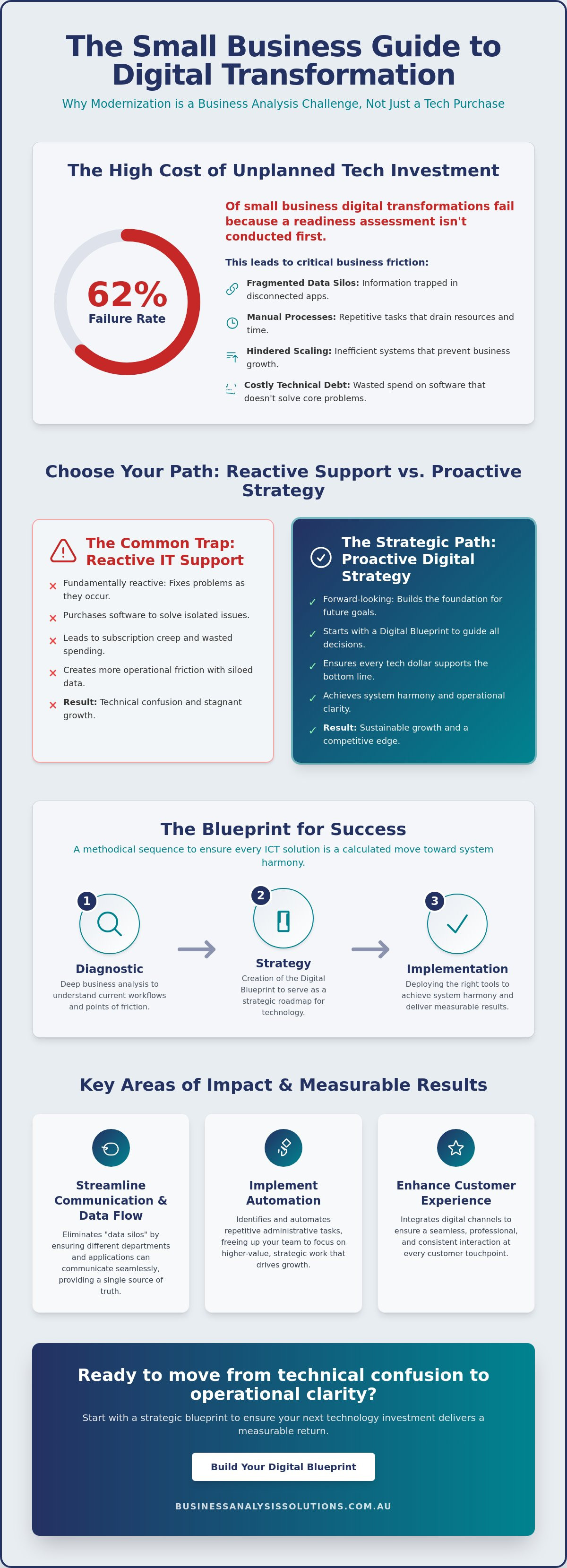
Research indicates that 62% of small business digital transformations fail because a readiness assessment isn't conducted before purchasing technology. This data highlights a critical reality for leadership: modernization is primarily a business analysis challenge rather than a software procurement task. If you've struggled with fragmented data across multiple apps or manual processes that hinder your scaling efforts, engaging a digital transformation consultant for small business provides the strategic clarity required to avoid costly technical debt. It's about ensuring that every tool you implement serves a specific, measurable objective within your broader organizational framework.
You likely feel that your current technology stack acts as a source of friction rather than a catalyst for efficiency. It's difficult to maintain momentum when you're forced to navigate siloed systems while fearing that the next software investment won't solve your core problems. This guide outlines how a structured digital strategy eliminates operational bottlenecks and secures sustainable growth. We'll examine the 2026 landscape, detailing how fractional CIO services and precise process mapping create a clear roadmap for tech investment. By the end, you'll understand how to achieve system harmony and drive measurable improvements in your bottom line.
Table of Contents
What is a Digital Transformation Consultant for Small Business?
Digital transformation isn't a simple upgrade of hardware or a migration to a new email provider. It's the strategic alignment of technology with specific business objectives to drive value. At its core, Digital Transformation involves integrating digital technology into all areas of a business, fundamentally changing how you operate and deliver value to customers. A digital transformation consultant for small business acts as the architect of this change. They bridge the gap between technical ICT solutions and high-level organizational goals. Instead of focusing on the latest gadgets, they prioritize operational efficiency and financial performance. This role is about problem-solving through a structured, methodical approach that treats technology as a tool for resolution rather than an end in itself.
The consultant's primary objective is to ensure that every dollar spent on technology directly supports the company's bottom line. They don't just suggest software; they perform deep business analysis to understand where friction exists within your current workflows. By focusing on system harmony, they help leadership move away from fragmented, reactive tech adoption. This analytical collaborator ensures that your technical infrastructure is robust, scalable, and, most importantly, logical. It's a move from ambiguity toward precision in how your business handles data and processes.
The Difference Between IT Support and Digital Strategy
Standard IT support is fundamentally reactive. It's designed to maintain current systems, fix broken hardware, and manage helpdesk tickets. This is essential for day-to-day operations, but it doesn't drive growth. In contrast, digital strategy is proactive. It looks at where the business needs to be in the future and builds the technical foundation to get there. Many small enterprises eventually outgrow their "IT guy" because they need more than troubleshooting. They require executive-level guidance to resolve systemic friction. A consultant moves beyond keeping the lights on to identifying how technology can create a competitive advantage through better resource allocation and process management.
Key Areas of Impact for Small Enterprises
The influence of a digital transformation consultant for small business extends across three primary domains. First, they streamline internal communication and data flow. This eliminates the "data silos" that occur when different departments use disconnected apps. Second, they focus on automation implementation. By mapping repetitive administrative tasks, they identify where software can take over, freeing staff for higher-value work. Finally, they enhance the customer experience. This is achieved by integrating digital channels to ensure a seamless, professional interaction at every touchpoint. This methodical approach ensures that tech investments yield a tangible return rather than becoming a sunk cost.
The 2026 Strategic Framework: Why You Need a Digital Blueprint First
A structured approach is the only way to avoid the common pitfalls of modernization. The digital transformation blueprint for business serves as the foundational document for any successful project. Without this roadmap, organizations often fall into the trap of purchasing software to solve isolated problems. This reactive procurement leads to siloed data, where information is trapped in disconnected applications, creating more operational friction than it resolves. A digital transformation consultant for small business prevents this by ensuring technology serves the strategy, not the other way around. It's about moving from a state of technical confusion to one of operational clarity.
Purchasing software without a blueprint is a high-risk strategy that rarely delivers the promised results. It leads to wasted spend on features you don't need and creates fragmented datasets that require manual reconciliation. This friction slows down growth and frustrates employees. Success in Navigating the Unique Challenges of Small Business Digitalisation depends on a methodical sequence: Diagnostic, Strategy, and then Implementation. This ensures that every ICT solution you deploy is a calculated move toward system harmony. If you're looking for a structured way to begin, engaging with Business Analysis & Solutions ensures your strategy is built on data rather than guesswork.
Process mapping identifies where your team is losing time. It might be redundant data entry or a lack of integration between your CRM and accounting software. Once these bottlenecks are visible, the consultant can recommend targeted ICT solutions. This diagnostic phase is the most critical part of the framework because it prevents you from investing in solutions that don't address the root cause of your inefficiency. It's illogical to automate a broken process; you must refine the workflow first to see a real return on investment.
Step 1: The Business Efficiency Diagnostic
The process begins by identifying core pain points within your existing workflows. This involves auditing your current software to discover underutilized features that might already solve your problems without additional spend. A business efficiency diagnostic is a logical audit of organisational health. By uncovering where resources are being wasted, you can redirect your budget toward tools that actually drive performance. This audit provides a clear baseline for measuring the success of future digital initiatives.
Step 2: Developing the Strategic Roadmap
Once the diagnostic is complete, you can prioritize technology investments based on their projected ROI and ease of implementation. A strategic roadmap ensures that all ICT solutions are scalable, allowing your infrastructure to grow alongside your revenue. This phase focuses on aligning digital changes with the long-term vision of the founders. Founders often have a clear destination but lack the technical map to reach it. The roadmap bridges this gap, translating high-level ambitions into specific technical requirements that support the broader business mission.
Navigating the Unique Challenges of Small Business Digitalisation
Financial discipline is paramount when modernizing operations. Small enterprises frequently fall into the trap of subscription creep, where multiple SaaS products are adopted without a central oversight mechanism. This leads to redundant costs and fragmented data. Effective budget management involves auditing every tool to ensure it provides a measurable return on investment. By adhering to digital transformation best practices, businesses can ensure their tech stack remains lean and purposeful. This methodical oversight prevents the accumulation of technical debt and ensures that capital is allocated to tools that drive tangible growth.
Change management is another critical hurdle. In tight-knit teams, the emotional response to new software is often more pronounced than in large corporations. Employees may resist new automation if they feel it complicates their daily workflows. Success depends on clear communication and demonstrating immediate value to the end-user. When staff see that a new process eliminates a repetitive administrative burden, adoption becomes organic. This transition requires a consultant who acts as an analytical collaborator, ensuring that the human element of the business isn't lost in the technical transition.
Overcoming Resource Constraints
Resource limitations don't have to stall progress. A phased implementation allows you to address the most critical bottlenecks first, spreading the investment over time. This approach focuses on high-impact, low-effort wins to build momentum and prove the strategy's efficacy. Leveraging low-code or no-code platforms, such as the Microsoft Power Platform, provides a cost-effective way to build internal tools without the high price tag of custom software development. This allows for rapid iteration and ensures that your technical infrastructure remains flexible as your business scales.
Bridging the Technical Knowledge Gap
Leaders don't need to be technical experts to make informed decisions. They need a partner who translates complex ICT jargon into plain English. The role of the consultant is to provide objective, third-party advice that keeps the leadership team in control of the technology. This ensures that technical requirements are always subordinate to broader organizational objectives. By removing the ambiguity surrounding digital tools, founders can make confident decisions that align with their long-term vision. This clarity is the foundation of professional competence in a digital-first economy.
The Fractional CIO: Executive IT Leadership On-Demand
Small businesses often lack the budget for a full-time Chief Information Officer but still face enterprise-level technical challenges. The Fractional CIO services Australia model solves this by providing executive-level IT leadership on a part-time or project basis. This allows leadership to access specialized expertise in digital strategy and ICT solutions without the financial burden of a six-figure salary. A digital transformation consultant for small business acting in this capacity ensures that technical investments are always aligned with broader organizational goals. It's a strategic partnership designed to provide clarity and direction during periods of growth or transition. This approach transforms IT from a cost center into a driver of financial performance.
One of the most significant advantages of this model is the provision of objective, unbiased advice. Because the consultant doesn't sell hardware or software, their recommendations are rooted purely in logic and business requirements. They manage vendor relationships and IT budgets with a focus on operational efficiency rather than sales quotas. This transparency builds trust and ensures that your technical infrastructure is built on the most effective solutions rather than the most convenient ones. This level of professional distance is essential for maintaining a clear-eyed view of your company's technical needs. It ensures that the solutions implemented are those that provide the highest degree of system harmony.
Strategic Technology Procurement
Evaluating vendors is a specialized skill that requires deep industry knowledge. A Fractional CIO assesses potential partners to ensure they meet specific business requirements and technical standards. This oversight prevents "vendor lock-in," a situation where a company becomes overly dependent on a single provider's proprietary systems. By maintaining ownership of the digital strategy, the business retains the flexibility to pivot as market conditions change. The consultant also negotiates contracts and service level agreements (SLAs) from a position of expertise, ensuring that performance metrics are clear and enforceable. This methodical approach to procurement protects the company's long-term interests.
Risk Management and Cybersecurity
In the 2026 landscape, security is a non-negotiable component of operational efficiency. A consultant ensures the business adheres to the Essential 8 framework, a set of prioritized mitigation strategies for Australian cybersecurity. This involves implementing robust data backup and disaster recovery protocols that are regularly tested to ensure they actually work when needed. Managing the risks associated with cloud computing and remote work requires a methodical approach to access control and data encryption. If you're ready to secure your technical future, you can engage with Fractional CIO services to build a resilient foundation that supports sustainable growth.
Implementation: Turning Strategy into Operational Reality
Implementation is the phase where strategic intent becomes operational reality. It's also where the highest risk of failure exists. Without expert project management, even the most robust digital strategy can stall due to poor resource allocation or technical bottlenecks. A digital transformation consultant for small business provides the necessary oversight to ensure that ICT solutions are integrated correctly and on schedule. They act as a single point of truth between your leadership team and technical vendors. This involves coordinating timelines, managing technical dependencies, and keeping the project aligned with the initial business efficiency diagnostic. Success requires a steady, methodical focus on the granular details of the transition to ensure no operational gaps remain.
User adoption is the final hurdle in any transformation project. If your team doesn't understand or value the new systems, the investment won't deliver a return. Training must be structured and outcomes-focused, ensuring that every staff member feels confident using the new workflows. The consultant's role includes facilitating this transition and ensuring that the human element of your business is supported throughout the change. This isn't just about showing people where to click; it's about explaining why the new process is superior. A professional hand-off ensures that your business can maintain these systems long-term, moving from consultant-led implementation to internal operational mastery.
Process Mapping and Automation
Process mapping identifies the specific sequences that are ripe for automation. By documenting each step of a workflow, you can spot redundancies that software can resolve. This reduces human error through the use of logical system triggers and standardized workflows. Automation is the execution of a well-mapped process. It's not a shortcut; it's a way to ensure that high-value tasks receive the attention they deserve while repetitive administration is handled by the system. This methodical approach ensures that automation implementation delivers a measurable reduction in operational friction.
Measuring Success and ROI
Transformation isn't complete until you've measured the results against your initial objectives. Setting clear KPIs, such as hours saved per week or a reduction in manual data entry errors, provides the data needed to justify the technical spend. Post-implementation reviews allow you to verify that the system harmony promised in the blueprint has been achieved. These reviews also help identify any minor refinements needed to fully optimize the new environment. Digital transformation is an ongoing journey of continuous improvement. As your business scales, your technical infrastructure must be reviewed and optimized to ensure it continues to support your financial performance goals.
Securing Your Digital Future through Strategic Alignment
Modernization is fundamentally a logic problem. It's about ensuring every technical component serves a broader organizational purpose. By focusing on a digital blueprint first, you eliminate the risk of siloed data and wasted investment. This structured path, guided by a digital transformation consultant for small business, ensures that your technology stack remains a catalyst for progress rather than a source of friction. Achieving system harmony requires a methodical approach that prioritizes long-term financial performance over short-term technical fixes.
With over 20 years of industry experience, Business Analysis & Solutions specializes in bridging technical and organizational gaps through specialized leadership and strategic blueprints. We provide the meticulous oversight required to resolve complex challenges and deliver end-to-end results through our Fractional CIO and strategy services. You can book a Business Efficiency Diagnostic with Business Analysis & Solutions to gain the clarity and direction needed for your next phase of growth. A methodical approach to technology is the most certain way to secure your company's competitive advantage and operational excellence in 2026.
Frequently Asked Questions
How much does a digital transformation consultant cost for a small business?
Industry data for 2026 indicates that hourly rates for transformation consultants vary based on specialization and firm size. In the US market, rates for small business consultants typically range from $75 to $175 per hour, while senior experts in high-demand fields like AI or cybersecurity command upwards of $300 per hour. The total investment depends on the project's complexity and the specific strategic outcomes required by your organization.
What is the difference between a digital consultant and an IT company?
An IT company primarily focuses on technical maintenance, hardware procurement, and reactive helpdesk support to keep existing systems operational. A digital transformation consultant for small business operates at a strategic level, performing business analysis to align technical infrastructure with organizational goals. They focus on process mapping and system harmony rather than just troubleshooting hardware issues or managing servers.
How long does a typical digital transformation project take?
Project timelines vary significantly based on the breadth of the digital transformation blueprint. A focused automation implementation might take three to six months, whereas a comprehensive organizational overhaul could span twelve months or longer. Most successful engagements utilize a phased approach to deliver incremental improvements and measurable ROI at each stage, ensuring that the business remains agile throughout the transition.
Do I need to replace all my current software to undergo transformation?
Replacing every application is rarely necessary or logical. The process begins with a business efficiency diagnostic to audit your current stack and identify underutilized features or integration gaps. The goal is to achieve system harmony by connecting existing tools or replacing only those that create significant operational friction. This approach protects your previous investments while ensuring your technical environment supports future growth.
Is my small business too small for a Fractional CIO?
The Fractional CIO model is specifically designed for organizations that require executive-level IT leadership but lack the resources for a full-time hire. If your business faces complex technical decisions, vendor management challenges, or cybersecurity compliance requirements, you're a candidate for this service. It provides the strategic guidance necessary to scale operations without the financial overhead of a traditional C-suite salary.
How do I know if my business is ready for digital transformation?
Your business is ready for transformation when manual processes and fragmented data silos begin to hinder growth or reduce financial performance. If your team spends excessive time on administrative tasks or if leadership lacks real-time visibility into operational data, a digital transformation consultant for small business can provide the necessary resolution. Readiness is defined by a commitment to resolving systemic friction through a structured approach.
What are the first steps in creating a digital transformation blueprint?
The foundational step in creating a digital transformation blueprint is a comprehensive business efficiency diagnostic. This involves mapping your current workflows to identify bottlenecks and auditing your technical infrastructure for scalability. Once you've identified the core pain points, you can develop a strategic roadmap that prioritizes investments based on their projected impact on your bottom line and organizational efficiency.
Can a consultant help with automation without custom software development?
Yes, modern automation implementation frequently leverages low-code or no-code platforms to achieve results without the expense of custom software development. By using tools like the Microsoft Power Platform, a consultant can create logical workflows and system triggers that connect your existing applications. This approach reduces human error and streamlines operations while maintaining technical flexibility and cost-efficiency for the business.



Comments