Digital Strategy for Business Growth: The 2026 Strategic Framework
Most mid-market companies aren't suffering from a lack of technology; they're suffering from an abundance of disconnected tools that consume capital without delivering a measurable return. You likely feel the friction of software systems that refuse to communicate, creating operational bottlenecks that hinder your ability to scale. Developing a cohesive digital strategy for business growth isn't about adding more icons to your desktop; it's about engineering a unified ecosystem where every technical asset serves a specific organizational objective.
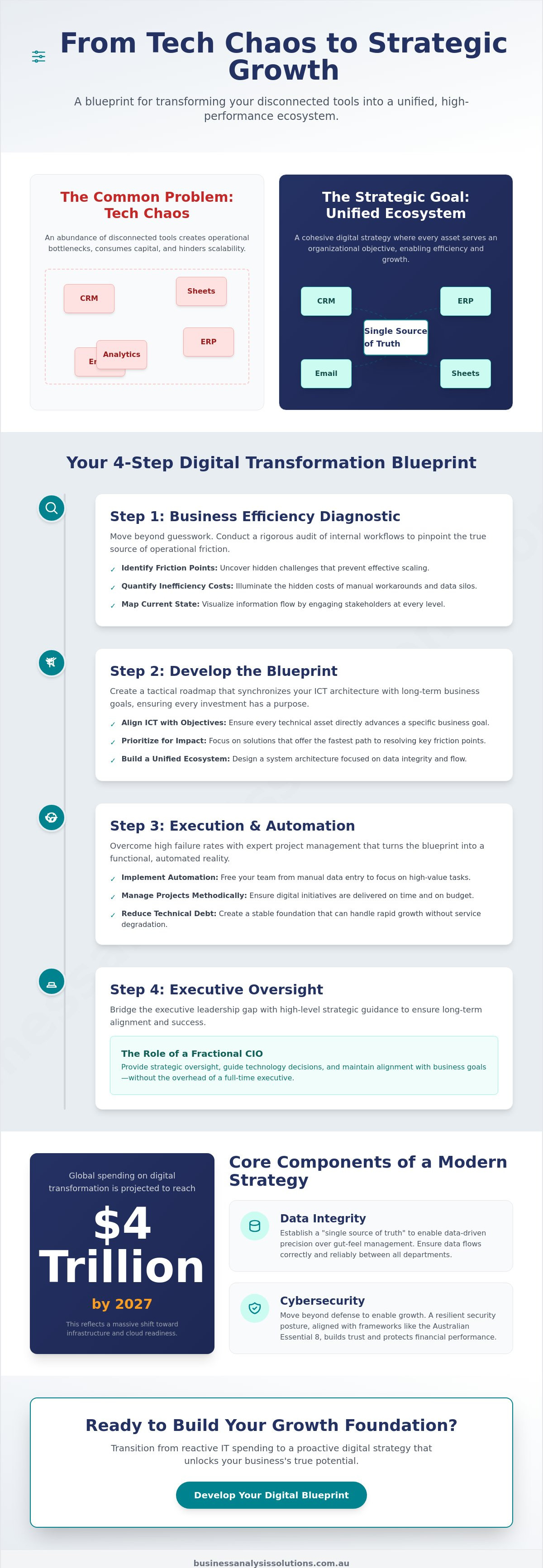
This guide will show you how to transition from reactive IT spending to a proactive Digital Transformation Blueprint that drives efficiency through automation. We'll explore a 2026 strategic framework that includes process mapping, business analysis, and the high-level ICT leadership necessary to turn your technology stack into a genuine competitive advantage. By aligning your digital assets with logical operational workflows, you can finally achieve the scalability and system harmony your business requires.
Key Takeaways
Understand how to align ICT solutions with organizational objectives to move beyond mere marketing visibility and establish a robust digital strategy for business growth.
Discover why a comprehensive Business Efficiency Diagnostic is the essential first step in identifying the operational friction points that prevent effective scaling.
Learn how to develop a Digital Transformation Blueprint that serves as a tactical roadmap for synchronizing your ICT architecture with long-term commercial goals.
Identify the critical role of expert project management and automation implementation in overcoming the high failure rates often seen during the execution phase of digital initiatives.
Explore the benefits of Fractional CIO services to bridge the executive leadership gap and provide high-level strategic oversight without the overhead of a full-time hire.
Table of Contents
What is a Digital Strategy for Business Growth in 2026?
In 2026, a digital strategy for business growth is the structural bridge between business goals and ICT execution. It's no longer a peripheral concern managed by a siloed IT department; it's a core component of a modern business strategy that dictates how an organization creates, delivers, and captures value. While many leaders conflate digital strategy with digital marketing, the two serve fundamentally different purposes. Marketing focuses on front-end visibility and customer acquisition. In contrast, a true digital strategy prioritizes the back-end architecture and ICT solutions that ensure those customers are served profitably and at scale.
Technology has transitioned from a passive support function to a primary growth engine. This shift requires a logical, methodical approach to tech procurement to prevent the "shiny object syndrome" that leads to fragmented software environments. When you choose tools based on individual features rather than their place in a unified ecosystem, you create silos. A professional digital strategy ensures every technical investment justifies its existence by directly advancing a specific organizational objective, maintaining a focus on clarity and reliability over marketing hype.
The Growth vs. Efficiency Paradox
Scaling an organization on a fractured digital foundation is a recipe for operational collapse. Growth acts as a stress test for your internal processes. If your systems don't talk to each other, increased volume simply magnifies existing bottlenecks. A mature digital strategy creates the capacity for expansion through automated workflows and system harmony. By reducing technical debt and manual data entry, you free your team to focus on high-value tasks rather than administrative troubleshooting. Efficiency isn't just about saving costs; it's about creating the structural stability required to handle rapid growth without service degradation.
Core Components of a Modern Strategy
Global spending on digital transformation is projected to reach $4 trillion by 2027, reflecting a massive shift toward infrastructure and cloud readiness. For a digital strategy for business growth to be effective in 2026, it must prioritize data integrity. Decision-makers need a "single source of truth" to move away from gut-feel management toward data-driven precision. This requires high-level business analysis to ensure data flows correctly between departments.
Cybersecurity has also evolved into a critical growth enabler. In the current landscape, security isn't just a defensive measure; it's a prerequisite for trust and national scalability. Aligning with established frameworks, such as the Australian Essential 8, provides a structured approach to risk management. This methodical security posture ensures that your growth is built on a resilient foundation, protecting your financial performance and your reputation in an increasingly complex digital economy.
The Growth Foundation: Conducting a Business Efficiency Diagnostic
Successful implementation of a digital strategy for business growth requires more than a vision; it demands a forensic understanding of your current operational state. Without a comprehensive Business Efficiency Diagnostic, any technological investment is merely an expensive guess. This diagnostic serves as a rigorous audit of your internal workflows, identifying the specific friction points that prevent your organization from scaling effectively. By quantifying the hidden costs of manual workarounds and fragmented data silos, you can move from subjective complaints to objective, data-driven decisions.
Quantifying the cost of operational inertia is vital for executive buy-in. When data is trapped in fragmented silos, your team spends more time reconciling spreadsheets than analyzing insights. These manual workarounds represent a form of technical debt that compounds as you grow. A methodical diagnostic illuminates these costs, allowing you to prioritize high-impact ICT solutions that offer the fastest path to resolution. It's about moving from a reactive stance to one of professional competence where technology is a controlled asset rather than a source of constant frustration.
Mapping Your Current State
Mapping your current state involves detailed process mapping to visualize how information moves through your business. This isn't just a technical exercise; it requires engaging stakeholders at every level to uncover the hidden challenges that don't appear on standard reports. Often, there's a significant gap between how leadership believes a process works and the reality of daily operations. Evaluating current software utilization against actual business requirements frequently reveals that organizations are paying for features they don't use while lacking the core ICT solutions needed for efficiency. If you're ready to identify these gaps, a professional Business Efficiency Diagnostic provides the clarity required to proceed with confidence.
Setting Benchmarks for Digital Growth
Establishing benchmarks is the final step in creating a foundation for growth. You must define clear key performance indicators (KPIs) that link ICT performance directly to financial outcomes and business efficiency. Effective Digital Transformation Strategies rely on these metrics to justify ongoing investment. By creating a baseline now, you ensure that future progress is measurable and that every step of your digital strategy for business growth contributes to a tangible return on investment. This methodical approach builds trust and reinforces the stability of your partner relationship.
Developing Your Digital Transformation Blueprint
A digital strategy for business growth remains a theoretical exercise until it's translated into a tactical roadmap. This roadmap, or blueprint, serves as the engineering grade documentation for your organization's future. It moves beyond high-level goals to define the specific ICT architecture required to support your commercial objectives. A methodical blueprint prevents the common mistake of implementing software in a vacuum; instead, it ensures that every new tool integrates seamlessly into a broader, logical ecosystem.
The development of this blueprint follows a four-step sequence designed to ensure structural integrity:
Step 1: Aligning ICT Architecture: We map your technical infrastructure against long-term scaling goals to ensure the foundation can handle increased load.
Step 2: Designing Data Flows: We engineer the communication pathways between departments, ensuring that information moves from sales to operations without manual intervention.
Step 3: Logical Technology Selection: We identify ICT solutions based on functional requirements and process compatibility rather than marketing promises.
Step 4: Phased Implementation: We create a realistic timeline that manages organizational change in manageable stages, reducing the risk of operational shock.
Bridging the Technical-Executive Gap
One of the primary reasons digital initiatives stall is a lack of alignment between technical teams and the board. Your digital transformation blueprint must serve as a translation layer that turns technical requirements into clear business value. This requires strategic planning that addresses the human element of change. By focusing on how these systems improve financial performance and employee capacity, you secure the executive buy-in necessary for long-term success. An agile approach ensures the blueprint can adapt to shifting market conditions without losing sight of the core digital strategy for business growth.
Technology Selection and Architecture
In 2026, the focus has shifted from "best-of-breed" software to "best-of-fit" solutions. A tool that's excellent in isolation is a liability if it doesn't integrate with your existing stack. We prioritize API-first thinking to future-proof your growth, ensuring that your systems remain open to future connections. For national Australian operations, the choice between cloud and hybrid models must be based on objective criteria like data sovereignty, latency, and cost-efficiency. This methodical selection process ensures that your architecture remains a stable asset that supports, rather than hinders, your expansion.
Execution Strategy: Project Management and Automation
Execution is where the most sophisticated digital strategy for business growth faces its greatest challenge. Industry data suggests that approximately 70% of digital transformations fail to meet their original objectives during the implementation phase. This failure usually stems from a lack of disciplined project management rather than technical limitations. Expert oversight is required to ensure that ICT solutions are delivered on time, within budget, and in full alignment with the pre-defined Digital Transformation Blueprint. Without this rigour, even the best strategic intentions can result in fragmented systems and wasted capital.
Maintaining operational continuity during a transition is a non-negotiable requirement for professional leadership. A phased rollout ensures that business-as-usual activities remain stable while new systems are introduced. This methodical approach minimizes the risk of service disruptions that can damage client relationships and financial performance. By treating the implementation as a series of controlled milestones, you maintain the stability of your current operations while building the capacity for future expansion.
Automation Implementation for Scalability
Implementing automation allows an organization to remove repetitive, low-value tasks from human workloads. By shifting high-volume, low-complexity processes like data entry or report generation to automated systems, you free up human capital for strategic initiatives that drive revenue. Research from early 2026 indicates that companies utilizing marketing automation see an average of a 544% return on investment over three years. This level of efficiency is achievable when you integrate tools like the Microsoft Power Platform into your custom workflows, ensuring that automation serves your specific operational logic rather than forcing you to adapt to rigid software constraints.
Risk Mitigation in Digital Projects
Managing vendor relationships and technical deliverables requires a firm grasp of industry standards and service level agreements. It's not enough to purchase software; you must manage the implementation with the same precision as any other capital project. Rigorous testing and quality assurance protocols must be completed before a full rollout to ensure data integrity and system harmony. The creation of a formal requirements document serves as a foundational safeguard, establishing clear boundaries that prevent project scope creep from compromising your timeline or budget. If your organization requires assistance in navigating these complexities, our Project Management services provide the methodical oversight necessary to deliver tangible results and secure your digital strategy for business growth.
Executive Oversight: The Role of a Fractional CIO
Mid-market organizations frequently encounter a strategic void where technical decisions are made in isolation from commercial goals. While these firms face enterprise-level complexities, the cost of a full-time Chief Information Officer is often prohibitive. This executive leadership gap results in reactive IT spending and missed opportunities for operational harmony. A Fractional CIO resolves this by providing high-level strategic oversight on a project or part-time basis, ensuring your digital strategy for business growth remains aligned with your organizational vision.
This role functions as an analytical collaborator at the executive table. Instead of focusing on individual software features, the Fractional CIO evaluates how every technical asset contributes to financial performance and scalability. Research indicates that approximately 65% of mid-sized enterprises now report using at least one fractional C-suite leader, with the CIO role being the most in-demand after the CFO. This partnership offers the quiet confidence needed to navigate complex ICT investments, ensuring that every dollar spent on technology is a calculated move toward a specific business outcome.
Strategic vs. Tactical IT Management
It's a common misconception that a managed service provider (MSP) can fulfill the role of a digital strategist. An MSP is primarily tactical, focusing on ticket resolution and system uptime. While these functions are necessary, they aren't a substitute for executive-level ICT leadership. A Fractional CIO bridges the gap between external vendors and internal business goals. They don't just keep the lights on; they drive the digital strategy for business growth by ensuring your ICT solutions are integrated, efficient, and capable of supporting rapid expansion. This strategic focus shifts the conversation from technical maintenance to long-term value creation.
Achieving Sustainable Digital Growth
A successful digital strategy is never a static document. It must be a living framework that evolves alongside market shifts and emerging technologies. Achieving sustainable growth requires continuous improvement and rigorous ICT governance. By leveraging Fractional CIO services, organizations can implement a cycle of regular reviews and adjustments, ensuring the strategy remains relevant for 2027 and beyond. This ongoing oversight ensures that your Digital Transformation Blueprint stays agile, allowing your business to capitalize on new efficiencies while maintaining a stable, secure foundation. Professional governance is the final piece of the puzzle, turning technical potential into a permanent competitive advantage.
Securing Your Operational Future
A resilient digital strategy for business growth isn't a luxury; it's the structural foundation for any organization intending to scale in 2026. You've seen how a methodical approach, starting with a forensic diagnostic and moving through a tactical blueprint, replaces technical debt with operational harmony. By bridging the gap between high-level business objectives and granular ICT execution, you ensure that every technical investment delivers measurable financial value rather than just another software subscription.
With over 20 years of industry experience, we specialize in providing the executive-level leadership and analytical collaboration required to solve complex organizational challenges. Our national Australian service coverage ensures that your business receives consistent, professional oversight regardless of location. To move from fragmented systems to a unified growth engine, the first step is a logical assessment of your current state. Request a Business Efficiency Diagnostic to Kickstart Your Growth and begin your transition toward a more efficient, scalable future. Your organization's potential is best realized through precision and strategic clarity.
Frequently Asked Questions
How do I start creating a digital strategy for business growth?
The process begins with a Business Efficiency Diagnostic to establish an objective baseline of your current operations. This diagnostic involves detailed process mapping to identify the specific friction points and data silos that hinder your ability to scale. Once you've identified these operational gaps, you can begin aligning ICT solutions with your commercial objectives to form a cohesive digital strategy for business growth.
What is the difference between digital transformation and digital strategy?
Digital strategy is the structural plan that aligns technology with organizational outcomes, whereas digital transformation is the broader execution of that plan. The strategy provides the logical framework and the "why" behind technical procurement. Transformation involves the actual implementation of the Digital Transformation Blueprint, which includes the cultural and operational shifts required to achieve system harmony.
How much should a business invest in a digital strategy blueprint?
Investment levels are determined by the complexity of your current ICT architecture and your long term scaling goals. Rather than focusing on a fixed cost, businesses should evaluate the investment relative to the potential reduction in technical debt and manual workarounds. A professional blueprint prevents capital waste by ensuring every technical acquisition is justified by its contribution to operational efficiency and financial performance.
Why do most digital growth strategies fail during implementation?
Implementation failure, which affects approximately 70% of digital initiatives, is typically caused by a lack of disciplined project management and formal requirements. Without professional oversight, projects often suffer from scope creep and a lack of alignment between external vendors and internal business goals. A methodical execution strategy is required to move from high level vision to granular, functional reality.
Can a small business benefit from Fractional CIO services?
Mid-market and smaller organizations benefit from Fractional CIO services by accessing executive level ICT leadership without the burden of a full time salary. This model is highly effective for organizations that require sophisticated strategic planning but don't have the internal capacity for high level ICT governance. It provides the quiet confidence needed to make complex technical decisions that support a digital strategy for business growth.
How do I measure the ROI of my digital strategy?
You should measure ROI by tracking specific performance indicators like reduced processing times, improved data integrity, and increased output capacity. For instance, research indicates that companies see an average of a 544% return on investment over three years from marketing automation. By linking these technical improvements directly to financial outcomes, you can clearly demonstrate the tangible value of your strategic investments.
What role does cybersecurity play in a growth-focused digital strategy?
Cybersecurity is a fundamental growth enabler that protects your operational resilience and brand reputation. In 2026, aligning with frameworks like the Australian Essential 8 is a prerequisite for national scalability and trust. Robust security measures ensure that your expansion is built on a resilient foundation, preventing the technical disruptions that could otherwise compromise your long term financial performance.
How long does it take to see results from a new digital strategy?
The timeline for measurable results depends on the phased implementation schedule defined in your roadmap. While initial wins from automation implementation can often be realized within the first 90 days, the full impact of a unified strategy typically matures over six to twelve months. This steady, methodical progression ensures that new systems are fully integrated and that operational continuity is maintained throughout the transition.



Comments