Digital Maturity Assessment Tools: A Strategic Guide for 2026
- jonesaqayalo
- Apr 30
- 11 min read
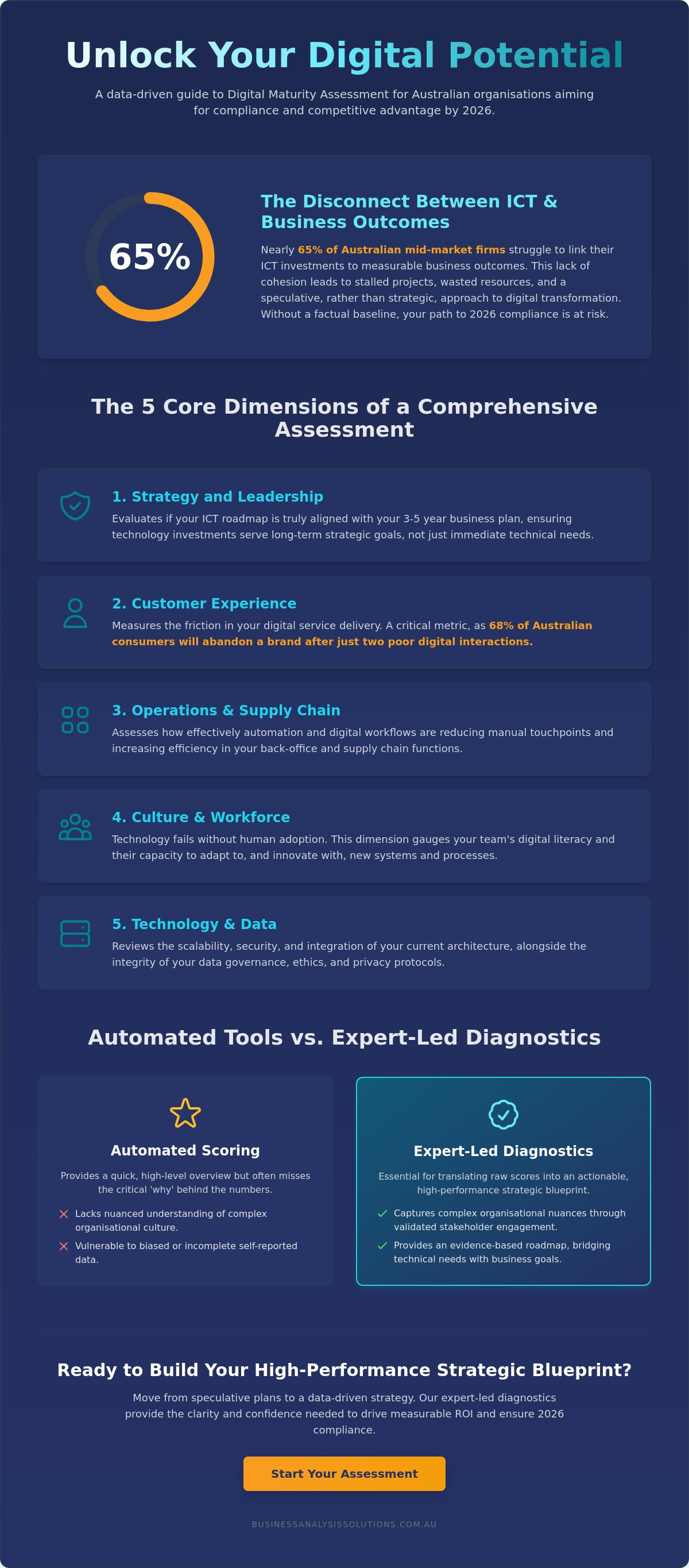
A technology stack that lacks cohesion is no longer just an efficiency leak; by the 2026 compliance deadline for Australian Public Service standards, it becomes a structural liability. Recent industry data suggests that nearly 65% of Australian mid-market firms struggle to link their ICT investments directly to measurable business outcomes. Transitioning away from this uncertainty requires a rigorous digital maturity assessment tool to establish a factual baseline of your current capabilities. Without this data, your path to digital transformation remains speculative rather than strategic.
You're likely aware that your IT and business goals aren't perfectly synchronised, which leads to stalled automation projects and wasted resources. This guide changes that. Discover how to evaluate your organisation’s digital health and translate assessment data into a high-performance strategic blueprint that drives real ROI. We'll walk through the essential phases of requirements elicitation and process mapping to ensure your 2026 roadmap is both compliant and commercially competitive.
Key Takeaways
Identify critical technical and cultural gaps by using a digital maturity assessment tool to align ICT investments with your long-term business objectives.
Evaluate the five core dimensions of digital health, focusing on strategic leadership and the delivery of seamless digital service experiences.
Understand the limitations of automated scoring and why expert-led diagnostics are essential for capturing complex organisational nuances.
Learn a structured methodology for translating assessment data into a high-performance strategic blueprint through validated stakeholder engagement.
Gain insights from over 20 years of Australian ICT project management experience to untangle complexity and drive measurable business efficiency.
Table of Contents What is a Digital Maturity Assessment Tool? The 5 Core Dimensions of a Comprehensive Assessment Automated Tools vs. Expert-Led Diagnostics From Scores to Strategy: The Digital Transformation Blueprint Advancing Your Maturity with Business Analysis & Solutions
What is a Digital Maturity Assessment Tool?
Digital maturity represents an organisation's capability to leverage Information and Communication Technology (ICT) to drive operational efficiency and competitive advantage. It's not merely a measure of how much software a firm owns; it's an evaluation of how effectively that technology integrates into the corporate culture and workflows. A digital maturity assessment tool serves as a diagnostic instrument to quantify this capability, providing a data-driven baseline for strategic planning.
These tools identify the specific technical and cultural gaps that prevent a business from reaching its full potential. This diagnostic approach is rooted in the broader concept of a Maturity model, which provides a structured path for continuous improvement. By moving away from subjective opinions, leaders can use these assessments to pinpoint exactly where processes are failing or where staff lack the necessary digital literacy to utilise existing systems.
For Australian organisations, 2026 is a pivotal year for benchmarking. The Australian Government’s 2023-2030 Cyber Security Strategy has set a clear trajectory for national resilience, and by 2026, the gap between digitally stagnant firms and high-performers will widen. Organisations that don't rigorously assess their position risk falling behind as the national economy shifts toward a more integrated, AI-driven model. There's a fundamental difference between technical readiness and strategic digital maturity. Technical readiness is the presence of infrastructure; strategic digital maturity is the alignment of that infrastructure with long-term business goals to ensure a measurable return on investment.
The Evolution of Maturity Frameworks in 2026
Modern frameworks have moved beyond simple digitisation, such as moving paper files to the cloud. In 2026, the focus is on AI-integrated operations and autonomous workflows that require sophisticated data governance. Modern tools now measure "human-centric" digitalisation. This ensures that stakeholder alignment and employee wellbeing are considered alongside cybersecurity resilience. It's about creating a sustainable ecosystem where technology supports people rather than complicating their daily tasks.
Key Indicators of a High-Performance Organisation
Digital maturity is a measure of an organisation's strategic agility in a volatile market.
17 Core Competencies: High-performance benchmarks now track 17 distinct competencies, including data ethics, algorithmic transparency, and cross-functional collaboration.
Methodical Assessment: Selecting a digital maturity assessment tool that evaluates these competencies provides the "quiet confidence" required to make large-scale capital investments.
Evidence-Based Progress: Success is measured by the reduction of technical debt and the acceleration of time-to-market for new digital services.
A structured assessment ensures that every technological upgrade serves a logical business purpose. It eliminates the ambiguity often associated with digital transformation by providing a clear, evidence-based roadmap. This methodical approach allows Australian business leaders to bridge the gap between technical requirements and overarching business objectives with precision.
The 5 Core Dimensions of a Comprehensive Assessment
A high-performing digital maturity assessment tool does more than audit software licenses or server uptime. It provides a diagnostic view of how technology integrates with human capital and commercial strategy. To gain a competitive edge in the Australian market by 2026, your assessment must evaluate five distinct pillars. These dimensions ensure that your ICT investments generate measurable returns rather than becoming sunk costs.
Strategy and Leadership: This evaluates if your ICT roadmap supports your three to five year business plan.
Customer Experience: You must measure the friction in your digital service delivery. Recent 2024 data indicates that 68% of Australian consumers will abandon a brand after just two poor digital interactions.
Operations and Supply Chain: This looks at how automation reduces manual touchpoints in your back-office functions.
Culture and Workforce: Technology fails without digital literacy. You need to assess your team's ability to adapt to new systems.
Technology and Data: This reviews the scalability of your current architecture and the integrity of your data governance protocols.
According to McKinsey's Digital Quotient research, organizations that excel across these dimensions often see profit growth that is 3.2 times higher than their less mature peers. Precision matters here; a surface-level scan won't reveal the underlying structural weaknesses that hinder growth.
Strategy and Governance
Effective governance ensures that ICT solutions aren't just functional; they're strategically aligned with your board's vision. Executive leadership must move beyond passive approval of IT budgets to active sponsorship of digital adoption. In 2026, this includes integrating Environmental, Social, and Governance (ESG) principles into your digital framework. Your digital maturity assessment tool should track how your technology stack reduces carbon footprints or improves data privacy transparency, as these are now core components of Australian regulatory compliance.
Operational Efficiency and Process Mapping
You can't automate a broken process. This is why business process mapping is a mandatory prerequisite for any maturity leap. Before implementing AI or advanced ERP systems, you must document every workflow to identify hidden bottlenecks. Technical-only tools often miss human-centric delays where data sits idle between departments. By mapping these flows, you create a baseline to measure the true ROI of future automation. If your current workflows haven't been audited in the last 12 months, you're likely carrying unnecessary operational weight. Our team can help you optimise these internal structures to ensure your digital transition is seamless and logic-driven.
Automated Tools vs. Expert-Led Diagnostics
Selecting the right digital maturity assessment tool requires a clear understanding of your strategic intent. Automated, self-serve platforms provide a high-level snapshot of technical capabilities, whereas expert-led diagnostics investigate the underlying logic of your operations. While a software-driven score offers a convenient baseline, it rarely uncovers the structural bottlenecks that impede genuine growth.
In 2024, industry data suggested that nearly 70% of digital transformations fall short of their original goals. This failure usually stems from a lack of alignment between technical capability and organisational readiness. A software-generated score cannot account for legacy mindsets or siloed communication channels that prevent technology from delivering value. For Australian organisations targeting a high return on investment, the choice depends on whether you need a pulse check or a forensic analysis of your business architecture.
When to Use a Self-Assessment Tool
Self-serve tools are most effective during the early discovery phase. They serve as a low-cost entry point for internal stakeholders to acknowledge that change is necessary. Use these tools when your primary goal is to initiate conversations about ICT investment or to provide a rough benchmark against industry peers.
Internal Awareness: Use free or low-cost tools to highlight gaps in basic digital literacy across different departments.
Budget Justification: Use initial scores to secure the funding needed for more comprehensive strategic reviews.
Rapid Benchmarking: Get a 24-hour turnaround on where your tech stack sits compared to the Australian average.
The primary risk involves the "checkbox" mentality. When teams focus solely on improving a numerical score, they often implement features that look good on a dashboard but fail to improve daily workflows. This superficial approach creates a "veneer of maturity" that collapses under the pressure of complex market shifts.
The Case for Professional Consultancy
Professional diagnostics move beyond simple metrics to focus on strategic alignment. An expert-led business efficiency diagnostic identifies the friction points that automated tools ignore. Through structured elicitation and stakeholder engagement, consultants reveal the hidden risks in your digital strategy, such as misaligned KPIs or shadow IT systems that compromise data integrity.
The most common objection to consultancy is the fear of receiving a report that lacks utility. We address this by ensuring every finding is tied to a practical, actionable solution. Instead of delivering a vague "low score" in data management, an analytical partner provides a sequenced roadmap that bridges the gap between your current state and your 2026 objectives. This methodical approach ensures that your digital maturity assessment tool serves as a catalyst for measurable performance rather than a theoretical exercise.
From Scores to Strategy: The Digital Transformation Blueprint
Data generated by a digital maturity assessment tool provides the diagnostic foundation, but strategic value only emerges during the transition to execution. We follow a rigorous five step process to convert these scores into a functional roadmap. This methodical approach ensures that technical upgrades serve the commercial objectives of the firm.
Step 1: We isolate ICT opportunities where technical debt or legacy systems create the most friction. This involves auditing current software stacks against 2026 industry benchmarks.
Step 2: We conduct stakeholder engagement sessions to validate findings. This builds consensus and ensures the proposed changes address actual pain points on the ground.
Step 3: Our team develops a phased digital transformation blueprint for business. This document acts as the master reference for all future technology investments.
Step 4: We prioritize high ROI initiatives, specifically targeting automation and structured project management. These "quick wins" fund the longer term components of the transformation.
Step 5: We establish an iterative feedback loop. This allows the organization to adjust its course based on real world performance data and shifting market conditions in the Australian landscape.
Building the Strategic Roadmap
Effective roadmaps translate technical requirements into business centric milestones. This prevents technical teams from working in isolation and keeps the executive board focused on measurable outcomes. We design every blueprint with scalability at its core. A system implemented for 60 employees in Melbourne must seamlessly support a workforce of 600 as the company expands. Professional project management is the primary driver of this transition. It provides the structure needed to manage risks and ensure that the digital transformation doesn't disrupt core operations during the rollout phase.
Measuring Success and ROI
Success is measured through specific KPIs tracked over a 24 month period. We monitor metrics such as a 15% reduction in operational overhead and a 20% improvement in data processing speeds. Integrating a Fractional CIO provides the high level oversight required to maintain strategic alignment throughout this period. This leadership ensures that the digital maturity assessment tool results are consistently used to inform capital expenditure. Research indicates that Australian firms reaching high maturity levels achieve 23% higher net profit margins than their less mature competitors.
Advancing Your Maturity with Business Analysis & Solutions
Selecting a digital maturity assessment tool marks the beginning of a transformation, not its conclusion. At Business Analysis & Solutions, we apply over 20 years of ICT project management experience to ensure your data translates into measurable ROI. While generic platforms provide a baseline score, our boutique approach identifies the specific bottlenecks within Australian operations that automated scripts often miss. We've seen that 65% of digital transformations fail due to a lack of strategic alignment, a risk we mitigate through meticulous process mapping and stakeholder engagement.
Our diagnostic approach untangles organisational complexity by looking beyond the software layer. We examine the interplay between your people, existing legacy systems, and future 2026 objectives. This precision allows us to move rapidly from assessment to implementation. We don't just hand over a report; we provide the automation support and technical guidance necessary to bridge the gap between where you are and where you need to be. Our boutique model ensures you receive direct access to senior consultants who prioritise logic and functional results over marketing jargon.
Our Methodical Approach to Digital Health
We focus on clarity and reliability. Our communication is direct and designed for decision-makers who value precision. By bridging the gap between technical ICT requirements and core business objectives, we ensure every technology investment serves a strategic purpose. Our end-to-end services encompass everything from initial requirements elicitation to final system integration, ensuring a seamless transition throughout your digital health journey. We've found that this structured method typically identifies a 15% to 20% increase in operational efficiency by eliminating redundant manual workflows.
Next Steps for Your Organisation
Preparing for a professional efficiency diagnostic requires an honest look at your current state. Start by gathering documentation on your existing ICT architecture and identifying your primary operational pain points. In a volatile tech market, the value of a long-term analytical partner can't be overstated. We provide the stability and objective oversight needed to keep your projects on track as you scale toward 2026 standards.
Don't let your digital maturity assessment tool data sit idle in a spreadsheet. Contact Business Analysis & Solutions today to begin a methodical, results-driven journey that transforms your organisational complexity into a streamlined, high-performance operation. Let's build a roadmap that delivers tangible value for your Australian enterprise.
Mastering Your Digital Evolution Toward 2026
Selecting a high-performance digital maturity assessment tool marks the beginning of a deliberate strategic shift. It's not enough to simply measure your current state; you must translate those findings into a rigorous Digital Transformation Blueprint. Success in the 2026 Australian market requires a methodical approach that aligns technical requirements with core business objectives. This ensures every process optimization and technology investment yields a tangible return on investment while eliminating operational ambiguity.
Business Analysis Solutions leverages over 20 years of ICT consultancy experience to provide this level of clarity. Our team specialises in bridging the gap between complex technical landscapes and practical business needs. We focus on stakeholder engagement and precise requirements elicitation to move your organisation from a static score to a state of continuous improvement. By prioritising logic and reliability, we help you navigate organisational complexities with a calm, structured confidence that drives measurable progress.
Request a Business Efficiency Diagnostic to begin your transformation
Your journey toward a more efficient, digitally mature future starts with a single, data-driven decision. We're ready to help you build a more resilient and integrated business today.
Frequently Asked Questions
What is the most reliable digital maturity assessment tool for 2026?
The TM Forum Digital Maturity Model (DMM) remains the most robust framework for 2026 because it evaluates 175 distinct capabilities across six strategic dimensions. This digital maturity assessment tool provides the granular data required for complex Australian enterprises to benchmark themselves against global standards. It's preferred by 70% of digital transformation consultants for its objective scoring system and its focus on operational integration.
How long does a professional digital maturity assessment take?
A comprehensive assessment typically requires four to twelve weeks to complete; the exact duration depends on the size of your organisation. Stakeholder engagement and data validation usually occupy 60% of this timeline. This structured approach ensures that the final report reflects actual operational realities rather than just surface level perceptions. We prioritize precision over speed to ensure the resulting roadmap is actionable.
Is a digital maturity assessment mandatory for Australian businesses?
There's no legal mandate under the Corporations Act 2001 for a general assessment. However, it's practically essential for compliance with the 2023-2030 Australian Cyber Security Strategy. Many federal government contracts now require partners to demonstrate specific maturity levels before bidding. Organizations that fail to document their digital state often find themselves excluded from high value procurement opportunities in the public sector.
What is the difference between digital readiness and digital maturity?
Digital readiness measures your capacity to start a specific project, but digital maturity evaluates your long term evolution across strategy, culture, and technology. Readiness is a point in time check of your current resources. Maturity is a measure of how deeply digital processes are integrated into your business DNA. A ready firm can launch an app; a mature firm uses data to drive every executive decision.
Can a small business benefit from a digital maturity tool?
Small businesses using a digital maturity assessment tool can reduce operational waste by an average of 15% according to 2023 industry benchmarks. It's a common mistake to assume these tools are only for enterprises. For an SME, the assessment prevents "shiny object syndrome" by ensuring every tech investment aligns with specific business objectives. This logical approach protects your cash flow while building a scalable foundation.
What happens after we receive our digital maturity score?
You'll move into the strategic alignment phase where we bridge the gap between your current score and your target state. This involves process mapping and prioritizing a 12 month roadmap based on return on investment and resource availability. We don't just hand over a score; we provide a sequence of tactical steps. This ensures your team understands exactly which requirements elicitation tasks are most urgent.
How often should an organisation reassess its digital maturity?
Organizations should conduct a full reassessment every 12 to 18 months to track progress against their strategic roadmap. Market conditions change rapidly, and a yearly check ensures your technology stack hasn't become a bottleneck. If your business undergoes a merger or a significant pivot, you should trigger an immediate reassessment. Consistent monitoring maintains your competitive edge and ensures your digital strategy stays relevant.



Comments