Digital First Business Strategy: A Strategic Framework for 2026
Updated: Jun 22
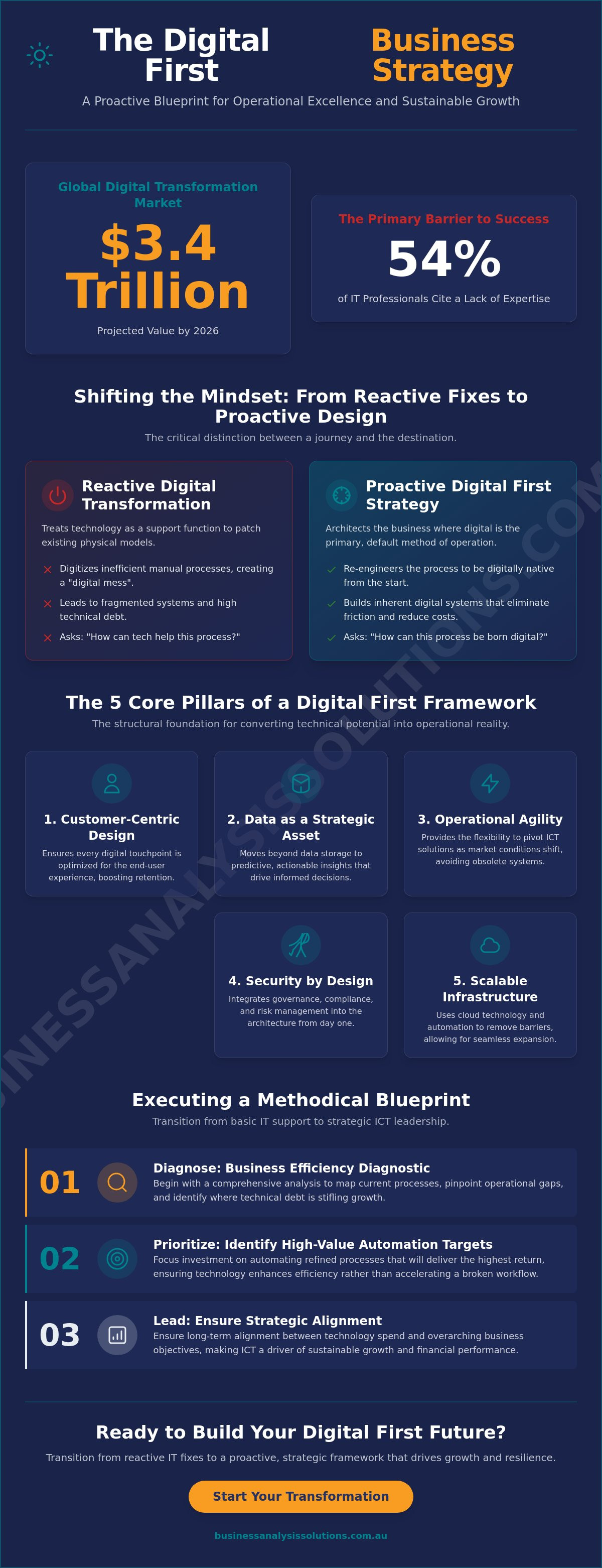
While the global digital transformation market is projected to reach $3.4 trillion by 2026, 54% of IT professionals report that a lack of expertise remains the primary barrier to success. You've likely experienced the friction of fragmented systems that refuse to communicate; it's a common hurdle that drives up operational costs and creates significant technical debt. Adopting a digital first business strategy isn't merely about purchasing new software. It requires a fundamental shift from reactive technology fixes to a proactive, logical framework where digital tools serve as the primary engine for value creation.
We understand that scaling a business becomes nearly impossible when manual processes consume your team's capacity. This guide will show you how to transition to a proactive mindset that prioritizes operational efficiency and long-term stability. We'll provide a clear roadmap for digital maturity, covering essential components like process mapping and automation implementation. By the end of this article, you'll have a strategic blueprint to align your ICT spend with measurable business outcomes, ensuring your organization is resilient and ready for the regulatory demands of 2026.
Table of Contents
What is a Digital First Business Strategy?
A digital first business strategy represents a fundamental architecture where digital engagement is the primary, rather than secondary, method of operation. It isn't a department; it's the default logic governing every internal process and customer interaction. Historically, businesses treated technology as a support function to be integrated into existing physical models. By 2026, this "integrated IT" approach is insufficient. The objective has shifted toward creating "inherent digital" systems that eliminate the friction between a customer's requirement and the organization's delivery.
The Evolution of Digital Maturity
Manual processes and paper records defined the legacy approach to business. Most organizations moved past this by digitizing their records, but they often kept the same inefficient workflows. The transition phase involves automated workflows, where software handles the movement of data. However, the digital-first end-state goes further. It focuses on autonomous operations where data-driven decision making is baked into the system. In this environment, leaders spend less time on coordination and more time on strategic planning.
Digital First vs. Digital Transformation
It's helpful to view Digital Transformation as the journey and digital-first as the destination. Many transformation projects fail because they simply digitize inefficient manual processes. This mistake creates a "digital mess" rather than operational harmony. A proactive digital first business strategy re-engineers the process itself before applying any technology. This ensures that the system is optimized for speed and scalability from the outset.
Successful implementation requires a structured methodology. Utilizing a Digital Transformation Blueprint allows an organization to map its current state and identify where technical debt is stifling growth. By focusing on the end-state first, you avoid the common trap of adopting "shiny" new tools that don't actually solve core business problems. This methodical approach ensures that every dollar of ICT spend contributes directly to sustainable growth and improved financial performance.
The 5 Core Pillars of a Digital First Framework
A robust digital first business strategy rests on five structural pillars that convert technical potential into operational reality. First, customer-centric design ensures that every digital touchpoint serves the user experience directly. Second, treating data as a strategic asset allows leadership to move beyond simple storage toward predictive, actionable insights. According to various Digital Transformation Statistics, companies that prioritize digital experience see significantly higher retention rates. Third, operational agility provides the flexibility to pivot ICT solutions as market conditions shift, ensuring the business doesn't become tethered to obsolete systems. Fourth, security by design integrates governance and compliance into the architecture itself from the initial planning phase. Finally, scalable infrastructure uses cloud technology and automation to remove the physical and technical barriers to growth, allowing for seamless expansion.
Operational Efficiency Through Process Mapping
You cannot achieve a digital-first state without accurate business process mapping. Technology often fails when it's applied to broken manual workflows. Identifying bottlenecks requires a logical analysis of how value moves through your organization. If a system doesn't harmonize across all departments, it creates silos that drive up costs and frustrate employees. Mapping ensures that automation enhances a refined process rather than accelerating an inefficient one. This methodical clarity is the foundation of any successful ICT investment. If you're unsure where your current system friction lies, exploring a professional Digital Strategy can help align your technology with your business goals.
Governance and the Essential 8
In the Australian context, a digital first business strategy must align with the Essential 8 cybersecurity framework. This is not just a technical checklist; it's a governance requirement for protecting digital assets in an increasingly volatile environment. For organizations seeking expert support, CyberOne provides specialized Managed Extended Detection and Response (MXDR) and Microsoft Security solutions that integrate directly into a digital-first architecture. Balancing rapid innovation with rigorous risk management is essential for maintaining stakeholder trust and ensuring business continuity. By embedding these standards into your initial planning, you ensure that progress isn't derailed by preventable security breaches or compliance failures. This methodical approach to risk allows for faster, more confident scaling. It turns security from a cost center into a competitive advantage that protects long-term financial performance.
Common Pitfalls in Digital First Implementation
Transitioning to a digital first business strategy is a complex undertaking that requires more than just capital investment. Many organizations fail because they succumb to "Shiny Object" syndrome, purchasing high-profile tools without seeking strategic ICT consultancy first. This reactive approach creates a landscape of disconnected software that doesn't solve core operational problems. Additionally, building modern automation on legacy foundations creates technical debt. These old systems often lack the architecture to support current data requirements, leading to inevitable performance bottlenecks that stifle growth.
Siloed data is another significant hurdle. When business units operate as "digital islands," information stays trapped within specific departments. This fragmentation prevents the business from achieving a unified operational view. It's a failure of coordination that directly undermines the goal of operational efficiency. Without a central logic for data flow, you can't leverage the insights needed for competitive decision-making. These digital barriers often lead to redundant manual work, as staff are forced to bridge the gaps between systems that don't communicate.
The Cost of Misaligned ICT Projects
Poor project management frequently leads to scope creep and financial waste. The cost of implementing software that remains unused is a burden many businesses can't afford. Rigorous requirements documentation acts as the necessary safeguard against these failures. It ensures that every technical feature serves a verified business need, keeping projects on track and within budget. This structured approach bridges the gap between technical potential and actual results, ensuring that ICT spend delivers a measurable return.
Overcoming Resistance to Digital Change
Success depends on people as much as technology. Neglecting change management is a common error that creates internal friction. Leadership must clearly communicate the strategic rationale for a digital first business strategy to ensure team alignment. While training is essential, prioritizing intuitive design helps reduce the initial learning curve for the workforce. Organizations must cultivate a culture that prioritizes data over intuition. This shift ensures that every level of the business supports the move toward a more efficient, digitally native future, rather than clinging to legacy habits.
Building Your Digital First Blueprint
Constructing a resilient digital first business strategy is a methodical exercise in business analysis, not a simple software procurement task. Success depends on a five-step framework designed to align technical capabilities with organizational objectives. This blueprint directly addresses the technical debt and siloed data discussed previously by creating a unified path forward. The process begins with a comprehensive diagnostic of current operations and moves toward a scalable, governed end-state. This structured approach ensures that every change is rooted in logic and delivers tangible value.
Step 1: Conduct a Business Efficiency Diagnostic to identify current operational gaps.
Step 2: Execute detailed process mapping to uncover high-value automation opportunities.
Step 3: Define the target state architecture and specific ICT requirements.
Step 4: Prioritize implementations based on projected ROI and operational impact.
Step 5: Establish ongoing governance and executive-level ICT leadership.
The Business Efficiency Diagnostic
A diagnostic evaluation serves as the baseline for all future growth. It moves beyond a simple inventory of hardware to assess how current software stacks actually perform under daily pressure. Leaders must identify the manual workarounds that drain staff productivity and create hidden costs. These workarounds are often symptoms of deeper system friction that hasn't been addressed. By quantifying these inefficiencies, organizations can build a compelling case for automation implementation. This phase ensures that you aren't just digitizing existing problems, but resolving them at the source through evidence-based decision making.
Prioritising High-Impact Automation
Not all technical updates offer equal value. A digital-first approach requires a clear distinction between "nice to have" features and "business critical" automation. High-impact projects focus on solving immediate bottlenecks that prevent the business from scaling. By using targeted ICT Solutions, organizations can achieve quick wins that fund longer-term digital evolution. This roadmap maintains momentum and builds internal confidence in the strategy. It ensures that technical investments remain focused on improving financial performance and system harmony; this prevents the waste associated with chasing industry trends that offer little practical benefit. Establishing this priority list is the final step in moving from a reactive posture to a proactive, digital-first mindset.
The Role of Strategic Leadership in a Digital First World
Successful implementation of a digital first business strategy depends entirely on the quality of executive oversight. Technology cannot lead itself; it requires a structured governance model that aligns technical capabilities with broader commercial goals. There's a significant gap between basic IT support and strategic ICT leadership. While a helpdesk is essential for maintaining daily uptime, it lacks the specialized focus required to drive organizational change. Strategic leadership ensures that every technical investment is a logical response to a specific business challenge, rather than a reactive purchase based on industry trends.
Many organizations find that a Fractional CIO provides the necessary high-level advisory without the financial burden of a full-time executive position. This model allows businesses to access veteran expertise for process mapping and project management on a flexible basis. It bridges the gap between the boardroom and the server room, ensuring that technology spend remains focused on driving operational efficiency. This leadership ensures that the systems built today are capable of supporting the growth targets of tomorrow, protecting the organization from future technical debt.
ICT Consultancy vs. Managed Services
Managed services are typically tactical; they focus on hardware maintenance and ticket resolution. However, a helpdesk cannot build a digital-first strategy. Achieving a digital-native state requires objective, vendor-neutral ICT consultancy that prioritizes business outcomes over specific software sales. This consultancy focuses on how data moves through the organization and where friction can be eliminated. It's about building a cohesive ecosystem where systems communicate seamlessly. By focusing on resolution and tangible value, strategic consultants help leadership make informed decisions that improve long-term financial performance.
Sustaining the Digital First Momentum
The digital landscape doesn't remain static. Maintaining a competitive edge in 2026 requires regular audits of your Digital Transformation Blueprint to ensure it still aligns with market realities. As emerging technologies like AI and Microsoft Copilot become standard, your framework must be agile enough to incorporate these tools without disrupting core operations. This ongoing refinement prevents the "digital islands" discussed earlier and ensures that your infrastructure remains scalable. To begin your transition toward a more proactive and efficient model, you can Request a Business Efficiency Diagnostic to establish your baseline and identify the most direct path to operational maturity.
Securing Your Competitive Advantage for 2026
The transition toward 2026 requires more than just incremental technology updates. It demands a cohesive digital first business strategy that prioritizes process harmony and data-driven decision making. By addressing technical debt and eliminating fragmented systems through methodical process mapping, you create a foundation for sustainable growth. We've established that success depends on bridging the gap between technical requirements and broader organizational objectives. This isn't a task for a standard helpdesk; it's a strategic mandate that requires expert oversight and logical planning.
With over 20 years of industry experience, we specialize in conducting business efficiency diagnostics that reveal the hidden costs of manual workarounds. Our methodology ensures that your ICT spend delivers measurable financial performance and long-term stability. We provide the clarity needed to navigate complex organizational transitions with calm assurance. You can optimise your operations with a Digital Transformation Blueprint to begin this shift today. Taking this structured step now ensures your organization remains resilient, efficient, and ready for the evolving operational demands of the future.
Frequently Asked Questions
What is the first step in creating a digital first business strategy?
The first step is conducting a Business Efficiency Diagnostic to identify current operational gaps and technical debt. This objective assessment ensures that your strategy is rooted in logic rather than reactive tool adoption. By quantifying manual workarounds and system friction early, you establish a clear baseline for measuring future improvements in financial performance and operational speed.
How does a digital first approach differ from standard digital transformation?
A digital first business strategy establishes digital pathways as the default for every process, whereas standard transformation is often a reactive journey to fix legacy issues. In a digital-first model, you re-engineer processes to be digitally native from the start. Standard transformation projects often fail by simply digitizing existing manual workflows without improving the underlying organizational logic.
Can a small business afford a digital first strategy?
Yes, small businesses can afford this approach because it reduces long-term operational costs by eliminating manual inefficiencies and technical debt. Automation implementation allows smaller teams to scale their output without a proportional increase in headcount. Starting with a clear blueprint prevents wasteful spending on unnecessary software licenses and ensures every technical investment delivers a high ROI.
What role does a Fractional CIO play in a digital first company?
A Fractional CIO provides high-level executive ICT oversight and strategic advisory on a flexible basis. They bridge the gap between technical requirements and broader business goals, ensuring technology investments remain aligned with financial performance. This leadership is essential for maintaining a unified roadmap and preventing the development of "digital islands" within the organization.
How does process mapping contribute to a digital first strategy?
Process mapping provides the structural clarity needed to identify bottlenecks and high-value automation opportunities within your workflows. It ensures that new ICT solutions harmonize across all departments rather than creating isolated fixes. Without accurate mapping, technology often accelerates an inefficient process rather than resolving the root cause of friction, leading to wasted capital and employee frustration.
What are the risks of ignoring a digital first approach in 2026?
Organizations risk high operational costs, an inability to scale, and failure to meet new regulatory standards like the ADA's WCAG 2.1 Level AA requirements. By April 2026, many public entities must meet specific digital accessibility standards. Ignoring a digital-first framework leads to increased technical debt and fragmented systems that cannot compete with more agile, digitally native peers.
How do we ensure our digital first strategy remains secure?
Security must be integrated into the business architecture from the beginning through a "Security by Design" approach. Aligning with the Australian Essential 8 framework provides a methodical way to protect digital assets against evolving threats. Regular audits and a zero-trust security model ensure that rapid innovation doesn't compromise organizational resilience or lead to costly data breaches.
What is a Digital Transformation Blueprint?
A Digital Transformation Blueprint is a strategic roadmap that outlines the transition from legacy operations to a future digitally native state. It defines the target architecture, ICT requirements, and implementation priorities based on operational impact and ROI. This document serves as the primary reference for coordinating all technical projects and ensuring they contribute to sustainable business growth.



Comments