Developing a Strategic Automation Strategy for Small Business in 2026
Updated: Jun 11
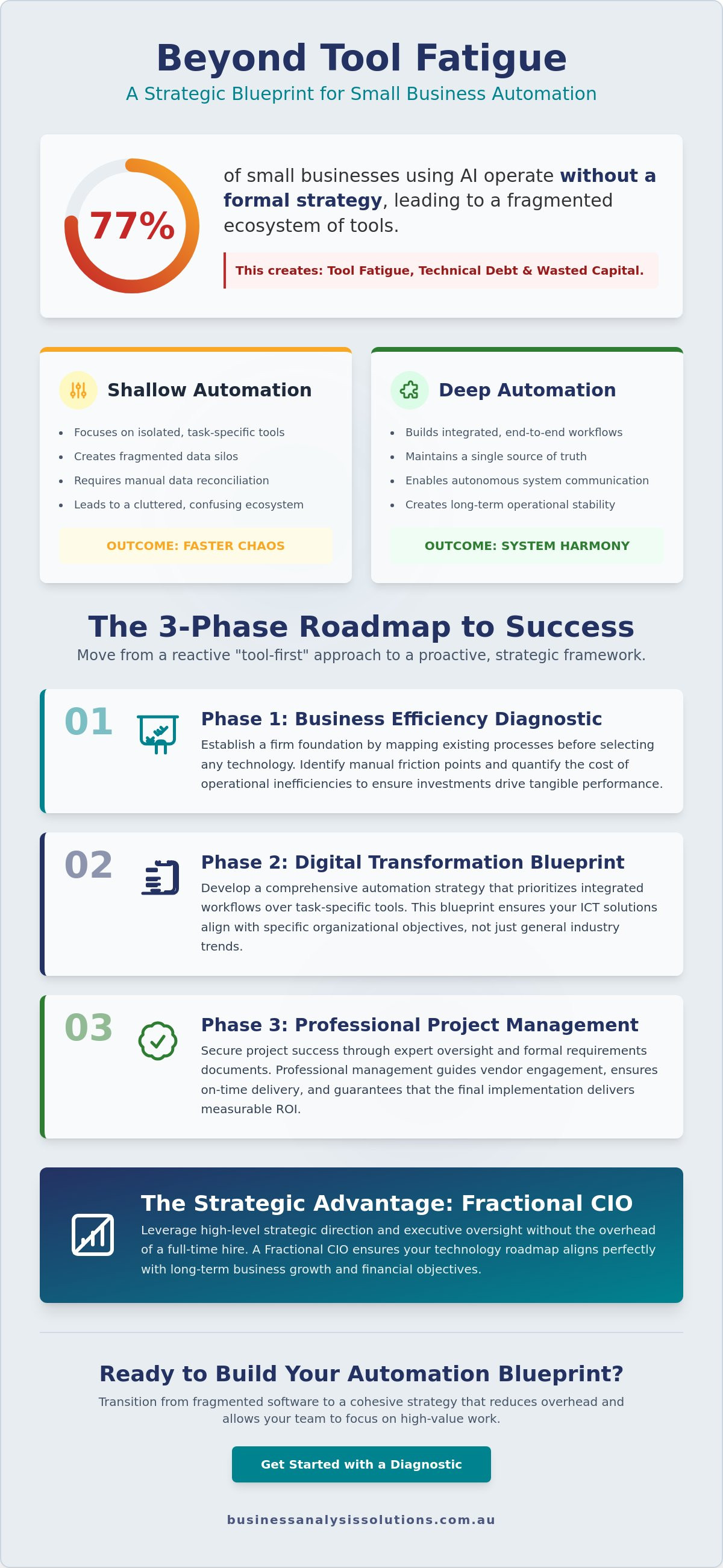
Did you know that 77% of small businesses currently using AI are operating without a formal strategy? This lack of structure often leads to tool fatigue, where a fragmented ecosystem of software creates more administrative friction than it resolves. Without a cohesive automation strategy for small business, your digital investments may actually hinder the operational efficiency they were meant to improve.
You likely feel the weight of this technical debt. It's frustrating to watch your team manage manual data entry across disconnected platforms while software costs continue to rise in 2026. You want to scale without a linear increase in headcount, yet the path to true system harmony remains unclear. Many leaders recognize that adding more tools isn't the solution; the challenge lies in coordinating them into a logical, functional whole.
This article provides a professional roadmap for moving beyond fragmented software toward a diagnostic-led digital transformation. You'll learn how to apply process mapping and business analysis to identify high-impact opportunities for automation. We will outline a clear path for implementing a Digital Transformation Blueprint that reduces overhead and allows your staff to focus on high-value, strategic outcomes rather than routine administration.
Key Takeaways
Establish a firm foundation by utilizing a Business Efficiency Diagnostic to map existing processes before selecting any technology.
Transition from isolated software purchases to a comprehensive automation strategy for small business that prioritizes integrated workflows over task-specific tools.
Develop a Digital Transformation Blueprint to ensure your ICT solutions align with specific organizational objectives rather than general industry trends.
Secure project success through professional project management and the creation of formal requirements documents to guide vendor engagement.
Leverage Fractional CIO services to gain high-level strategic direction and executive oversight without the overhead of a full-time hire.
Table of Contents
The Core Pillars of a 2026 Automation Strategy for Small Business
A successful automation strategy for small business is a methodical alignment of technology with specific organizational objectives. It isn't merely a collection of software subscriptions or a reaction to market trends. Instead, it represents a deliberate framework for operational excellence. True strategy begins with business analysis to ensure that every technical implementation serves a clear financial or operational purpose. In the context of Business Process Automation (BPA), the focus shifts from individual actions to end-to-end orchestration, ensuring that data flows logically across the entire enterprise.
We distinguish between "shallow automation" and "deep automation." Shallow automation focuses on isolated tasks, such as triggering a notification when a form is submitted. While helpful, these disconnected actions often create fragmented data silos. Deep automation involves integrated workflows where systems communicate autonomously to maintain a single source of truth. This creates system harmony, a state where your ICT solutions work in concert to provide long-term operational stability. Without this harmony, businesses often accumulate technical debt, where the cost of maintaining disparate tools outweighs the efficiency they provide.
Adopting a "tool-first" approach is a primary driver of organizational friction. When leadership prioritizes software features over process logic, the result is often a cluttered ecosystem that confuses staff and complicates reporting. Research from June 2026 shows that while 89% of small businesses have adopted AI, a staggering 77% operate without a formal strategy. This gap between adoption and architecture leads to wasted capital and missed opportunities for genuine growth, which is why many leaders visit Business With AI Strategist for expert AI consultancy and strategic implementation.
Beyond Simple Task Automation
In 2026, automation has evolved beyond basic "if-this-then-that" logic. Modern systems now utilize AI-driven decision-making to handle complex variables and predictive modeling. A robust Digital Transformation Blueprint ensures these capabilities are scalable. Rather than relying on standalone apps that require manual reconciliation, sophisticated businesses implement integrated ICT solutions. This architectural precision allows for a seamless flow of information from customer acquisition through to financial reporting, ensuring that your infrastructure supports your long-term vision.
Why Small Businesses Fail at Automation
The most common pitfall is the attempt to automate a broken or inefficient manual process. Automating chaos only produces faster chaos. Without initial process mapping, businesses often lock themselves into sub-optimal routines that are difficult to correct later. Furthermore, the hidden costs of "free" or low-cost tools often manifest as significant integration hurdles as the company grows. The primary cause of project failure is a lack of strategic oversight. Without professional project management and a clear roadmap, automation efforts remain fragmented and fail to deliver a measurable return on investment.
Phase 1: The Business Efficiency Diagnostic and Process Mapping
Effective automation doesn't begin with a software demonstration; it starts with a methodical audit of your current state. A Business Efficiency Diagnostic serves as the essential foundation for any automation strategy for small business. This diagnostic identifies manual friction points and quantifies the cost of operational inefficiencies. Software cannot fix a fundamentally flawed process; it only accelerates it. By beginning with a diagnostic, leadership gains the clarity needed to ensure that technical investments drive tangible financial performance rather than adding to technical debt.
The diagnostic process involves a deep dive into organizational coordination and resource allocation. It uncovers where data silos exist and where manual intervention is currently required to bridge the gap between systems. With software costs for popular tools like HubSpot and QuickBooks rising by 15-25% in 2026, precision in tool selection is a fiscal necessity. This phase ensures that every dollar spent on an ICT solution maps directly to a resolved bottleneck.
Process Mapping: Visualising the Workflow
Process mapping is a strategic tool that translates abstract daily routines into a structured visual format. We distinguish between the "As-Is" state, which documents current realities, and the "To-Be" state, which represents the optimized future. This visualization reveals redundant steps that should be eliminated rather than automated. It's a critical component of a professional automation strategy for small business, ensuring that system harmony is built into the architecture from day one. Mapping the workflow prevents the common error of digitizing an inefficient manual habit.
Identifying High-Impact Automation Candidates
Not all tasks deserve automation. We use a matrix to evaluate processes based on frequency and complexity. High-frequency, low-complexity tasks represent the "low-hanging fruit" of digital transformation. Focusing on these areas delivers immediate ROI and reduces operational overhead. Common candidates include:
Data Entry: Automating the transfer of information between CRM and accounting platforms to eliminate human error.
Lead Routing: Ensuring inquiries reach the correct team member instantly based on predefined logic.
Invoicing: Reducing the lag time between project milestones and payment requests to improve cash flow.
Prioritizing processes that directly impact financial performance and customer experience ensures that your digital transformation delivers measurable value. If you're unsure where to begin your journey, engaging in professional business analysis can provide the necessary prioritization framework to maximize your results.
Phase 2: Building Your Digital Transformation Blueprint
Once the diagnostic phase is complete, the next step is codifying the findings into a Digital Transformation Blueprint. This document acts as a strategic roadmap, bridging the gap between current technical limitations and future operational goals. It provides a structured timeline for implementation, ensuring that each phase of your automation strategy for small business is executed with precision. A well-constructed blueprint prevents the erratic adoption of technology, replacing it with a sequence of logical improvements that build cumulative value.
A critical component of this blueprint is maintaining a vendor-neutral perspective. Many small businesses fall into the trap of adopting software based on aggressive marketing or current industry hype. A seasoned consultant prioritizes functional requirements over brand names. This approach ensures that your ICT solutions are chosen based on their ability to solve specific bottlenecks identified during the process mapping phase. By focusing on requirements first, you ensure that the technology fits the business, rather than forcing the business to adapt to the software's limitations.
We must also address data integrity and cybersecurity within the automation architecture. As you connect disparate systems to facilitate data flow, the risk of data corruption or unauthorized access increases. A robust blueprint includes protocols for data validation and encryption. It ensures that automation enhances your security posture rather than creating new vulnerabilities. Maintaining a clean, secure data environment is essential for the long-term reliability of any automated workflow.
Aligning ICT Solutions with Business Objectives
Every automation initiative must be tied to a measurable business outcome. Whether your goal is a 20% reduction in lead response time or a 15% increase in billable hours, having clear KPIs prevents project drift. Strategic business technology isn't about owning the latest tools; it's about leveraging infrastructure to drive a competitive advantage. This focus helps leadership avoid "shiny object syndrome," where capital is wasted on AI features that offer little practical utility to the specific needs of the organization.
Integration vs. Isolated Tools
Modern agility relies on API-led connectivity. This allows specialized tools to communicate seamlessly, creating a unified ecosystem. While "all-in-one" suites promise simplicity, they often lack the depth required for specialized workflows and can lead to vendor lock-in. Platforms like the Microsoft Power Platform enable businesses to build custom automation layers that connect their existing tools without the need for custom software development. This integrated approach ensures that your automation strategy for small business remains flexible as your organizational needs evolve.
Phase 3: Execution Through Professional Project Management
Execution is where a theoretical automation strategy for small business becomes a functional reality. Success in this phase depends on disciplined project management. Without structured oversight, even the most logical blueprint can succumb to scope creep or technical misalignment. We advocate for a staged implementation approach. Deploying automation in manageable increments allows your team to adjust to new workflows without overwhelming daily operations. This iterative method ensures that system harmony is maintained as new ICT solutions are introduced into the environment.
Small business owners often face a "Build vs. Buy" dilemma. While purchasing established platforms like HubSpot or Zendesk is usually more cost-effective than custom development, the real value lies in how these tools are integrated. You aren't just buying software; you're building a proprietary workflow. This requires a formal requirements document before any vendor engagement begins. This document serves as your technical North Star. It ensures that the chosen tools meet the exact specifications of your business analysis rather than offering generic features that don't solve your specific problems.
Requirements Documentation and Vendor Selection
A Business Analyst acts as the vital link between technical requirements and organizational goals. They translate high-level vision into granular functional specifications. A comprehensive requirements document should include data mapping, user access levels, and security protocols. This level of detail is necessary to vet automation vendors effectively. You must evaluate partners based on their support structures, scalability, and adherence to modern data privacy standards. This rigorous selection process protects your investment from long-term obsolescence.
Managing Change and Staff Adoption
Technology is only as effective as the people who use it. Staff resistance is a common obstacle in any digital transformation. To overcome this, prioritize clear communication and comprehensive training early in the project lifecycle. Employees need to understand that automation is a tool to augment their capabilities, not replace them. Establishing post-launch feedback loops allows your team to report friction points. These insights are invaluable for refining automated processes and ensuring that the final solution delivers the promised operational efficiency.
Reliable execution requires experienced oversight to bridge the gap between technical potential and practical results. If you're ready to move from planning to performance, consider our professional project management services to guide your implementation.
The Strategic Advantage of a Fractional CIO
Small businesses often struggle because they lack executive-level technical oversight. Unlike large corporations, they cannot justify the expense of a full-time Chief Information Officer. A Fractional CIO bridges this gap by providing on-demand executive leadership. This model allows business owners to access big-business strategy on a small-business budget. This role is pivotal for a sustainable automation strategy for small business, as it ensures technology decisions remain rooted in financial logic and operational reality.
One of the greatest risks in digital transformation is receiving advice from vendors with a vested interest in a specific platform. A Fractional CIO acts as an objective advisor. They don't sell software; they sell outcomes. Their primary focus is maintaining long-term system harmony. This oversight ensures that as your business grows, your technical architecture remains stable. It allows for scaling without a proportional increase in administrative overhead. You gain a partner who prioritizes the most effective solution over the easiest one.
Continuous Improvement and System Harmony
Automation is a living ecosystem. A strategic automation strategy for small business is never truly finished. It requires a commitment to continuous improvement. Regular audits are necessary to ensure that automated workflows remain efficient as market conditions and internal requirements change. A Fractional CIO provides the consistent oversight needed to identify when a process has become obsolete or when a new ICT solution could further optimize performance. This proactive approach prevents the accumulation of technical debt and keeps the organization agile.
Bridging the Gap Between Technical and Organisational Goals
Technical failure often stems from a breakdown in communication between leadership and technical implementers. The Fractional CIO translates complex ICT concepts into actionable business insights. They ensure every technical requirement serves a broader organizational objective. This strategic technology leadership significantly reduces the risk of expensive project failures. By aligning technical potential with practical results, they turn technology from a cost center into a driver of measurable value. They provide the clarity needed to make confident investment decisions.
Ready to identify where your operations can be optimized? Enquire about a Business Efficiency Diagnostic to establish the foundation for your digital transformation.
Achieving Operational Excellence Through Strategic Integration
Transitioning from fragmented tools to a unified ecosystem requires more than just software procurement; it demands a fundamental shift in how you view your technical architecture. By prioritizing a diagnostic-led approach, you ensure that every automation initiative resolves a specific operational bottleneck rather than adding to your technical debt. This methodical alignment between technology and organizational objectives is the hallmark of a successful automation strategy for small business in 2026. True digital transformation isn't about the quantity of tools you use, but the quality of the harmony between them.
Our team brings over 20 years of industry experience to every engagement, utilizing a vendor-neutral methodology that prioritizes your unique requirements. We specialize in bridging the gap between technical complexity and business objectives to deliver tangible results. Book a Business Efficiency Diagnostic today to establish a clear roadmap for your digital transformation. This initial audit provides the clarity needed to make confident, data-driven investment decisions.
Building a scalable, automated enterprise is a deliberate process of refinement. With a professional framework in place, you can confidently transform your operations into a logical, high-performance engine that supports long-term growth.
Frequently Asked Questions
How do I start creating an automation strategy for my small business?
You start by conducting a Business Efficiency Diagnostic and process mapping to identify manual friction points within your operations. This initial audit ensures your automation strategy for small business is built on logic rather than software hype. By documenting current workflows, you can prioritize high-impact tasks that offer the best return on investment. This methodical approach prevents you from investing in technology that doesn't align with your organizational goals.
What is the difference between an automation tool and an automation strategy?
An automation tool is a specific software application, such as Zapier or HubSpot, while an automation strategy is a methodical alignment of technology with organizational objectives. Tools solve isolated tasks, but a strategy ensures all systems work in harmony to drive measurable efficiency. Without a strategy, businesses often accumulate fragmented software that creates data silos. A strategy provides the architectural framework necessary for long-term operational stability.
How much does it cost to implement business automation?
The total cost depends on the complexity of your requirements and the specific ICT solutions selected. Subscription fees for popular tools like QuickBooks and HubSpot have seen increases of 15% to 25% in early 2026, making precise selection a fiscal necessity. Implementing a strategic framework helps you avoid wasted capital on redundant features. By focusing on high-value outcomes, you ensure your budget is allocated to tools that deliver a measurable return.
Will automation replace my employees in a small business setting?
Automation is designed to augment your workforce by handling repetitive, low-value administrative tasks. This shift allows your staff to focus on high-value, strategic work that requires human judgment and creativity. Research from 2026 indicates that 87% of small business owners believe AI and automation enhance their employees' capabilities. It's a tool for scaling your output without necessarily increasing your headcount, creating a more productive and engaged team.
What is a digital transformation blueprint and why do I need one?
A Digital Transformation Blueprint is a strategic roadmap that outlines the sequence of technical improvements needed to reach your organizational goals. It provides a structured timeline and technical specifications for implementation. You need one to prevent erratic technology adoption and ensure that every new system integrates seamlessly with your existing infrastructure. This document acts as your technical North Star, ensuring that all digital investments support your long-term business vision.
How do I know if a manual process is ready to be automated?
A manual process is ready for automation if it is repetitive, rule-based, and occurs frequently. Tasks like data entry, lead routing, and invoicing are prime candidates because they follow a predictable logic. Use process mapping to visualize the workflow first. If the process is efficient but consumes excessive staff time, it's likely ready for a digital solution. Automating a refined process ensures that you maximize the efficiency gains.
What are the most common mistakes small businesses make with automation?
The most common error is attempting to automate a broken or inefficient manual process. This simply accelerates chaos rather than resolving it. Other mistakes include adopting tools without a formal automation strategy for small business or failing to provide staff with adequate training. Many leaders also fall into the trap of "tool-first" thinking, which leads to fragmented data and rising technical debt. Strategic oversight is essential for avoiding these pitfalls.
How can a Fractional CIO help with my automation strategy?
A Fractional CIO provides executive-level technical leadership and objective guidance on an as-needed basis. They bridge the gap between technical requirements and business goals, ensuring your technology investments support long-term growth. By acting as a vendor-neutral advisor, they help you maintain system harmony and avoid expensive ICT failures. This model provides small businesses with high-level strategy that was previously only accessible to large corporations with significant IT budgets.



Comments