Creating a Business Technology Strategy: The 2026 Strategic Framework
Global spending on digital transformation is projected to reach $3.4 trillion in 2026, yet many organizations still struggle with fragmented systems that dilute their operational impact. It's a common frustration to see technology investments fail to deliver the promised ROI, often because the focus remains on procurement rather than process. Creating a business technology strategy requires a shift in perspective; it's a diagnostic exercise in optimization, not just a list of new software to buy. You've likely experienced the friction of data silos or the absence of high-level guidance to steer your digital roadmap.
We agree that disconnected software and a lack of high-level IT leadership can stall even the most ambitious growth plans. By reading this guide, you'll learn how to align your digital infrastructure with specific organizational goals through a structured, diagnostic-led framework. We will examine the essential components of a 2026 strategic roadmap, moving from high-level vision to the granular details of automation and system harmony.
Table of Contents
Defining the Business Technology Strategy: More Than an IT Roadmap
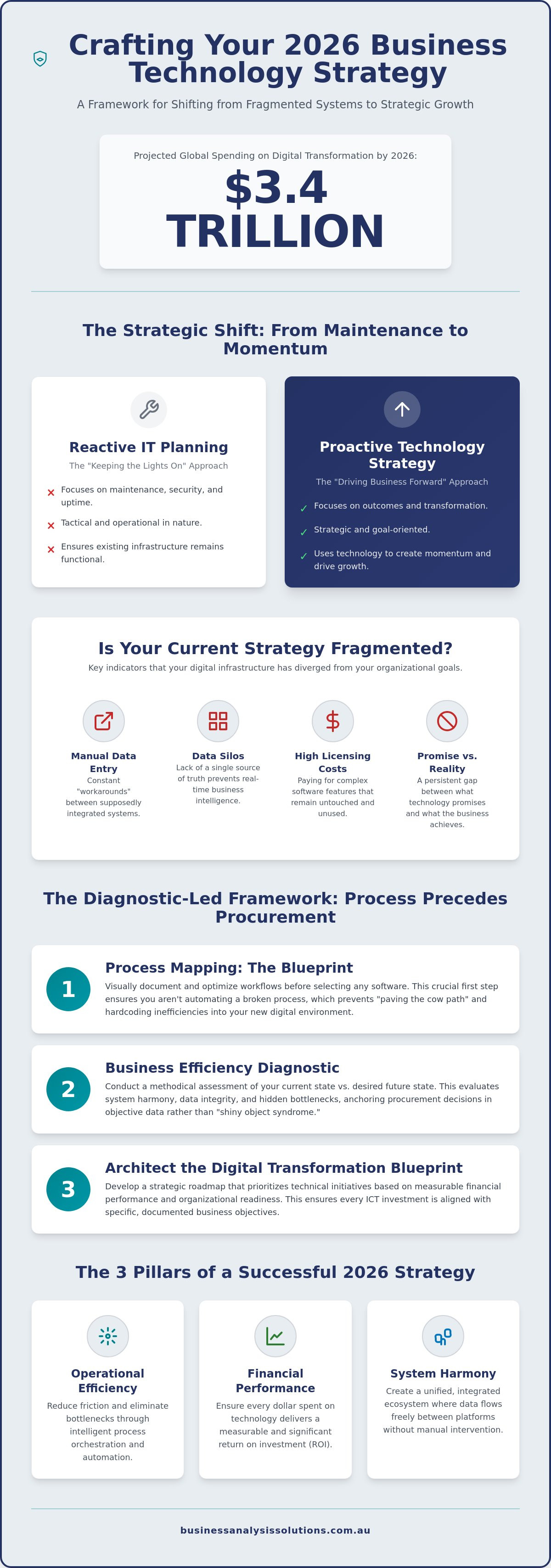
A Technology strategy is frequently misunderstood as a simple procurement list or a technical roadmap. In professional practice, it serves as a logical framework that aligns ICT investments with specific organizational objectives. Creating a business technology strategy involves more than selecting software; it requires a methodical approach to ensure that every digital tool serves a documented business purpose. By 2026, global spending on digital transformation is projected to reach $3.4 trillion, according to industry research. This scale of investment demands a transition from reactive IT support to proactive strategic planning.
Success in the 2026 digital environment depends on three core pillars: operational efficiency, financial performance, and system harmony. Operational efficiency focuses on reducing friction through intelligent process orchestration. Financial performance ensures that every dollar spent on technology delivers a measurable return on investment. System harmony creates a unified ecosystem where data flows freely between platforms without manual intervention. Without these pillars, technology becomes a source of organizational drag rather than a driver of growth.
The Difference Between IT Planning and Technology Strategy
IT planning is primarily tactical. It focuses on maintenance, security patches, and uptime. It's the "keeping the lights on" approach that ensures the infrastructure remains operational. Conversely, a technology strategy focuses on outcomes and transformation. While IT planning might ensure a server is running, creating a business technology strategy determines whether that server should exist at all or if a cloud-native solution better serves the business objective. Understanding business technology at this strategic level allows executives to move from maintenance to momentum, using technical capabilities to drive the organization forward.
Signs Your Current Strategy is Fragmented
Fragmented systems often hide in plain sight through "workarounds" that employees accept as normal. If your team spends significant time on manual data entry between supposedly integrated systems, your architecture is failing you. This lack of system harmony creates data silos that prevent leadership from accessing real-time business intelligence. Other common indicators of a fractured strategy include high software licensing costs for features that remain untouched and a persistent gap between what the technology promises and what the business actually achieves. When these signs appear, it's a clear signal that your digital infrastructure has diverged from your organizational goals.
The Diagnostic Foundation: Why Process Mapping Precedes Procurement
Many organizations approach digital transformation with a procurement first mindset, assuming that a new software suite will inherently resolve operational friction. This reactive approach often leads to "paving the cow path," a scenario where inefficient manual processes are simply digitized rather than optimized. When creating a business technology strategy, the focus must first land on the underlying logic of your operations. Automating a broken process doesn't fix the problem; it merely allows the error to occur at a much higher frequency and scale.
A structured diagnostic phase reveals the hidden bottlenecks that software alone cannot solve. By identifying single points of failure in your current human to system workflows, you can address vulnerabilities before they are hardcoded into a new digital environment. This stage is about ensuring that your technical roadmap is built on a foundation of sound business logic rather than a collection of disparate tools that don't talk to each other.
The Business Efficiency Diagnostic Explained
A Business Efficiency Diagnostic serves as a methodical assessment of your current state versus your desired future state. It evaluates system harmony and data integrity across the entire organization to find where information is getting trapped or lost. A Business Efficiency Diagnostic anchors procurement decisions in objective data, effectively neutralizing the "shiny object syndrome" that often leads to redundant or underutilized tech investments. It provides the clarity needed to ensure every new system serves a documented purpose.
Process Mapping: The Blueprint for Automation
Process mapping acts as the visual language of your business logic. By visualizing the "life of a transaction," you can see exactly where technology can intervene to add the most value. This level of detail is essential for identifying high value candidates for automation implementation. It's not enough to rely on policy manuals; you must engage stakeholders to ensure the map reflects the reality of daily work. This collaborative approach uncovers the nuances of how tasks are actually completed, allowing for a more precise and effective technical transition.
Starting with a clear map ensures that your digital transformation is purposeful and results driven. To begin identifying the friction points in your own workflows, consider a professional Business Efficiency Diagnostic to ground your strategy in operational reality.
Architecting the Digital Transformation Blueprint
Architecting a Digital Transformation Blueprint involves defining a target state architecture that serves your 2026 technology goals. This phase moves beyond the diagnostic findings to create a structured execution plan. Creating a business technology strategy requires a logical prioritization of initiatives based on three key factors: projected ROI, technical risk, and organizational readiness. By focusing on these elements, leadership can ensure that resources are allocated to projects that deliver the highest strategic value first.
The "Build vs. Buy" debate has shifted significantly with the proliferation of low-code platforms and specialized SaaS solutions. Most organizations now find more value in integrating best-of-breed tools rather than investing in custom development for non-core functions. Your blueprint must also address the tightening regulatory environment. For instance, companies operating in the European Union must comply with phase two of the EU AI Act by August 2, 2026. Similarly, Colorado's AI Act takes effect on June 30, 2026, requiring security risk management programs for AI used in consequential decisions. These compliance milestones are strategic requirements that must be hardcoded into your architectural design.
5 Steps to Building Your Digital Strategy
A successful roadmap follows a methodical sequence to minimize disruption and maximize impact:
Step 1: Define clear business objectives, such as reducing lead times by 20% or increasing system uptime to 99.9%.
Step 2: Inventory existing assets to identify technical debt and redundant licensing costs.
Step 3: Create a phased implementation roadmap to manage organizational change without overwhelming the team.
Step 4: Establish governance and data ownership protocols to ensure long-term data integrity.
Step 5: Define specific KPIs to measure the ongoing success of the digital transformation blueprint for business.
System Harmony: Integrating the Tech Stack
The trend for 2026 is a decisive shift away from monolithic ERPs toward a "composable" tech stack. This approach allows businesses to select and integrate specialized tools that work together through robust APIs and middleware. The goal is to create a "single source of truth" where data flows bidirectionally in real time. Creating a business technology strategy that prioritizes this level of integration ensures that your infrastructure is scalable. A composable architecture allows you to swap out individual components as technology evolves without needing to dismantle your entire digital ecosystem.
Bridging the Executive Gap: Fractional CIO Leadership
Mid-market organizations often encounter a significant obstacle after the initial planning phase: the strategy execution gap. While a board might approve a Digital Transformation Blueprint, the lack of high-level IT leadership often leads to fragmented implementation. Creating a business technology strategy requires more than a one-time vision; it necessitates continuous executive oversight to translate technical requirements into business outcomes. Without this dedicated advisory, technical teams and boardrooms often speak different languages, leading to misaligned priorities and wasted capital. Professional industry data indicates that 84% of CIOs now focus their roles primarily on digital innovation, highlighting a global shift from technical maintenance to strategic leadership.
The challenge for many growing firms is that the complexity of their digital ecosystem has outpaced their internal management capabilities. When technology decisions are made in a vacuum without considering broader organizational coordination, the result is often a series of expensive, disconnected systems. Bridging this gap requires a partner who understands both the granular technical details and the high-level financial implications of every ICT investment.
Strategic Leadership On-Demand
For many businesses, hiring a full-time Chief Information Officer is not financially viable, yet the need for strategic direction remains critical. Fractional CIO services Australia offer a pragmatic solution by providing executive-level expertise on a flexible basis. This model allows leadership to access specialized knowledge for vendor negotiations, ICT budget management, and long-term planning without the overhead of a permanent executive hire. A Fractional CIO brings quiet confidence to the boardroom, ensuring that technology investments remain aligned with financial performance goals while maintaining the strategy as a living document that adapts to market changes.
Ensuring Successful Project Implementation
Execution relies heavily on structured project management to mitigate risks during complex software migrations or automation rollouts. It's not enough to simply install new systems; you must manage the transition to ensure high feature utilization and system harmony. This involves developing an internal culture of continuous digital improvement where stakeholders are engaged throughout the process. When creating a business technology strategy, integrating professional oversight ensures that the roadmap actually reaches its intended destination. This methodical approach reduces the likelihood of project delays and ensures that the technical capabilities delivered match the original business requirements.
To bridge the gap between your technical capabilities and organizational goals, explore how our Fractional CIO Services can provide the strategic leadership your business requires to navigate the 2026 landscape.
Future-Proofing for 2026: Automation and AI Integration
By 2026, the distinction between "business software" and "AI tools" has largely dissolved. Artificial intelligence is no longer an experimental add-on but a fundamental component of the modern digital infrastructure. Successful organizations are now integrating features like Microsoft Copilot directly into their daily operations to augment human capability rather than replace it. Creating a business technology strategy in this environment requires a transition from basic task automation to intelligent process orchestration. This shift allows systems to handle complex, non-linear workflows that previously required constant manual oversight.
Data-driven decision-making has become the primary driver of competitive advantage. With more than 80% of enterprises expected to have deployed generative AI applications by 2026, the ability to extract actionable intelligence from internal data is a baseline requirement for survival. A strategy that prioritizes data integrity ensures that these AI tools have a reliable foundation, preventing the "garbage in, garbage out" cycle that plagues poorly planned implementations. Your digital roadmap must treat data as a high-value asset that requires rigorous governance and protection.
The 2026 Automation Landscape
Modern organizations are increasingly leveraging the Microsoft Power Platform to facilitate rapid internal tool development. This low-code approach allows business units to solve specific operational challenges without waiting for extensive development cycles. The focus has moved toward using AI to assist in high-level decision-making, such as predictive resource allocation and automated risk assessment. Intelligent automation differs from standard task automation by incorporating machine learning to interpret complex patterns and execute decisions in environments where variables are constantly shifting. This level of sophistication ensures that your automation implementation remains effective even as your business scales.
Maintaining Strategic Agility
A strategy is only as effective as its execution and its ability to adapt. Creating a business technology strategy isn't a one-time event; it's a continuous process of refinement. You should review your Digital Transformation Blueprint on a quarterly basis to ensure it still aligns with your evolving organizational goals and the latest technical capabilities. This agility is particularly critical when addressing cybersecurity. In Australia, staying ahead of the "Essential 8" cybersecurity standards is no longer optional; it's a core requirement for operational resilience. These standards provide a methodical framework for mitigating threats in an increasingly complex digital world.
Long-term success depends on having access to objective, expert guidance to navigate these transitions. Partnering with a strategic business analysis consultancy provides the external perspective needed to identify blind spots and ensure your technology stack remains in total harmony with your business objectives.
Aligning Digital Infrastructure with Organizational Objectives
Success in the 2026 digital environment requires a transition from reactive procurement to a methodical, diagnostic-led approach. You've seen how process mapping serves as the necessary foundation for automation and why a Digital Transformation Blueprint must account for both technical debt and emerging regulatory requirements. Creating a business technology strategy is not a static project; it's an ongoing commitment to system harmony and operational efficiency. By bridging the communication gap between the boardroom and the server room, your organization can ensure that technology remains a driver of growth rather than a source of friction.
With over 20 years of experience in business analysis and ICT consultancy, our team specializes in bridging the gap between technical requirements and organizational objectives. We provide national delivery of Strategic Blueprints and Fractional CIO services designed to deliver tangible results. To ensure your digital roadmap is grounded in logic and performance, book a Business Efficiency Diagnostic with our expert consultants today. You have the opportunity to transform your technical capabilities into a sustainable competitive advantage.
Frequently Asked Questions
What is the first step in creating a business technology strategy?
The first step is a comprehensive diagnostic of current operational states and business objectives. This identifies the gap between existing technical capabilities and desired organizational outcomes. It's a foundational phase that ensures the strategy is built on objective evidence rather than subjective technical preferences.
How long does it take to develop a Digital Transformation Blueprint?
Developing a Digital Transformation Blueprint typically requires four to eight weeks of intensive analysis and stakeholder engagement. This timeline allows for thorough process mapping, technical debt assessment, and the prioritization of initiatives based on ROI. The duration varies depending on organizational complexity and the scope of the systems under review.
What is the difference between an IT roadmap and a technology strategy?
An IT roadmap is a tactical schedule for infrastructure maintenance and software updates. In contrast, creating a business technology strategy is a high-level framework that aligns every ICT investment with broader business goals. While the roadmap focuses on how to keep systems running, the strategy defines why those systems exist and how they drive transformation.
Does my business need a full-time CIO to manage our technology strategy?
Most mid-market organizations don't require a full-time CIO to maintain a high-level technology strategy. Fractional CIO services provide the necessary executive leadership and strategic advisory on a part-time or project basis. This model ensures that the business receives professional guidance for complex decision-making without the overhead of a full-time executive salary.
How much should a business invest in technology strategy development?
Investment levels for technology strategy development are typically scaled based on the organization's revenue and the complexity of its digital ecosystem. While specific costs vary, industry standards suggest allocating a percentage of the total ICT budget toward strategic planning and governance. This ensures that the remaining budget is spent on tools that deliver verified operational value.
How do we ensure our technology strategy stays relevant as AI evolves?
Ensuring relevance as AI evolves requires a composable architecture that allows for the rapid integration of new capabilities. By creating a business technology strategy that includes quarterly reviews, leadership can pivot to adopt emerging tools like Microsoft Copilot or specialized machine learning models. This agile approach prevents the organization from becoming locked into rigid, legacy frameworks.
What role does process mapping play in a digital strategy?
Process mapping serves as the visual logic that underpins the entire digital strategy. It identifies exactly where human-to-system interactions occur and where automation can reduce operational friction. Without this map, technology implementation risks automating inefficient workflows, which ultimately increases complexity without improving productivity.
Can a technology strategy help reduce operational costs?
A well-executed technology strategy significantly reduces operational costs by eliminating redundant software licensing and automating repetitive manual tasks. By consolidating fragmented systems and improving data integrity, organizations reduce the time spent on data entry and error correction. This optimization ensures that resources are redirected from maintenance toward value-generating activities.



Comments