CPA Australia: A Strategic Guide for Business Leaders in 2026
- jonesaqayalo
- Apr 15
- 11 min read
Updated: Apr 20
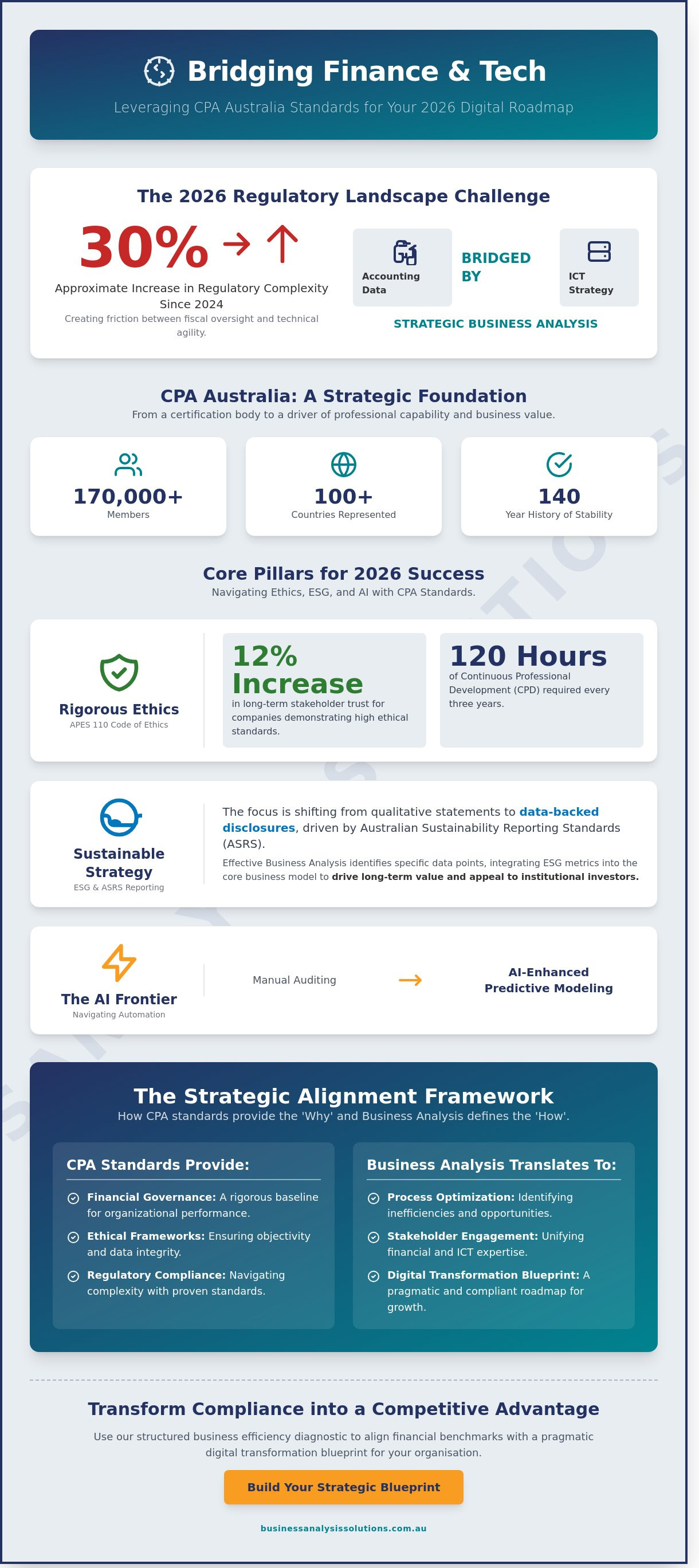
If your 2026 digital transformation roadmap treats financial compliance as a secondary checklist rather than a core driver of ROI, how much capital are you actually leaving on the table? Most Australian executives recognize that regulatory complexity has increased by approximately 30% since 2024, creating a persistent friction point between fiscal oversight and technical agility. You've likely found that maintaining CPA Australia standards is no longer just about reporting; it's about establishing a rigorous, logical baseline for organizational performance.
It's understandable to feel that bridging the gap between accounting data and ICT strategy is a moving target. We'll show you how to transform these professional standards into a strategic asset that drives measurable efficiency across your entire enterprise. This guide provides a clear framework for integrating financial expertise into your Business Analysis & Solutions, ensuring your digital evolution remains compliant and profitable. We'll start by deconstructing the 2026 regulatory environment before moving into the granular steps of strategic alignment and process optimization.
Key Takeaways
Leverage the strategic authority of cpa australia standards to navigate the complex regulatory environment and business landscape of the 2026 Australian economy.
Integrate rigorous ethical frameworks and modern ESG reporting to ensure your organisation remains compliant and competitive within the evolving AI landscape.
Differentiate between financial reporting and operational optimisation to successfully bridge the gap between high-level data and functional business requirements.
Execute a structured business efficiency diagnostic to align financial benchmarks with a pragmatic digital transformation blueprint for your organisation.
Facilitate seamless stakeholder engagement to unify financial expertise and ICT strategy, driving long-term organisational efficiency and success.
Table of Contents What is CPA Australia and Its Role in the 2026 Economy? Core Standards: Ethics, ESG, and the AI Era CPA Standards vs. Business Analysis: Bridging the Gap Actionable Guidance: Leveraging Professional Standards for Growth Integrating Professional Expertise for Long-Term Success
What is CPA Australia and Its Role in the 2026 Economy?
CPA Australia is one of the world's largest professional accounting bodies, representing more than 170,000 members across 100 countries. Its 140-year history establishes a foundation of stability that underpins the Australian financial system. In the 2026 economy, the organisation serves as a critical bridge between complex regulatory requirements and strategic business execution. It isn't merely a certification body; it's a driver of professional capability that ensures financial experts can navigate a digital-first market with precision.
The core mission focuses on enhancing the professional capability of members to drive tangible business value. For Australian organisations, the cpa australia designation represents a guarantee of ethical standards and technical proficiency. This ensures that financial governance aligns with long-term commercial objectives rather than just short-term reporting. By prioritising strategic alignment, the organisation helps firms untangle organizational complexities and optimize their financial processes through a structured, methodical approach.
The Evolution of the CPA Designation
Modern accounting has shifted from traditional ledger management to active strategic partnership. The introduction of the Experience-Based Pathway has broadened professional diversity, allowing a wider range of skilled professionals to achieve certification based on practical performance. This pathway recognizes that requirements elicitation and process mapping are as vital as balance sheet reconciliation. 140 years of rigorous standards provide an anchor in volatile markets, ensuring that members can manage risk effectively during economic shifts. It's a transition that moves the accountant from the back office to the boardroom.
CPA Australia in the 2026 Global Context
By 2026, the role of a CPA involves managing international trade and cross-border ICT solutions within a digital-first framework. Australian businesses prioritise cpa australia aligned governance because it adheres to global accounting standards and ethical frameworks. This alignment is vital for firms looking to integrate into international supply chains. The focus remains on bridging the gap between technical requirements and business objectives to deliver seamless integration in global markets.
Key focus areas in the 2026 landscape include:
Real-time data analytics for cross-border transactions to ensure transparency.
Alignment with International Financial Reporting Standards (IFRS) to facilitate global trade.
Strategic oversight of AI-driven financial reporting tools to maintain data integrity.
Stakeholder engagement strategies that translate technical financial data into actionable business insights.
Development of robust financial solutions that support sustainable business growth.
Core Standards: Ethics, ESG, and the AI Era
The ethical framework governing cpa australia members provides a competitive advantage that extends beyond simple compliance. Adherence to the APES 110 Code of Ethics ensures that financial data remains objective, which directly impacts a firm's market valuation. Research shows that Australian companies demonstrating high ethical standards often experience a 12% increase in long-term stakeholder trust. This trust is maintained through a rigorous Continuous Professional Development (CPD) program. Members must complete 120 hours of CPD every three years, ensuring they can interpret complex regulatory shifts like the 2024 Treasury Laws Amendment without hesitation.
ESG and Sustainable Business Strategy
The 2026 ESG global livestream series marks a definitive shift in how Australian businesses report on sustainability. These requirements demand that firms move beyond qualitative statements into data-backed disclosures. By integrating Environmental, Social, and Governance metrics into core strategy, businesses improve their efficiency and appeal to institutional investors. Effective business analysis is the engine behind this transition. It identifies the specific data points needed to meet Australian Sustainability Reporting Standards (ASRS). This methodical approach ensures that sustainability reporting isn't a peripheral task but a core component of the business model that drives long-term value.
Navigating the AI Frontier in Accounting
The transition from manual auditing to AI-enhanced predictive financial modeling is accelerating. Automated systems now handle high-volume data processing, allowing cpa australia professionals to focus on high-level strategic advisory roles. However, this shift introduces new risks. Predictive models can hallucinate or reflect biases if they aren't properly governed. Managing these risks requires constant oversight to ensure that automated outputs align with reality. Organizations that successfully bridge the gap between technical AI requirements and business objectives often see a 25% improvement in decision-making speed. In 2026, the intersection of AI and professional ethics is defined by the mandatory requirement for human-led verification of all algorithmic financial outputs to ensure data integrity.
Implementing these advanced systems requires a structured approach to process mapping to ensure that new technologies don't compromise existing internal controls. This logical progression from data collection to strategic outcome is what defines modern financial leadership in the Australian market.
CPA Standards vs. Business Analysis: Bridging the Gap
Mastery of cpa australia standards provides a robust framework for financial reporting; however, compliance is not a strategy for growth. While financial reporting records historical performance, business analysis designs the future state of an organisation. Relying solely on balance sheets often leads to a digital transformation gap where investments don't yield expected returns. A comprehensive digital transformation blueprint for business requires more than just capital. It needs a granular understanding of operational bottlenecks that financial statements cannot reveal. CPAs provide the "what" by identifying fiscal constraints, while Business Analysts provide the "how" by re-engineering the underlying workflows to overcome them.
Financial Integrity Meets Operational Efficiency
Financial data serves as the diagnostic starting point for business efficiency audits. When finance and operations operate in silos, roughly 40% of Australian mid-market firms experience friction during software migrations. Using cpa australia certified data ensures that the baseline for any diagnostic is accurate. This prevents the common mistake of "optimising" a process that shouldn't exist in the first place. Cross-functional collaboration frameworks allow Australian enterprises to move past departmental friction. By aligning financial integrity with operational logic, leaders can ensure that cost-cutting measures don't inadvertently damage service delivery quality or employee morale.
The ROI of Integrated Strategic Planning
Measuring the success of ICT investments requires a dual perspective. Finance teams track the A$ spend against the budget, while analysts track the adoption rates and process cycle times. Without this alignment, organisations risk a cashflow crisis during system changes. Process mapping acts as a safeguard. It identifies the "double whammy" of high implementation costs coupled with operational downtime before they occur. Executive leadership requires both perspectives to make informed decisions. Consider these advantages of an integrated approach:
Precision Budgeting: Aligning project requirements with financial forecasts to prevent A$ budget overruns.
Risk Mitigation: Identifying operational dependencies that could impact the bottom line during transitions.
Value Realisation: Ensuring that technical solutions actually deliver the A$ savings promised in the initial business case.
It's clear that the most successful Australian firms don't choose between financial rigor and analytical agility. They integrate both to create a stable foundation for long-term scalability. This synergy ensures that every dollar spent on technology or process improvement is backed by a logical, data-driven mandate.
Actionable Guidance: Leveraging Professional Standards for Growth
To achieve measurable growth, organisations must align their operational workflows with the rigorous frameworks established by cpa australia. This alignment starts with a structured four-step methodology. First, conduct a business efficiency diagnostic. This assessment compares current overheads against the 2024-2025 financial benchmarks for your industry sector to identify waste. Second, facilitate formal stakeholder engagement sessions. These meetings bridge the communication gap between finance teams and ICT departments, ensuring technical roadmaps support fiscal objectives. Third, deploy automation tools that maintain immutable audit trails. These trails must satisfy the high-level assurance requirements expected during a professional audit. Finally, integrate Power BI with your core financial reporting systems. This provides a real-time view of performance indicators, allowing for rapid adjustments to strategy before small variances become significant losses.
Implementing Digital Strategy with Financial Precision
Successful digital transformation requires more than just purchasing software. It demands a formal requirements document that maps every technical feature to a specific business outcome. Integrating fractional cfo services alongside Fractional CIO services Australia ensures that your IT infrastructure remains compliant with cpa australia ethical and professional standards while maintaining fiscal health. This strategic oversight reduces the risk of project scope creep, which historically accounts for a 27% increase in budget overruns for Australian SMEs. Financial oversight during implementation ensures that every dollar spent contributes to long-term scalability and operational stability.
Strategic Technology Solutions for 2026
Selecting the right business technology is critical for maintaining compliance as regulatory environments evolve. With the Australian Federal Budget 2024-25 introducing stricter reporting requirements for digital transactions, data-driven decision-making isn't optional. Modern platforms automate the collection of evidence needed for annual reviews and tax obligations. Integrating these systems ensures that your data remains clean, accessible, and ready for scrutiny. Strategic technology deployments simplify the process of gathering data, which significantly reduces the administrative burden of annual membership renewals and ongoing compliance reporting.
For a structured approach to your next digital project,
to discuss your requirements.
Integrating Professional Expertise for Long-Term Success
Aligning your business operations with the strategic insights provided by cpa australia creates a foundation for sustained fiscal resilience. While many organisations treat financial reporting as a retrospective task, high-performing Australian firms use these standards to drive forward-looking strategy. Business Analysis & Solutions facilitates this transition by translating high-level financial objectives into functional, everyday workflows. This ensures that your organisation isn't just meeting regulatory requirements but is actively using data to secure a market advantage.
Moving from basic compliance to a position of competitive strength requires more than just good intentions; it demands structured execution. Expert project management serves as the essential bridge between your financial strategy and operational reality. By applying a methodical approach to business transformation, we help leaders implement changes that stick. This process reduces waste and ensures that every A$ invested in your systems delivers a measurable return on investment. It's about creating a lean, responsive organisation that can pivot as market conditions fluctuate.
The Trusted Advisor Model
Boutique consultancies offer a level of dedicated focus that larger, more generalised firms often lack. Our team brings over 20 years of direct experience in the Australian market, having assisted diverse sectors since our inception in 2004. This longevity provides us with a deep understanding of local regulatory shifts and economic cycles. We don't rely on marketing fluff or vague promises. Instead, we act as an analytical partner, using logic and precision to untangle organisational complexities. Starting your journey toward an optimised business structure begins with an honest assessment of your current process efficiency.
Next Steps for Your Organisation
The path to mastering your cpa australia integration involves a clear, three-step audit of your current synergy between finance and operations. Leaders should act now to ensure their infrastructure is prepared for future challenges. Consider these immediate actions:
Review your 2026 strategic goals against your 2023 and 2024 financial performance to identify trend deviations.
Identify specific gaps where your current ICT and digital strategy fail to provide the real-time data required for informed decision-making.
Engage a specialist to bridge the functional gap between your professional accounting standards and your daily operational activities.
By addressing these areas, you move away from reactive management and toward a model of quiet confidence and professional competence. We provide the clarity and direction needed to ensure your financial and operational goals are perfectly aligned.
Securing Operational Excellence in the 2026 Economy
Navigating the complexities of the 2026 landscape requires more than just compliance; it demands a proactive synthesis of financial integrity and technical agility. Business leaders must leverage the rigorous framework provided by cpa australia to ensure that ESG mandates and AI integrations aren't just checked boxes, but core drivers of long-term value. Effective governance hinges on your ability to bridge the gap between high-level financial requirements and the granular realities of technical execution. Success in this era depends on transforming these professional standards into actionable growth strategies that protect your bottom line.
Business Analysis & Solutions brings over 20 years of experience in Australian business analysis and ICT consultancy to this challenge. We've developed a proven track record in delivering digital transformation blueprints that align with professional standards while driving measurable growth. Our specialized expertise ensures that your strategic objectives translate into functional, high-performing systems that withstand market shifts. We focus on removing ambiguity to provide the clarity your organization needs to thrive. It's time to move beyond simple process mapping toward true strategic alignment.
Optimise your business efficiency with our expert diagnostic services and turn your organizational complexity into a clear path for sustainable success. Your team's potential is waiting to be unlocked through precise, methodical alignment.
Frequently Asked Questions
What are the main benefits of hiring a CPA for my Australian business?
Hiring a CPA provides your business with strategic financial oversight and ensures strict compliance with Australian Taxation Office (ATO) regulations. A 2023 study indicated that Australian firms utilizing professional accountants saw a 22% increase in operational efficiency. These experts move beyond basic bookkeeping to provide high-level risk mitigation and strategic tax planning. This methodical approach ensures your organizational complexities are managed with precision and logical rigor.
How has CPA Australia addressed the rise of AI in accounting for 2026?
CPA Australia updated its curriculum to include advanced modules on AI-augmented decision making and data governance for the 2026 period. By prioritizing the Digital Finance and Data Analytics segment, the organization ensures members can manage the 30% increase in automated transactional processing expected by 2026. This transition shifts the focus from manual entry to strategic data interpretation. It allows professionals to provide clearer direction for clients navigating technological shifts.
What is the difference between an Associate member and a full CPA?
The primary difference lies in the completion of the professional program and the required 36 months of mentored practical experience. An Associate member holds a recognized degree but hasn't yet finished the six professional exams required for full status. Achieving full cpa australia certification signals a higher level of professional competence and a commitment to rigorous international standards. This distinction ensures that clients receive advice from a seasoned expert.
How do CPA Australia standards impact small business cash flow management?
CPA Australia standards impact cash flow by enforcing a structured approach to liquidity analysis and working capital management. Following the AASB 107 Statement of Cash Flows helps small businesses identify exactly where capital is tied up. This precision allows for a 15% improvement in debt recovery times when implemented correctly. It turns vague financial data into a functional logic that drives better business outcomes and sustainable growth.
Can a CPA help with digital transformation and ICT strategy?
A CPA is essential for digital transformation because they align technical ICT investments with overall business objectives and budget constraints. Recent industry data shows that 48% of Australian CPAs now lead or advise on ERP system implementations. They ensure that ICT strategies aren't just technical upgrades but represent a calculated return on investment. This partnership bridges the gap between complex technical requirements and the firm's strategic financial goals.
What are the continuing professional development (CPD) requirements for 2026?
For the 2024 to 2026 triennium, members must complete a total of 120 CPD hours to maintain their professional standing. This requirement includes a mandatory minimum of 20 hours per year to ensure consistent skill development. At least 10 of these hours must focus specifically on professional ethics and conduct. This steady, methodical approach to learning ensures that every cpa australia member remains a reliable and authoritative partner for their clients.
How does the CPA Program integrate ESG principles into its curriculum?
The CPA Program integrates ESG principles through the Sustainability Reporting and Assurance module, which became a core focus in 2024. This curriculum update aligns with the Australian Government's 2024 mandate for climate-related financial disclosures. By mastering these principles, members can guide organizations through the complexities of non-financial reporting. This ensures that ESG strategies are rooted in logic and provide a clear path toward long-term value creation.
Is it necessary to have both a CPA and a Business Analyst?
Engaging both professionals is a strategic move that addresses different but complementary aspects of organizational performance. While a CPA ensures financial accuracy and regulatory compliance, a Business Analyst focuses on process mapping and requirements elicitation to drive efficiency. Combining these roles, often by engaging small business advisory services Perth, can lead to a 25% reduction in operational waste while increasing owner profitability. It's a pragmatic solution for leaders who want to ensure their financial reporting and operational workflows are perfectly aligned.



Comments