Cost of a Fractional CIO in Australia: 2026 Strategic Pricing Guide
- jonesaqayalo
- May 1
- 12 min read
What if the A$350,000 base salary for a full-time technology executive is actually a secondary concern compared to the strategic inertia currently stalling your digital transformation? Many Australian mid-market firms find themselves trapped in a cycle of rising technology expenditure without a measurable return on investment. You're likely managing tactical IT providers who maintain the status quo but lack the specialized expertise to address critical cybersecurity gaps or complex process mapping.
Determining the cost of fractional CIO Australia services is no longer just a procurement exercise; it's a strategic necessity for leaders who require high-level guidance without the permanent overhead. This 2026 guide delivers a methodical breakdown of market rates and engagement models. You'll gain a structured framework to justify the expense to your Board and a clear roadmap for aligning technical requirements with your long-term business objectives. We'll move from high-level pricing structures directly into the granular details of retainer versus project-based delivery to ensure your organization achieves seamless integration and pragmatic performance.
Key Takeaways
Define the strategic value of a Fractional CIO compared to traditional IT consulting to ensure board-level alignment and long-term technical direction.
Benchmark the cost of fractional CIO Australia engagements against full-time executive salaries to determine the most efficient investment for your scale of operations.
Assess how variables such as legacy system complexity and stakeholder volume impact pricing, allowing for more accurate budgeting and resource allocation.
Quantify the return on investment through cost avoidance strategies that eliminate redundant software and prevent high-risk project failures.
Utilise the Business Efficiency Diagnostic to identify immediate opportunities for process automation and logical technology spend optimisation.
Table of Contents What is a Fractional CIO and Why Does the Australian Market Demand Them? Fractional CIO Pricing Models: Comparing Retainers, Projects, and Salaries Key Variables Influencing Fractional CIO Rates in Australia Measuring ROI: Why Strategic Leadership is More Cost-Effective Than Tactical IT Optimising Technology Spend with Business Analysis & Solutions
What is a Fractional CIO and Why Does the Australian Market Demand Them?
Australian mid-market organizations are increasingly distancing themselves from the traditional full-time executive model. By 2026, the demand for flexible, high-level leadership has reached a critical point as businesses grapple with rapid technological shifts. Understanding What is a Fractional CIO is the first step in optimizing your leadership structure. These professionals provide senior-level IT leadership on a part-time or contract basis, ensuring that technology serves as a growth lever rather than a cost center.
The role bridges the gap between technical requirements and business objectives. While a standard IT manager focuses on keeping the lights on, a Fractional CIO sits at the executive table. They translate complex technical data into actionable business intelligence. This shift is driven by a need for agility; companies require the expertise of a seasoned executive without the A$300,000 plus annual salary commitment. Consequently, the cost of fractional CIO Australia has become a primary metric for CEOs looking to balance fiscal responsibility with digital transformation.
Fractional CIO vs. Traditional IT Consultant
Distinguishing between these roles is essential for strategic alignment. A traditional IT consultant typically handles tactical execution, such as a cloud migration or a software implementation. They're external vendors with a defined, short-term scope. In contrast, fractional CIO services Australia provide an internal advocate who owns the long-term technology roadmap. They focus on board-level reporting and stakeholder engagement to build a sustainable technology culture.
Accountability: The Fractional CIO is integrated into the leadership team and shares responsibility for organizational outcomes.
Strategic Depth: They prioritize long-term ROI over immediate technical fixes.
Vendor Management: They manage your existing IT providers to ensure they deliver promised value.
The 2026 Digital Landscape in Australia
The Australian business environment in 2026 is defined by heightened regulatory scrutiny. Following the 2024 Privacy Act reforms, companies face stricter data privacy and cybersecurity compliance requirements. Managing these risks requires more than just software; it demands executive oversight. Furthermore, the 2023-2030 Australian Cyber Security Strategy has placed the onus of digital resilience directly on board members.
Automation and AI integration are no longer optional for maintaining competitive efficiency. Mid-market firms are leveraging AI to automate 30% of routine administrative tasks, yet successful implementation requires a structured, methodical approach. A Fractional CIO acts as a strategic partner for Australian mid-market growth by aligning complex technology investments with core commercial objectives. This ensures that the cost of fractional CIO Australia remains a high-yield investment in the company's future readiness.
Fractional CIO Pricing Models: Comparing Retainers, Projects, and Salaries
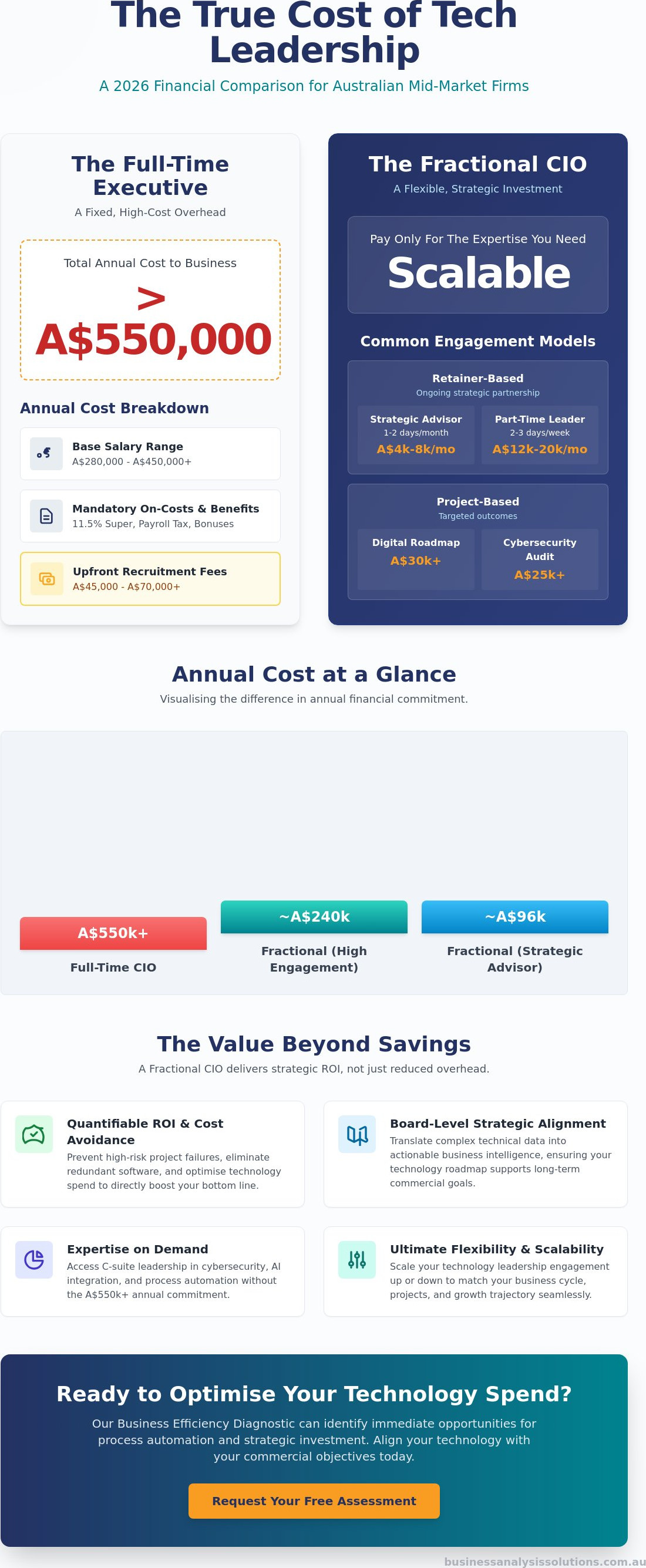
Traditional executive hiring creates a fixed overhead that rarely aligns with the fluctuating needs of a scaling business. In major Australian hubs like Sydney, Melbourne, and Brisbane, the base salary for a full-time CIO currently ranges from A$280,000 to over A$450,000. When you factor in the 11.5% Superannuation Guarantee, payroll tax, and executive bonuses, the total cost to the business often exceeds A$550,000 annually. Recruitment fees for these roles typically sit at 15% to 25% of the first-year salary, adding an immediate upfront burden of A$45,000 or more before the executive even starts.
The cost of fractional CIO Australia services offers a more precise alternative. Instead of a permanent high-cost fixture, firms engage strategic leadership as a variable expense. This model eliminates the "hidden" costs of full-time employment while providing the same level of seniority. Organizations gain the ability to scale engagement up during heavy infrastructure changes or down once systems stabilize. This flexibility is critical for maintaining financial health while pursuing aggressive growth targets.
Retainer-Based Pricing
Most Australian mid-market firms opt for a monthly retainer. This model generally involves an investment of A$6,000 to A$14,000 per month for two to four days of dedicated engagement. A retainer ensures consistent oversight of high-level strategy, vendor management, and board-level participation. It provides the most stable foundation for long-term business efficiency because the CIO remains deeply embedded in the company's operational rhythm. This continuity allows the advisor to anticipate technical bottlenecks before they impact the bottom line.
Project-Based and Interim Engagements
Project-based models focus on specific, time-bound outcomes. A firm might engage a fractional leader specifically to design a digital transformation blueprint for business or to oversee a complex ERP migration. These engagements are priced based on the scope of the deliverable rather than time spent. Interim roles are also common during executive searches or restructuring, where the cost of fractional CIO Australia experts is justified by the need to maintain momentum during a leadership vacuum. Often, these successful project deliveries transition into long-term advisory roles as the business recognizes the value of objective, external expertise.
Selecting the right model depends entirely on your current technical debt and future objectives. Securing a professional technology assessment can help determine whether a retainer or a project-based approach will deliver the highest return on your investment.
Key Variables Influencing Fractional CIO Rates in Australia
The cost of fractional CIO Australia engagements isn't determined by a simple flat rate. Instead, it's a reflection of the specific risks, technical hurdles, and strategic demands inherent in your business. A logical assessment of these variables allows for a more accurate budgetary forecast. Pricing usually scales based on the volume of "heavy lifting" required to align your technology with your commercial goals.
Organizational complexity: Managing a single-site office is fundamentally different from overseeing multi-site operations across Sydney, Melbourne, and Perth. Increased stakeholder volume and disparate physical locations naturally drive up the required hours for effective oversight.
Technical debt: If your infrastructure consists of unpatched legacy systems and "shadow IT" solutions, the initial engagement cost will be higher. The CIO must first stabilize the environment before moving into high-level strategy.
Industry compliance: Sectors like finance, health, and legal face rigorous Australian regulatory frameworks. Adhering to APRA standards or the Privacy Act requires a level of precision that adds roughly 15% to 20% to the management workload compared to non-regulated industries.
The Complexity Factor
The number of active users and software integrations directly dictates the depth of strategic oversight needed. A business with 50 users and five core SaaS integrations requires less diagnostic effort than an enterprise managing hundreds of users across complex ERP and CRM ecosystems. Managing these vendor relationships is a critical cost-saving function. An expert CIO often recovers their own fee through the negotiation of more favorable A$ contracts with software providers. We recommend a diagnostic phase before committing to a fixed price, ensuring the scope reflects reality rather than assumptions.
Strategic vs. Operational Involvement
There's a clear price distinction between high-level advisory work and hands-on execution. Pure advisory roles focus on board-level reporting and long-term roadmaps. However, many Australian mid-market firms require a blend of executive leadership and practical project management to ensure digital transformation actually happens.
Determining the right "fraction" depends on your internal team's maturity. If you lack a strong internal IT manager, your Fractional CIO will likely spend more time on operational hurdles, increasing the monthly retainer. Most successful engagements start with a higher intensity, perhaps two days per week, before tapering off to a steady-state advisory rhythm once the technical debt is cleared and the strategy is set.
Measuring ROI: Why Strategic Leadership is More Cost-Effective Than Tactical IT
Evaluating the cost of fractional CIO Australia requires a shift from viewing IT as a utility to viewing it as a driver of profit. Most Australian mid-market firms lose between 15% and 30% of their technology budget to "shadow IT," redundant software licenses, and misaligned vendor contracts. A strategic leader identifies these inefficiencies immediately. Beyond simple cost-cutting, strategic leadership addresses the financial drain of failed IT projects. Research suggests that approximately 70% of digital transformations fail to meet their original objectives, often due to a lack of executive-level oversight. By providing this oversight, a Fractional CIO ensures that every dollar spent on technology correlates directly to a business requirement.
Risk mitigation is another critical factor in the ROI equation. The Australian Cyber Security Centre (ACSC) reported that the average cost of cybercrime for medium-sized businesses has risen to over A$97,000 per incident. A Fractional CIO reduces the probability and financial impact of these breaches by implementing robust governance frameworks and disaster recovery plans. This proactive stance is significantly more affordable than the reactive costs of data recovery, legal fees, and brand damage following a security failure.
Quantifying the Value of Strategy
Industry benchmarks indicate that a Fractional CIO typically saves organizations between 15% and 30% on annual technology spend by auditing existing vendor contracts and eliminating redundant SaaS subscriptions. Implementing a digital transformation blueprint ensures that long-term scalability is baked into every technical decision, preventing the need for expensive "rip and replace" cycles every three years. Strategic ICT consultancy prevents the sunk cost fallacy in software procurement by providing the objective data needed to decommission legacy systems that fail to deliver promised outcomes.
Bridging the Gap to Business Outcomes
A Fractional CIO improves stakeholder confidence by replacing technical jargon with transparent technology reporting that focuses on business health. They align ICT solutions with measurable business KPIs, such as reducing customer churn or increasing order processing speed through automation. A diagnostic assessment serves as the starting point for this alignment, identifying immediate ROI opportunities that often pay for the CIO's engagement within the first six months. By mapping processes before applying technology, they ensure that automation solves actual bottlenecks rather than just making inefficient processes run faster.
To determine how a strategic leader can optimize your technology budget, explore our professional business analysis and CIO solutions.
Optimising Technology Spend with Business Analysis & Solutions
Technology spend is often the second largest overhead for Australian mid-market firms after payroll. Without a logical framework, this expenditure frequently fails to deliver a measurable return on investment. We use a Business Efficiency Diagnostic to identify where capital is leaking and how to redirect it toward high-impact initiatives. This diagnostic acts as a primary cost-control tool, ensuring that every dollar spent on your digital infrastructure is justified by a data-driven business case.
Our team brings more than 20 years of expertise to every engagement. This tenure allows us to provide logical, data-driven leadership that prioritises objective results over technical trends. We integrate deep business analysis with ICT consultancy to create a holistic improvement plan. By bridging the gap between operational requirements and technical execution, we help organisations move away from tactical firefighting and toward a model of strategic, sustainable growth.
The Diagnostic Approach
We don't prescribe solutions before we understand the problem. Our methodology begins with comprehensive process mapping and efficiency diagnostics. This phase identifies bottlenecks that software alone cannot fix. In many cases, Australian businesses find that 15% to 20% of their technology budget is tied up in redundant SaaS subscriptions or underutilised hardware. We eliminate this waste by ensuring every investment is backed by a formal requirements document.
Our approach maintains a national Australian perspective on ICT standards. We align your systems with the ACSC Essential Eight and other relevant cybersecurity frameworks. This focus on precision means that your technology stack isn't just functional; it's secure and compliant. By establishing these benchmarks early, the total cost of fractional CIO Australia services is offset by the long-term savings generated through improved operational efficiency and risk mitigation.
Detailed process mapping to identify operational gaps.
Comprehensive audits of existing software and hardware assets.
Rigorous requirements elicitation to prevent scope creep in future projects.
Alignment with Australian national standards for data security and privacy.
Partnering for Long-Term Success
Successful technology leadership requires clarity, reliability, and precision. We act as your analytical partner, untangling complex organisational challenges to deliver a clear roadmap for the future. Our goal is to provide a sense of calm assurance that your business technology is being managed by seasoned experts who value logic over marketing hype.
Engaging our Fractional CIO services starts with a conversation about your specific objectives and pain points. We don't offer one-size-fits-all packages because every Australian business has unique requirements. Whether you're preparing for a major digital transformation or need to stabilise your current infrastructure, we provide the structured, methodical approach necessary for success. It's time to stop reacting to technical issues and start driving your business forward with confidence.
Take the first step toward a more efficient organisation: Request a Business Efficiency Diagnostic today.
Securing Strategic IT Leadership for 2026 and Beyond
Navigating the complexities of the Australian technology landscape requires more than just technical support; it demands a structured approach to executive leadership. The cost of fractional CIO Australia services represents a calculated investment in business maturity rather than a mere operational expense. By leveraging flexible pricing models such as monthly retainers or project-based engagements, organisations can access high-level expertise without the overhead of a full-time executive salary. Business Analysis Solutions bridges the gap between technical requirements and commercial objectives, drawing on over 20 years of industry experience to drive tangible results.
Our specialists focus on Business Efficiency Diagnostics and strict adherence to Australian ICT standards and compliance to ensure your infrastructure is both robust and scalable. We've seen that companies prioritising strategic alignment over reactive troubleshooting achieve higher returns on their technology spend. It's time to move past the ambiguity of unmanaged IT and implement a roadmap built on logic and precision. This methodical approach ensures your organisation remains competitive in an increasingly digital economy. We're committed to finding the right solution for your specific operational challenges.
Book a Strategic Consultation with a Fractional CIO today to begin optimising your operations. We're ready to help you untangle organisational complexities and deliver the clarity your business needs to thrive.
Frequently Asked Questions
What is the average daily rate for a Fractional CIO in Australia?
The average daily rate for a fractional CIO in Australia typically ranges from A$1,500 to A$3,000 depending on the engagement's complexity. This pricing reflects the cost of fractional CIO Australia services for senior leaders who possess over 15 years of executive experience. Higher rates often apply to specialized digital transformation projects or urgent turnaround strategies that require immediate intervention.
How many days per month does a Fractional CIO typically work?
A fractional CIO typically works between 2 and 4 days per month for a mid-sized organization. Smaller firms might only require 1 day of strategic oversight to maintain project momentum. This schedule ensures that technical roadmaps align with business objectives without the financial burden of a full-time executive salary. It's a scalable model that adjusts as your organizational requirements evolve.
Is a Fractional CIO the same as a Managed IT Service Provider (MSP)?
A fractional CIO is a strategic leader, while a Managed IT Service Provider (MSP) focuses on operational support and infrastructure maintenance. While the MSP ensures your servers and helpdesk function daily, the CIO provides high-level governance and technology roadmaps. They act as your internal advocate to ensure your MSP delivers tangible value and meets specific service level agreements.
Can a Fractional CIO help with cybersecurity and Essential 8 compliance?
Yes, a fractional CIO provides the strategic framework necessary to achieve and maintain the Australian Signals Directorate (ASD) Essential 8 compliance. They don't just implement tools; they manage the risk profile and stakeholder engagement required for robust cyber resilience. By 2026, most Australian businesses will require this level of oversight to secure professional indemnity insurance and government contracts.
Does a Fractional CIO manage my internal IT team?
A fractional CIO provides direct leadership and mentorship to your internal IT team to improve performance. They bridge the gap between technical requirements and business objectives by establishing clear KPIs and professional development paths. This structure empowers your existing staff to execute projects with greater precision and accountability while reducing turnover in technical roles.
How do I know if my business is large enough to need a Fractional CIO?
Businesses with annual revenue between A$10 million and A$100 million often find the greatest return on investment from a fractional CIO. If your technology spend exceeds A$250,000 annually but you lack a clear digital strategy, you've likely reached the threshold for executive-level oversight. It's a pragmatic solution for firms that have outgrown their current IT management structure and need professional direction.
What is the difference between a Fractional CIO and a Virtual CIO (vCIO)?
The primary difference lies in independence and scope because a fractional CIO is an embedded executive, while a vCIO is often a technical account manager provided by an MSP. The cost of fractional CIO Australia services includes objective advice that isn't tied to selling specific hardware or software licenses. This ensures that your technology investments are driven by business logic rather than vendor commissions.



Comments