Common Reasons ICT Projects Fail: A Strategic Analysis for 2026
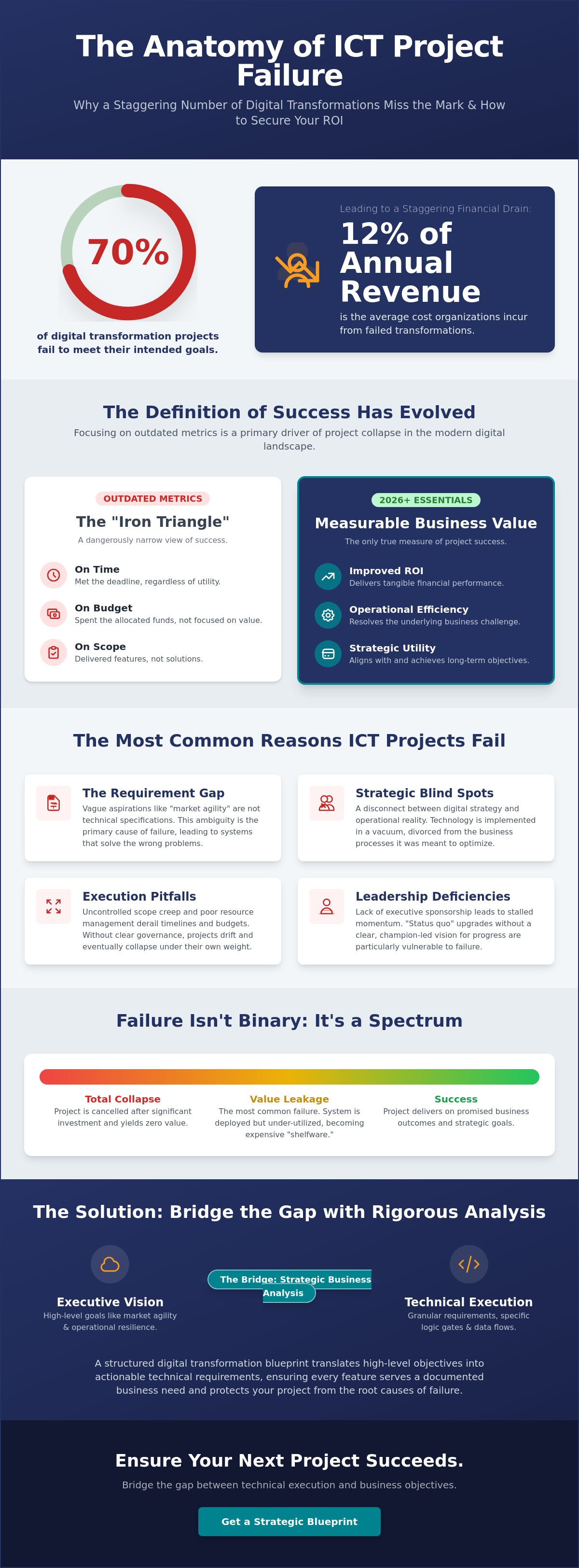
Approximately 70% of digital transformation projects fail to meet their intended goals, a statistic that highlights a persistent disconnect between technical ambition and organizational reality. You've likely experienced the frustration of wasted capital on unused technology or the operational disruption that occurs when a rollout misses the mark. It's a common sentiment among leadership that these investments should yield higher reliability and better returns. The reality is that failed transformations cost organizations an average of 12% of their annual revenue, often due to a breakdown in translating business objectives into technical requirements.
This article explores the common reasons ICT projects fail and provides the methodical frameworks required to ensure strategic alignment and delivery success. We'll analyze the structural risks inherent in modern implementations, from the retirement of legacy tools like Microsoft Project Online in late 2026 to the complexities of the NIST Cybersecurity Framework 2.0. By bridging the gap between technical execution and broader organizational objectives, you can secure a clear path toward improved ROI on digital transformation and sustainable operational efficiency.
Key Takeaways
Shift your definition of success from mere technical completion to the measurable delivery of business value within the 2026 digital landscape.
Understand that the most common reasons ICT projects fail are rooted in vague requirements and a lack of rigorous business analysis during the planning phase.
Resolve strategic blind spots by aligning fragmented departments and securing the executive sponsorship necessary to maintain project momentum.
Protect your budget and timelines from scope creep by implementing methodical resource management and clear governance structures.
Use a structured digital transformation blueprint to bridge the gap between complex technical requirements and your broader organizational objectives.
Table of Contents
Defining ICT Project Failure in the 2026 Digital Landscape
Traditionally, project success was measured by the "Iron Triangle": staying on time, within budget, and meeting specific scope requirements. In the 2026 digital economy, this definition is dangerously narrow. Success is no longer binary. While a system might technically deploy, failure occurs when that system fails to yield the promised operational efficiency or financial performance. One of the most common reasons ICT projects fail is the fixation on technical completion at the expense of strategic utility. If a platform is launched but does not resolve the underlying business challenge, it hasn't succeeded; it has simply consumed resources.
For Australian organisations, the stakes are particularly high. Operating in a competitive, high-cost environment means that capital efficiency is paramount. Strategic misalignment occurs when there is a fundamental disconnect between the digital strategy and the operational reality of the business. This misalignment is the primary driver of project collapse. It creates a scenario where technology is implemented in a vacuum, divorced from the processes it was intended to optimize. When technical requirements don't mirror organizational objectives, the resulting "solution" often becomes a new problem to manage.
The Spectrum of Failure: From Total Collapse to Value Leakage
Failure exists on a broad spectrum. At one end lies complete abandonment, where projects are cancelled after significant investment. Examining the list of notable project failures reveals that even projects meeting technical milestones can result in catastrophic financial loss if they lack strategic utility. More common, however, is "Value Leakage." This happens when a system is technically sound but remains under-utilised by staff, eventually becoming expensive shelfware. We define ICT failure as the inability to achieve the intended digital transformation blueprint and the specific business outcomes it promised. It's the gap between what the technology can do and what the business actually achieves.
The Evolving Risks of 2026
The complexities of 2026 have introduced new layers of risk. AI integration and hybrid cloud environments have made system harmony more difficult to achieve. Technical debt, often the result of rushed "good enough" solutions, now acts as a silent killer of long-term project sustainability. Many organisations find that another of the common reasons ICT projects fail is the pursuit of "Status Quo" upgrades. These projects, which aim merely to keep pace with existing systems rather than drive innovation, often lack the executive sponsorship and rigorous business analysis needed to survive. Without a clear vision for progress, these initiatives frequently stall, leaving the organisation with fragmented processes and wasted capital.
The Requirement Gap: Why Misaligned Business Analysis is Fatal
Failure in ICT isn't usually a coding error; it's a conceptual one. The most critical breakdown occurs long before the first line of code is written. One of the most common reasons ICT projects fail is the lack of rigorous, objective business analysis. When leadership defines a project through vague aspirations rather than granular technical specifications, they invite ambiguity. This ambiguity inevitably leads to scope creep, as implementation teams attempt to interpret intent without a definitive roadmap. Without a fixed target, the project drifts, consuming resources without delivering a functional result.
A significant "translation error" often exists between executive vision and technical execution. Leadership typically focuses on high-level outcomes like "market agility" or "operational resilience," while developers require specific logic gates and data flows. Bridging this gap requires professional business process mapping to ensure every technical requirement serves a documented business need. Without this step, projects often succumb to "feature bloat," where complex systems are built to solve problems that don't exist, while the core operational bottlenecks remain unaddressed. Academic research on ICT project failure supports this, indicating that poor requirement elicitation is a primary factor in both public and private sector project collapse.
The Danger of Assumptions in ICT Planning
Many organisations fall into the trap of assuming that "off-the-shelf" solutions will resolve their inefficiencies without modification. Technology is only as effective as the processes it supports. Focusing on software features rather than functional outcomes results in a system that staff find difficult to use or irrelevant to their daily tasks. A comprehensive digital transformation blueprint is the only safeguard against assumption-led failure. It provides the structural clarity needed to align technical capabilities with specific, measurable business goals, ensuring the final product actually fits the organization.
The Cost of Poor Documentation
Inadequate documentation creates a "single point of failure" risk, where critical project knowledge resides only in the minds of a few individuals. If those staff members leave, the project often stalls or requires expensive reverse-engineering. This lack of clarity is one of the common reasons ICT projects fail during the testing phase, where budget overruns occur because the system doesn't behave as stakeholders expected. A formal requirements document is a non-negotiable asset for maintaining control over the implementation. If your current project lacks this clarity, an objective business efficiency diagnostic can identify where the requirement gap is widest before it impacts your bottom line.
Strategic Blind Spots: Governance and Leadership Deficiencies
Technical competence cannot compensate for a leadership vacuum. While developers and analysts manage the granular details, an ICT project without a dedicated executive "North Star" will inevitably drift. One of the most common reasons ICT projects fail is the absence of active, informed executive sponsorship. When leadership views technology as a separate department rather than a core business driver, the project loses its strategic anchor. This leads to the "Silo Effect," where fragmented departments implement isolated ICT solutions that fail to integrate, creating operational friction instead of harmony.
Strategic risk management is another area where leadership deficiencies often emerge. Treating security and compliance as afterthoughts rather than foundational requirements creates long-term vulnerability. With the 2026 emphasis on frameworks like NIST CSF 2.0, governance must be proactive. For many organisations, the cost of a full-time executive to manage these complexities is prohibitive. This is where Fractional CIO services provide a pragmatic solution. They offer high-level oversight and strategic coordination without the full-time overhead, ensuring that technical decisions align with financial performance.
The Governance Vacuum in ICT
Effective governance requires a clear distinction between project steering and strategic oversight. Project steering focuses on timelines and tasks, whereas strategic oversight ensures the project remains aligned with the company’s long-term objectives. IT managers often find themselves in a difficult position; they possess the technical knowledge but lack the organisational authority to drive business-wide change. An independent business efficiency diagnostic is often the first step in identifying these governance gaps. It provides an objective assessment of where leadership structures are failing the project and where authority needs to be redistributed.
Accountability vs. Responsibility
Ownership must be clearly defined at the executive level. Responsibility for task completion is not the same as accountability for the ultimate business outcome. When projects fall into the trap of "Design by Committee," the resulting system is often a series of compromises that fails to excel in any single area. It's another of the common reasons ICT projects fail; the lack of a single, accountable owner leads to diluted objectives. To avoid this, ICT strategy must be integrated into the broader business strategy. It shouldn't exist as a separate silo but as a functional pillar that supports end-to-end results and operational excellence.
Execution Pitfalls: From Scope Creep to Manual Mayhem
Even with a sound strategy, the transition from planning to implementation often reveals hidden friction. Scope creep remains one of the most persistent common reasons ICT projects fail; it usually begins with the request for "just one more feature" that hasn't been vetted against the original business case. These small, incremental additions compound, eventually destroying budgets and timelines. This is often exacerbated by "Resource Lies," where organisations underestimate the internal effort required. Effective implementation demands significant time from subject matter experts and end-users, not just the technical team. When this internal capacity is ignored, the project stalls under its own weight.
Many organisations also fall victim to the "Sunk Cost Fallacy." They continue to fund failing initiatives because of the capital already invested, rather than objectively assessing the project's current viability. This manual mayhem often extends to the delivery pipeline itself. Failing to automate testing or deployment creates bottlenecks that slow progress and introduce human error. When delivery processes remain manual, the project cannot scale, and the risk of catastrophic deployment failure increases with every update.
Underestimating the Human Element
Technical success is irrelevant if the workforce rejects the system. Resistance to change is a natural response to operational disruption, yet it is frequently overlooked during the execution phase. Robust project management must include comprehensive change management and training protocols to mitigate this risk. Measuring adoption rates, rather than just "go-live" dates, provides the only true metric of project success. If employees don't use the tool as intended, the strategic objectives remain unfulfilled.
Technical Execution Failures
Modern ICT initiatives don't exist in isolation. Ignoring the complex dependencies between legacy systems and new business technology is another of the common reasons ICT projects fail during the final stages of rollout. Another risk involves moving "Proof of Concept" (PoC) code directly into production environments without the necessary hardening or scalability testing. This creates a fragile infrastructure that is prone to failure. Manual testing processes also present a significant bottleneck; they are slow, inconsistent, and often fail to catch the regressions that automated suites identify instantly.
To resolve these execution bottlenecks and secure your project's trajectory, you can request a Business Efficiency Diagnostic to identify and eliminate operational friction before it impacts your bottom line.
Navigating Recovery: A Framework for ICT Project Success
Recovering a project in distress requires a departure from the reactive habits that caused the initial drift. It's a process of clinical reassessment rather than simply increasing the volume of technical output. Many of the common reasons ICT projects fail are reversible if leadership is willing to halt momentum to secure the foundation. This recovery process begins with an independent diagnostic to identify where the misalignment between technical execution and business intent first occurred. By treating the project as a series of logical dependencies, you can reset the trajectory without discarding the entire initial investment.
Building a culture of logical confidence is essential for long-term resilience. This means shifting from gut-based decisions to data-driven governance. When every stakeholder understands the "why" behind a technical requirement, the project gains a steady, predictable rhythm. This structured approach ensures that complex organizational challenges are met with methodical solutions rather than fragmented fixes. It provides the clarity needed to bridge the gap between technical requirements and broader organizational objectives, ensuring end-to-end results.
The 5-Step ICT Success Framework
To ensure strategic alignment and delivery success, we advocate for a structured, five-step framework designed to eliminate ambiguity and drive progress:
Step 1: Conduct a comprehensive Business Efficiency Diagnostic to uncover hidden friction and baseline current performance.
Step 2: Re-align technical requirements with a Digital Transformation Blueprint, ensuring every feature serves a documented business outcome.
Step 3: Establish a Fractional CIO or executive steering committee to provide the high-level oversight necessary for strategic harmony.
Step 4: Focus on Automation Implementation within testing and deployment pipelines to create reliable guardrails and reduce manual error.
Step 5: Execute with rigorous Project Management and active change advocacy to ensure the human element is integrated into the rollout.
Why Professional Consultancy is the Best Insurance
The ROI of getting requirements right the first time far outweighs the cost of project remediation. External analysts provide a level of objectivity that internal teams, often too close to the technical debt or departmental politics, cannot maintain. They serve as analytical collaborators who prioritize finding the most effective solution over the easiest one. While common reasons ICT projects fail are numerous, they are almost entirely preventable through disciplined planning and professional business analysis. Ultimately, success is a choice made during the planning phase. By committing to a methodical, results-driven approach, you ensure that your digital strategy delivers tangible value and sustainable operational efficiency.
Securing Strategic Alignment for Future Digital Initiatives
The path to a resilient digital infrastructure requires more than just technical deployment; it demands a rigorous alignment between organizational objectives and technical execution. We've identified that a lack of clear requirements and fragmented leadership represent the most common reasons ICT projects fail in the 2026 landscape. By prioritizing a structured recovery framework and precise business analysis, you can transform these systemic risks into opportunities for operational efficiency. It's a shift from reactive problem-solving to proactive, logic-based governance.
With over 20 years of expertise in strategic ICT consultancy, our team specializes in bridging the gap between high-level vision and granular technical reality. Our methodical approach ensures that your digital transformation blueprint remains both actionable and sustainable. You don't have to navigate these complex organizational challenges without a reliable partner. Book a Business Efficiency Diagnostic to secure your next ICT project and gain the objective clarity needed to drive measurable results. Success is a predictable outcome when your strategy is grounded in precision and professional oversight.
Frequently Asked Questions
What is the most common reason ICT projects fail in Australia?
The most common reason ICT projects fail in the Australian market is strategic misalignment between technical implementation and core business objectives. Often, technology is treated as an isolated purchase rather than an integrated operational pillar. This disconnect leads to systems that are technically functional but fail to drive the required business value. Ensuring that every technical requirement is anchored in a documented digital strategy is the only way to mitigate this systemic risk.
How does poor business analysis contribute to project failure?
Poor business analysis creates a "translation error" between executive vision and developer execution. When requirements are vague or based on unverified assumptions, technical teams are forced to guess, leading to scope creep and functional gaps. This lack of precision is one of the common reasons ICT projects fail during the testing phase. Rigorous process mapping ensures that the final solution actually resolves the identified operational bottlenecks.
Can a failing ICT project be saved once it is over budget?
A failing project can be recovered by pausing momentum to conduct an objective Business Efficiency Diagnostic. This assessment identifies where the project diverged from its intended outcomes and provides a logical path for re-alignment. Rather than succumbing to the sunk cost fallacy, leadership should use this data to reset the digital transformation blueprint. This methodical approach allows for the salvage of existing investments while securing the project’s future delivery success.
What is the difference between project management and ICT consultancy?
Project management focuses on the tactical execution of defined tasks, while ICT consultancy, specifically business analysis, focuses on the strategic validity of those tasks. Project managers ensure a rollout stays on schedule; consultants ensure the rollout is the right solution for the business. Professional consultancy bridges the gap between organizational needs and technical requirements, providing the strategic oversight that traditional task management often lacks in complex environments.
How much should a business invest in the planning phase of an ICT project?
Investment in the planning phase should be sufficient to eliminate technical ambiguity and define a clear digital transformation blueprint. While specific budget allocations vary based on complexity, the planning phase is the most cost-effective time to identify risks. Skimping on business analysis often leads to exponential costs later in the lifecycle. Thorough planning acts as insurance against common reasons ICT projects fail, ensuring the implementation team has a definitive roadmap.
Why is leadership engagement so critical for digital transformation?
Leadership engagement provides the strategic authority required to break down departmental silos and drive organizational change. Without a dedicated executive sponsor to act as a "North Star," ICT projects often lose their focus and become bogged down in "design by committee." Active involvement from the C-suite ensures that technical decisions are always made with an eye toward financial performance and long-term business agility.
What role does change management play in preventing ICT failure?
Change management prevents project failure by addressing the human element of technology adoption. Even the most sophisticated ICT solutions will fail if employees resist the new processes or find them difficult to navigate. By integrating training and change advocacy into the project management lifecycle, organizations can ensure that staff are prepared for the transition. High adoption rates are the final metric of any successful digital transformation initiative.
How can a Fractional CIO help prevent project collapse?
A Fractional CIO provides the high-level governance and strategic direction typical of a full-time executive without the associated overhead. They act as an analytical collaborator, ensuring that technical investments align with broader business goals. By providing objective oversight and bridging the communication gap between technical teams and leadership, a Fractional CIO helps prevent the strategic drift that often leads to total project collapse.



Comments