Challenges of Digital Transformation in Australia: A Strategic Guide for 2026
Updated: May 31
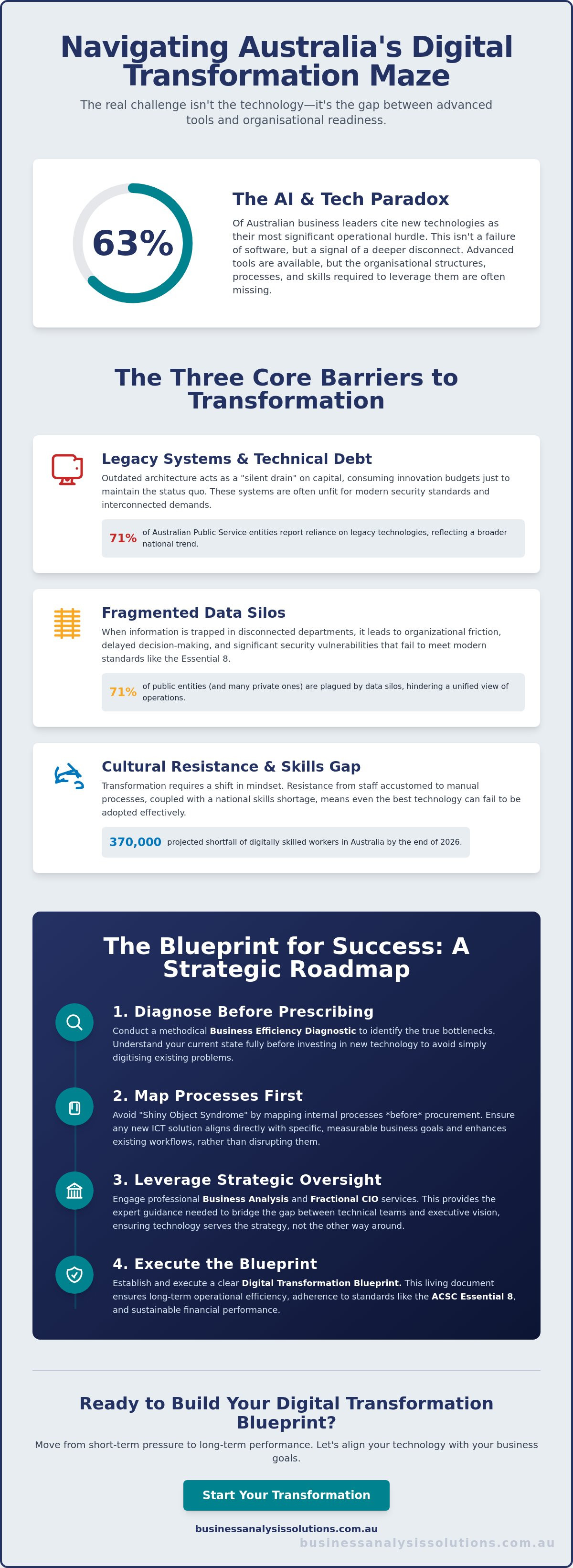
63% of Australian business leaders now cite AI and new technologies as their most significant operational hurdle, yet the real bottleneck is rarely the software itself. The fundamental challenges of digital transformation in Australia arise from a disconnect between sophisticated tools and the structural readiness of the organizations adopting them. You've likely experienced the friction of fragmented data silos or watched innovation budgets get consumed by the high costs of maintaining legacy systems. It's a common frustration to see strategic momentum stall because long-term staff are hesitant to abandon familiar, manual processes.
This guide offers a methodical approach to identifying and dismantling the technical and cultural barriers that impede progress. We'll move beyond the "AI paradox" where advanced tools exist without the workforce literacy to leverage them effectively. By following a structured roadmap for ICT implementation, you can align your technology with specific business goals to drive measurable efficiency. We'll explore how to transition from short-term operational pressure to a Digital Transformation Blueprint that ensures your infrastructure supports, rather than hinders, your financial performance.
Key Takeaways
Understand why structural and cultural barriers, rather than technology, represent the primary challenges of digital transformation in Australia for 2026.
Learn how to mitigate "technical debt" and resolve fragmented data silos through a methodical Business Efficiency Diagnostic.
Discover why mapping internal processes before ICT procurement is essential to avoiding the financial pitfalls of "Shiny Object Syndrome."
Explore how Fractional CIO services and professional business analysis provide the strategic oversight required to align technology with organizational goals.
Establish a clear roadmap for your Digital Transformation Blueprint to ensure long-term operational efficiency and sustainable financial performance.
Table of Contents
Defining Digital Transformation Challenges in the Australian Business Landscape
The Core Barriers: Legacy Systems, Data Silos, and Cultural Resistance
The Strategic Gap: Why Technology-First Initiatives Fail to Deliver ROI
Strategic Frameworks to Overcome Digital Transformation Hurdles
Executing Your Transformation: The Role of Business Analysis and Fractional CIO Services
Defining Digital Transformation Challenges in the Australian Business Landscape
Digital transformation isn't merely the acquisition of new software; it's the methodical alignment of technology with specific organisational objectives. For many leaders, the primary challenges of digital transformation in Australia stem from treating technology as a standalone solution rather than a fundamental shift in business logic. In the 2026 market, where 78% of tech leaders identify AI as their dominant focus, the pressure to adopt tools quickly often leads to a disconnect between technical capability and operational reality. This misalignment creates a "run" versus "change" conflict, where short-term operational demands often stifle long-term strategic growth.
Understanding What is Digital Transformation? requires a clear distinction between tactical digitisation and strategic evolution. While digitisation converts manual data into digital formats, true transformation reengineers how a business delivers value. Addressing the challenges of digital transformation in Australia requires acknowledging a projected shortfall of 370,000 digitally skilled workers by the end of 2026. Furthermore, stringent regulatory shifts, such as the Cyber Security Rules 2025 which mandated unique passwords and vulnerability reporting for smart devices as of March 4, 2026, demand a more calculated approach to investment than in less regulated markets.
The 2026 Digital Evolution: Beyond Simple Automation
Current maturity models have moved past standalone tools toward integrated ecosystem harmony. In 2026, successful strategies don't just automate tasks; they ensure that every system communicates effectively to eliminate data silos that currently plague 71% of the public service and many private entities. This evolution is heavily influenced by the Australian Cyber Security Centre's Essential 8, which now serves as a baseline for any transformation effort. Adhering to these standards isn't just about compliance. It's a strategic move to protect financial performance in an economy where data-driven decision-making is the only way to maintain a competitive edge.
Identifying the Threshold of Transformation
It's easy to mistake the implementation of a new CRM for a complete overhaul. However, if your underlying processes remain manual or inefficient, you're merely digitising existing problems. True transformation occurs when business technology is used to fundamentally scale national operations and remove structural bottlenecks. You've reached this threshold when your digital architecture actively predicts and resolves friction points before they impact the bottom line. This requires moving beyond "governance theatre" and into a space where technology serves the strategy, not the other way around.
Digital transformation is the strategic evolution of business logic through the purposeful integration of technology to achieve superior organisational outcomes.
The Core Barriers: Legacy Systems, Data Silos, and Cultural Resistance
The challenges of digital transformation in Australia aren't limited to choosing the right software. They're often rooted in the structural weight of legacy systems that weren't designed for the interconnected demands of 2026. Technical debt, the cumulative cost of additional rework caused by choosing easy solutions over strategic ones, is a silent drain on mid-market capital. When 71% of Australian Public Service entities report a reliance on legacy technologies, it reflects a broader national trend where innovation is frequently sacrificed to maintain outdated architecture that's no longer fit for purpose. To navigate these complexities, many organizations engage global IT consultancies like Kagool to modernize their core infrastructure and ensure their technology stacks are future-ready.
Data silos amplify this issue by creating organisational friction. When information is trapped in disconnected departments, it leads to delayed decision-making and lost revenue. These silos also present significant security vulnerabilities. Outdated systems often fail to meet the Australian Cyber Security Centre’s Essential 8 standards, leaving firms exposed to risks that modern ICT solutions are built to mitigate. Navigating these regulatory and policy challenges requires a shift from reactive patching to proactive strategic planning.
Technical Debt and Legacy Constraints
Technical debt is a logical consequence of prioritising short-term fixes over long-term system harmony. Legacy constraints prevent the implementation of modern automation because the underlying data structures can't support real-time processing. This creates a financial imbalance where businesses spend a disproportionate amount of their budget just "keeping the lights on" rather than investing in growth. For many Australian firms, the $20,000 instant asset write-off available for eligible assets from July 2026 provides a tactical opportunity to begin retiring these legacy burdens. Identifying these inefficiencies through a professional business analysis consultancy is the first step toward reclaiming operational capacity.
The Human Element: Change Fatigue and Leadership Gaps
Technology doesn't fail; implementation does. Change fatigue occurs when staff feel bombarded by new tools that don't solve their immediate pain points. This resistance is frequently a symptom of a leadership gap. If executives don't demonstrate clear ownership of a digital initiative, staff will treat it as a temporary disruption rather than a permanent improvement. Australia is projected to face a shortfall of 370,000 digitally skilled workers by 2026. This means that upskilling current staff and communicating the logic behind every change is essential. Clear, consistent communication bridges the gap between technical requirements and the human effort needed to sustain them.
The Strategic Gap: Why Technology-First Initiatives Fail to Deliver ROI
Technology-first procurement is a primary driver of investment failure. Many organisations succumb to 'Shiny Object Syndrome,' where the allure of generative AI or new cloud platforms overrides the necessity of structural process mapping. With up to $70 million allocated for private sector AI development through AI Accelerator rounds in the 2026-27 Federal Budget, the temptation to rush into implementation without a clear Digital Strategy is higher than ever. Without a foundation of rigorous project management, these initiatives often result in expensive tools that staff don't use or that fail to integrate with existing workflows. The challenges of digital transformation in Australia are frequently exacerbated when executive teams treat ICT as a separate cost centre rather than a core component of business strategy.
When a business prioritises the 'how' of technology over the 'why' of the business case, the result is almost always a lack of ROI. High-performance organisations understand that digital tools are only as effective as the processes they support. If a process is logically flawed, automating it only accelerates the error rate. This strategic gap is where many Australian mid-market firms lose their competitive edge, spending significant capital on sophisticated software that ultimately creates more organisational friction than it resolves. True progress requires a shift from buying solutions to building a cohesive technical architecture.
Misalignment Between ICT and Business Objectives
Identifying whether your current IT spend aligns with a three-year growth plan requires more than just a budget review. It demands an audit of utility across every department. A common symptom of misalignment is 'shadow IT,' where departments independently purchase software to bypass perceived bottlenecks in central IT. This creates a fragmented environment that increases security risks and duplicates costs. Technology is a lever for business efficiency, not a solution in itself. Navigating these digital transformation policy challenges requires central oversight to ensure every procurement contributes to a unified objective. Without this alignment, technology becomes a distraction rather than a driver of progress.
The High Cost of Reactive Implementation
Reactive implementation involves 'bolting on' digital solutions to fundamentally broken manual processes. This approach rarely delivers a return on investment because it merely digitises inefficiency. A comprehensive business efficiency diagnostic is essential before committing capital to new infrastructure. In Australia, the hidden costs of failed ICT projects include not just the software licensing fees, but the hundreds of hours lost to training on redundant systems and the subsequent loss of staff morale. Quantifying these failures is difficult, but the cumulative impact on financial performance and operational stability is often enough to stall growth for several fiscal years. Moving forward requires a transition from reactive purchasing to proactive strategic design that treats process mapping as a prerequisite for any new tool.
Strategic Frameworks to Overcome Digital Transformation Hurdles
Resolving the challenges of digital transformation in Australia requires a departure from reactive procurement toward a sequence of logical, data-backed steps. Most failures occur because leaders skip the diagnostic phase and move straight to software implementation. A structured framework ensures that capital is allocated only to solutions that provide measurable operational value. This process begins with an objective assessment of your current state to identify exactly where technical debt is most corrosive to your bottom line. By following a methodical sequence, you can transform technology from a source of friction into a driver of performance.
Step 1: Conduct a comprehensive Business Efficiency Diagnostic to establish an objective baseline of current operations.
Step 2: Execute thorough Business Process Mapping to identify hidden bottlenecks and manual redundancies.
Step 3: Develop a formal digital transformation blueprint for business that aligns technical capabilities with growth targets.
Step 4: Align ICT solutions with documented business requirements rather than adjusting your business to fit the software.
Step 5: Implement all changes through structured, expert project management to ensure timelines and budgets are respected.
Process Mapping as the Foundation of Success
Visualising workflows is the only reliable way to reveal hidden inefficiencies that staff have come to accept as "normal." When you document every touchpoint in a process, you expose the logical gaps that lead to data silos and duplicated effort. This clarity is essential for successful automation implementation; you can't automate a process that isn't first defined and optimised. Beyond the technical benefits, clear process maps serve as a powerful communication tool. They help secure buy-in from all organisational levels by showing staff exactly how new ICT solutions will reduce their daily administrative burden and improve their focus on high-value tasks.
Building a Scalable ICT Roadmap
Transitioning from reactive fixes to a proactive digital strategy requires a roadmap that accounts for more than just the next twelve months. Your blueprint must ensure system harmony, where every new tool integrates seamlessly with your existing architecture. This scalability is particularly important as you prepare for the increased data demands of 2026. Maintaining data integrity is the core of this future-ready approach. If your underlying data is fragmented or inaccurate, even the most sophisticated AI tools will fail to deliver actionable insights. A professional Business Efficiency Diagnostic can help you identify these data risks before they compromise your long-term transformation goals.
Executing Your Transformation: The Role of Business Analysis and Fractional CIO Services
Execution is the stage where the most significant challenges of digital transformation in Australia become visible. Even the most robust strategy will falter without precise leadership and objective oversight. For many mid-market organisations, the cost of a full-time Chief Information Officer is prohibitive, yet the need for executive-level technical direction is absolute. This is where Fractional CIO services Australia provide a logical solution. These services offer the strategic leadership required to bridge the gap between boardroom objectives and the technical realities of the server room without the overhead of a permanent executive salary.
A professional Business analysis consultancy serves as the objective third party necessary to dismantle long-standing data silos and cultural resistance. Internal teams are often too close to existing processes to identify their inherent flaws. An external analyst brings a methodical approach to process mapping, ensuring that every technical requirement is anchored in a documented business need. This collaboration culminates in a Digital Transformation Blueprint, a comprehensive deliverable that provides the clarity and momentum needed to move from fragmented legacy systems to a unified, high-performance architecture.
Leveraging Executive IT Advisory
A Fractional CIO is often the catalyst needed to rescue a stalled project or realign a drifting ICT strategy. Their role is fundamentally different from a Managed Service Provider (MSP). While an MSP typically handles day-to-day maintenance and helpdesk functions, a Fractional CIO focuses on how ICT solutions deliver tangible financial performance. They ensure that technology isn't just "running" but is actively contributing to the organisation's 2026 growth targets. This executive advisory ensures that every technical investment is vetted against its ability to improve operational efficiency and mitigate risk.
Taking the First Step: The Efficiency Diagnostic
Transformation shouldn't begin with a software purchase; it must begin with an assessment. A professional Business Efficiency Diagnostic provides the empirical data required to justify your transformation roadmap. This diagnostic identifies exactly where manual redundancies are draining capital and where automation will provide the most immediate ROI. It removes the ambiguity from digital investment, replacing guesswork with a structured plan based on your unique operational data. To ensure your 2026 strategy is built on a foundation of logic and efficiency, book a consultation to begin your diagnostic process today. This initial step provides the baseline needed to overcome the structural hurdles and achieve end-to-end digital success.
Securing Sustainable Operational Performance
Navigating the challenges of digital transformation in Australia requires a transition from reactive software procurement to a disciplined, process-first methodology. Success in 2026 won't be defined by the sheer volume of technology adopted, but by how effectively those tools align with your core business logic. By prioritizing comprehensive process mapping and dismantling data silos, you can ensure that technical investments drive measurable financial performance rather than adding to your technical debt.
With over 20 years of industry experience, our team provides the specialized Business Efficiency Diagnostics and expert Fractional CIO advisory needed to bridge the gap between high-level strategy and technical execution. We focus on creating system harmony that supports long-term scalability and operational resilience. You can optimise your organisational efficiency with a Digital Transformation Blueprint designed to resolve structural bottlenecks and secure your competitive edge. Establishing a clear, logical roadmap today ensures your organization remains agile and profitable in an increasingly complex digital landscape. We look forward to helping you achieve a seamless, results-driven transformation.
Frequently Asked Questions
What are the biggest challenges of digital transformation in Australia for 2026?
The primary challenges of digital transformation in Australia for 2026 include a projected shortfall of 370,000 digitally skilled workers and the rapid adoption of AI without proper governance. A 2026 KPMG survey found that 63% of business leaders identify new technologies as their top hurdle. These issues are often compounded by technical debt and the high costs of maintaining legacy systems while attempting to innovate.
How does legacy technology impact my business growth?
Legacy technology impacts growth by locking capital into maintenance instead of innovation, creating a cumulative burden of technical debt. These outdated systems often result in fragmented data silos that prevent effective decision-making and hinder operational efficiency. Since 71% of Australian Public Service entities rely on legacy tech, private organisations must proactively retire these systems to maintain their competitive edge and long-term financial performance.
Why do most digital transformation projects fail in the first 12 months?
Many challenges of digital transformation in Australia arise when organisations prioritise software procurement over structural process mapping. Projects often fail in the first year because they lack a clear business case or executive ownership, leading to "Shiny Object Syndrome." Without expert project management, new tools frequently fail to integrate with existing workflows, resulting in low staff adoption and a failure to deliver measurable ROI.
What is a Digital Transformation Blueprint and why do I need one?
A Digital Transformation Blueprint is a strategic roadmap that aligns your technical infrastructure with specific organisational objectives. It provides the clarity needed to transition from reactive ICT fixes to a proactive, scalable digital strategy. You need this blueprint to ensure system harmony and to prevent the financial waste associated with implementing tools that don't support your long-term growth targets or operational requirements.
How can a Fractional CIO help my business overcome ICT hurdles?
A Fractional CIO provides the executive leadership and strategic advisory required to navigate complex ICT hurdles without the cost of a full-time hire. They bridge the gap between technical requirements and boardroom goals, ensuring every investment drives financial performance. By offering an objective perspective, they help rescue stalled initiatives and ensure your digital architecture remains compliant with evolving Australian security standards and industry best practices.
What is the role of Business Process Mapping in digital strategy?
Business Process Mapping is the logical starting point for any digital strategy because it visualises every touchpoint in your current operations. This process reveals hidden bottlenecks and redundancies that software alone cannot fix. By optimising these workflows before implementation, you ensure that new ICT solutions enhance efficiency rather than simply digitising existing problems, which is critical for achieving long-term system harmony.
How do Australian regulations like the Essential 8 affect my digital transformation?
Regulations like the Essential 8 and the Cyber Security Rules 2025 mandate specific security protocols that must be foundational to your digital architecture. These standards protect your organisation from escalating cyber risks and ensure your data integrity remains intact. Integrating these requirements into your transformation strategy isn't just about compliance; it's a strategic move to safeguard your financial performance and maintain operational stability in a regulated economy.
What is a Business Efficiency Diagnostic and how does it work?
A Business Efficiency Diagnostic is a methodical assessment used to identify where manual processes and technical debt are draining your resources. It works by auditing your existing workflows and ICT systems to provide an empirical baseline for improvement. This diagnostic provides the data-driven insights necessary to develop a successful Digital Transformation Blueprint and prioritise investments that offer the most significant and immediate operational value.



Comments