Calculating ROI on Business Automation: A Strategic Framework for 2026
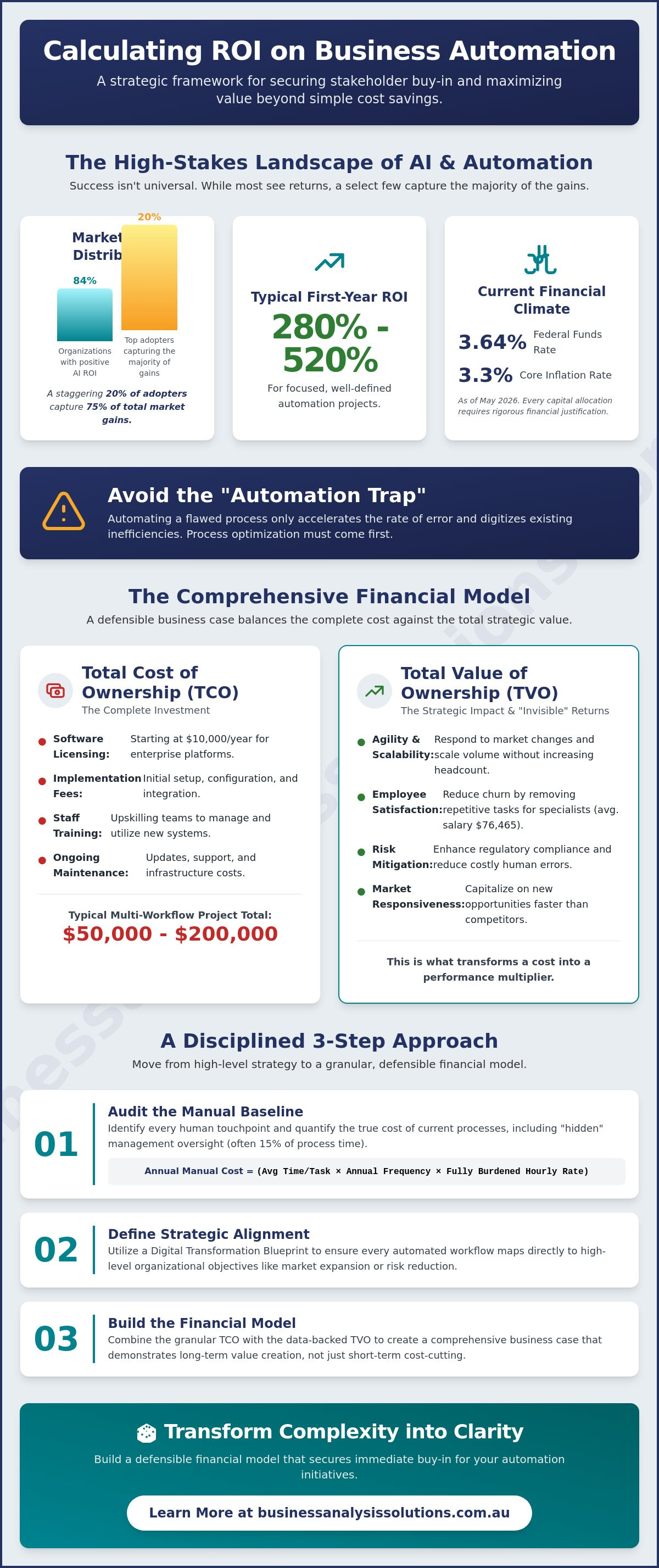
While 84% of organizations report a positive return on their AI investments, a staggering 20% of adopters capture 75% of the total market gains. This bimodal distribution proves that success isn't about simply deploying software; it's about precision in calculating ROI on business automation. You likely understand that traditional metrics often fail to satisfy skeptical stakeholders who view saved time as a phantom benefit. With the effective federal funds rate sitting at 3.64% and core inflation at 3.3% as of May 2026, every capital allocation must be defensible against rigorous financial scrutiny.
We agree that quantifying intangible benefits like risk reduction or error mitigation often feels like an exercise in guesswork. This article provides the logical methodology you need to transform these complexities into a defensible financial model that secures immediate buy-in. We'll examine a strategic framework that moves beyond simple cost savings to account for the 280% to 520% first year ROI typical for focused projects. You'll gain clarity on total cost of ownership and learn how to validate technology choices that support long term scalability.
Key Takeaways
Distinguish between Total Cost of Ownership (TCO) and Total Value of Ownership (TVO) to build a more comprehensive and accurate financial model.
Master a logical methodology for calculating ROI on business automation by establishing precise baselines for current manual process costs and labor displacement.
Quantify the strategic value of "invisible" returns, including regulatory compliance, risk mitigation, and the capacity to scale volume without increasing headcount.
Avoid the "Automation Trap" by ensuring process optimization occurs before technical deployment to prevent the digitisation of existing inefficiencies.
Utilise a Digital Transformation Blueprint to maintain strategic alignment between technical requirements and long-term organisational objectives.
Table of Contents The Strategic Framework for Measuring Business Automation ROI Step-by-Step: Calculating Hard Costs and Direct Savings Quantifying the "Invisible" Returns: Quality, Compliance, and Scalability Avoiding the "Automation Trap": Factors That Dilute Your Return Maximising Investment Through a Digital Transformation Blueprint
The Strategic Framework for Measuring Business Automation ROI
In the context of modern ICT consultancy, a Return on Investment (ROI) is more than a simple financial ratio. It represents the measurable efficiency gained when technology is applied to structured business processes. For leaders in 2026, calculating ROI on business automation requires a shift from viewing technology as a cost center to seeing it as a performance multiplier. Precision is vital because stakeholders now demand a rigorous accounting of how capital expenditure translates into operational resilience. With the federal funds rate held at 3.64% as of May 2026, the opportunity cost of capital is too high to permit vague projections or "soft" metrics.
A methodical approach identifies and eliminates Process Debt before automation begins. Process Debt is the accumulated cost of inefficient, manual workarounds that have become "standard" over time. If you automate a flawed process, you simply accelerate the rate of error. By quantifying this debt through process mapping and requirements elicitation, we establish a realistic baseline. This ensures that the resulting financial model is built on verified data rather than optimistic estimates.
Beyond the Formula: Strategic Alignment
Automation initiatives fail when they exist in a technical vacuum. To secure stakeholder buy-in, every proposed workflow must map directly to high-level organisational objectives like market share expansion or risk mitigation. Successful stakeholder engagement ensures that "success" is defined by those who own the business outcomes, not just the IT department. Strategic alignment acts as the bridge between technical requirements and business goals, ensuring that every bot deployed serves a specific corporate purpose.
TCO vs. TVO: A Comprehensive View
Sophisticated business analysis distinguishes between what an automation costs and what it's worth. Total Cost of Ownership (TCO) includes the granular expenses of software licensing, initial implementation fees, staff training, and ongoing maintenance. In 2026, enterprise platforms like UiPath often start at $10,000 per year, but the hidden costs of integration can push project totals between $50,000 and $200,000 for multi-workflow builds.
Conversely, Total Value of Ownership (TVO) captures the broader strategic impact. This includes:
Agility: The ability to pivot operations in response to a 3.3% inflation rate.
Employee Satisfaction: Reducing the churn of specialists who command average salaries of $76,465 by removing repetitive tasks.
Market Responsiveness: The speed at which a firm can capitalise on new opportunities.
When presenting to a board, you must balance these metrics. A defensible business case pairs a transparent TCO with a data-backed TVO to show that calculating ROI on business automation is an exercise in long-term value creation, not just short-term cost-cutting.
Step-by-Step: Calculating Hard Costs and Direct Savings
Moving from a high-level strategic framework to a granular financial model requires a disciplined approach to data collection. To succeed in calculating ROI on business automation, you must first strip away assumptions and focus on the verifiable hard costs of your current state. Most organisations fail here by underestimating the cumulative impact of micro-tasks. A methodical audit ensures that the business case is built on a foundation of reality rather than optimistic projections.
Step 1: Auditing the Manual Baseline
Precision begins with business process mapping to identify every human touchpoint within a workflow. We use a standard formula for Annual Manual Cost: (Average Time per Task x Annual Frequency x Fully Burdened Hourly Rate). It's essential to use the "fully burdened" rate, which includes payroll taxes and benefits, rather than just the base salary. For an Automation Specialist in 2026, the average annual salary is approximately $76,465, but the cost to the employer is significantly higher.
Don't overlook "hidden" management oversight time. Every manual process requires a supervisor to review work, handle exceptions, or provide guidance. In complex environments, this oversight can account for 15% to 20% of the total process cost. Capturing these details allows for a more accurate comparison against the projected automated state.
Step 2: Projecting Post-Automation Efficiency
Calculating savings is not synonymous with assuming immediate headcount reduction. Instead, focus on labor cost displacement. This identifies the capacity regained by the organisation, allowing skilled staff to focus on higher-value requirements elicitation and strategic tasks. You must also estimate the "Human-in-the-loop" requirement. Even highly sophisticated multi-agent systems often require a 5% to 10% human intervention rate for quality assurance and exception handling.
The "Error Tax" is another critical factor. Manual processes inherently suffer from a 1% to 5% error rate, leading to expensive rework. The 1-10-100 rule states that it costs $1 to prevent a data error, $10 to correct it, and $100 if the error reaches the customer. Automation reduces this tax by providing consistent, rule-based precision. When you account for the fact that mid-range automation projects in 2026 typically cost between $50,000 and $200,000, these direct savings often result in a 3 to 6 month payback period for specific workflows. If your internal team needs assistance in identifying these high-value opportunities, our Business Analysis & Solutions can help untangle your current complexities.
Finally, factor in internal resource allocation. Implementation isn't just about external consulting fees, which range from $100 to $450 per hour. It also requires time from your subject matter experts to define rules and test outcomes. A defensible model accounts for this "internal friction" to ensure the final ROI figure is both realistic and achievable.
Quantifying the "Invisible" Returns: Quality, Compliance, and Scalability
While direct labor savings provide the foundation for calculating ROI on business automation, the most significant long-term gains often stem from intangible improvements. In the current economic environment where core inflation reached 3.3% in March 2026, operational resilience is a strategic priority. Automation serves as a force multiplier for business technology standards, ensuring that organizational growth isn't tethered to linear headcount increases. By embedding rules directly into workflows, you eliminate the variance that leads to costly quality issues.
Scalability represents a primary revenue driver in our framework. A manual process that functions at 100 transactions per month might break at 1,000. Automation allows a firm to handle a 10x increase in volume without a 10x increase in staff costs. This decoupling of labor from output is vital for maintaining margins when the federal corporate tax rate is a flat 21%. It also addresses the "Brain Drain" associated with repetitive work. When specialists are freed from drudgery, retention rates improve. This saves the organization the $76,465 average annual salary plus the substantial recruitment and training costs required to replace a seasoned employee.
Audit readiness is often an overlooked expense in traditional models. Manual data gathering for compliance reviews can consume weeks of senior management time. By automating data capture, you turn a reactive scramble into a proactive, continuous compliance model. This transition reduces the "compliance tax" on your most expensive resources, allowing them to focus on strategic alignment rather than administrative firefighting.
Risk Mitigation and Compliance Value
Quantifying the value of a non-event is difficult but necessary for a complete business case. Automated workflows create immutable audit trails, significantly reducing the internal labor required for annual audits. By aligning with Australian cybersecurity frameworks like the Essential 8, businesses mitigate the risk of data breaches that can cost millions in penalties and lost reputation. Automation ensures that security protocols are followed every time, without the variance inherent in human execution.
The Opportunity Cost of Inaction (COI)
A critical gap in many financial models is the failure to calculate the Cost of Inaction. COI measures the financial penalty of maintaining legacy processes while competitors optimize. If your processing times are 40% slower than market standards, you aren't just "less efficient"; you're actively losing sales and increasing customer churn. In a market where 84% of organizations report positive ROI on AI as of May 2026, staying manual isn't a neutral choice. It's a defensive liability.
Consider the impact of 3.3% inflation on your operational costs. If your processes remain manual, your costs will rise in lockstep with inflation. Automation provides a hedge by locking in efficiency and reducing the impact of rising labor costs over time. We view automation as a strategic necessity to protect market share against more agile, tech-enabled competitors who are already capturing a disproportionate share of industry gains.
Avoiding the "Automation Trap": Factors That Dilute Your Return
Automating an inherently inefficient process is a common strategic error that leads to the "Garbage In, Garbage Out" phenomenon. If you digitise a flawed workflow, you simply accelerate the rate at which errors occur and complexities multiply. This mistake often happens when organisations rush to implement technology without first conducting a thorough diagnostic of their current operations. When calculating ROI on business automation, you must account for the reality that technical speed cannot compensate for logical process failures. Without process optimisation, the expected gains in throughput are frequently negated by the rising costs of exception handling.
Underestimating the change management requirement is another significant factor that dilutes returns. Successful adoption depends on the willingness of your team to integrate new tools into their daily routines. If staff perceive automation as a threat or find the new systems unintuitive, they'll revert to manual workarounds. This creates a fragmented environment where the organisation pays for automation software but continues to incur manual labor costs. Expert project management is essential here to bridge the gap between technical deployment and cultural acceptance, ensuring the ROI timeline remains protected.
Technical debt also poses a long-term threat to your margins. Poorly implemented automation, often built on fragile "no-code" patches without proper ICT governance, creates a maintenance burden that grows over time. These "quick fixes" might show a positive return in the first quarter, but they often require expensive emergency repairs when software versions change or APIs are updated. To ensure your investment remains viable, you must plan for a structured lifecycle rather than a one-off installation.
The Requirement Elicitation Gap
Skipping the requirements analysis phase is a primary driver of project failure. Data shows that projects with poorly defined objectives lead to 40% higher implementation costs due to mid-project changes and scope creep. A formal requirements document is a non-negotiable prerequisite before purchasing any software licenses. It serves as the blueprint that ensures the selected solution actually solves the identified business problem. If you want to avoid these hidden expenses, our team can provide a comprehensive diagnostic assessment to identify potential roadblocks before they impact your budget.
Maintenance and Long-Term Ownership
A defensible model for calculating ROI on business automation must factor in the ongoing costs of ownership. This includes monitoring API stability and managing software versioning to prevent workflow interruptions. You also need to evaluate the cost of maintaining internal skills versus engaging external expertise. As the market for automation specialists remains competitive in 2026, many firms find that a managed service model provides more predictable costs than attempting to maintain a full-time, high-salary internal team for occasional maintenance needs.
Maximising Investment Through a Digital Transformation Blueprint
Achieving a 330% ROI over a three year enterprise initiative requires moving beyond reactive, tactical fixes. A Digital Transformation Blueprint serves as your strategic roadmap, ensuring that every technical implementation aligns with overarching business objectives. Without this high-level vision, organisations often find themselves with a collection of disconnected tools that increase technical debt rather than reducing it. By codifying your automation journey, you transform calculating ROI on business automation from a one-time project estimate into a continuous cycle of performance optimisation.
The transition from tactical fixes to strategic excellence is marked by a shift in how technology is governed. Instead of chasing the latest software trend, a blueprint-led approach focuses on the end-to-end results. This methodology ensures that your automation architecture is resilient enough to handle a 3.3% inflation rate while maintaining the margins required under a 21% federal corporate tax rate. It provides the logical structure necessary to untangle organisational complexities and deliver a stable, predictable return on every dollar invested.
The Diagnostic Advantage
The Business Efficiency Diagnostic provides the empirical data necessary for this journey. It allows you to identify high-impact, low-effort "Quick Wins" that can deliver a positive return within the first 3 to 6 months. This early success is crucial for maintaining stakeholder engagement and validating the logic of your strategic technology choices. By using process mapping to visualise the "To-Be" state, you eliminate ambiguity before a single line of code is written or a software license is purchased. This establishes a baseline that stakeholders can trust, turning calculating ROI on business automation into a data-driven certainty rather than a speculative exercise.
Securing the Future with Fractional Leadership
Many small to medium enterprises struggle to maintain the high-level IT oversight required for complex, multi-year automation goals. Fractional CIO services provide the necessary strategic leadership without the expense of a full-time executive. This advisory role is critical for bridging the gap between technical ICT solutions and tangible business outcomes. A Fractional CIO ensures that your technology choices don't just work today but remain scalable as your volume increases.
High-level IT advisory prevents expensive technology missteps by enforcing rigorous standards for requirements elicitation and vendor selection. This oversight is what separates the 20% of adopters who capture 75% of market gains from those who merely see marginal improvements. To secure your financial model and ensure long-term scalability, your first step should be a comprehensive diagnostic to establish your baseline and roadmap. This structured approach is the most reliable way to guarantee that your automation investment delivers the strategic value your organisation demands.
Securing Strategic Excellence Through Logical Automation
Mastering the methodology for calculating ROI on business automation ensures your organisation remains resilient in a market defined by 3.3% inflation and rapid technological shifts. By moving beyond simple labor savings to account for scalability and risk mitigation, you transform technical deployments into strategic assets. Success depends on maintaining a clear line of sight between granular technical requirements and high-level corporate objectives. This disciplined approach prevents the accumulation of technical debt and ensures that every automation initiative contributes to the bottom line.
Business Analysis & Solutions brings over 20 years of industry experience to this challenge; we specialise in bridging the gap between operational complexity and financial performance. Our logic-based methodology prioritizes precision over marketing hype, ensuring your investment delivers a defensible return. To begin your transformation, book a Business Efficiency Diagnostic to identify your automation ROI and establish a roadmap for long-term growth. We're ready to help you untangle your processes and secure the strategic excellence your business deserves.
Frequently Asked Questions
What is a realistic ROI timeframe for business automation?
Specific workflow automations typically achieve a payback period within 3 to 6 months. For enterprise-wide rollouts, a timeframe of 12 to 24 months is the industry standard as of May 2026. These durations account for the initial build and the time required for the system to reach peak operational efficiency within your existing ICT infrastructure.
How do I calculate the ROI of automation if we don’t plan on firing anyone?
Focus on labor cost displacement rather than headcount reduction. You measure the hours reclaimed by skilled staff and reallocate that time to high-value strategic objectives or requirements elicitation. This capacity gain allows your organization to handle increased volume without hiring additional personnel, effectively decoupling business growth from linear labor costs.
Does business automation always require custom software development?
No, modern automation leverages a spectrum of tools from no-code platforms to enterprise systems. Small businesses often start with platforms like Zapier, which offers tiers beginning at $20 per month. Enterprise solutions such as Workato or UiPath provide robust multi-agent systems for complex requirements without needing ground-up custom coding.
What are the most common hidden costs in an automation project?
Implementation and ongoing maintenance are frequently understated in initial estimates. Organizations often face "bill shock" from per-execution pricing models that can triple costs as usage scales. You must also account for internal resource time during the diagnostic phase and the cost of managing API updates to prevent workflow breakage.
How can I measure the ROI of improved data accuracy?
Apply the 1-10-100 rule to quantify the "Error Tax" associated with manual entries. It costs $1 to prevent an error, $10 to correct one internally, and $100 if it reaches a customer. By calculating ROI on business automation through the lens of error reduction, you can value the savings in rework labor and the mitigation of customer churn.
What is the difference between RPA and broader business process automation in terms of ROI?
Robotic Process Automation (RPA) targets repetitive, task-level actions with a fast, short-term ROI. Broader business process automation (BPA) focuses on end-to-end strategic alignment across multiple departments. While BPA requires more initial investment, it delivers a more sustainable 330% ROI over a three-year period by optimizing the entire organizational logic.
Is a Business Efficiency Diagnostic necessary for small automation projects?
Yes, a diagnostic prevents the "Garbage In, Garbage Out" trap regardless of project size. It identifies high-impact "Quick Wins" and establishes a baseline that stakeholders can trust. This step ensures that your technical requirements are grounded in actual business needs, preventing the 40% cost increase associated with poorly defined project objectives.
How does the Essential 8 framework impact automation ROI in Australia?
Automation supports the Essential 8 by standardizing security protocols and creating immutable audit trails. This alignment reduces the internal labor required for compliance audits and mitigates the risk of data breaches. When calculating ROI on business automation in Australia, you must factor in the insurance-like value of meeting these cybersecurity standards to protect the organization's reputation.



Comments