Business Process Improvement Perth: A Strategic Framework for 2026
- jonesaqayalo
- Jun 16
- 11 min read
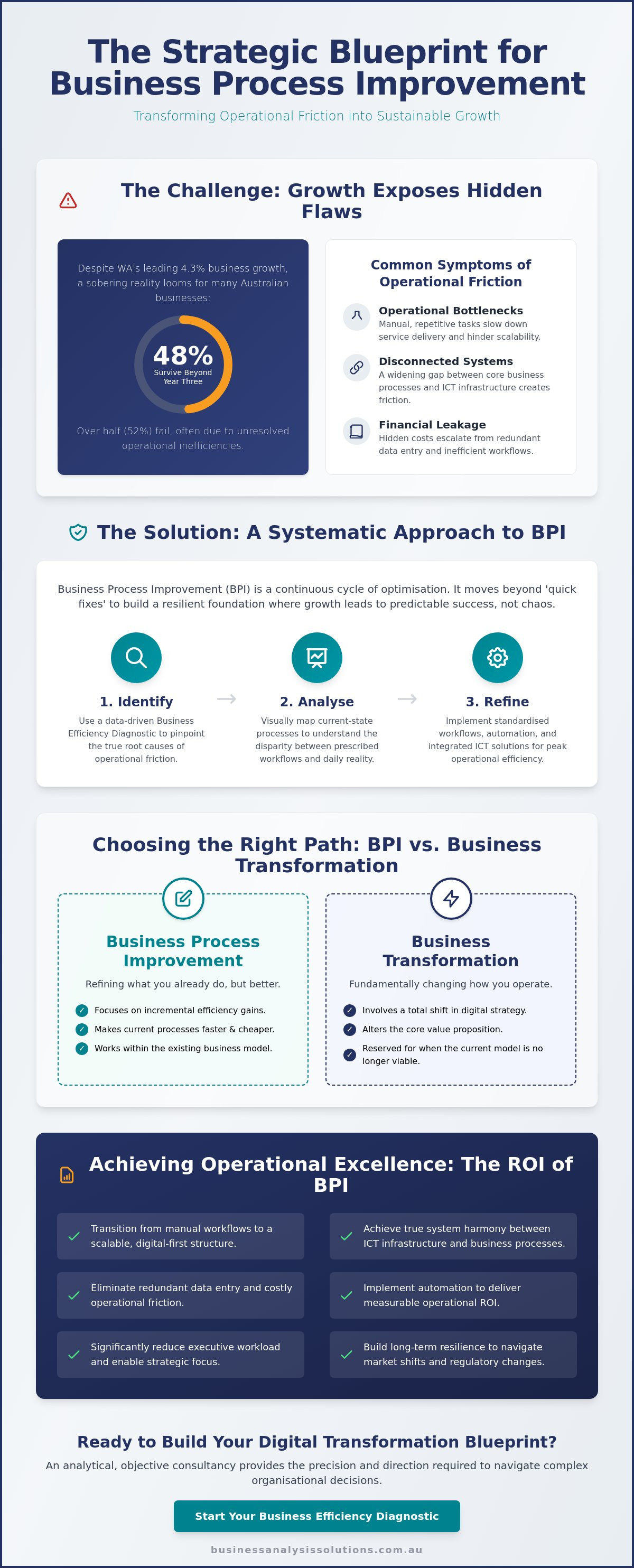
Western Australia currently leads the nation with a 4.3% business growth rate, yet this momentum often exposes a sobering reality: only 48% of Australian businesses survive beyond their third year of trading. For many local executives, rapid expansion quickly reveals deep-seated operational bottlenecks and a widening disconnection between core business processes and ICT systems. It's likely you've felt the weight of manual, repetitive tasks that escalate overheads while obstructing your ability to scale effectively in a competitive market.
Achieving long-term stability requires more than reactive fixes; it demands a logical, structured approach to business process improvement Perth that aligns technical infrastructure with broader organizational objectives. This article outlines a strategic framework for 2026, specifically designed to eliminate friction and prepare your operations for upcoming regulatory shifts such as Payday Super and the PRIS Act. We'll preview a clear digital transformation blueprint that delivers measurable ROI through automation and establishes the system harmony needed to reduce executive workload while driving sustainable performance.
Key Takeaways
Learn how to transition from manual workflows to a digital-first structure that supports organizational scalability and long-term resilience.
Identify the root causes of operational friction through a logical, data-driven framework for business process improvement Perth.
Discover how visual process mapping ensures your ICT solutions are technically feasible and aligned with your strategic vision.
Understand how a Digital Transformation Blueprint acts as a roadmap for implementing automation and achieving measurable operational ROI.
Explore how analytical consultancy provides the precision and direction required to navigate complex organizational decision-making.
Table of Contents
What is Business Process Improvement (BPI)?
Business process improvement (BPI) is a systematic discipline dedicated to identifying, analysing, and refining existing workflows to achieve peak operational efficiency. It isn't a superficial adjustment; it's a rigorous evaluation of how work flows through an organisation. To fully grasp What is Business Process Improvement (BPI)?, leaders must view it as a continuous cycle of optimisation that ensures internal activities remain aligned with strategic goals. In the evolving market for business process improvement Perth, this methodology serves as a critical tool for companies transitioning from fragmented, legacy manual workflows to integrated, digital-first organisational structures.
The transition toward digital-first operations is motivated by a need for system harmony. When ICT infrastructure and human processes operate in isolation, friction is inevitable. A structured BPI approach resolves these disconnects, ensuring that technology supports rather than hinders performance. This alignment leads to tangible financial performance gains, as streamlined operations naturally reduce the cost of service delivery and administrative overhead. Unlike temporary 'quick fixes' that address symptoms in isolation, a professional BPI framework prioritises long-term structural integrity. It builds a foundation where growth doesn't lead to chaos but to sustained, predictable success.
The Core Objectives of Process Optimisation
Effective process optimisation focuses on the elimination of operational friction and the removal of redundant data entry points. These redundancies often cause delays and compromise data integrity. By implementing standardised work development and detailed process mapping, organisations can ensure consistent output quality across all departments. This standardisation is particularly vital for Perth firms anticipating the regulatory changes of 2026. It creates the organisational agility needed to respond to market shifts with precision, ensuring that the business remains resilient and competitive regardless of external pressures.
BPI vs. Business Transformation
It's necessary to clarify the distinction between BPI and fundamental business transformation. BPI targets incremental efficiency within an existing business model. It focuses on making current processes faster, cheaper, and more reliable. Business transformation, however, involves a total shift in digital strategy that may alter the core value proposition of the company. A business should choose BPI when its current model is sound but requires refinement to improve margins. Transformation is reserved for instances where the current model is no longer viable. Understanding your organisation's maturity level is key to determining which path provides the most logical route to success and why business process improvement Perth remains a priority for established enterprises.
The Business Efficiency Diagnostic: Identifying Root Causes
A successful strategy for business process improvement Perth begins with a Business Efficiency Diagnostic. This isn't a casual review; it's a logical, data-driven assessment of your current state efficiency. Many leaders misinterpret symptoms like operational delays or rising overheads as the primary problem. In reality, these are merely indicators of underlying system failures. The diagnostic phase bridges this gap, moving beyond surface-level observations to identify exactly where organisational coordination is failing. It provides the objective evidence required to justify strategic changes.
Financial leakage points are often hidden within manual, repetitive tasks that haven't been audited in years. By focusing on these friction points, we can quantify the cost of inefficiency. Maintaining absolute objectivity during this phase is paramount. Internal teams often possess blind spots or emotional attachments to legacy workflows that hinder progress. An external, analytical perspective ensures the assessment remains focused on performance metrics rather than historical precedent. This clarity is essential for ensuring that your 2026 operations are lean and resilient.
Mapping the Current State Architecture
Granular process mapping is the essential tool for visualising how work actually flows through your organisation. There's frequently a significant disparity between how a process is supposed to work in a manual and the daily reality of staff members. By documenting every touchpoint, we identify bottlenecks that slow down service delivery. This visual foundation allows us to apply various Core BPI Methodologies to streamline operations. Identifying these constraints is the first step toward creating a scalable environment that supports Western Australia's 4.3% business growth rate.
Data-Driven Decision Making
The data gathered during the diagnostic serves as the primary driver for prioritising improvement projects. It's inefficient to address every issue at once; instead, we focus on the changes that deliver the highest ROI. This involves a deep assessment of your existing technology stack through professional ICT consultancy. It's critical that this evaluation occurs before any automation implementation is considered. Automating a broken process only accelerates failure. By establishing a clear baseline, you ensure that every subsequent investment in your digital infrastructure is grounded in logic. For those seeking a structured way to begin this journey, a professional Business Efficiency Diagnostic provides the necessary clarity to move forward with confidence.
Core Methodologies: Process Mapping and ICT Integration
Process mapping serves as the essential visual foundation for every strategic business technology decision. Without a clear representation of how information and tasks move through an organisation, technical implementations are likely to miss their mark. By documenting workflows with precision, leaders can identify exactly where technology should intervene to add value. This methodology is fundamental to Achieving Operational Excellence as it provides the granular detail needed for technical execution. In the context of business process improvement Perth, this step ensures that any proposed changes are grounded in the functional reality of the local business environment.
Bridging the gap between operational requirements and IT execution is often where projects falter. Integration must focus on technical feasibility; it's not enough for a process to look good on paper if the existing ICT infrastructure cannot support it. A professional framework ensures that ICT solutions are woven into mapped workflows from the outset. This proactive alignment prevents the common mistake of purchasing software first and trying to force-fit processes into it later. Instead, the process dictates the technical requirements, ensuring that every digital tool serves a specific, documented purpose.
Strategic Process Mapping Techniques
Utilising SIPOC (Supplier, Input, Process, Output, Customer) diagrams and cross-functional flowcharts is vital for complex organisations with multiple departments. These techniques allow us to document critical decision points and hand-offs where delays typically occur. By creating "To-Be" maps, we can incorporate future-state efficiencies that account for projected growth and upcoming regulatory changes. This visual roadmap allows stakeholders to see the direct path from current bottlenecks to an optimised state, providing clarity and direction for the entire project team.
Aligning Technology with Human Workflows
Selecting the right strategic technology solutions often reveals that expensive custom software development is unnecessary. In many cases, existing ICT solutions can be optimised or integrated more effectively to achieve the desired outcomes. The focus should always remain on how technology supports human workflows, not the other way around. High levels of user adoption are only achieved when the transition feels logical to the staff performing the work. Providing structured training during the transition phase ensures that the new, improved processes are adopted permanently and deliver the intended ROI.
Consistency is maintained through rigorous project management. Applying these methodologies across different departments requires a steady, methodical approach to ensure that no stage of the framework is bypassed. Project management acts as the connective tissue that holds the technical and operational elements together, ensuring that the final result is a cohesive, high-performance system. This disciplined execution is what separates a successful business process improvement Perth initiative from a series of disconnected, temporary fixes.
Implementing Automation and Digital Transformation Blueprints
Once the diagnostic phase is complete, the focus shifts to execution through a Digital Transformation Blueprint. This document is a strategic roadmap that translates high-level organisational goals into technical requirements. In the context of business process improvement Perth, the blueprint ensures that automation implementation is not a random act of digitisation but a calculated move toward operational efficiency. It provides the technical clarity needed to align your ICT infrastructure with your long-term growth objectives.
Disruption is a primary concern for established firms during any transition. A phased approach allows the organisation to absorb change incrementally, reducing the risk of system failure or staff fatigue. This systematic rollout relies heavily on expert project management to maintain technical standards and ensure timeline adherence. By breaking the transformation into manageable stages, you maintain business continuity while building a more resilient digital foundation.
Steps to a Successful Automation Project
Success in automation implementation requires a methodical sequence of actions to ensure the technology delivers the intended value:
Step 1: Identify high-volume, low-complexity tasks. These are the areas where manual effort creates the most significant friction and where automation provides the fastest ROI.
Step 2: Define clear business requirements. Technology must be selected based on functional needs and technical feasibility, not market trends or software hype.
Step 3: Execute a pilot program. Validating the blueprint logic in a controlled environment prevents widespread errors and allows for fine-tuning before a full rollout.
Step 4: Scale implementation. Once validated, the automation is deployed across the organisation with continuous monitoring to ensure it integrates seamlessly with existing workflows.
Measuring ROI and Performance Gains
Resolution is the ultimate goal of any business process improvement Perth initiative. Success is measured through specific, data-driven metrics such as reduced lead times, lower error rates, and direct cost savings from manual labour reduction. Data gathered post-implementation allows for the refinement of automation logic, ensuring the system remains optimised as the business scales. It's vital to remember that automation is a tool for resolution, not a replacement for a sound digital strategy. To begin your transition, explore how a professional Digital Transformation Blueprint can secure your operational future.
Achieving Operational Excellence with Strategic Consultancy
Achieving operational excellence requires a transition from tactical fixes to high-level strategic leadership. Engaging an analytical collaborator provides the objective perspective necessary to identify systemic issues that internal teams might overlook. This partnership is built on logic and a shared commitment to resolution. Through professional business analysis consultancy, executives receive the clarity needed to make informed, complex decisions about their infrastructure. A reliable partner focuses on tangible outcomes rather than industry jargon, ensuring that every initiative for business process improvement Perth delivers practical, end-to-end results.
The Role of Fractional CIO Services
Many growing Australian firms face a common challenge: the need for executive-level IT leadership without the budget for a full-time hire. Fractional CIO services solve this by providing strategic oversight on an as-needed basis. This model is exceptionally cost-effective, offering high-level advisory that bridges the gap between technical requirements and organisational objectives. It ensures your digital strategy remains proactive, particularly as you navigate the regulatory complexities of 2026. Having a seasoned expert to guide your ICT investments prevents costly misalignments and keeps your technology stack lean and functional.
Sustaining a Culture of Continuous Improvement
It's a mistake to view BPI as a one-off event. True operational excellence is a strategic commitment to ongoing refinement. This requires more than just new software; it necessitates robust internal documentation and clear process ownership. When employees understand the logic behind their tasks and have the authority to maintain standards, the business gains a competitive edge. This culture of improvement ensures that the system harmony achieved during the initial rollout doesn't degrade over time. It creates a feedback loop where data-driven insights lead to incremental gains, keeping your business process improvement Perth strategy relevant as market dynamics shift.
The path toward a scalable, high-performance organisation starts with a clear-eyed look at your current operations. By removing friction and aligning your systems with a professional framework, you reduce executive workload and secure your financial future. To determine the most effective roadmap for your unique challenges, the first step is always a rigorous evaluation. A professional diagnostic assessment provides the data you need to move from operational delay to strategic momentum.
Securing Your Operational Future in 2026
Establishing a resilient organisational structure requires more than reactive adjustments; it demands a logical alignment of human workflows and technical systems. We've explored how a diagnostic-first approach identifies root causes and how a Digital Transformation Blueprint provides a structured roadmap for automation. Implementing a professional framework for business process improvement Perth ensures your firm remains agile and prepared for the regulatory shifts ahead, such as Payday Super and the PRIS Act.
Success depends on a partner who understands the intricate relationship between operational requirements and ICT infrastructure. With over 20 years of industry experience, our Australian-owned and operated boutique consultancy specialises in bridging the gap between technical execution and business strategy. We focus on delivering practical, end-to-end results that reduce executive workload and drive measurable ROI. Request your Business Efficiency Diagnostic today to identify your highest-impact opportunities for optimisation. Building a scalable, friction-free business is a methodical process, and the right start makes all the difference.
Frequently Asked Questions
How long does a typical business process improvement project take?
Project duration depends on the scope of your diagnostic and the complexity of your current systems. A standard engagement often spans eight to twelve weeks from the initial assessment to the delivery of a strategic roadmap. Larger initiatives involving complex automation may require additional time to ensure technical stability and successful staff adoption across the organization.
What is the difference between process mapping and process modelling?
Process mapping provides a visual representation of your current workflows to identify existing bottlenecks. Process modelling takes this data a step further by simulating "what-if" scenarios to test the logic of a proposed future state. While mapping documents the reality of your operations, modelling validates the technical feasibility of improvements before you commit to implementation.
Will automation implementation require me to replace my current software?
Not necessarily; many projects focus on optimizing and integrating your existing ICT solutions to achieve higher efficiency. We prioritize leveraging your current technology stack whenever it remains technically viable. Replacement is only recommended if your legacy systems are fundamentally incapable of supporting the requirements defined in your Digital Transformation Blueprint.
Can business process improvement help with Australian regulatory compliance?
Yes, a structured framework for business process improvement Perth establishes the standardized workflows and data integrity required for modern compliance. This approach is particularly effective for managing upcoming 2026 mandates like Payday Super and the PRIS Act. By embedding regulatory requirements directly into your automated processes, you significantly reduce the risk of manual oversight.
What is a Business Efficiency Diagnostic and how do I start?
A Business Efficiency Diagnostic is a data-driven assessment that identifies the root causes of operational friction and financial leakage. It serves as the logical starting point for any strategic improvement initiative. To begin, you engage an analytical collaborator to audit your current workflows and ICT infrastructure, resulting in a clear report on performance gaps and optimization opportunities.
How do I measure the ROI of process improvement initiatives?
ROI is measured by comparing your pre-implementation baselines against specific post-implementation performance metrics. These typically include reduced lead times, lower error rates, and decreased operational overhead. By quantifying these gains in financial terms, we ensure that every initiative delivers a tangible return that justifies the initial investment in your digital infrastructure.
Is business process improvement only for large enterprises?
No, BPI is essential for any organization seeking to scale without a proportional increase in administrative burden. In fact, small to medium-sized firms often experience the fastest results from business process improvement Perth initiatives. Streamlining your operations early prevents the high cost of resolving deep-seated inefficiencies once your business has already expanded.
How does a Fractional CIO assist with process improvement?
A Fractional CIO provides the executive-level leadership required to bridge the gap between technical requirements and business goals. They ensure that every process improvement is backed by a sound, cost-effective digital strategy without the expense of a full-time hire. This high-level advisory is critical for maintaining system harmony and ensuring that your ICT infrastructure supports long-term growth.



Comments