Business Process Improvement Methodologies: A Strategic Framework for 2026
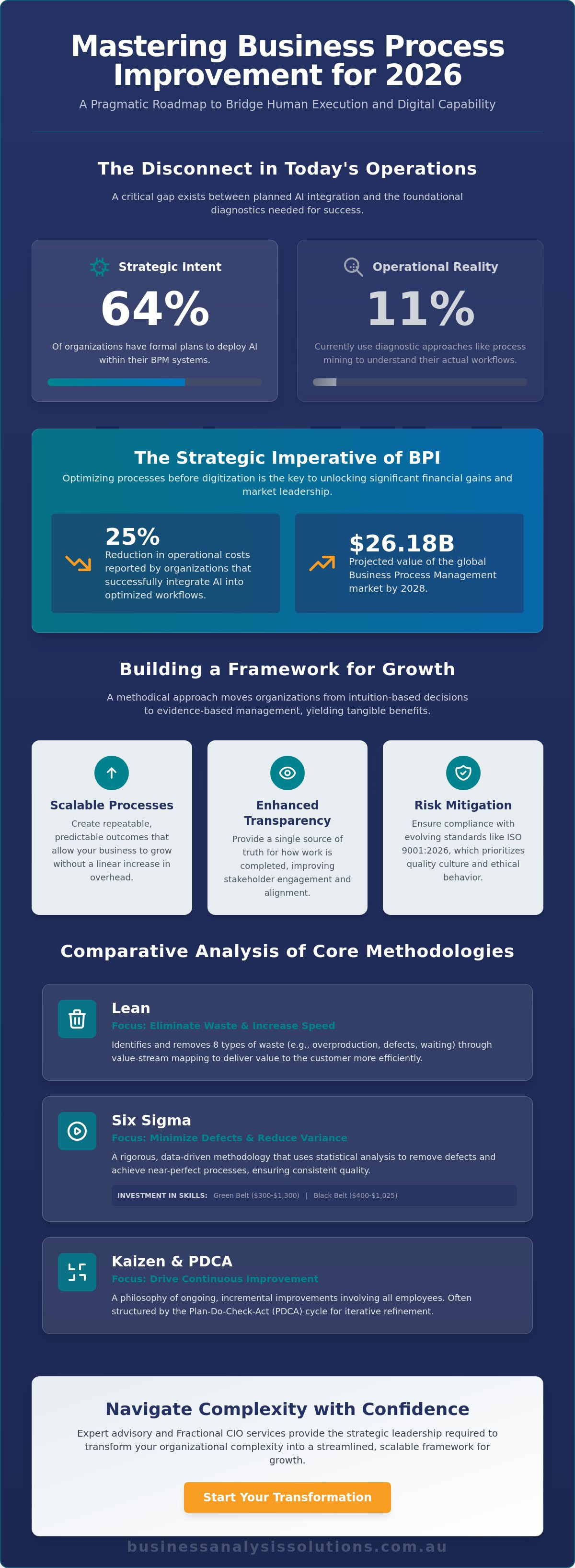
Did you know that 64% of organizations now have formal plans to deploy AI within their BPM systems, yet only 11% currently use diagnostic approaches like process mining to understand their actual workflows? You've likely experienced the friction of siloed departments where manual redundancies persist despite significant ICT investment. It's frustrating to see strategic goals undermined by processes that simply don't scale or adapt to new requirements.
This article provides the clarity you need to master the core business process improvement methodologies that bridge the gap between human execution and digital capability. We'll move beyond the theory to deliver a pragmatic roadmap for 2026. You'll learn how to integrate traditional lean principles with the updated ISO 9001:2026 standards, published this September, to drive the 25% reduction in operational costs that AI-enhanced management now offers. We'll systematically break down how to transform your organizational complexity into a streamlined, scalable framework for growth.
Key Takeaways
Identify the specific business process improvement methodologies, such as Lean and Six Sigma, that effectively eliminate waste and standardize quality in a 2026 landscape.
Learn why technical strategy must mirror operational reality to bridge the gap between human workflows and ICT capabilities.
Apply a "diagnostic-first" principle to process mapping, ensuring every improvement is rooted in stakeholder elicitation and measurable data.
Understand how scalable processes reduce operational costs and create a foundation for seamless digital transformation.
Explore how professional advisory and Fractional CIO services provide the strategic leadership required to navigate complex organizational change.
Table of Contents The Strategic Imperative of Business Process Improvement Methodologies Comparative Analysis: Lean, Six Sigma, and Modern BPI Frameworks The Strategic Bridge: Integrating Process Mapping and ICT Solutions A Phased Approach to Sustainable Process Optimization Navigating Implementation: The Role of Expert Advisory
The Strategic Imperative of Business Process Improvement Methodologies
Business process improvement (BPI) is a logical discipline essential for maintaining organizational health. It isn't a temporary project or a reactive fix; it's a structured approach to identifying, analyzing, and refining existing workflows to meet new performance standards. In 2026, the financial burden of "status quo" operations is too high to ignore. With 64% of organizations planning to deploy AI and machine learning within their BPM systems by 2026, companies that cling to inefficient legacy systems risk total obsolescence. As the global Business Process Management market moves toward a projected $26.18 billion by 2028, the objective must be Strategic Alignment. Precision in these frameworks ensures that technical requirements are always subordinate to business objectives, preventing the misalignment that often plagues large-scale digital initiatives.
Achieving a measurable return on investment (ROI) requires more than just installing new software. It demands a rigorous evaluation of how value is created within the firm. Organizations that successfully integrate AI into their workflows have reported a 25% reduction in operational costs, but these gains are only possible through the application of proven business process improvement methodologies. Without a methodical framework, efficiency remains an abstract goal rather than a predictable outcome. Logic dictates that you must optimize the process before you can successfully digitize it. This approach transforms business analysis from a support function into a strategic engine for growth.
Why Frameworks Fail Without Precision
Most process improvement initiatives fail because they're built on a foundation of ambiguity. When processes aren't clearly defined, ICT projects inevitably stall, leading to wasted capital and organizational frustration. Professional business analysis is the only way to untangle this complexity. We focus on rigorous requirements elicitation to ensure the "as-is" state is fully understood before any "to-be" solutions are proposed. A methodology is only as effective as the ground truth it uncovers. If you don't engage stakeholders to map the actual path of a task, you're merely guessing at the solution.
The Core Benefits of a Methodical Approach
A structured approach to process optimization provides a clear roadmap for efficiency. The selection of appropriate business process improvement methodologies moves the organization away from intuition-based decisions toward evidence-based management. By implementing these frameworks, you'll see a quantifiable reduction in operational waste and the elimination of redundant manual handoffs that slow down production.
Scalable Processes: Methodologies create repeatable, predictable outcomes that allow your business to grow without a linear increase in overhead.
Transparency: Documented workflows improve stakeholder engagement by providing a single source of truth for how work is completed across departments.
Risk Mitigation: Clear processes ensure compliance with evolving standards, such as the ISO 9001:2026 revision published in September 2026, which prioritizes ethical behavior and quality culture.
Comparative Analysis: Lean, Six Sigma, and Modern BPI Frameworks
Selecting the right framework requires an understanding of your specific operational bottlenecks. While Lean focuses on speed and the elimination of non-value-added activities through value-stream mapping, Six Sigma utilizes a data-driven approach to minimize variance. These business process improvement methodologies aren't mutually exclusive. Kaizen introduces a philosophy of incremental, continuous improvement, while the Plan-Do-Check-Act (PDCA) cycle provides the iterative structure necessary for refinement. This cycle is particularly relevant for organizations transitioning to the ISO 9001:2026 standards, which emphasize a culture of quality. As of April 2026, the cost of formalizing these skills remains a significant investment; Six Sigma Green Belt certifications range from $299.95 to $1,301.40, while Black Belt certifications cost between $399.95 and $1,025.00. Understanding these Process Improvement Methodologies is the first step toward organizational maturity.
Lean vs. Six Sigma: Choosing Your Primary Lens
Lean methodology identifies eight types of waste, ranging from overproduction to untapped employee talent. Six Sigma, conversely, aims for near-perfect consistency by identifying the root causes of defects. Most Australian organizations find that a hybrid Lean Six Sigma approach delivers the best results by combining speed with quality control. This integration is essential when building a digital transformation blueprint for business, as it ensures that the underlying processes are robust before they're automated. If you're struggling to choose a lens, consulting with a specialist can provide the objective diagnostic needed to move forward.
Total Quality Management (TQM) and BPM
Total Quality Management (TQM) shifts the focus toward long-term customer satisfaction through organization-wide commitment to quality. When viewed through the lens of the Business Process Management (BPM) lifecycle, TQM becomes a governance model rather than just a set of tools. These frameworks establish the necessary foundation for expert project management, ensuring that every transformation initiative is anchored in strategic logic rather than technical convenience. With only 11% of organizations currently utilizing diagnostic approaches like process mining, those who adopt these rigorous business process improvement methodologies now gain a distinct competitive advantage in a market projected to reach $26.18 billion by 2028.
The Strategic Bridge: Integrating Process Mapping and ICT Solutions
Methodology without technical alignment is merely academic. It creates a theoretical model that fails the moment it meets real-world execution. Effective Business Process Improvement (BPI) requires a seamless bridge between operational logic and ICT architecture. Process mapping serves as the critical "as-is" diagnostic tool to identify where current ICT capabilities fall short of business requirements. By visualizing the workflow, we identify prime candidates for automation implementation. This ensures that technology serves the process, rather than forcing the process to adapt to the limitations of a rigid software suite. It's about ensuring your business process improvement methodologies result in a functional, integrated ecosystem.
The Role of Process Mapping in Digital Strategy
Visual process maps expose bottlenecks that software alone cannot fix. While a platform might promise efficiency, it can't resolve a logical flaw in how data moves between departments. We use process mapping to transition from "as-is" documentation to "to-be" strategic design. This transition is a core component of a successful digital strategy. It provides the clarity needed to ensure that every technical investment supports a documented, optimized workflow. With 64% of organizations planning to deploy AI and machine learning within their BPM systems by 2026, the cost of proceeding without a clear map is simply too high. Digital transformation remains a high-risk gamble without this level of precision.
Aligning ICT Solutions with Methodology Outcomes
ICT solutions must follow process design, not dictate it. When technology leads, the result is often a digital version of a broken process. We advocate for selecting technology stacks based on the specific requirements generated through business process improvement methodologies. This ensures that the chosen tools actually solve the identified pain points of siloed departments and manual redundancies. By implementing strategic technology solutions that support lean workflows, organizations can realize the 25% reduction in operational costs reported by firms that successfully integrate AI into their BPM. This alignment transforms ICT from a cost center into a strategic asset that scales with the business. It's a partner in performance, not a barrier to it.
A Phased Approach to Sustainable Process Optimization
Sustainable optimization requires a disciplined sequence that begins with a diagnostic. It's impossible to improve what hasn't been measured. Currently, 21% of organizations collect raw data but lack the analytical maturity to act on it, while only 11% utilize diagnostic approaches like process mining. This gap is where professional business process improvement methodologies provide the necessary structure. We move from elicitation to governance through a logical, phased approach that ensures every change is rooted in evidence rather than intuition.
The elicitation phase is the foundation of this process. We engage stakeholders at every level to uncover the ground truth of how work actually moves through the firm. This data then informs the analysis phase, where we select the specific business process improvement methodologies best suited to the identified bottlenecks. The implementation phase follows, moving the project from a strategic blueprint to a functional operational reality. Finally, we establish a governance phase to ensure improvements stick over the long term, preventing the organization from regressing into old, inefficient habits.
The Business Efficiency Diagnostic
The diagnostic acts as a comprehensive health check for your organizational workflows. It identifies where manual redundancies exist and where ICT capabilities are misaligned with business goals. The diagnostic is a 20-year proven framework for identifying hidden inefficiencies. By quantifying these gaps early, we provide a clear justification for subsequent technical investments. If you're ready to uncover the friction points in your operations, you can book a business efficiency diagnostic to start your transformation.
Stakeholder Engagement and Change Management
Buy-in is essential from the executive level to the frontline. Without it, even the most logically sound process improvement will fail during implementation. We use transparent methodologies to reduce resistance, showing staff exactly how new ICT solutions will remove the burden of manual workflow redundancies. This clarity addresses the psychological impact of change, shifting the organizational culture from one of apprehension to one of proactive improvement. When stakeholders understand the "why" behind the "how," they become partners in the transition rather than barriers to it.
Navigating Implementation: The Role of Expert Advisory
Implementation is where theoretical business process improvement methodologies meet the hard reality of organizational resistance and technical debt. While internal teams possess deep institutional knowledge, they often lack the objective distance required to identify systemic "blind spots." Professional consultancy serves as the catalyst for successful methodology adoption by providing a structured, outside-in perspective. This external diagnostic identifies logical inconsistencies that internal stakeholders might overlook due to years of operational habit. A tailored, end-to-end approach ensures that transformation isn't just a series of isolated projects but a cohesive strategic evolution. It's about moving from a project-based effort to a continuous, automated capability.
The complexity of modern ICT environments means that process change cannot happen in a vacuum. With the global BPM market projected to reach $26.18 billion by 2028, the technical stakes are higher than ever. Organizations that attempt to navigate this without expert oversight often find themselves with fragmented systems that fail to deliver the promised 25% reduction in operational costs. Logic dictates that expert advisory is not an optional luxury but a strategic necessity for ensuring that the chosen business process improvement methodologies actually translate into measurable efficiency.
Fractional CIO Services and Strategic Oversight
A Fractional CIO provides the executive IT leadership necessary to maintain this cohesion. Many mid-market firms require strategic oversight but don't need a full-time executive. This on-demand leadership ensures that your ICT strategy remains subservient to your business goals. They manage the complexities of ICT project management, ensuring that technical requirements gathered during the elicitation phase translate into functional solutions. By untangling these organizational complexities, a Fractional CIO prevents the fragmentation that typically leads to failed digital initiatives. They provide the steady, methodical guidance needed to align people, processes, and technology.
Moving Toward Automation and Beyond
Automation is the ultimate goal for many, yet it's a high-risk investment without process maturity. A refined process is the absolute prerequisite for successful automation. If you automate a broken workflow, you simply accelerate inefficiency. Our role is to deliver practical, results-driven implementation that bridges the gap between technical requirements and business objectives. We move beyond academic discussions to provide tangible outcomes that support the new ISO 9001:2026 standards. If your organization is struggling with manual redundancies or misaligned technology, the first step is a professional assessment. You can book a Business Efficiency Diagnostic to identify your specific operational bottlenecks and begin the journey toward a scalable, efficient future.
Securing Operational Excellence for 2026
The shift toward an "AI-first" landscape in 2026 requires more than just technical adoption; it demands a fundamental refinement of your organizational logic. We've established that technical strategy must always be subordinate to process design to ensure that ICT investments deliver the 25% cost reduction seen in optimized firms. By applying a "diagnostic-first" approach, you move away from intuition-based decisions toward a framework of evidence and precision. Mastering these business process improvement methodologies is the only way to transform operational complexity into a scalable strategic advantage.
With over 20 years of experience, our firm specializes in bridging the gap between technical requirements and business objectives through a methodical, logic-based approach. We untangle the manual redundancies that slow your progress and provide the expert advisory needed to navigate the September 2026 ISO standards update. It's time to replace ambiguity with clarity and direction. Book Your Business Efficiency Diagnostic Today and start building a more resilient, efficient future for your organization. Your path to measurable efficiency starts with a single, structured step.
Frequently Asked Questions
What is the difference between Lean and Six Sigma in business process improvement?
Lean focuses on eliminating waste and increasing speed by identifying non-value-added steps in a workflow. Six Sigma targets quality and consistency by using data to reduce variance and defects. While Lean streamlines the path of a process, Six Sigma ensures the output is nearly perfect every time. Most firms now combine these into a hybrid approach to address both operational velocity and technical precision.
How do I choose the right methodology for my small to medium business?
Select a methodology based on your primary operational bottleneck rather than following industry trends. If your team is overwhelmed by backlogs and slow turnaround times, Lean is the logical starting point. If your output quality is inconsistent or error rates are high, Six Sigma offers the necessary control. For many SMBs, the PDCA cycle provides a manageable entry point for iterative refinement without excessive complexity.
Is process mapping necessary before implementing new business software?
Yes, process mapping is an essential diagnostic step that prevents the automation of inefficient or broken workflows. Without a visual map of your "as-is" state, you risk purchasing software that doesn't align with your actual operational requirements. This misalignment is a primary reason why ICT projects fail to deliver a return on investment. Mapping ensures the technology supports a logical, optimized process.
Can business process improvement methodologies be applied to service-based industries?
Absolutely, business process improvement methodologies are highly effective in service sectors where waste often appears as time delays and information silos. In professional services, Lean principles help eliminate redundant manual handoffs and improve the flow of client data. This results in faster service delivery and higher stakeholder engagement. It transforms intangible service steps into measurable, repeatable, and scalable workflows.
How long does it typically take to see results from a process improvement project?
Initial improvements are often visible within 90 days of the implementation phase. While full organizational transformation is a long-term governance effort, "quick wins" from waste elimination typically emerge shortly after the diagnostic phase. Sustaining these results requires a commitment to continuous improvement. Periodic health checks are necessary to ensure that new processes remain efficient as the business scales.
What role does ICT play in modern business process improvement?
ICT serves as the execution layer for modern business process improvement methodologies. In 2026, technology provides the infrastructure for hyperautomation and real-time data analysis. Strategic ICT alignment ensures that your software stack reinforces your optimized processes rather than creating new technical bottlenecks. Technology should always be the servant of the process, providing the data needed for evidence-based decision-making.
What are the most common pitfalls when implementing a new process methodology?
The most common pitfall is treating methodology as a one-time project rather than a permanent shift in organizational governance. Other failures stem from a lack of executive buy-in or neglecting the requirements elicitation phase. if you don't engage frontline staff to uncover the ground truth, your redesigned process will likely fail. It won't reflect the operational reality of those performing the work.
How does a Business Efficiency Diagnostic differ from a standard audit?
A Business Efficiency Diagnostic is a proactive, forward-looking health check, whereas a standard audit is usually a retrospective compliance exercise. The diagnostic identifies hidden inefficiencies and ICT gaps to create a clear roadmap for future growth. It uses a 20-year proven framework to provide strategic direction. It focuses on how to improve performance rather than just verifying historical records.



Comments