Business Analysis as a Service Australia: A Strategic Guide for 2026
Most Australian organisations don't lose money on technology because the software is broken; they lose it because the requirements were never understood in the first place. You likely recognize the friction caused when inefficient manual processes drain your resources or when technical teams and leadership speak entirely different languages. It's a common frustration in a market where senior business analyst contractor rates in Sydney and Melbourne can reach $1,200 per day, making internal hiring a significant financial commitment for many firms.
Utilising business analysis as a service Australia offers a logical resolution to these complex organisational challenges. This model provides a scalable, expert-led approach to creating strategic blueprints and driving operational efficiency without the burden of internal recruitment. By reading this guide, you'll discover how to secure a clear digital transformation blueprint and reduce the risk of ICT project failure through methodical process management. We will explore the shift toward project-based consulting and how these structured engagements bridge the gap between technical requirements and your broader business objectives for 2026.
Key Takeaways
Access on-demand expertise to identify organisational needs and design logical digital solutions that align with your high-level vision.
Compare the ROI of business analysis as a service Australia against traditional internal hiring to understand the strategic benefits of industry-wide cross-pollination.
Implement a methodical engagement framework that utilizes a Business Efficiency Diagnostic to establish a clear baseline for operational improvement.
Bridge the implementation gap by leveraging expert project management to ensure your strategic blueprints result in successful ICT execution.
Leverage over 20 years of regional experience to drive sustainable growth through structured digital transformation and professional process mapping.
Table of Contents
What is Business Analysis as a Service (BAaaS)?
The adoption of business analysis as a service Australia represents a shift from reactive staffing to proactive strategic planning. At its core, BAaaS provides organisations with on-demand access to senior business analysts and ICT consultants who operate as an extension of the leadership team. This model focuses on identifying specific organisational needs and recommending structured, logical digital solutions that align with long-term goals. BAaaS functions as a scalable alternative to traditional recruitment, allowing organisations to bypass the friction of permanent hiring cycles and the associated overheads of the 11.5% superannuation guarantee and GST compliance.
A common misconception in the 2026 market is the conflation of business analysis with data analytics. While analytics focuses on interpreting historical data to identify trends, professional Business analysis is a discipline dedicated to process architecture and strategic alignment. It's about designing the future state of an organisation rather than just reporting on its past. By focusing on how systems, people, and technology interact, BAaaS ensures that every ICT investment serves a documented business purpose.
The Core Pillars of Modern Business Analysis
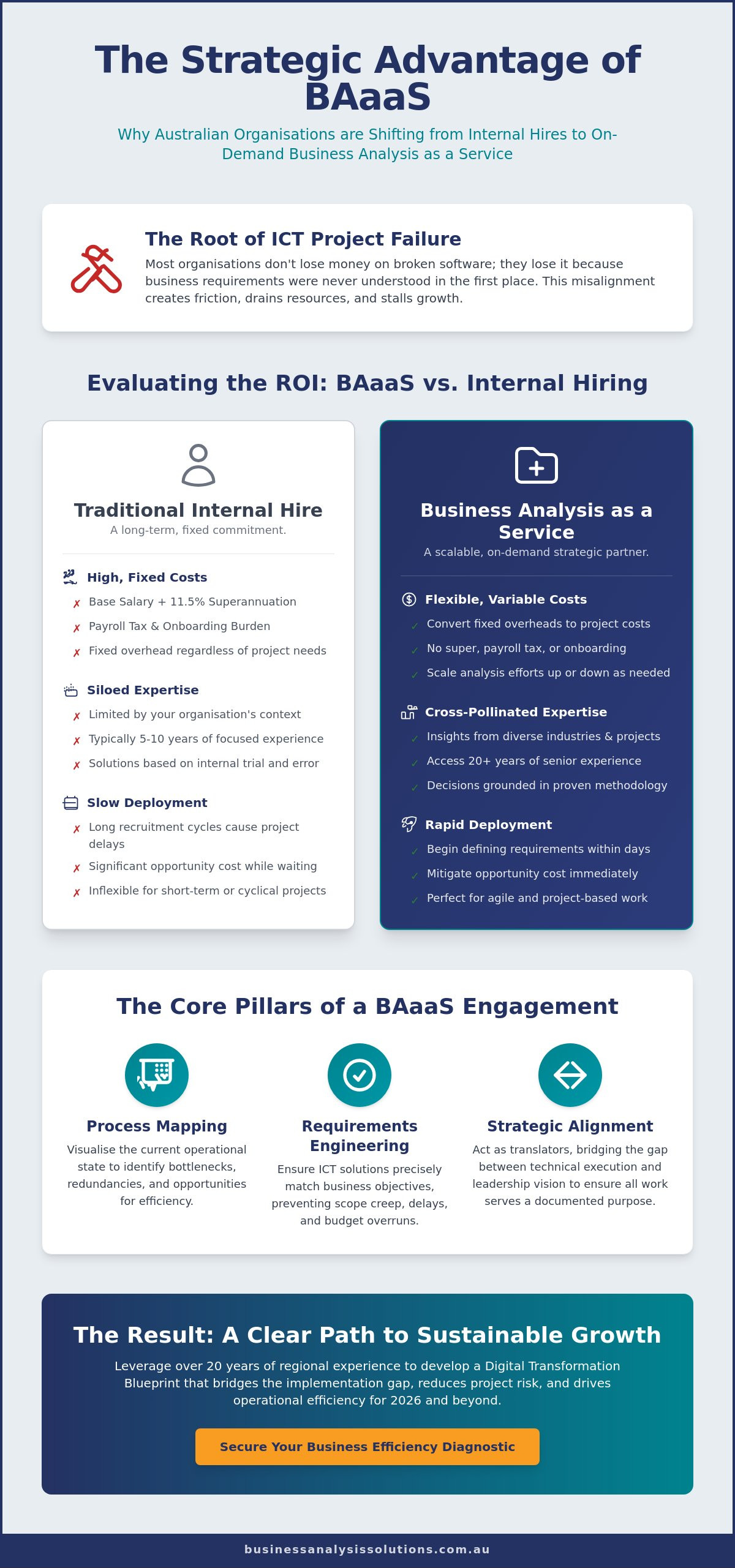
Process Mapping: This involves visualising the current operational state to identify bottlenecks and redundancies. It provides the empirical evidence needed to justify system changes.
Requirements Engineering: This pillar ensures that ICT solutions match actual business objectives. It prevents the common "requirement creep" that often leads to project delays and budget overruns.
Strategic Alignment: Analysts act as translators, bridging the gap between technical execution and leadership vision. They ensure that technical teams understand the "why" behind every line of code or system configuration.
Why the 2026 Market Demands BAaaS
Australian organisations are increasingly moving toward lean structures to maintain agility. In a post-AI landscape, the complexity of digital transformation has intensified. It's no longer enough to simply implement new tools; those tools must integrate seamlessly into a wider ecosystem. By leveraging business analysis as a service Australia, leadership teams gain the clarity needed to approve high-stakes ICT investments with confidence. Within this environment, developing a digital transformation blueprint for business has become a prerequisite for sustainable growth. This strategic framework provides a methodical path forward, ensuring that operational efficiency isn't sacrificed for the sake of technical novelty.
BAaaS vs. Internal Hiring: Evaluating the ROI
Internal recruitment is a long-term commitment that doesn't always align with the cyclical nature of ICT projects. For many Australian firms, the total cost of ownership for a full-time senior business analyst extends far beyond the base salary. When you factor in the 11.5% superannuation guarantee, payroll tax, and the administrative burden of onboarding, the financial weight is substantial. Choosing business analysis as a service Australia allows your organisation to convert these fixed overheads into variable project costs, providing the flexibility to scale analysis efforts up or down based on your specific project lifecycle.
The strategic advantage of BAaaS lies in the "cross-pollination" of expertise. An internal hire is limited by the boundaries of your specific organisation, while an external consultant brings insights harvested from diverse industries and complex transformation initiatives. While a standard internal hire might possess five to ten years of experience, a BAaaS engagement provides immediate access to professionals with over 20 years of industry experience, ensuring that your strategic decisions are grounded in decades of proven methodology rather than individual trial and error.
Direct Cost vs. Strategic Value
Recruitment bottlenecks often lead to an "opportunity cost" that is difficult to quantify but easy to feel. Projects delayed by months while searching for the right candidate result in lost efficiency and stalled growth. BAaaS mitigates this by providing immediate access to senior ICT consultancy expertise. Instead of waiting for a hiring cycle to conclude, your organisation can begin defining requirements and mapping processes within days. This rapid deployment ensures that your digital strategy maintains its momentum, delivering value to stakeholders without the friction of traditional HR processes.
Objective Perspective and Risk Mitigation
Internal stakeholders often carry biases that can cloud the requirements-gathering process. By conducting independent business efficiency diagnostics, BAaaS providers offer an objective perspective that is immune to internal politics. This neutrality is vital for reducing the risk of ICT project failure. Rigorous requirements documentation ensures that the final solution actually solves the identified problem rather than just automating a broken process. Engaging with professional business analysis services provides the methodical distance required to navigate complex stakeholder interests and reach a logical, results-driven consensus.
Core Components of a BAaaS Engagement
A successful engagement for business analysis as a service Australia follows a rigid, functional logic. It begins by aligning technical possibilities with the high-level vision of the leadership team. This ensures that every subsequent granular detail serves a specific strategic purpose. This methodical progression prevents the common pitfall of selecting technology before understanding the organisational problem it's intended to solve. Without this alignment, organisations often find themselves with expensive software that doesn't address the underlying operational friction.
A Digital Transformation Blueprint serves as the central roadmap for all future ICT investments. This document ensures that system harmony is maintained across the entire enterprise, preventing the creation of disconnected data silos. Each proposed solution is then grounded in a formal requirements document. This documentation acts as a contract of understanding between business stakeholders and technical teams; it eliminates the ambiguity that often leads to project failure. By defining functional and non-functional requirements with precision, the service ensures that the final delivery matches the initial expectation.
The Business Efficiency Diagnostic
The engagement typically starts with a Business Efficiency Diagnostic. This is a structured audit designed to evaluate current workflows and existing ICT systems against industry benchmarks. It identifies "hidden" inefficiencies. These are often manual workarounds or redundant data entry points that quietly drain profitability over time. By establishing clear KPIs during this phase, organisations can measure the tangible impact of the transformation. This diagnostic provides the empirical baseline required for objective decision-making. It transforms subjective complaints about slow systems into documented evidence of process failure.
Comprehensive Process Mapping
Process mapping provides the visual evidence needed to drive change. Analysts create detailed representations of the "As-Is" state to expose current friction points. They then design the "To-Be" state, illustrating how optimised workflows will function once the transformation is complete. These maps aren't created in isolation; they're linked directly to broader organisational objectives. This clarity allows leadership to identify high-value candidates for automation implementation. When you use business analysis as a service Australia, you ensure that automation is applied to optimised processes rather than simply speeding up inefficient ones. This methodical approach ensures that technology serves the process, not the other way around.
Bridging the Implementation Gap: From Analysis to Action
The primary objection to high-level consultancy is often the implementation gap. Organisations frequently find themselves with a comprehensive analysis but no clear mechanism for execution. It's a common scenario where strategic reports become "shelfware" because the internal team lacks the capacity or specialized skill set to translate those findings into technical reality. Bridging this gap requires a methodical transition from strategic planning to tactical delivery. This is where expert project management becomes the essential catalyst, turning blueprints into functional systems.
By utilizing business analysis as a service Australia, leadership teams gain more than just a diagnostic report; they secure a partner capable of managing the complex transition from legacy systems to modern ICT solutions. This process involves more than just software installation. It requires a coordinated effort to ensure that new technologies integrate with existing infrastructure without disrupting daily operations. To begin your transition from analysis to action, you can engage our senior ICT consultants to review your current project roadmap and identify immediate efficiency gains.
Fractional CIO Services for High-Level Oversight
Mid-market organisations often require executive-level IT leadership but don't have the budget or need for a full-time Chief Information Officer. Fractional CIO services fill this void by providing strategic technology guidance and robust ICT governance on a part-time or project basis. These experts advise on strategic investments, ensuring that every technical decision supports the long-term business strategy. This oversight is vital for maintaining system harmony as the organisation scales. It allows your leadership team to focus on growth while a seasoned professional manages the technical roadmap and mitigates digital risk.
Automation and Strategic Technology Solutions
The successful implementation of automation requires a deep understanding of process architecture. Business analysis as a service Australia identifies high-impact areas within finance, HR, and operations where manual tasks are draining profitability. Instead of deploying isolated tools, the focus remains on selecting technologies that integrate seamlessly with your existing infrastructure. The goal of automation implementation is achieving system harmony rather than just increasing processing speed. When systems communicate effectively, data flows logically across the organisation, reducing the need for manual intervention and eliminating the risk of human error in critical workflows.
Partnering with Business Analysis & Solutions for National Growth
Partnering with Business Analysis & Solutions means leveraging over 20 years of immersion in the Australian market. Our commitment to professional, authoritative, and logic-rooted consultancy ensures that your organisation receives more than just advice; you receive a blueprint for sustainable performance. We focus on tangible results such as operational efficiency, increased profitability, and absolute operational clarity. By providing end-to-end support, we guide your team from the initial diagnostic through to the final stages of implementation, ensuring that the strategic vision is never lost in technical complexity.
This focus on resolution and outcomes serves as our thematic anchor. We understand that for Australian organisations to thrive in 2026, they require a partner who can bridge the gap between high-level objectives and granular execution. Leveraging business analysis as a service Australia ensures that your digital transformation is handled with the precision and reliability that only two decades of industry experience can provide.
Our Methodical Approach to Excellence
Our methodology is defined by quiet confidence and meticulous problem-solving. We recognize that complex organisational challenges require a structured approach rather than marketing jargon or hyperbole. This clarity allows us to bridge the gap between technical requirements and broader business goals effectively. Our clients trust us for their most complex ICT challenges because we maintain a professional distance that ensures objectivity and precision in every recommendation.
We act as an analytical collaborator, prioritizing the most effective solution over the easiest one. This rhythmic consistency in our delivery builds trust and reinforces the image of a stable, predictable partner. By focusing on system harmony and process management, we ensure that your organisational coordination remains seamless even as you scale to meet new market demands.
Get Started with a Strategic Diagnostic
Every successful transformation begins with a clear understanding of your unique organisational challenges. Whether you're looking to optimize current workflows or overhaul your entire ICT infrastructure, the first step is a formal, evidence-based evaluation. For organisations requiring high-level strategic direction, you can engage our Fractional CIO services for on-demand leadership and governance. This ensures your technology roadmap remains aligned with your long-term commercial objectives without the overhead of a full-time executive hire.
To begin this process and establish an empirical baseline for improvement, Request a Business Efficiency Diagnostic today. Adopting business analysis as a service Australia provides the scalable expertise needed to navigate the complexities of the 2026 market with precision. We invite you to experience a partnership that prioritizes logic, clarity, and tangible results above all else.
Securing Your Competitive Advantage in 2026
The shift toward lean, agile operations requires a departure from traditional, high-overhead recruitment. By adopting business analysis as a service Australia, your organisation gains immediate access to senior expertise that aligns technical execution with high-level commercial objectives. We've established that methodical process mapping and a structured Digital Transformation Blueprint serve as the essential foundation for reducing ICT project risk. These tools don't just identify problems; they provide a logical path toward system harmony and sustainable efficiency.
Success in the 2026 market depends on your ability to move from analysis to action with absolute precision. With over 20 years of industry experience, our team specializes in Business Efficiency Diagnostics and expert Fractional CIO services that provide the strategic oversight necessary for growth. Our ICT consultancy prioritizes clarity and reliable outcomes over marketing jargon, ensuring that your technical investments deliver measurable value. It's time to resolve the friction in your workflows and bridge the implementation gap for good.
Optimise your organisation with expert Business Analysis as a Service
Take the first step toward operational harmony today. Your path to a more efficient and profitable future is grounded in logic and meticulous planning.
Frequently Asked Questions
What is the difference between Business Analysis as a Service and hiring a contractor?
BAaaS provides a methodical service framework and firm-level accountability rather than just an individual resource. While a contractor offers temporary labor, business analysis as a service Australia delivers a structured methodology backed by senior oversight and specialized tools. This model ensures that your project benefits from a standardized approach to requirements engineering and process mapping, providing greater stability and a more predictable outcome for complex ICT initiatives.
How much does a typical Business Efficiency Diagnostic cost?
The cost of a diagnostic engagement depends on the scale of your organization and the complexity of your current ICT environment. Factors such as the number of departments included and the depth of system integration reviews influence the final investment. Because each diagnostic is tailored to identify specific operational friction points, we recommend a preliminary consultation to define the scope and provide an accurate project fee based on your requirements.
Can BAaaS help with the implementation of new software or just the planning?
Our services cover the entire lifecycle from strategic planning to tactical implementation. We don't just provide a blueprint and leave the execution to chance. Through expert project management and automation implementation, we ensure that the recommended ICT solutions are integrated seamlessly into your existing infrastructure. This end-to-end approach bridges the implementation gap, ensuring that the final system harmony matches the initial strategic vision.
Does Business Analysis & Solutions provide custom software development?
No, we don't provide custom software development or managed IT helpdesk services. Our expertise lies in business analysis, digital strategy, and process mapping. We act as an objective partner to identify the best technology solutions for your needs and manage their implementation. This professional distance ensures that our recommendations remain focused on your operational efficiency rather than selling a specific proprietary software product.
What industries in Australia benefit most from BAaaS?
Any sector with complex workflows or heavy reliance on ICT systems will find significant value in this model. We frequently work with professional services, finance, and operations-focused businesses that struggle with manual process drain. Utilizing business analysis as a service Australia allows these organizations to resolve technical friction and align their digital infrastructure with long-term commercial goals. It's particularly effective for firms undergoing rapid growth or digital transformation.
How long does a Digital Transformation Blueprint take to complete?
The duration of a blueprint engagement varies based on the size of the organization and the complexity of its systems. A typical engagement involves several weeks of methodical discovery, stakeholder interviews, and process mapping. This timeline ensures that we establish a comprehensive baseline and design a logical roadmap for your future ICT investments. The result is a precise document that provides clarity for all subsequent technical projects.
What is the role of a Fractional CIO in a business analysis engagement?
A Fractional CIO provides the executive-level ICT leadership and governance required for high-stakes digital initiatives. They ensure that technical decisions aren't made in isolation but support the broader business strategy. During an engagement, they manage digital risk and advise on strategic technology investments. This role offers the benefits of a seasoned technology leader without the financial commitment of a full-time executive hire, providing professional oversight and direction.
Is BAaaS suitable for small businesses or only large enterprises?
The service is designed to be scalable for organizations of all sizes. Small businesses benefit from accessing senior-level analysis and fractional leadership that might otherwise be out of reach. Large enterprises often utilize the service to manage specific, complex transformation projects that require an objective, external perspective. Regardless of size, the focus remains on delivering operational clarity and driving efficiency through a structured, methodical approach to business analysis.



Comments