Avoiding IT Project Budget Overruns: A Strategic Framework for 2026
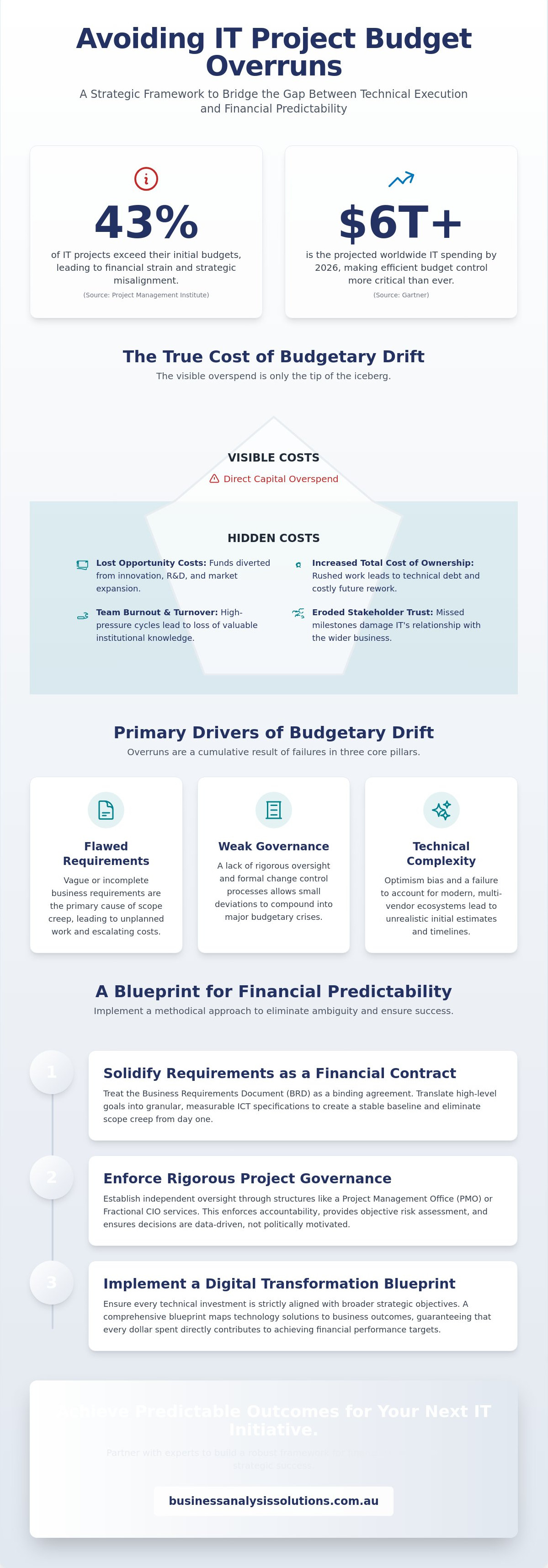
With worldwide IT spending projected by Gartner to exceed $6 trillion in 2026, the stakes for digital transformation have never been higher. Yet, research from the Project Management Institute indicates that 43% of projects still exceed their initial budgets, making the goal of avoiding IT project budget overruns more critical than ever. You've likely experienced the frustration of watching a strategic initiative lose momentum as hidden costs surface and stakeholder trust begins to erode. It's a common challenge, but it isn't an inevitable one.
Success requires moving beyond simple task tracking toward a framework rooted in precise business analysis. This article demonstrates how to eliminate financial ambiguity and ensure project predictability through a methodical approach to strategic oversight. We'll explore how bridging the gap between technical requirements and broader organizational objectives creates a stable lifecycle for your next major implementation. This shift in perspective helps you deliver technical results that satisfy both the CFO and the end user without the burden of unforeseen expenses.
Key Takeaways
Understand the full financial impact of cost overruns, including hidden variables like lost opportunity costs and team burnout that extend beyond the initial capital expenditure.
Identify the three pillars of budgetary drift—requirements, governance, and technical complexity—to proactively counter optimism bias during the estimation phase.
Treat your Business Requirements Document as a formal financial contract that translates high-level goals into granular ICT specifications to eliminate scope creep.
Leverage independent oversight through Fractional CIO services or a PMO structure to establish the rigorous governance necessary for avoiding IT project budget overruns.
Implement a Digital Transformation Blueprint to ensure every technical investment remains strictly aligned with your broader strategic objectives and financial performance targets.
Table of Contents
Understanding the Financial Impact of IT Project Cost Overruns
Identifying the Primary Drivers of Budgetary Drift in Technology Projects
Establishing a Robust Requirements Framework to Prevent Scope Creep
Strategic Project Governance: The Role of Fractional CIOs and PMOs
Implementing a Digital Transformation Blueprint for Predictable Outcomes
Understanding the Financial Impact of IT Project Cost Overruns
A cost overrun represents the measurable variance between the approved financial baseline and the actual expenditure required to reach project completion. In a technical context, these discrepancies rarely stem from a single error. Instead, they're usually the result of compounding failures in requirements gathering and governance. For leadership, avoiding IT project budget overruns is a critical priority because these financial gaps do more than just deplete cash reserves. They signal a breakdown in the alignment between technical execution and business strategy.
When a project exceeds its budget, the visible price tag is only the beginning. The hidden costs are often more damaging to the organization's long-term health. Consider the loss of opportunity. Every dollar diverted to rescue a failing initiative is a dollar taken away from research and development or market expansion. Then there's the human element. Chronic budgetary drift often forces teams into cycles of high-pressure crunch time. This leads to burnout and the loss of institutional knowledge through staff turnover, which creates a secondary financial burden through recruitment and training costs.
Financial predictability is the foundation of organizational trust. When a project stays within its parameters, it validates the strategic vision of the leadership team. Conversely, a project that spirals out of control forces executives to defend failing investments to the board. This creates a defensive culture where risk-aversion replaces innovation. By establishing rigorous financial controls early, you protect both the project and the professional reputations of everyone involved in its delivery.
The Direct and Indirect Costs of Budgetary Drift
Capital misallocation creates a ripple effect throughout the enterprise. When technical debt accumulates due to rushed, over-budget implementations, the Total Cost of Ownership (TCO) spikes. You aren't just paying for the initial build; you're paying for the re-work required to fix foundational flaws. This inefficiency erodes stakeholder trust. When milestones are consistently missed, the relationship between IT and the broader business becomes strained, making it harder to secure funding for future digital initiatives.
Why 2026 Requires a New Approach to ICT Budgeting
The 2026 technology landscape is defined by integrated, multi-vendor ecosystems rather than the monolithic software of the past. This complexity makes traditional guesstimation obsolete. Too often, preliminary estimates are treated as fixed quotes by leadership, creating a mismatch between expectations and technical reality. Success in this environment requires a shift toward data-driven forecasting. Modern Australian enterprises must prioritize expert project management to bridge the gap between technical complexity and financial predictability. Avoiding IT project budget overruns in this decade requires a commitment to resolution and outcomes over mere task completion.
Identifying the Primary Drivers of Budgetary Drift in Technology Projects
Budgetary drift is rarely the result of a single catastrophic error. It is typically a cumulative process driven by failures within three core pillars: requirements definition, governance structures, and technical complexity. To succeed in avoiding IT project budget overruns, leadership must move beyond superficial tracking and address these underlying causes with clinical precision. When these pillars are weak, even the most well-funded projects can quickly become financial liabilities.
A significant psychological hurdle in project planning is "optimism bias." This occurs when stakeholders underestimate costs and timelines due to an inherent preference for favorable outcomes over realistic assessments. McKinsey research on IT projects indicates that large-scale initiatives frequently exceed their budgets because initial estimations fail to account for systemic risks and integration hurdles. Countering this bias requires a commitment to data-driven forecasting and a willingness to confront uncomfortable technical truths during the discovery phase.
Inadequate vendor management also serves as a primary driver of unexpected expenditure. Without a rigorous ICT solution framework, organizations often find themselves facing "out-of-scope" charges for features they assumed were standard. These costs are exacerbated by changing market conditions. In a landscape that shifts as rapidly as 2026, a project lifecycle that spans twelve to eighteen months risks obsolescence before it even launches. Maintaining financial predictability requires a flexible yet disciplined approach to procurement and contract management.
Scope Creep: The Silent Budget Killer
Scope creep is the uncontrolled expansion of project boundaries without corresponding adjustments to time, budget, or resources. It often begins with a seemingly harmless request for "just one more feature." While individual additions may appear minor, their cumulative effect creates significant financial risk and technical debt. Protecting the budget requires a formal mechanism to distinguish between "critical needs," which are essential for core operational functionality, and "discretionary wants," which should be deferred to future iterations. A Business Efficiency Diagnostic can provide the clarity needed to make these distinctions before resources are wasted.
Inadequate Stakeholder Alignment and Communication
Late-stage changes requested by senior leadership are among the most expensive disruptions a project can face. These shifts usually stem from a lack of early-stage alignment. Utilizing business process mapping ensures that all parties understand the operational workflow before the first line of code is written. This alignment prevents the rise of "shadow IT," where departments make siloed technical decisions that bypass official governance, leading to integration failures and redundant spending that threatens the entire initiative's ROI.
Establishing a Robust Requirements Framework to Prevent Scope Creep
The Business Requirements Document (BRD) is often viewed as a technical manual, but its primary function is that of a financial contract. It defines the specific boundaries of what an organization is purchasing. When requirements remain vague or high-level, vendors and internal teams are forced to make assumptions that inevitably lead to expensive variations. Avoiding IT project budget overruns requires a shift toward granular ICT specifications that leave no room for interpretation. This precision ensures that the approved financial baseline remains intact throughout the development cycle.
A Business Efficiency Diagnostic serves as the foundational step in this process. By conducting a clinical assessment of current operations, leadership can uncover the true technical needs of the project before any capital is committed. This diagnostic prevents the common mistake of over-engineering solutions or investing in features that don't drive measurable value. research on IT project overruns highlights that large-scale initiatives frequently exceed their budgets by 45 percent, often because the initial scope didn't align with actual business requirements. Implementing formal "sign-off" gates at key milestones locks in the budget and prevents unauthorized expansions of the project scope.
The Role of Business Analysis in Cost Containment
Engaging a professional business analysis consultancy is a strategic move to identify potential gaps before they transform into costly errors. The "Discovery" phase represents the highest-ROI investment in any technical initiative because it resolves ambiguity early. While many organizations follow a functionality-first planning model, a more effective approach is business-outcome planning. This methodology ensures that every technical requirement is directly linked to a specific organizational goal, eliminating the waste associated with non-essential development.
Bridging the Gap Between Business Needs and Technical Reality
Translating the needs of non-technical stakeholders into actionable ICT specifications requires structured facilitation. Professional workshops help extract clear requirements that developers can execute without constant clarification. To maintain financial discipline, teams should use the MoSCoW prioritization framework: Must have, Should have, Could have, and Won't have. This allows leadership to protect the core budget while identifying which features can be deferred if resources become constrained. Requirements traceability ensures that every technical task is linked back to a documented business need, effectively preventing unapproved expenditure throughout the project lifecycle.
By treating the requirements phase with the same financial rigor as a procurement audit, organizations can build the stability necessary for avoiding IT project budget overruns. Precision in the planning stage is the most effective safeguard against the budgetary drift that characterizes failed digital transformations in 2026.
Strategic Project Governance: The Role of Fractional CIOs and PMOs
Independent oversight serves as a critical financial circuit breaker for complex technical initiatives. Without a structured governance layer, projects often succumb to internal biases that mask escalating risks until they become irreversible. Establishing a Project Management Office (PMO) provides the mechanism to standardize reporting across the enterprise. This structure ensures that decision-making is driven by objective data rather than the optimism of project delivery teams. For leadership, the primary value of a PMO is its role as an "early warning system" that identifies budgetary drift before it compromises the entire initiative's viability.
Professional governance is the most effective tool for avoiding IT project budget overruns because it enforces a culture of accountability. When every expenditure is mapped against a predefined strategic outcome, the likelihood of wasteful spending drops significantly. This methodical approach allows organizations to maintain a clear line of sight between technical milestones and financial performance. It transforms project management from a reactive exercise into a proactive strategy for value preservation.
Executive Oversight Without the Full-Time Cost
Many mid-sized Australian enterprises face sophisticated technical challenges but don't require a full-time executive salary on their permanent payroll. Fractional CIO services address this gap by providing high-level financial stewardship and strategic direction on a flexible basis. These seasoned experts bring an "outside-in" perspective that is often missing from internal teams. They specialize in vendor negotiation and contract management, ensuring that third-party agreements are structured to protect the client's budget rather than the vendor's profit margins. This level of executive oversight ensures that ICT solutions remain aligned with the broader organizational roadmap.
Implementing Rigorous Change Control Processes
Budgetary drift is frequently the result of small, unmanaged changes that aggregate into significant financial gaps. A formal change request process is essential for maintaining control. Every proposed pivot must undergo a clinical budget impact analysis before approval. If a change doesn't demonstrably increase the final ROI or resolve a critical technical blocker, it should be rejected or deferred. Use this checklist when evaluating a project pivot:
Does the change align with the original Digital Transformation Blueprint?
What is the specific impact on the project's timeline and resource allocation?
Is there a documented business outcome that justifies the additional capital expenditure?
Have the long-term maintenance costs of this change been factored into the TCO?
Effective governance ensures that your technical investments deliver the promised value without the burden of unforeseen costs. Secure your project's financial future by engaging with our Fractional CIO Services to establish the oversight your organization requires.
Implementing a Digital Transformation Blueprint for Predictable Outcomes
A Digital Transformation Blueprint serves as the definitive master plan for achieving financial and technical harmony. It moves an organization beyond the fragmented adoption of digital tools toward a unified, outcome-oriented strategy. By integrating business technology with specific operational goals, leadership can maintain rigorous control over capital expenditure. This alignment is the most effective method for avoiding IT project budget overruns in an environment where technical complexity often masks financial risk.
Transitioning from a reactive to a proactive project culture is a fundamental requirement for modern enterprises. A reactive culture waits for a budgetary crisis before adjusting course, often resulting in "emergency" spending that yields low ROI. In contrast, a proactive culture utilizes a structured ICT roadmap to anticipate challenges and allocate resources with precision. This shift ensures that every technical initiative is a deliberate step toward a defined business objective rather than a response to a perceived technical deficiency. It replaces the chaos of firefighting with the steady momentum of planned growth.
From Diagnostic to Implementation: A Phased Approach
Success is achieved through a clinical, phased methodology that eliminates ambiguity at every stage. This process begins with a Business Efficiency Diagnostic to establish the "as-is" state of the organization, identifying existing bottlenecks and redundant processes. Once the baseline is established, we develop a Digital Transformation Blueprint to map the "to-be" state, providing a clear technical and financial path forward. Finally, the plan is executed with independent project management to ensure vendor accountability and strict adherence to the approved baseline.
The Long-Term ROI of Strategic Planning
A structured blueprint significantly reduces total ICT spend over a three to five year horizon by eliminating redundant investments and optimizing system harmony. It allows for modular implementation, where complex transformations are broken down into manageable phases. This approach enables leadership to spread capital expenditure over time, reducing the financial strain on the organization while maintaining steady progress toward digital maturity. Strategic planning ensures that you aren't just spending on technology; you're investing in a high-performance operational future with a predictable financial profile.
Avoiding IT project budget overruns is a matter of strategic discipline and expert oversight. If your current initiatives lack a clear financial roadmap, contact Business Analysis & Solutions for a strategic review to secure your digital future and ensure your technology spend drives genuine value.
Securing Financial Predictability in Your 2026 Technical Roadmap
Achieving stability in technical delivery requires more than just vigilant tracking; it demands a fundamental shift toward rigorous business analysis and independent oversight. By treating requirements as financial contracts and implementing structured governance, organizations can replace reactive crisis management with a proactive strategy for value preservation. This methodical approach is the most reliable path toward avoiding IT project budget overruns while ensuring that every technical investment remains aligned with your broader organizational objectives.
Success in this complex landscape is built on experience and precision. With over 20 years of strategic ICT experience and specialized Fractional CIO expertise, Business Analysis & Solutions provides the proven methodology needed to bridge the gap between technical reality and business goals. Our focus remains on delivering practical, end-to-end results that satisfy both operational needs and financial stakeholders. Secure your project’s financial future with a Business Efficiency Diagnostic to establish the clarity your next initiative deserves. You can move forward with the confidence that your digital transformation is anchored in fiscal discipline and strategic logic.
Frequently Asked Questions
What is the most common cause of IT project budget overruns?
The most frequent cause of budgetary failure is the uncontrolled expansion of project boundaries, commonly known as scope creep. This occurs when additional features or technical changes are integrated without a formal impact analysis on resources and timelines. Without a rigorous change control process, these small increments aggregate into significant financial gaps that compromise the original baseline and strain stakeholder trust.
How much contingency budget should I set aside for an ICT project in 2026?
A standard contingency of 15% to 20% is recommended for complex ICT projects in the 2026 landscape. This buffer accounts for integration hurdles and market shifts that occur during the implementation lifecycle. However, the exact percentage should be determined by a clinical risk assessment during the discovery phase rather than relying on a generic industry average which may not reflect your specific technical complexity.
Can business process mapping actually save money on software implementation?
Process mapping directly reduces costs by identifying operational inefficiencies and technical requirements before development begins. By visualizing the "as-is" and "to-be" workflows, organizations avoid the expensive rework that occurs when software is built on flawed or misunderstood business logic. It ensures that the final technical solution is optimized for actual performance needs, preventing the waste associated with non-essential functionality.
What is the difference between a project manager and a Fractional CIO?
A project manager focuses on the execution of specific tasks and timelines, while a Fractional CIO provides high-level strategic direction and financial stewardship. The CIO's role involves vendor negotiation, contract management, and ensuring that technical initiatives remain aligned with broader organizational objectives. This executive-level oversight is essential for avoiding IT project budget overruns in multi-vendor environments where tactical management alone is insufficient.
How do I tell if my project is already heading for a cost overrun?
Early indicators of budgetary drift include a high frequency of change requests and consistent delays in reaching minor milestones. If technical tasks are being completed without clear traceability to the original requirements document, the project is likely accumulating hidden costs. A sudden increase in unplanned vendor communications regarding "out-of-scope" work is also a definitive warning sign that the project has deviated from its financial baseline.
Is it possible to have a "fixed price" IT project without risk?
A fixed price model does not eliminate financial risk; it often shifts it toward the vendor, which can lead to reduced quality or frequent change orders for essential features. True financial predictability is achieved through precise requirements gathering and a robust governance framework rather than a specific contract type. Rigid contracts without clear specifications often result in legal disputes that further inflate the total cost of ownership.
Why do software vendors often underestimate the true cost of implementation?
Vendors often focus on the software license and standard configuration, underestimating the complexity of integrating with existing legacy systems and unique business processes. This optimism bias serves to lower the initial price point but fails to account for the specialized business analysis required for a successful rollout. Consequently, the organization is left to fund the gap between the vendor's estimate and the technical reality of the implementation.
How can a Digital Transformation Blueprint prevent financial waste?
A Digital Transformation Blueprint acts as a master plan that ensures every technical investment is modular and strategically justified. By mapping out a multi-year roadmap, organizations avoid redundant spending on siloed solutions that don't integrate with the broader ecosystem. This structured approach is a primary tool for avoiding IT project budget overruns by maintaining a clear link between capital expenditure and measurable business outcomes.



Comments