Aligning IT Strategy with Business Goals: A Strategic Framework for 2026
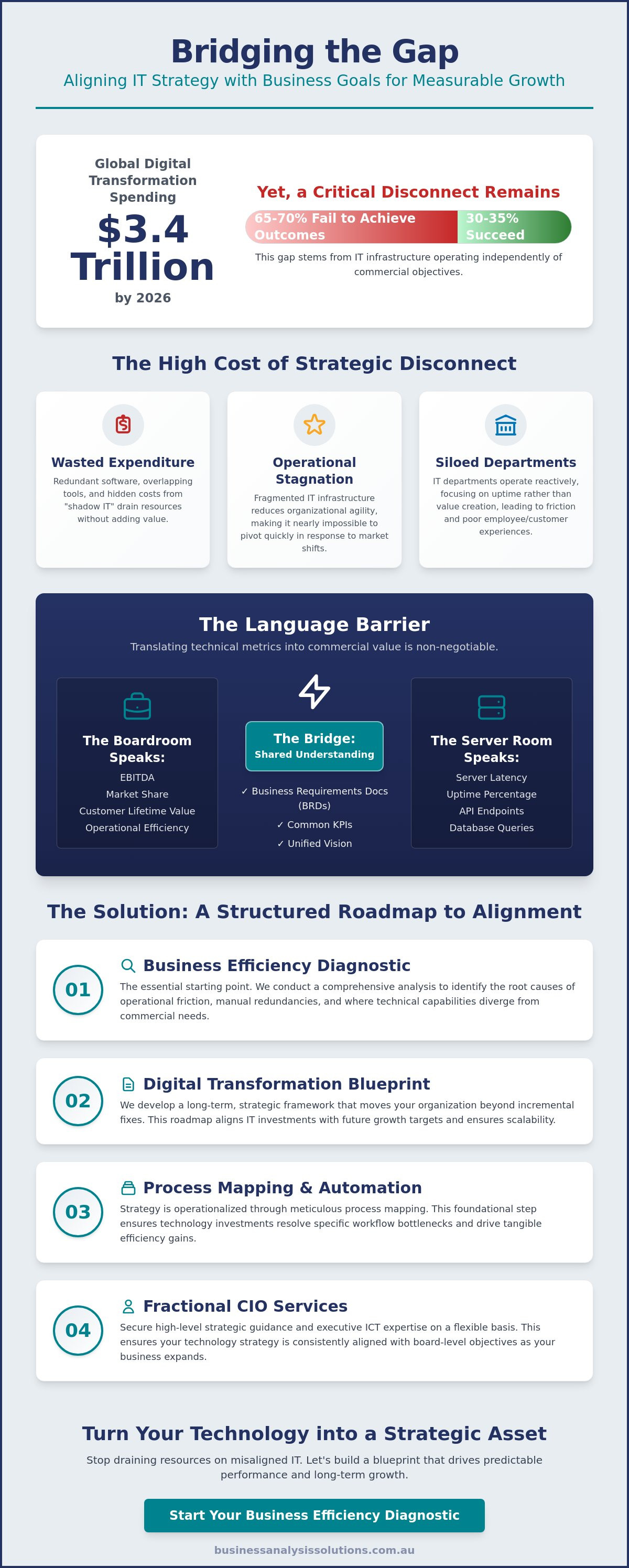
While global digital transformation spending is projected to reach $3.4 trillion by 2026, research indicates that only 30% to 35% of these initiatives achieve their intended outcomes. This gap often stems from a fundamental disconnect where technical infrastructure operates independently of commercial objectives. You've likely experienced the frustration of wasted expenditure on redundant software or the stagnation caused by IT departments operating in silos. Aligning IT strategy with business goals is the only reliable method to ensure your technology investments actually support long-term growth rather than draining resources.
We understand that complex organizational challenges require a structured, methodical approach rather than marketing jargon. You'll discover how to bridge the gap between technical requirements and broader organizational objectives to drive measurable efficiency. This article provides a clear roadmap for your digital transformation, moving from a Business Efficiency Diagnostic to a Digital Transformation Blueprint. We'll examine how to achieve system harmony and leverage fractional ICT leadership to ensure your technology scales effectively as your business expands.
Key Takeaways
Identify the root causes of operational friction and manual redundancies through a comprehensive Business Efficiency Diagnostic.
Establish a long-term roadmap for aligning IT strategy with business goals using a Digital Transformation Blueprint that accounts for future scalability.
Secure high-level strategic guidance and executive ICT expertise on a flexible basis through the Fractional CIO Services model.
Utilize process mapping as a foundational step for automation implementation to ensure technology investments resolve specific workflow bottlenecks.
Mitigate the financial risks of shadow IT by synchronizing fragmented digital ecosystems with core organizational objectives.
Table of Contents
Understanding the Critical Need for IT and Business Alignment
True alignment is more than a technical handshake. It's the synchronization of technology resources with specific organizational objectives. For many leaders, the process of aligning IT strategy with business goals remains an abstract concept rather than a functional reality. This disconnect transforms IT into a reactive cost center, where the primary focus is maintaining uptime rather than driving commercial value. When technology exists in a vacuum, it ceases to be a tool for growth and instead becomes a source of organizational friction.
Traditional IT managed services often fail to address high-level strategic goals because they're designed for maintenance, not growth. While basic support ensures day-to-day stability, it doesn't solve the problem of shadow IT. This occurs when departments procure their own software outside of a central strategy, creating fragmented digital ecosystems. These silos lead to hidden costs, redundant technology stacks, and significant security risks that erode operational efficiency. Moving from a reactive posture to a proactive strategic asset requires a fundamental shift in how leadership views ICT solutions.
The Language Barrier Between the Boardroom and the Server Room
Technical jargon often obscures commercial value, causing delays in critical decision-making. When IT speaks in terms of server latency and the boardroom speaks in terms of EBITDA, clarity is lost. Transitioning to a model of shared success requires translating technical requirements into robust Business Requirements Documents (BRDs). This ensures that every technology investment is measured against common KPIs that both technical and commercial teams support. Clear communication ensures that technical limitations are understood as business risks, while commercial goals are seen as technical mandates.
The Consequences of Strategic Disconnect
Organizations without a unified vision face severe resource allocation issues. Without a structured methodology like The Open Group Architecture Framework (TOGAF) to guide enterprise architecture, businesses often accumulate expensive, overlapping tools. This lack of cohesion reduces organizational agility. When market shifts occur, a fragmented infrastructure makes it nearly impossible to pivot quickly. You end up paying for multiple licenses that perform the same function, while critical gaps in your digital strategy remain unaddressed.
The impact extends beyond the balance sheet. Misalignment directly affects the employee experience. Staff struggle with clunky, disconnected systems that hinder their ability to perform, which eventually impacts customer satisfaction. A methodical approach to aligning IT strategy with business goals resolves these tensions. This transition often begins with a business efficiency diagnostic to identify exactly where technical capabilities diverge from commercial requirements. By bridging this gap, you turn technology into a predictable driver of organizational performance.
Developing a Digital Transformation Blueprint for 2026
A strategic framework is the only way to move beyond incremental fixes toward systemic improvement. A digital transformation blueprint for business serves as this foundational roadmap. It provides a long-term vision that prevents the common pitfall of purchasing technology for technology's sake. Effective IT strategic planning requires a rigorous assessment of current ICT infrastructure against future growth targets. By identifying "low-hanging fruit"; those immediate efficiency gains that require minimal capital expenditure; organizations can build the momentum necessary for larger shifts. This approach ensures that the blueprint remains adaptable to emerging technologies like AI and automation, rather than becoming a static document that gathers dust.
Step 1: Stakeholder Discovery and Objective Mapping
Precision begins with people. We conduct deep-dive interviews with department heads to identify specific operational pain points that technical teams often overlook. This discovery phase ensures that every technology initiative is tethered to the organization's three-to-five-year vision. It isn't enough to simply upgrade hardware; we must understand the commercial workflows that the hardware supports. Comprehensive discovery prevents project failure by ensuring technical solutions are built upon a foundation of validated commercial needs. It's the difference between a generic software rollout and a targeted strategic implementation that delivers measurable value.
Step 2: Gap Analysis and Solution Architecture
Once objectives are clear, the focus shifts to the distance between current capabilities and the desired future state. This gap analysis allows us to prioritize investments based on their projected ROI and overall strategic impact. We focus on evaluating vendor-neutral ICT solutions to avoid the restrictive trap of platform lock-in. This neutrality is critical for aligning IT strategy with business goals, as it allows your technology stack to evolve as your commercial requirements change. By designing a flexible solution architecture, we ensure your systems remain assets rather than liabilities.
This architecture must also account for modern governance standards, such as risk-informed decision-making frameworks that address AI integration and cybersecurity. As global cybercrime costs are projected to surpass $10.5 trillion by 2026, your blueprint must treat security as a core business strategy rather than a technical afterthought. If your current systems feel like a bottleneck, a professional Digital Strategy review can help reorient your technical trajectory toward growth.
The Role of Fractional CIO Services in Bridging the Gap
Mid-sized organizations often operate within a leadership vacuum. While they require high-level technical direction, the financial commitment of a full-time Chief Information Officer is frequently prohibitive. This absence of executive oversight often results in a fragmented digital environment where technology decisions are made in isolation. Fractional CIO services Australia offer a pragmatic resolution by providing executive expertise on an on-demand basis. This model ensures that aligning IT strategy with business goals isn't just a periodic exercise but a continuous operational standard that adapts to new regulations like the EU AI Act. Leadership isn't optional.
An external advisor brings the objectivity required to resolve internal silos. They act as a bridge, ensuring that technical projects remain strictly aligned with the broader Digital Strategy during implementation. By applying the foundational principles of business strategy, a fractional executive ensures that every ICT investment directly contributes to value creation for stakeholders. This role is particularly critical during the transition from legacy systems to cloud-native infrastructure, where the risk of cost overruns is high. Results matter most.
Strategic Advisory vs. Managed IT Support
There is a fundamental distinction between keeping the lights on and driving the business forward. Traditional managed IT support focuses on maintenance and helpdesk functions; however, strategic advisory addresses the "why" behind the technology. A Fractional CIO manages external IT vendors and internal project teams to ensure cohesive delivery. This high-level ICT consultancy is vital for navigating complex risk management and cybersecurity standards, such as the NIST Cybersecurity Framework 2.0. By focusing on outcomes rather than just infrastructure, leadership can transform IT from a cost center into a competitive advantage. It's about ensuring your ICT solutions are robust enough to withstand the forecasted $10.5 trillion global cost of cybercrime in 2026.
Execution and Governance
Success requires a robust governance framework to track the progress of ICT initiatives. Without clear metrics, technology spending can easily spiral without delivering tangible results. Board-level visibility into technology performance and spend is no longer optional in 2026. This oversight ensures that organizational resources are allocated to projects with the highest strategic impact. Strategic leadership provides the necessary oversight and commercial context that ensures project management success across all digital initiatives. By establishing clear implementation tiers and governance protocols, businesses can achieve the three times higher success rates seen by organizations following comprehensive best practices.
Operationalising Strategy Through Process Mapping and Automation
Strategy remains theoretical until it's applied to the daily workflows of your staff. The process of aligning IT strategy with business goals requires a granular understanding of how information moves through your organisation. This is where automation implementation becomes a tangible driver of value. By visualising workflows, we identify the specific bottlenecks and manual redundancies that drain resources. Precision is paramount. Without this level of detail, technology investments often fail to resolve the underlying friction that limits growth.
The Art of Process Mapping
Capturing accurate workflows requires more than just high-level observation. It demands direct engagement with the personnel who perform these tasks daily to capture real-world scenarios. We distinguish between "as-is" processes, which represent your current reality, and "to-be" optimisations, which define your future state. These process maps serve as the definitive technical requirements for any new ICT solutions. They ensure that technical teams understand the commercial context of their work. By capturing the nuance of daily operations, we eliminate the ambiguity that typically leads to project scope creep and budget overruns.
Strategic Automation Implementation
Automating an inefficient process only results in faster inefficiency. Strategic implementation focuses on integrating communication services to ensure data flows seamlessly between departments without manual intervention. We often select tools like the Microsoft Power Platform to create custom automation that remains scalable and vendor-neutral. Leveraging Power BI for data-driven decision-making allows leadership to access real-time reporting on operational performance. This methodical approach ensures that every automated task contributes to aligning IT strategy with business goals. Results are tracked through a governance framework that ensures technical projects remain on schedule and within scope.
Success is measured by the measurable delta between the "before" and "after" operational states. We track specific metrics, such as cycle time reduction and error rate decreases, to quantify the impact of streamlined operations. This evidence-based approach builds confidence in the digital transformation journey and provides the board with clear visibility into technology ROI. If you're ready to identify and resolve your operational bottlenecks, our team can provide a professional Business Analysis to map your path toward measurable efficiency.
The Business Efficiency Diagnostic: Your Starting Point
A successful digital transformation doesn't begin with a procurement list; it starts with an objective assessment of reality. The business efficiency diagnostic serves as the essential entry point for any organization serious about aligning IT strategy with business goals. This professional strategic assessment identifies the root causes of operational friction that often remain hidden behind daily workarounds. It's a methodical deep-dive that moves beyond surface-level symptoms to reveal the structural disconnects between technical capabilities and commercial requirements.
The diagnostic report isn't a static audit. It's a functional document that directly informs your Digital Transformation Blueprint. By establishing an empirical baseline, leadership can make risk-informed decisions based on logic rather than technical trends. This transition from diagnostic insight to expert project management and delivery ensures that every subsequent ICT solution is anchored in a validated business need. It provides the clarity required to move from reactive maintenance to proactive strategic asset management. Logic dictates the path.
What Does a Diagnostic Reveal?
A professional assessment provides a comprehensive overview of your digital health. It doesn't just look at hardware; it evaluates how technology interacts with your people and processes. Efficiency is the metric. Key findings typically include:
Financial Performance Analysis: An in-depth review of your technology spend relative to actual commercial output and EBITDA impact.
Organizational Coordination Assessment: Evaluation of how well your various software platforms communicate and identifying where data silos are hindering system harmony.
Prioritized Resolution Roadmap: A logical sequence of recommendations for immediate efficiency gains and long-term strategic improvements.
Next Steps for National Organisations
Engaging with a strategic ICT consultancy allows you to leverage external objectivity. For national organizations navigating complex digital ecosystems, this outside perspective is vital to resolve internal silos and standardize operations. We bring over 20 years of experience in navigating complex ICT challenges, ensuring that your roadmap is grounded in international standards and proven methodologies. This expert oversight guarantees that your technology scales in lockstep with your business growth. Results are tracked.
The path to operational excellence requires a commitment to resolution and outcomes. By aligning IT strategy with business goals through a structured diagnostic process, you eliminate wasted expenditure and empower your workforce with optimized tools. Don't let technical ambiguity stall your progress. Request a Business Efficiency Diagnostic from Business Analysis & Solutions today.
Securing Your Competitive Advantage through Strategic Alignment
Sustainable growth in 2026 requires moving beyond reactive IT maintenance toward a unified Digital Transformation Blueprint. Achieving this state depends on two critical factors: objective diagnostic insight and high-level executive leadership. The process of aligning IT strategy with business goals is a continuous cycle of rigorous assessment and expert execution. By utilizing Fractional CIO services and detailed process mapping, your organization can transform technology from a recurring expense into a proactive strategic asset. This methodical approach ensures your digital ecosystem remains resilient as global cybercrime costs and regulatory requirements evolve.
Business Analysis & Solutions brings over 20 years of strategic ICT experience to help you navigate these complex organizational challenges. We specialize in Digital Strategy and Fractional CIO services, delivering proven results in automation and process mapping. Let us help you resolve operational friction and establish a clear roadmap for your future growth. Optimise your organisation with a Business Efficiency Diagnostic from our team today. You've established the vision; now it's time to build the technical infrastructure that makes it a reality.
Frequently Asked Questions
What does it mean to align IT strategy with business goals?
Alignment is the formal synchronization of technical infrastructure with specific commercial objectives. It ensures that every technology investment is measured against its ability to drive organizational value rather than operating in isolation. By aligning IT strategy with business goals, you transform your technical department from a reactive support unit into a proactive driver of operational performance and financial growth.
Why do most IT projects fail to meet business objectives?
Research indicates that only 30% to 35% of digital transformation initiatives achieve their intended goals. These failures often stem from a lack of clear vision or technical teams working in silos without commercial context. When technical requirements aren't anchored to a Digital Transformation Blueprint, businesses frequently suffer from wasted expenditure on redundant software and systems that don't scale with organizational growth.
How can a Fractional CIO help with strategic alignment?
A Fractional CIO provides high-level executive expertise on an on-demand basis to bridge the gap between technical and commercial teams. They offer the objectivity required to resolve internal silos and ensure that technical projects remain strictly aligned with the broader Digital Strategy. This model allows mid-sized organizations to access professional ICT leadership and governance without the financial commitment of a full-time executive.
What is the difference between an IT strategy and a Digital Transformation Blueprint?
An IT strategy defines the high-level vision and objectives for technology within the company. In contrast, a Digital Transformation Blueprint is a granular, long-term roadmap that details the specific steps required for implementation. The blueprint assesses the current state of ICT infrastructure against future growth targets, providing a structured methodology for moving from diagnostic insight to measurable efficiency gains.
How much does a Business Efficiency Diagnostic cost?
The investment required for a Business Efficiency Diagnostic depends on the specific scope and complexity of your organization's digital ecosystem. This assessment involves a thorough review of current capabilities against business needs to identify specific gaps and opportunities. Because every engagement is tailored to unique operational requirements, we determine the final cost after defining the diagnostic parameters during an initial consultation.
Can small businesses benefit from ICT consultancy, or is it only for large enterprises?
Small and mid-sized businesses often gain the most significant value from ICT consultancy because they frequently lack high-level technical leadership. Strategic guidance helps these organizations avoid the expensive trap of platform lock-in and redundant technology stacks early in their growth. Accessing Fractional CIO services ensures that smaller firms can build a scalable foundation that supports long-term commercial objectives efficiently.
How do I measure the ROI of IT and business alignment?
ROI is measured by tracking the tangible delta between the "before" and "after" operational states. Key metrics include the reduction of cycle times, lower error rates, and the elimination of redundant software licenses. Aligning IT strategy with business goals ensures that technical spend translates directly into improved financial performance and system harmony, which can be quantified through a professional Business Efficiency Diagnostic.
What role does process mapping play in technology strategy?
Process mapping is the essential foundation for any successful automation implementation. It involves capturing real-world workflows to identify bottlenecks and manual redundancies that drain resources. These maps serve as the definitive technical requirements for new ICT solutions, ensuring that technology resolves specific friction points. Without accurate process mapping, organizations risk the expensive mistake of automating an inherently inefficient workflow.



Comments