7 Critical Symptoms of Poor Business Processes and How to Resolve Them
Employees waste an average of 12 hours every week searching for information across disconnected systems, while poor data quality costs organizations millions in flawed decision-making. These inefficiencies are often the most visible symptoms of poor business processes that quietly erode your profitability and stall growth. You've likely noticed your profit margins declining despite steady sales or watched key staff members burn out because they're trapped in manual workflows. It's a common struggle where information silos prevent clear leadership and operational harmony feels out of reach.
This article identifies the specific structural failures draining your resources and offers a methodical approach to restoring organizational health. You will learn how to pinpoint exactly which processes are broken and gain a clear roadmap toward a robust digital strategy. We explore seven critical indicators of operational friction and the strategic steps required to implement effective automation and ICT solutions. By the end, you'll have the framework needed to transition from fragmented tools to a unified, efficient operation that supports long-term financial performance.
Key Takeaways
Learn why operational friction is often a byproduct of growth outpacing original process design and how to identify these structural failures.
Pinpoint the measurable symptoms of poor business processes that indicate a critical need for a professional business efficiency diagnostic.
Master the "Five Whys" approach to move beyond surface-level symptoms and address the underlying technical and procedural gaps.
Establish a structured roadmap for process mapping and automation implementation to eliminate manual bottlenecks and restore profitability.
Understand the strategic value of an objective third-party audit in creating a scalable digital transformation blueprint for your organization.
Table of Contents
What Are Poor Business Processes and Why Do They Occur?
A business process is a repeatable sequence of tasks designed to achieve a specific organizational objective. When these workflows are optimized, they function as a structural asset that ensures consistency, quality, and predictable outcomes. However, when the logic of these steps no longer matches the needs of the business, the resulting friction creates visible symptoms of poor business processes. This misalignment often occurs because growth happens faster than process evolution. What served a small team effectively becomes a bottleneck as the organization scales. This is why the discipline of Business Process Management is essential for maintaining operational integrity. Without a structured approach, your workflows become a collection of historical compromises rather than a strategic engine.
There's a critical distinction between a broken process and an inefficient one. A broken process is a catastrophic failure where the output isn't delivered, making the problem easy to identify. An inefficient process is often more insidious because it continues to function while quietly draining your profitability. It requires more labor, more time, and more capital than necessary to achieve the same result. When employees begin to rely on manual workarounds, such as offline spreadsheets or verbal handoffs, it's a clear signal that the official system has failed to adapt. These shadow processes are classic symptoms of poor business processes that obscure data, prevent scalable growth, and create hidden risks that eventually surface as financial losses.
The Lifecycle of Process Decay
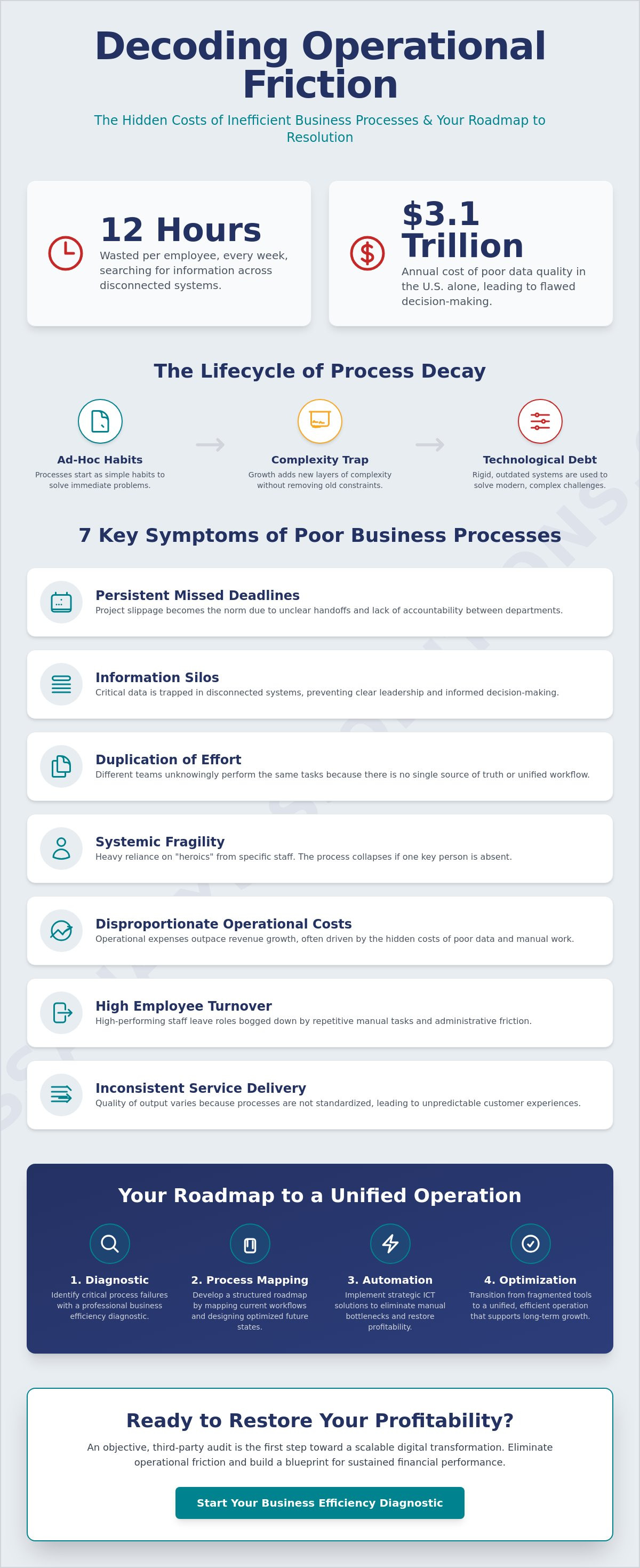
Most processes start as ad-hoc habits that solve immediate problems. As the company expands, leadership often bolts on new layers of complexity without removing original constraints. This creates a complexity trap where every new requirement adds friction. It results in technological debt. Organizations often try to solve 2026-level challenges using logic and ICT solutions designed for 2016. This creates a rigid architecture that resists change.
The Hidden Cost of "Making Do"
The financial impact of inefficient workflows extends beyond wasted hours. There's a significant opportunity cost when senior staff spend time on manual data entry rather than high-level strategy. This lack of agility makes it harder to respond to market shifts. There's also a human element. High-performing employees are driven by precision. When they're forced to navigate redundant steps, motivation declines. Persistent inefficiency leads to talent attrition.
7 Key Symptoms of Poor Business Processes
Identifying the symptoms of poor business processes requires looking past daily frustrations and focusing on quantifiable operational friction. When these indicators appear simultaneously, they reinforce a "bottleneck" culture where progress depends on individual effort rather than systemic reliability. Achieving business efficiency requires a structured response to these signals before they compromise your market position. Organizations that ignore these red flags often find themselves reacting to crises rather than executing a proactive digital strategy.
The transition to optimized operations begins with an objective assessment of these seven measurable indicators:
Persistent missed deadlines: Project slippage becomes the norm because handoffs between departments lack clear triggers or accountability.
Information silos: Critical data is trapped in disconnected systems. Research indicates employees waste an average of 12 hours per week searching for information, which directly impedes decision-making.
Duplication of effort: Different teams unknowingly perform the same tasks because there's no single source of truth or unified workflow orchestration.
Systemic fragility: A heavy reliance on "heroics" from specific staff members to get work done. If the system collapses when one person is absent, the process is fundamentally flawed.
Disproportionate operational costs: Financial performance suffers when operational expenses outpace revenue growth. This is often driven by the $3.1 trillion annual cost of poor data quality in the U.S. alone.
High employee turnover: High-performing staff often leave roles that are bogged down by repetitive manual tasks and administrative friction.
Inconsistent service delivery: When processes aren't standardized, customer experiences vary wildly. This leads to churn; 66% of consumers report moving to a competitor due to poor business communication and service gaps.
Operational Red Flags: Deadlines and Data
Operational friction is most visible in the gap between planning and execution. When information silos exist, "no one knows the full story," leading to fragmented client interactions and internal confusion. This environment forces staff to prioritize "firefighting" over high-value tasks. A structured process improvement initiative can resolve these silos by integrating disparate ICT solutions into a single, visible workflow.
Financial and Human Symptoms
The financial impact of poor processes is rarely confined to a single line item. It manifests as a slow erosion of margins. As manual workarounds increase, the cost per transaction rises, making it difficult to scale. Simultaneously, the psychological toll on your team shouldn't be underestimated. High-performing employees value precision and progress. When they're trapped in broken workflows, burnout is inevitable. For leadership, the first step toward resolution is often a comprehensive business efficiency diagnostic to uncover these hidden costs.
Analyzing Root Causes vs. Surface Symptoms
Distinguishing between a surface-level frustration and its underlying cause is the primary challenge in organizational recovery. Many leaders misinterpret symptoms of poor business processes as personnel issues or a lack of individual competence. This leads to the "training trap," where resources are wasted on educating staff to navigate a system that's fundamentally broken. If a high-performing employee fails to deliver consistent results, the failure typically resides in the process architecture rather than the person. A methodical approach requires moving beyond the immediate irritation to identify the structural breakdown.
The "Five Whys" technique serves as a foundational logic for this analysis. By repeatedly asking why a specific failure occurred, you strip away the layers of administrative noise to reach the core problem. For instance, if data is consistently inaccurate, the first "why" might reveal manual entry errors. The fifth "why" often uncovers a lack of integrated ICT solutions or a missing validation step in the workflow. Addressing the fifth "why" provides a permanent resolution; addressing the first merely creates a temporary patch that will inevitably fail again.
The Role of Misaligned Technology
Operational friction is frequently a direct result of software that creates more work than it saves. Legacy systems often lack the interoperability required for modern coordination, forcing staff to use "shadow IT" or manual spreadsheets to bridge the gaps. This technical debt is a primary driver of the symptoms of poor business processes discussed earlier. Developing a digital transformation blueprint for business allows leadership to visualize these gaps. It ensures that technology serves the strategic objectives of the organization rather than dictating its limitations.
Structural and Strategic Misalignment
Processes often decay because they no longer align with the current business model. A workflow designed for ten clients cannot support one hundred without structural revision. This misalignment manifests as a lack of clear ownership. When no single individual is accountable for an end-to-end process, handoffs become points of failure. The absence of documented standard operating procedures (SOPs) exacerbates this issue, as institutional knowledge leaves the company with every departing employee. Restoring harmony requires a rigorous audit of how these structures support, or hinder, your financial performance and operational agility.
The Diagnostic Framework: How to Audit Your Processes
A structured audit is the only way to move from anecdotal complaints to a data-driven resolution. Many organizations attempt to fix problems in isolation, but this often shifts the bottleneck to a different department. A professional Business Efficiency Diagnostic provides the objective observation required to see past internal biases. While internal teams might overlook redundant steps because they've become habitual, an external expert applies a logical framework to identify where the symptoms of poor business processes originate. This methodical approach ensures that you aren't just treating surface issues but are restructuring for long-term stability.
The urgency for a comprehensive audit is higher than ever due to shifting international standards. With the publication of ISO 9001:2026 expected in September 2026, organizations must begin evaluating their quality management systems now. The new standard formally integrates climate change considerations and ethical behavior into process requirements. Organizations with current certifications have a three-year transition period until September 2029, making a structured diagnostic essential for maintaining compliance while improving operational performance.
Step 1: Process Mapping and Visualization
Process mapping serves as the visual evidence of your current operational state. It's essential to document the "As-Is" workflow without filtering for what you wish was happening. This involves tracing every hand-off between departments, every decision point that requires manual approval, and every delay where work sits idle. By visualizing these paths, you can identify structural gaps that were previously invisible. Once the current state is documented, you can design a "To-Be" model that optimizes for speed, accuracy, and system harmony. This visualization is the foundation for any successful digital strategy and ensures that future ICT solutions are built on a solid procedural base.
Step 2: Quantifying the Impact
Strategic resolution requires more than just identifying a problem; it requires quantifying its cost. Assigning a specific value to the time wasted on manual tasks provides the financial justification needed for leadership approval. For instance, knowing that poor cash flow management is a factor in 82% of small business failures makes optimizing the accounts receivable process a high priority. Measuring the error rate in data-heavy tasks helps calculate the direct loss of profitability and the secondary costs of reputational damage. These metrics allow you to justify the ROI of Automation Implementation by demonstrating exactly how much capital is currently being drained by operational friction.
Moving from a diagnostic state to tactical execution requires rigorous project management. This ensures that process changes are implemented systematically rather than in a fragmented manner. Without this oversight, even the best-designed workflows can fail during the adoption phase. If you're ready to uncover the hidden frictions in your operation, a professional business efficiency diagnostic is the most effective starting point for restoring organizational harmony.
Strategic Resolution: Moving Beyond Inefficiency
Strategic resolution requires a shift from reactive troubleshooting to proactive system architecture. While identifying the symptoms of poor business processes is a critical first step, lasting recovery depends on a methodical restructuring of your operational environment. Specialized consultancy provides the objective distance necessary to implement these changes without the interference of internal politics or historical habits. This process moves the organization toward a state where efficiency is built into the workflow rather than being dependent on individual effort. By refining these systems, leadership can reclaim lost capacity and position the business for scalable growth that doesn't compromise service quality.
Automation implementation serves as the primary engine for this transformation. It isn't merely about replacing manual tasks with software; it's about orchestrating complex end-to-end processes. When data flows seamlessly between integrated ICT solutions, the risk of human error declines and decision-making speed increases. This systemic reliability allows high-performing staff to focus on strategic initiatives that drive revenue, effectively turning a previously stagnant operation into a high-performance engine.
The Business Efficiency Diagnostic
A professional diagnostic is the foundational phase of any recovery roadmap. It involves a rigorous analysis of how your current ICT infrastructure supports your business objectives. This diagnostic bridges the gap between technical requirements and organizational goals, ensuring that every procedural change serves a specific financial or operational purpose. The resulting roadmap balances immediate "quick wins," such as automating repetitive data entry, with long-term strategic improvements. This structured approach ensures that resources are allocated to the areas with the highest potential for ROI, preventing the common mistake of investing in technology that doesn't solve the root cause of friction.
Leveraging Fractional CIO Services
Maintaining process integrity in a rapidly changing technical environment is a significant challenge for SMEs. This is why many organizations now utilize Fractional CIO services Australia to provide executive-level guidance without the cost of a full-time hire. A Fractional CIO ensures that your technology investments remain aligned with your evolving business processes. They provide the strategic oversight needed to manage complex digital transformations and ensure that the symptoms of poor business processes don't resurface as the company scales.
Operational health isn't a static achievement; it's a state of continuous optimization. With professional oversight, your organization can maintain a culture of precision that anticipates friction before it impacts the bottom line. This ongoing alignment between process mapping, digital strategy, and executive leadership creates a stable foundation for long-term financial performance and operational harmony.
Restoring Operational Harmony Through Strategic Alignment
Operational friction is rarely a personnel problem; it's a structural failure of the process architecture. By identifying the symptoms of poor business processes early, you can move from reactive troubleshooting to a state of proactive efficiency. A methodical audit allows you to prioritize automation implementation where it will have the greatest impact on your financial performance. This transition ensures that your daily workflows support your long-term strategic objectives rather than hindering them.
With over 20 years of industry experience in strategic business analysis, we provide a proven methodology for bridging ICT solutions with organizational goals. Our specialized expertise in digital transformation blueprints ensures that your systems are designed for scalable growth and precision. Book your Business Efficiency Diagnostic today to uncover hidden frictions and restore your organization's profitability. You have the ability to transform these operational challenges into a stable, high-performance engine for your business.
Frequently Asked Questions
What is the most common symptom of a broken business process?
The most frequent indicator is the emergence of manual workarounds, such as offline spreadsheets, to bypass official systems. This occurs when existing workflows no longer support current operational requirements. These workarounds are clear symptoms of poor business processes that create data silos and increase the risk of human error. When staff rely on informal habits, it signals that the underlying process architecture has failed to scale with the organization.
How do I know if my business needs process mapping or a full digital strategy?
Process mapping is a tactical exercise used to visualize and optimize specific sequences of tasks within a single department or function. In contrast, a digital strategy provides an organization-wide roadmap for aligning technology with long-term business objectives. If your challenges are localized to one team, mapping may suffice. However, if you face systemic inefficiency across multiple departments, a strategy is required to ensure system harmony and strategic alignment.
Can poor business processes be fixed without buying new software?
Many operational frictions can be resolved by restructuring the logic of a workflow rather than purchasing new tools. Inefficiency often stems from redundant approval steps or unclear handoffs between teams. By refining these procedural gaps through professional business analysis, you can significantly improve throughput without additional technology spend. New software should only be introduced when the optimized process requires a level of data integration that manual effort cannot achieve.
How much does a business efficiency diagnostic typically cost?
The investment for a professional diagnostic depends on the complexity of your organizational structure and the depth of analysis required. Rather than viewing this as a fixed expense, leadership should evaluate the potential ROI based on recovered capacity and reduced error rates. A diagnostic identifies the hidden costs of friction, allowing you to justify the expenditure through the tangible financial gains achieved from restored operational efficiency and improved resource allocation.
What is the difference between a business analyst and an ICT consultant?
A business analyst focuses on defining the requirements and logical structure of organizational workflows to ensure they meet commercial goals. An ICT consultant specializes in the technical architecture and systems required to support those processes. While their roles overlap, the analyst ensures the process is worth doing, while the consultant ensures the technology enables it. Effective digital transformation requires both perspectives to bridge the gap between technical requirements and strategic objectives.
How long does it take to see results after optimizing a process?
Initial improvements, such as the elimination of redundant approval steps, can often be realized within weeks of implementation. However, systemic change that involves automation implementation or a full digital transformation typically requires three to six months to stabilize. This duration allows for proper testing, staff training, and the integration of new ICT solutions. The timeline is influenced by the complexity of the existing technical debt and the organization's readiness for change.
What role does employee feedback play in identifying poor processes?
Employees are the first to encounter the daily friction caused by inefficient workflows, making their feedback essential for an accurate diagnostic. They can identify specific bottlenecks and manual workarounds that leadership might overlook from a high-level perspective. While employees highlight the symptoms, professional analysis is required to translate these observations into structural solutions. This collaborative approach ensures that new processes are practical and gain immediate buy-in from the team.
Is automation the only solution for inefficient manual workflows?
Automation is a powerful tool for scaling, but it's not the only way to resolve inefficiency. Many symptoms of poor business processes are better addressed through process simplification, clearer accountability, or updated standard operating procedures. Automating a broken process only accelerates the delivery of errors. A methodical approach first optimizes the logic of the workflow, then determines if automation is the most cost-effective way to maintain that new standard of performance.



Comments