10 Critical Signs of a Failing IT Project: A Strategic Recovery Guide for 2026
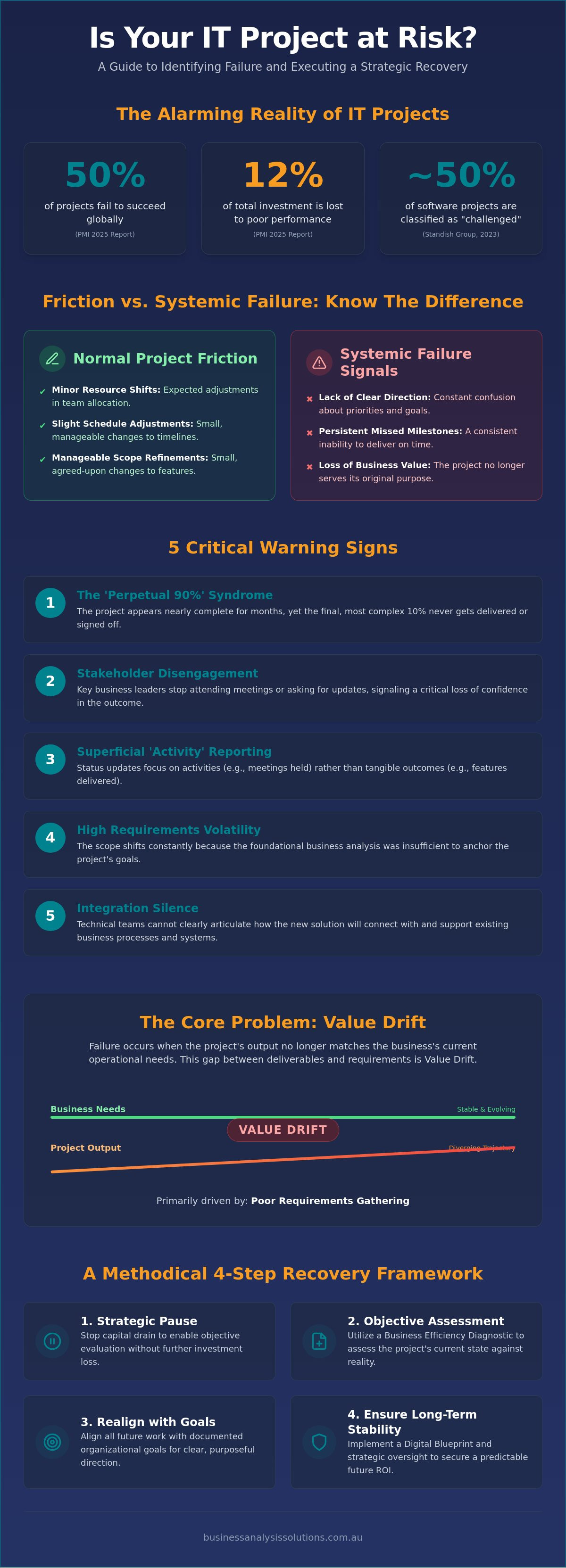
According to the PMI 2025 report, only 50% of projects succeed globally, while poor performance accounts for a loss of 12% of total project investment. If you suspect your current initiative is drifting, you aren't alone; the Standish Group's 2023 CHAOS Report indicates that nearly 50% of software projects are classified as challenged. Identifying the early signs of a failing IT project is the only way to prevent a total budget blowout and ensure your technical infrastructure supports your organizational goals.
It's common to feel a growing disconnect between technical teams and broader business strategy as deliverables become less tangible. You deserve a clear, logical path to stabilize these investments and restore confidence in your digital transformation. This article provides a comprehensive checklist to validate your concerns and a strategic recovery guide to realign your technology with your core objectives. We'll explore ten critical warning signals and the methodical steps required to secure your future ROI.
Table of Contents
Defining Project Failure: Friction vs. Systemic Instability
Project failure in a technical context is rarely the result of a single catastrophic event. Instead, it is a gradual erosion of alignment where the initiative no longer serves the objectives identified in an initial Business Efficiency Diagnostic. In current professional environments, failure is defined by the inability to deliver functional value that justifies the capital expenditure. While many leaders look for technical glitches, the most persistent signs of a failing IT project often stem from a breakdown in the bridge between requirements and organizational utility.
By 2026, the primary driver of ICT project collapse isn't technical incapacity. The global talent pool is capable, and the tools are robust. The true culprit is poor requirements gathering and a phenomenon known as Value Drift. This occurs when the project's output, though perhaps technically functional, no longer matches the business's current operational needs. When the gap between what is being built and what the business requires becomes too wide, the project has failed, regardless of whether the code runs.
The Cost of Ignoring Early Warning Signs
Ignoring the initial red flags creates a compounding effect similar to high-interest financial debt. When a project is pushed forward without resolving core misalignments, technical debt accumulates, making future adjustments exponentially more expensive. This trajectory does more than drain budgets; it erodes staff morale and destroys organizational trust in future digital strategies. In many Australian business contexts, the Sunk Cost Fallacy keeps failing initiatives on life support long after they've lost their strategic viability. Leaders often feel compelled to continue investing simply because of the resources already spent, rather than making a logical, evidence-based decision to pivot or pause.
Project Friction vs. Project Failure
It is vital to distinguish between acceptable friction and terminal failure. Normal project friction includes minor resource shifts, slight schedule adjustments, or manageable scope refinements. These are expected elements of the project lifecycle. Systemic instability, however, is characterized by a lack of clear direction and a persistent inability to meet milestones. Identifying common causes of project failure helps leadership recognize when they've reached the Point of No Return. At this juncture, continuing with the current trajectory is no longer a rational choice, and professional intervention becomes a necessity. Implementing a digital transformation blueprint for business acts as a preventative measure, ensuring that minor friction is resolved before it evolves into a systemic collapse of the project's value proposition.
The 5 Critical Signs of a Failing IT Project
Identifying the signs of a failing IT project requires a shift from monitoring task completion to analyzing structural health. When an initiative begins to drift, the symptoms are often visible in the data long before the project officially stalls. Recognition of these markers allows leadership to pivot from passive observation to active resolution. Without this clarity, organizations risk pouring capital into a vacuum where deliverables remain perpetually out of reach.
The 'Perpetual 90%': The project appears nearly finished for months, yet the final handover never occurs.
Stakeholder Disengagement: Key business leaders stop attending steering committee meetings, signaling a loss of confidence in the outcome.
Superficial Reporting: Status updates emphasize activities, such as the number of meetings held, rather than tangible outcomes like features delivered.
Requirements Volatility: The scope shifts weekly because the foundational business analysis was insufficient to anchor the project.
Integration Silence: Technical teams cannot articulate how the new solution will communicate with existing ICT systems or business processes.
The 'Perpetual 90%' Syndrome
The final 10% of a project often contains 90% of the complexity because it represents the point where disparate modules must finally achieve system harmony under real-world load conditions. To verify if 'done' translates to 'production-ready', leaders should use a methodical checklist. Ensure that User Acceptance Testing (UAT) is signed off, the production environment is fully provisioned, and data migration scripts are verified for integrity. Requirement Volatility is the primary driver of budget overruns in 2026.
Communication Breakdown and Reporting Gaps
It is common to encounter 'watermelon projects' that appear green on status dashboards but are red in reality due to hidden technical debt and unresolved dependencies. This disconnect usually happens when reporting lacks the objective metrics found in expert project management frameworks. When reporting gaps persist, 'Shadow IT' often emerges as departments build their own unauthorized workarounds to bypass the failing project. Organizations facing these challenges should consider a Business Efficiency Diagnostic to identify the root causes of reporting inaccuracies. By restoring transparency, you can realign the technical team with the strategic objectives originally set by the board.
The Strategic Disconnect: Why Good Teams Fail
Even highly competent technical teams can produce a failing result if the initiative lacks a coherent strategic anchor. This disconnect occurs when technical execution is decoupled from organizational objectives, leading to a project that functions in a vacuum but fails to deliver commercial value. One of the most persistent signs of a failing IT project is the unchecked accumulation of 'feature-creep', where additional functionalities are added without a corresponding increase in business utility. This bloat is typically a symptom of absent high-level ICT leadership capable of saying 'no' to non-essential requests.
SMEs are frequently lured into custom software development, a path that carries significant risk due to high maintenance requirements and technical complexity. While the appeal of a bespoke solution is high, the reality often involves a mismatch between 'off-the-shelf' expectations and the rigorous demands of custom engineering. Without a pre-existing business process mapping phase, these projects often attempt to automate inefficient manual workflows rather than optimizing them first. Success requires that technology follows process, not the other way around.
The Absence of a Digital Strategy
A missing digital strategy results in 'Siloed Solutions'—disparate systems that function independently but cannot share data effectively. This lack of system harmony creates operational bottlenecks that negate the benefits of new technology. A Fractional CIO provides the necessary oversight to bridge the gap between executive vision and technical implementation. By establishing a clear roadmap, leadership ensures that every technical decision serves a documented business goal, preventing the project from drifting into strategic irrelevance.
Technical Debt and Integration Hazards
Quick fixes applied during the development phase often mask deeper structural issues that will require expensive remediation later. These 'patches' are early signs of a failing IT project that prioritize short-term milestones over long-term stability. Automation Implementation often fails when applied to a flawed data architecture; you cannot automate a process that isn't logically sound. A formal ICT Solution audit during the mid-project phase is a necessary safeguard. It provides an objective assessment of whether the current trajectory is sustainable or if the technical debt has reached a level that threatens the entire investment.
Executing a Project Recovery: A Methodical Framework
Once you have identified the signs of a failing IT project, recovery requires a clinical, data-driven approach rather than a reactive one. The goal is to move from a state of systemic instability to one of controlled progress. This transition is achieved through a five-step methodical framework designed to protect your capital and realign the initiative with your strategic vision.
Step 1: The Pause. Implement a temporary 'Stop-Work' order. This is a tactical withdrawal that halts the burn rate, allowing leadership to assess the project's reality without the pressure of ongoing development costs.
Step 2: The Business Efficiency Diagnostic. Conduct a rigorous evaluation of the current project state. You must measure current progress against the original objectives to determine the exact degree of variance.
Step 3: Stakeholder Realignment. Re-establish a unified definition of success. This ensures that every executive and technical lead is working toward the same organizational outcomes.
Step 4: Objective Re-scoping. Aggressively cut features that do not contribute directly to core ROI. Focus resources on the minimum viable product that delivers the highest business value.
Step 5: Governance Reset. Establish new, transparent reporting lines. This includes defining clear ICT oversight and accountability structures that were likely absent during the initial failure.
Conducting an Independent Diagnostic
Internal teams are often too close to the project to provide an objective assessment; they may be blinded by their own proximity to the technical challenges or personal investment in the original plan. An external business analysis provides the necessary distance to identify the true root cause of delays. A recovery blueprint must include specific metrics like cost-to-complete, technical debt levels, and resource utilization rates. If your current trajectory is unsustainable, our Project Management services can help you implement the structural changes required for a successful pivot.
Managing the Human Element of Recovery
Communicating a project reset to the team requires logical, authoritative leadership to prevent a collapse in morale. Frame the pause as a strategic alignment rather than a failure of the individuals involved. By providing a clear, evidence-based roadmap for the new direction, you restore confidence and agency to the technical staff. Project Governance is the structured framework for decision-making and accountability. Establishing this framework ensures that future pivots are based on objective data rather than emotional reactions to project stress.
Stabilising ICT Delivery with Strategic Oversight
Recovering a project is a significant achievement, but preventing future instability requires a shift in organizational philosophy. Proactive strategic planning must replace reactive firefighting to ensure capital preservation and long-term operational efficiency. By establishing a Digital Transformation Blueprint, businesses create a documented roadmap that aligns every technical milestone with a specific business outcome. This structural oversight ensures that technology remains a servant to the organization's goals rather than a drain on its resources. When technical decisions are made through the lens of a broader strategy, the signs of a failing IT project are less likely to emerge.
The transition from a state of crisis to one of stability involves bridging the gap between technical requirements and executive vision. This alignment isn't a one-time event but a continuous process of verification and adjustment. It requires a commitment to transparency and a rejection of the ambiguity that often plagues complex ICT initiatives. By prioritizing system harmony and logical progression, leadership can ensure that digital investments deliver a predictable and measurable return on investment.
The Role of the Fractional CIO in Project Success
A Fractional CIO provides the high-level advisory necessary to maintain strategic alignment without the overhead of a full-time executive. This role serves as an expert translator between technical vendors and the executive team, ensuring that technical jargon doesn't mask underlying signs of a failing IT project. By focusing on financial performance and system harmony, a Fractional CIO ensures that ICT solutions are scalable, resilient, and logically sound. This oversight is particularly valuable when transitioning from a recovered project toward a future of streamlined Automation Implementation. They provide the quiet confidence required to navigate complex technical landscapes while keeping the focus firmly on business results.
Building a Foundation for Future Efficiency
Long-term efficiency is built on the foundation of meticulous Process Mapping. This practice creates a living document that identifies bottlenecks and opportunities for improvement before they are translated into technical requirements. It allows for a methodical approach to business technology where every investment is justified by documented logic. A logical foundation prevents the feature-creep discussed earlier and ensures that future digital strategies are grounded in operational reality rather than aspiration. This disciplined approach transforms ICT from a source of unpredictable cost into a stable driver of organizational growth. To secure your project's future and prevent the recurrence of systemic instability, taking the first step toward objective assessment is vital. Book a Business Efficiency Diagnostic to secure your project's future.
Securing Your Technical Future Through Strategic Realignment
Recognizing the early signs of a failing IT project isn't a signal of defeat; it's a critical opportunity for strategic correction. By distinguishing between normal lifecycle friction and systemic instability, leadership can intervene before technical debt becomes insurmountable. Recovery is achieved through a disciplined framework that prioritizes logical re-scoping and objective governance over reactive fixes. This methodical approach transforms a struggling initiative into a stable, high-performing asset.
Stability in 2026 demands a permanent bridge between technical requirements and organizational outcomes. With over 20 years of strategic ICT experience, we specialize in creating digital transformation blueprints that align infrastructure with financial performance. Our expertise ensures your technology serves as a predictable driver of growth rather than an operational burden. Complex organizational challenges are entirely resolvable when you move from uncertainty toward a structured, evidence-based roadmap.
Secure your project's ROI with a Business Efficiency Diagnostic. You have the ability to restore momentum and protect your capital through precise, authoritative oversight.
Frequently Asked Questions
What is the most common reason for IT project failure in 2026?
The most frequent cause of failure is a disconnect between technical requirements and organizational objectives. In 2026, projects don't usually fail due to technical incapacity but because of poor requirements gathering and 'Value Drift.' Without clear alignment, the project builds a solution for a problem the business no longer faces. Effective resolution involves anchoring the project in a documented Digital Strategy from the outset.
How do I know if my project is just behind schedule or actually failing?
Distinguishing between a delayed project and a terminal failure requires looking for signs of a failing IT project such as requirements volatility and stakeholder disengagement. Minor delays are often project friction, but when the 'Perpetual 90%' syndrome sets in, it's a sign of systemic instability. If the technical team can't articulate the path to completion or integration, the project is likely failing rather than just running late.
Should I fire my current project manager if the project is failing?
Terminating a project manager is rarely the most effective first step because failure is often rooted in the organizational framework. If the underlying process mapping or digital strategy is flawed, a new manager will face the same systemic obstacles. A more logical approach is to reset project governance and provide high-level advisory through Fractional CIO Services to bridge the gap between the server room and the boardroom.
What is a Business Efficiency Diagnostic and how does it help recovery?
A Business Efficiency Diagnostic is a methodical evaluation of an organization's current technical state against its commercial goals. It helps recovery by uncovering the root causes of friction, such as flawed data architecture or inefficient workflows. This diagnostic provides an objective baseline, allowing leadership to make evidence-based decisions about re-scoping or pivoting to protect their capital investment.
Can a failing IT project always be saved?
Not every project can or should be saved; some initiatives lose their strategic relevance before they're finished. If the cost-to-complete exceeds the projected ROI or if the technology no longer aligns with the Digital Transformation Blueprint, cancellation is the most rational decision. A successful recovery focus is about preserving value, which sometimes means stopping a project that no longer serves a purpose.
How does a Fractional CIO help with failing projects?
A Fractional CIO provides the strategic oversight needed to realign technical deliverables with executive vision. They act as an expert translator, ensuring that technical vendors are held accountable and that reporting remains transparent and outcome-focused. By establishing a clear roadmap, they prevent the 'Integration Silence' and 'Superficial Reporting' that often characterize failing initiatives.
Is it better to scrap a failing project or try to fix it?
The decision to scrap or fix a project should be based on a cold analysis of the 'Point of No Return' and future ROI. If the foundational architecture is sound but the scope was poorly managed, a governance reset and objective re-scoping can often recover the investment. However, if the project was built on flawed requirements that can't be remediated, scrapping it avoids the Sunk Cost Fallacy.
How much does a project recovery audit typically cost?
The cost of a recovery audit varies based on the technical complexity and organizational scale of the initiative. Instead of focusing on a fixed price, leaders should evaluate the audit's value in terms of capital preservation and risk mitigation. An independent audit identifies technical debt and resource waste, providing a logical path to stabilization that prevents further budget blowouts.



Comments