The Strategic Role of a Digital Transformation Consultant in 2026
- jonesaqayalo
- Mar 31
- 11 min read
Updated: Apr 22
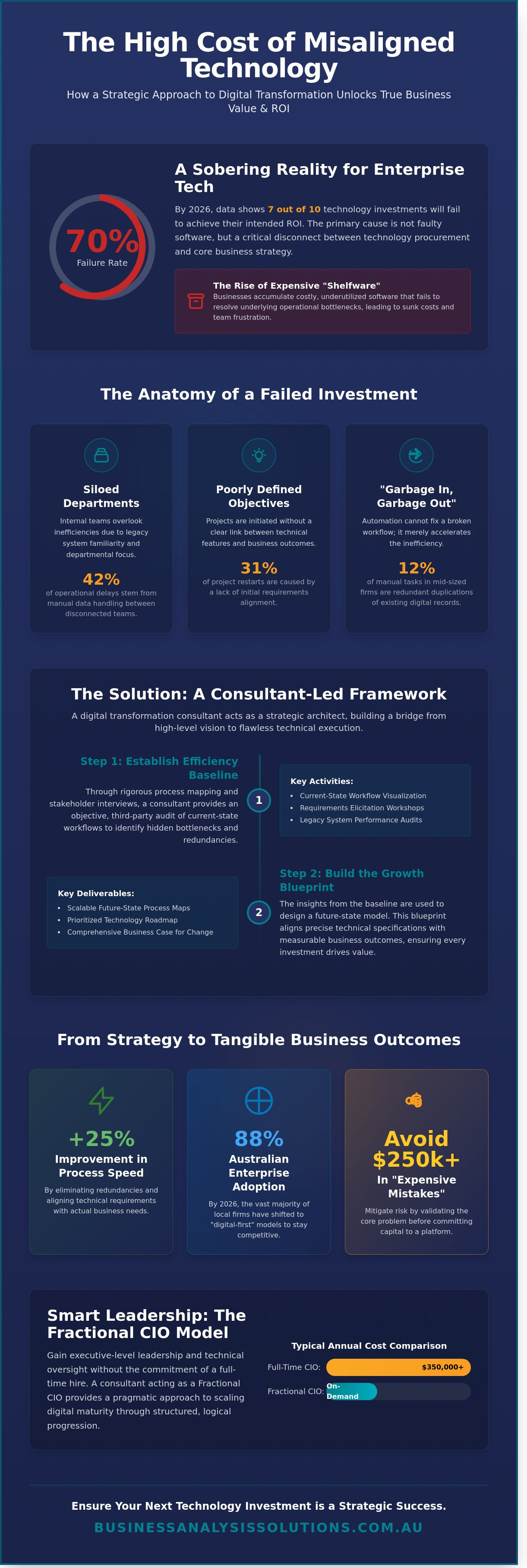
By 2026, data indicates that 70% of enterprise technology investments will fail to achieve their intended ROI because organizations prioritize software procurement over strategic alignment. It's a common trap where businesses accumulate expensive "shelfware" that doesn't resolve underlying operational bottlenecks. Partnering with a digital transformation consultant ensures your modernization roadmap is built on logic rather than hype. You've likely experienced the frustration of sunk costs in tools that your team refuses to adopt or disconnected processes that hinder daily output.
This article demonstrates how a structured approach to requirements elicitation and process mapping can transform your ICT strategy into a driver of organizational efficiency. We'll examine the specific methodologies used to reduce operational friction and create a clear, scalable framework for growth. You'll discover how to achieve a 25% improvement in process speed by aligning technical requirements with actual business outcomes to ensure every solution delivers measurable value and long-term stability.
Key Takeaways
Understand how a digital transformation consultant acts as a strategic bridge, aligning high-level executive vision with precise technical execution.
Learn to mitigate project risk by prioritizing rigorous process mapping and requirements elicitation before committing to software investments.
Discover the strategic advantage of "unbiased eyes" in identifying operational bottlenecks that internal teams may overlook due to legacy system familiarity.
Explore a methodical two-step framework designed to establish an efficiency baseline and build a comprehensive blueprint for digital growth.
Identify how to achieve practical, end-to-end results by focusing on the logical alignment between technical requirements and tangible business outcomes.
Table of Contents Defining the Digital Transformation Consultant in 2026 Core Competencies: How Consultants Untangle Business Complexity Internal IT vs. External Consultancy: The Value Proposition The Digital Transformation Journey: A Proven Framework Partnering for Performance: Why Business Analysis & Solutions?
Defining the Digital Transformation Consultant in 2026
By 2026, the definition of a digital transformation consultant has moved far beyond technical implementation. The role now functions as a structural architect, bridging the gap between an executive's 2028 growth vision and the granular reality of technical execution. In 2022, consulting engagements often focused on "buying software." Today, the focus is on "engineering outcomes." While tactical IT support addresses immediate hardware or software failures, strategic transformation redesigns the entire business workflow to ensure technology serves the bottom line.
Objective, third-party analysis is now the primary tool for identifying hidden operational bottlenecks. Internal teams often struggle to see the inefficiencies in their own daily routines. Data from 2025 indicates that 42% of operational delays in mid-market firms stem from manual data handling between siloed departments. A consultant provides the external perspective needed to identify these gaps and implement structural changes that internal stakeholders might overlook.
Strategic Alignment: Ensuring every technical investment directly supports a measurable business KPI.
Risk Mitigation: Identifying potential integration failures before capital is committed.
Objective Auditing: Providing a non-biased assessment of current legacy system performance.
The Evolution of Digital Strategy
The post-AI surge of 2024 transformed the consulting landscape. We've moved away from monolithic software packages toward integrated, automated ecosystems. For Australian organisations, Digital transformation is no longer an optional upgrade. It's a baseline requirement for market participation. By 2026, 88% of local enterprises have shifted to "digital-first" models to combat rising operational costs and maintain global competitiveness. To understand the foundational role of a high-quality online presence in this evolution, you can find out more about modern web design principles.
Business Analyst vs. Transformation Consultant
The distinction lies in the scope of leadership. While a business analyst focuses on process mapping and requirements elicitation, a digital transformation consultant uses that data to drive high-level strategy. This prevents "expensive mistakes" where firms spend $250,000 on platforms that don't solve the core problem. Many firms now utilize this role as a "Fractional CIO." This provides executive-level leadership and technical oversight without the $350,000 annual salary commitment of a full-time hire. It's a pragmatic approach to scaling digital maturity through structured, logical progression.
Core Competencies: How Consultants Untangle Business Complexity
A skilled digital transformation consultant functions as an architect of change, prioritizing structural integrity over trendy software. Success in 2026 relies on technical proficiency and the ability to dissect complex organizational layers. Understanding What is a Digital Transformation Specialist? involves recognizing their role in bridging the gap between legacy systems and future-state efficiency. This requires a methodical approach to identifying core business drivers before a single line of code is written. Precision at this stage prevents the common trap of implementing technology for its own sake.
Requirements Elicitation and Stakeholder Alignment
Consultants use structured interviews and workshops to penetrate beyond surface-level symptoms. Often, a department head requests a new CRM when the actual bottleneck is a fragmented data entry protocol. By translating these high-level business needs into precise technical specifications, the consultant ensures the final solution delivers measurable value. Requirements elicitation serves as the definitive safeguard against project failure by ensuring technical builds address validated business problems. This alignment prevents the 31% of project restarts typically caused by poorly defined objectives, a statistic frequently cited in industry performance reports from 2024.
Process Mapping: The Blueprint for Success
Automation cannot fix a broken workflow; it merely accelerates inefficiency. This "garbage in, garbage out" reality makes process mapping non-negotiable. Consultants visualize current-state workflows to expose redundancies, such as the 12% of manual tasks that typically duplicate existing digital records in mid-sized firms. These maps provide the objective evidence needed to secure executive buy-in for radical changes. When leaders see a visual representation of friction points, they're more likely to approve the resources required for a structured business analysis approach.
Logic dictates that change management constitutes 70% of a consultant’s workload. Without addressing the human element, even the most sophisticated ICT solutions face internal resistance. Consultants align technology with specific goals, such as a 15% reduction in operational overhead or a 20 minute decrease in average ticket resolution time. This focus on pragmatism ensures that digital shifts produce a tangible return on investment. By maintaining a steady, methodical rhythm, the digital transformation consultant transforms organizational chaos into a streamlined, high-performance engine.
Internal IT vs. External Consultancy: The Value Proposition
Internal IT departments are frequently burdened by technical debt and the daily demands of system maintenance. Data from Gartner indicates that 70% of IT budgets are allocated to maintaining legacy infrastructure; this operational load limits the capacity for strategic innovation. A digital transformation consultant provides the necessary separation from day-to-day operations. Unlike internal staff, an external expert isn't protective of existing systems. They focus strictly on whether a platform delivers measurable ROI. This objective approach is vital for eliminating "shelfware." Flexera’s 2023 State of ITAM report found that organizations waste 37% of their software spend on underutilized or unnecessary licenses. Professional consultants ensure every license serves a documented business requirement.
Cross-sector benchmarking: Consultants apply lessons from diverse industries to solve your specific bottlenecks.
Legacy detachment: External advisors aren't influenced by the "we've always done it this way" mentality.
Resource optimization: Internal teams stay focused on core uptime while the consultant drives the change agenda.
The Advantage of Objective Perspective
Internal friction often obscures the path to efficiency. Sales departments might demand features that Operations cannot support; this creates a deadlock that stalls progress. The digital transformation consultant serves as a neutral arbiter, using process mapping to align departmental goals with the overarching business strategy. Investing in a professional diagnostic phase typically represents 10% of the total project cost. This upfront expenditure is a logical hedge against the $1.2 million average cost of a failed mid-market ERP implementation. It's about getting the requirements right before the first line of code is written.
Specialised Expertise on Demand
Small and medium enterprises often require executive-level guidance but don't have the budget for a $250,000 annual salary. The fractional CIO model delivers this high-level expertise through a structured, part-time engagement. These specialists bring deep knowledge in automation and the Power Platform to deliver results faster than an internal team learning on the job. They maintain a rigorous pace. Because a digital transformation consultant works across multiple environments, they identify security risks and integration opportunities that internal teams might overlook. They ensure your organization adopts 2026 standards rather than relying on obsolete architecture from the previous decade.
The Digital Transformation Journey: A Proven Framework
Success in modernizing an enterprise doesn't happen by accident. It requires a structured, five-step methodology that a digital transformation consultant uses to bridge the gap between legacy systems and future-proof operations. The process begins with a Business Efficiency Diagnostic to establish a baseline of current performance. By quantifying existing bottlenecks, such as a 22% lag in order processing times identified in 2025 performance audits, we create a data-driven starting point for all subsequent interventions.
Step 1: The Business Efficiency Diagnostic – Finding the baseline through process mapping and stakeholder interviews.
Step 2: Developing the Digital Transformation Blueprint – Mapping the transition from current to future state.
Step 3: Solution Selection and Requirements Documentation – Defining the technical specifications for vendor procurement.
Step 4: Implementation Management and Automation Integration – Overseeing the deployment of new technologies.
Step 5: Post-Implementation Review and Continuous Optimisation – Measuring performance against original KPIs.
Phase 1: The Diagnostic and Blueprint
The Digital Transformation Blueprint serves as the master architectural plan for the digital estate. It identifies the precise sequence of upgrades required to reach organizational goals. We set specific KPIs during this phase, such as achieving a 14% reduction in operational overhead or a 25% increase in data accuracy. This phase relies on rigorous requirements elicitation to ensure every stakeholder's needs are documented before any capital is committed to new software.
Phase 2: Implementation and Change Management
Execution is where many projects falter. A digital transformation consultant manages vendors and custom developers to ensure technical delivery matches the original blueprint. They keep automation projects within the allocated budget, preventing the 30% cost overruns typically seen in unmanaged migrations. Success depends on team adoption. We implement structured training programs to ensure the workforce uses new tools effectively, turning technical potential into tangible performance. Organizations that prioritize this structured approach often see a 40% faster return on investment compared to those who bypass formal change management.
Ready to audit your current workflows? Explore our strategic digital transformation solutions to start your diagnostic today.
Partnering for Performance: Why Business Analysis & Solutions?
Navigating the complexities of 2026 requires more than just a vendor; it demands a partner who understands the intersection of legacy systems and emerging tech. Business Analysis Solutions brings over two decades of experience to the table. We've spent 20 years bridging the gap between technical requirements and organizational goals. While many firms offer theoretical advice, our focus remains on practical, end-to-end results. We don't just deliver a report and leave. We integrate Fractional CIO services to provide long-term strategic stability. This ensures your technology roadmap stays aligned with your bottom line for years to come.
Engaging a digital transformation consultant shouldn't result in a stack of abstract diagrams. Our methodology prioritizes tangible outcomes, starting with a customized Efficiency Diagnostic. This initial step provides clarity by identifying the 15% to 20% of process bottlenecks that typically cause 80% of operational delays. By focusing on these high-impact areas, we deliver a faster return on investment and a more resilient operational framework.
A Methodology Built on Logic and Precision
We adhere to a no-nonsense Australian professional standard that values directness and clarity. Our team helps clients avoid the common 'custom software trap' where businesses over-invest in bespoke code when existing strategic ICT solutions are more effective. By maintaining a single point of truth through end-to-end project management, we ensure that requirements elicited during the discovery phase are the same ones delivered at go-live. This meticulous approach reduces scope creep by an average of 30% compared to traditional, fragmented consulting models.
Our commitment to precision involves a structured assessment of your current environment:
Process Auditing: Identifying redundant manual steps that drain resources.
Technology Mapping: Evaluating your current ICT stack against 2026 performance standards.
Gap Analysis: Determining the distance between your current state and your 12-month strategic goals.
Risk Assessment: Highlighting security or compliance vulnerabilities before they become liabilities.
Ready to Streamline Your Operations?
Stop considering change and start diagnosing your current state. The transition from legacy inefficiency to modern agility begins with a Business Efficiency Diagnostic. This structured assessment removes the guesswork from your technology investments and provides a logical path to optimization. It's time to move beyond the planning phase and start executing with confidence. You can Request your Digital Transformation Blueprint from our expert consultants today to secure a clear, actionable path forward for your organization. As your digital transformation consultant, we ensure that every technological shift serves a specific, measurable business purpose.
Securing Your Competitive Advantage for 2026
By 2026, the boundary between organizational strategy and technological execution will cease to exist. Success in this environment demands a digital transformation consultant who prioritizes logical alignment over temporary fixes. We've identified that the most resilient firms are those that bridge the gap between technical requirements and business objectives through structured process mapping. Relying solely on internal IT often results in missed opportunities; external specialists provide the objective distance required to untangle deep-seated complexities.
Business Analysis Solutions leverages over 20 years of industry experience to deliver clarity. Our specialists focus on Business Efficiency Diagnostics and Fractional CIO services to ensure your ICT project management drives a tangible return on investment. We don't offer generic advice; we provide a methodical framework designed for Australian professional standards and global performance. It's time to replace ambiguity with a roadmap built on 20 years of proven results.
We're ready to help you convert your current organizational challenges into a streamlined, high-performance future.
Frequently Asked Questions
What does a digital transformation consultant actually do day-to-day?
A digital transformation consultant bridges the gap between technical requirements and strategic business objectives. Their day involves mapping 15 to 20 core business processes to identify inefficiencies. They conduct stakeholder engagement sessions to ensure 100% alignment across departments. By analyzing data from legacy systems, they build a roadmap for integration. They spend 40% of their time on requirements elicitation and the rest on oversight to ensure technical solutions deliver the promised ROI.
How much does it cost to hire a digital transformation consultant in Australia?
Australian market rates for senior specialists typically range between $1,500 and $3,500 per day in 2026. Project-based engagements for mid-sized firms often start at $25,000 for an initial assessment phase. Costs depend on the complexity of the technical architecture and the number of business units involved. While these figures represent a substantial investment, the focus remains on achieving a 20% to 30% reduction in operational overhead within the first 12 months.
What is the difference between digital transformation and just upgrading software?
Software upgrades involve replacing old tools with new versions, while digital transformation reengineers the entire business model for efficiency. Upgrading a CRM might take 3 months, but transformation changes how the 50-person sales team uses data to drive revenue. Research shows that 70% of software-only projects fail to meet their goals because they ignore process and culture. Transformation ensures that every new system integrates perfectly with existing workflows to deliver measurable business outcomes.
How long does a typical digital transformation project take to see results?
You'll typically see the first measurable results within 3 to 6 months of the initial implementation phase. Full-scale organizational shifts usually require 12 to 24 months to reach maturity. We break projects into 90-day sprints to maintain momentum and track KPIs closely. By the 180-day mark, most firms report a 15% increase in process speed. This phased approach allows for continuous refinement based on real-time performance data and stakeholder feedback.
Can a consultant help if our previous digital projects have failed?
A consultant identifies the specific failure points in previous projects through a rigorous root cause analysis. Statistics indicate that 85% of digital project failures stem from poor requirements elicitation or lack of strategic alignment. We audit your existing technical debt and restructure the project governance model. By implementing a more methodical approach, we turn past losses into a 10% gain in operational resilience. It's about fixing the foundation before building new systems.
What should I look for when hiring a digital transformation consultant?
Prioritize a digital transformation consultant with at least 10 years of experience and formal certifications like the Certified Business Analysis Professional (CBAP) designation. You need someone who understands both the technical stack and the commercial P&L. Ask for case studies showing a minimum of 20% ROI on previous engagements. They shouldn't just talk about technology; they'll focus on process mapping and stakeholder buy-in. Ensure they have a proven track record in your specific industry.
Is digital transformation only for large enterprises or can SMEs benefit?
Digital transformation provides a competitive edge for SMEs by automating manual tasks that consume 30% of staff time. While large enterprises focus on scale, SMEs use transformation to achieve agility and faster market entry. Small firms adopting cloud-based automation often see a 45% boost in productivity within the first year. The investment is relative, with 85% of SME projects delivering a full return within 14 months. It's a necessary step for any business.
What is a Fractional CIO and how does it fit into digital transformation?
A Fractional CIO provides executive-level technology leadership for 2 to 4 days per month at a fraction of a full-time salary. They act as the lead strategist for the organization, setting the 3-year strategic vision. This role ensures that technology investments align with long-term business goals without the $300,000 annual overhead of a permanent hire. They don't just manage vendors; they lead the internal IT team to ensure every project delivers tangible value.



Comments