
ESG in 2026: A Strategic Framework for Sustainable Business Efficiency
- jonesaqayalo
- Mar 15
- 7 min read
Updated: Mar 19
Stop seeing ESG as a compliance burden. It’s a powerful framework for making your business more efficient, resilient, and valuable. This guide provides a clear, practical roadmap for Australian business leaders to turn Environmental, Social, and Governance principles into a genuine competitive advantage.
What is ESG and Why is it the 2026 Standard for Australian Business?
Environmental, Social, and Governance (ESG) is a framework used to assess a company’s operational health beyond its financial statements. It’s the evolution of Corporate Social Responsibility (CSR), moving from feel-good statements to a system based on hard data and measurable performance.
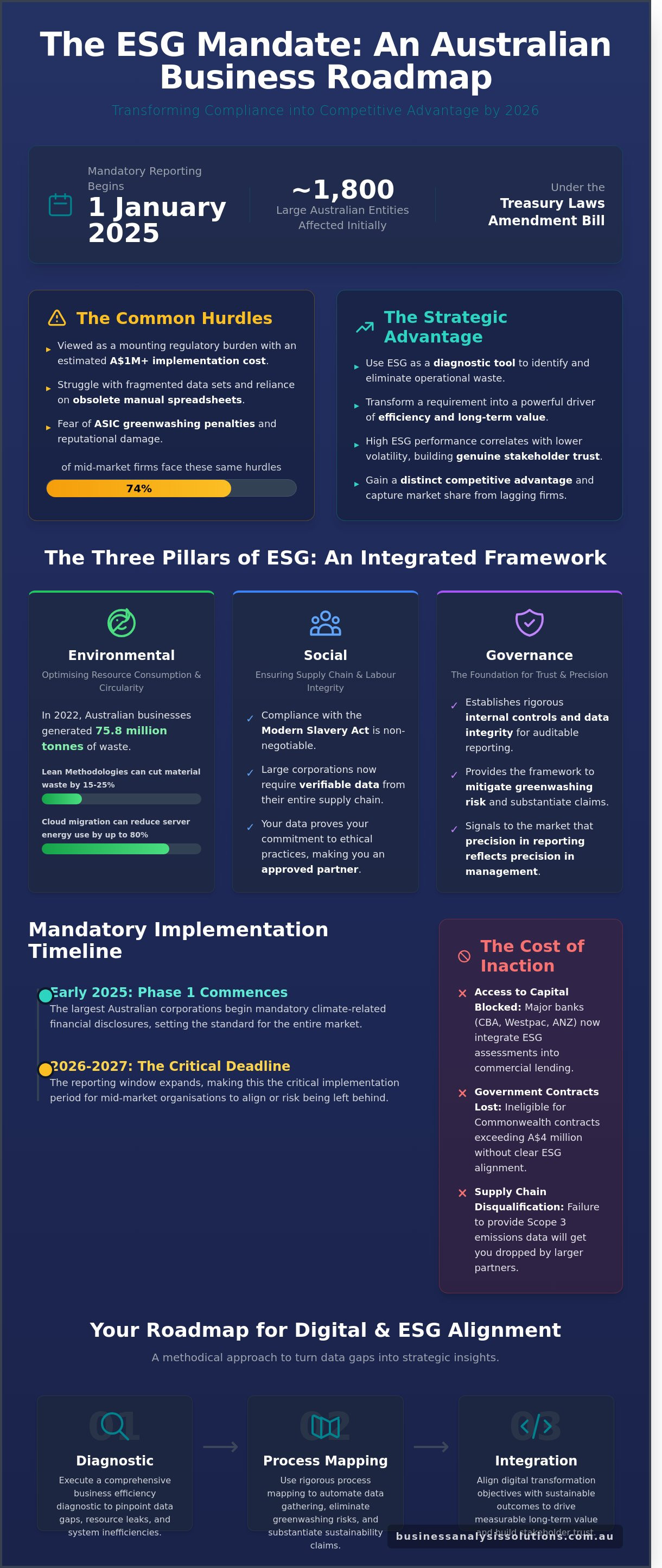
By 2026, ESG won’t be optional for many Australian businesses. Growing regulatory pressure, combined with demands from investors, major clients, and even government tenders, is making a strong ESG profile essential for securing capital and winning work.
The Shift from Voluntary to Mandatory Reporting
For years, ESG was a concern mainly for large, publicly listed companies. That’s changing fast. As the Australian Accounting Standards Board (AASB) rolls out mandatory climate-related disclosure requirements, the impact is trickling down the supply chain. Soon, your largest customers will need your ESG data to complete their own reporting, making it a condition of doing business. For Australian businesses, ESG is becoming a mandatory operational standard in 2026.
ESG as a Proxy for Operational Excellence
At its core, ESG is about managing risk and uncovering hidden inefficiencies. The process of gathering ESG data often reveals opportunities for significant cost savings and process improvements.
Revealing Inefficiencies: Tracking energy consumption to meet an environmental target also highlights exactly where you’re wasting money on electricity.
Strengthening Foundations: The 'Governance' pillar is simply about ensuring you have clear, accountable processes—the same foundation required for any successful business analysis or digital transformation project.
Gaining an Edge: Business leaders who were once sceptical are now seeing ESG as a powerful tool for building a more resilient and competitive organisation.
The Three Pillars of ESG: A Strategic Breakdown for Organisations
ESG isn't a single concept; it's an interconnected system of three core pillars. Understanding how they work together is the first step to building a robust strategy that protects and strengthens your business.
Environmental (E): This covers your company's impact on the natural world, from carbon emissions and energy use to waste management and resource consumption.
Social (S): This focuses on how you manage relationships with your employees, suppliers, customers, and the communities where you operate. It includes labour standards, data privacy, and compliance with legislation like the Modern Slavery Act.
Governance (G): This is the internal system of practices, controls, and procedures your company uses to govern itself, make effective decisions, and comply with the law. It’s about transparency, ethics, and accountability.
Environmental: Optimising Resource Consumption
The 'E' in ESG is a direct line to operational efficiency. By mapping your processes, you can pinpoint where energy, fuel, and materials are being wasted. A solid digital strategy is key to this, allowing you to monitor consumption in real-time. For many businesses, the best place to start is with low-hanging fruit like transitioning to paperless workflows or optimising cloud server usage for better energy efficiency.
Social and Governance: The Human and Ethical Infrastructure
The 'S' and 'G' pillars are about building a trustworthy and reliable organisation. Strong governance is like 'Process Mapping for the Board'—it ensures clear lines of accountability and guarantees the integrity of your data. This isn't just for compliance; robust governance is proven to reduce the risk of costly ICT project failures and builds deep trust with stakeholders, from your staff to your customers. On the 'Social' side, this trust is built on ensuring the well-being of employees and the community, which includes proactive health and safety management. For example, businesses in health-adjacent sectors can demonstrate this commitment by using modern, accessible solutions like mrsatest.co.uk to monitor and manage specific infection risks.
ESG vs. Greenwashing: Why Process Mapping is the Only Solution
One of the biggest fears for business owners is being accused of "greenwashing"—making unsubstantiated claims about your company's environmental or social credentials. In 2026, this isn't just a PR problem; it comes with significant legal and financial risks.
The antidote to greenwashing is evidence. You cannot have a credible ESG strategy without first understanding and documenting your core business operations. This is where foundational business analysis techniques like Process Mapping and Requirements Elicitation become critical. They provide the verifiable proof needed to back up every claim you make.
The Danger of Unstructured Data
Relying on scattered spreadsheets for ESG reporting is no longer a viable option. Without clear, documented processes, it's easy for data to be inconsistent or inaccurate, leading to accidental greenwashing and compliance breaches. To be effective, your ESG goals must be strategically aligned with your day-to-day operations, not treated as a separate, isolated task.
Building a Verifiable ESG Audit Trail
Well-documented process maps serve as the "source of truth" for your business. They provide a clear, auditable trail that shows how your company operates, bridging the gap between your ESG intentions and your actual, measurable outcomes. Ultimately, transparency is a natural byproduct of well-mapped business processes.
Implementing an ESG Framework: A Roadmap for Digital Alignment
Moving from theory to practice can feel overwhelming. This five-step roadmap provides a structured approach to integrating ESG into your business using a digital-first mindset.
Step 1: Conduct a Business Efficiency Diagnostic. Before you can improve, you need to know where you stand. A diagnostic assessment establishes your current ESG baseline and identifies key areas of risk and opportunity.
Step 2: Map Existing Processes. Document how your business actually runs. This crucial step will immediately reveal data gaps, resource leaks, and process inefficiencies that are holding you back.
Step 3: Develop a Digital Transformation Blueprint. Design a strategic plan that embeds ESG tracking into your core digital systems. This ensures data is captured automatically as part of your normal operations.
Step 4: Implement Automation for Data Collection. Use technology to automatically gather and consolidate ESG data. This removes the manual burden, reduces human error, and ensures your information is always consistent and up-to-date.
Step 5: Maintain Strategic Alignment with a Fractional CIO. Appoint senior IT leadership to regularly review your progress. This ensures your ESG strategy evolves with your business and remains aligned with your overarching commercial goals.
Leveraging Technology for ESG Reporting
Modern tools can transform ESG from a data-entry chore into a strategic dashboard. Platforms like the Microsoft Power Platform, particularly Power BI, are excellent for visualising complex ESG metrics in simple, easy-to-understand charts. Automation not only reduces the compliance burden but also frees up your team to focus on making meaningful improvements. For specific areas like energy management, dedicated platforms can provide even deeper insights. To see an example of a smart energy management system that supports ISO 50001 standards, you can visit Intelli-EMS.
The Fractional CIO’s Role in Sustainability
An experienced IT leader, like a Fractional CIO, plays a vital role in ensuring ESG isn’t siloed. They provide the executive oversight needed to integrate sustainability into every part of the business, from procurement and operations to managing the lifecycle of ICT assets to meet your environmental goals.
Optimising for Impact: How Business Analysis & Solutions Integrates ESG
At Business Analysis & Solutions, we specialise in turning complex business requirements into tangible operational improvements. We see ESG not as a separate service, but as the ultimate "Business Efficiency Diagnostic." Our approach is built on over 20 years of experience in untangling organisational processes and building strategies that deliver real-world results.
A Digital Transformation Blueprint developed with us naturally incorporates your ESG goals, ensuring your efforts are practical, measurable, and directly linked to improving your bottom line.
Tailored ESG Strategies for Australian Businesses
As a boutique, Perth-based consultancy, we understand the unique challenges and opportunities facing Australian businesses. We don't deliver generic reports that sit on a shelf; we partner with you to implement end-to-end solutions that create lasting value. The first step is a strategic consultation to understand your specific business context.
Future-Proofing Your Growth
The business landscape is changing. Waiting until 2027 to take ESG seriously will put you at a significant disadvantage in competitive tenders and capital markets. A proactive strategy that links ESG to your digital transformation is the key to building long-term business resilience and securing your future growth.
Frequently Asked Questions
Is ESG only for large ASX-listed companies in Australia? Not anymore. While large corporations led the way, the requirements are now trickling down to mid-sized businesses through supply chain pressure and new regulations. Getting ahead of it now is a smart strategic move.
How much does it cost to implement an ESG framework? The cost varies, but it should be viewed as an investment, not an expense. A well-implemented ESG framework, guided by a business efficiency diagnostic, often uncovers cost savings in energy, waste, and process optimisation that provide a clear return on investment.
What is the difference between ESG and CSR? Corporate Social Responsibility (CSR) is often qualitative and focused on reputation, like sponsoring a local sports team. ESG is a data-driven framework that uses specific, measurable metrics to assess a company's risk and performance.
Can business automation help with ESG compliance? Absolutely. Automation is one of a business owner's most powerful tools for ESG. It removes the manual, error-prone work of collecting data, ensuring your reporting is consistent, accurate, and always ready for an audit.
How do I start an ESG audit for my mid-sized business? The best starting point is a Business Efficiency Diagnostic. This assessment establishes a baseline by reviewing your current operations, data sources, and processes to identify the most critical areas for ESG improvement.
What are the legal risks of greenwashing in 2026? Regulators are cracking down on unsubstantiated environmental and social claims. The risks include significant fines, legal action from shareholders, and severe reputational damage that can impact customer trust and sales.
How does process mapping improve our ESG score? Process mapping provides the verifiable evidence needed to support your ESG claims. It creates a clear audit trail that shows how you manage resources, engage with suppliers, and ensure governance, which is exactly what ratings agencies and auditors look for.
Why should I involve an ICT consultant in our ESG strategy? ESG is fundamentally a data management challenge. An ICT consultant or Fractional CIO ensures you have the right systems and digital strategy to collect, analyse, and report on your ESG data accurately and efficiently. They bridge the gap between your sustainability goals and the technology needed to achieve them.



Comments