
Digital Strategy Consulting: Bridging the Gap Between Technology and Business Value
Updated: Mar 20
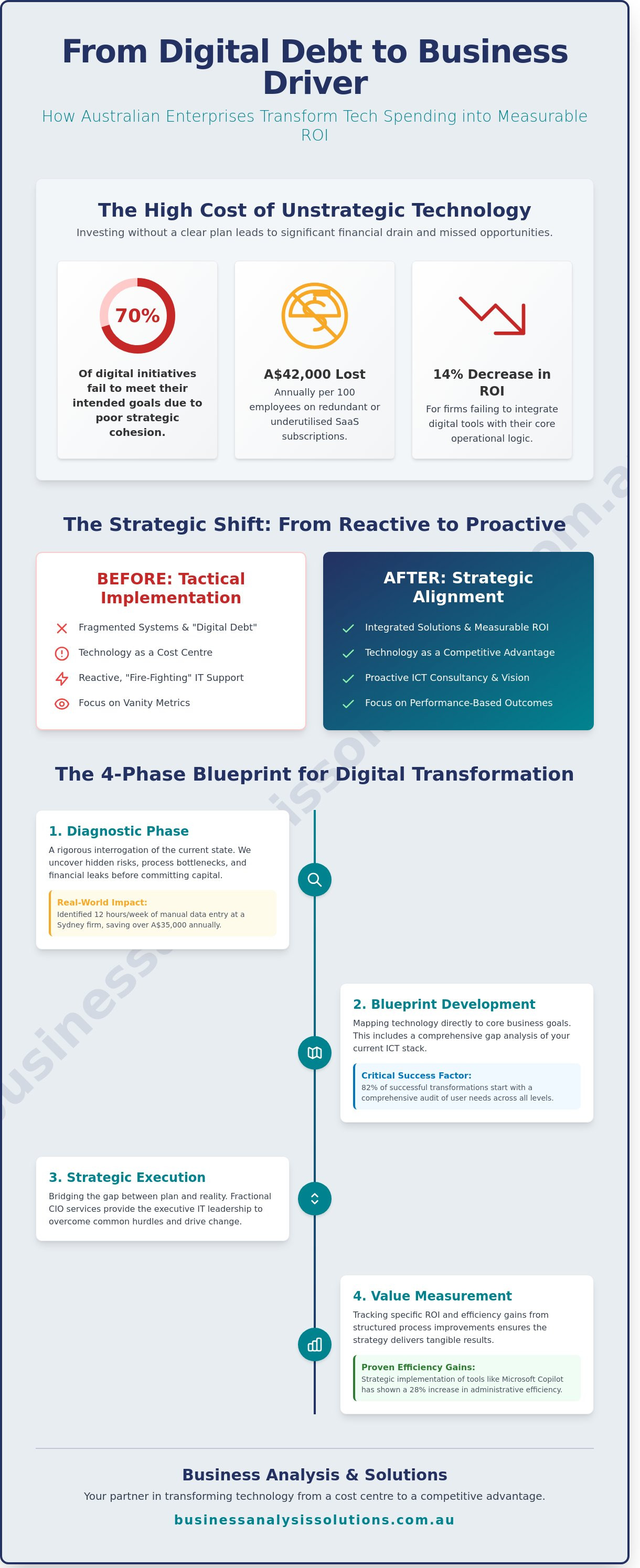
Investing in new technology without a clear alignment to business objectives is often just an expensive way to automate existing inefficiencies. For Australian enterprises, the cost of fragmented ICT systems is high, with industry data indicating that nearly 70% of digital initiatives fail to meet their intended goals due to a lack of strategic cohesion. This is where digital strategy consulting becomes essential; it acts as the critical link between technical capabilities and tangible commercial outcomes that drive the bottom line.
You've likely seen high-priced software sit idle or experienced the friction of internal resistance to change when new systems don't reflect actual workflow needs. It's a common frustration when technical debt accumulates while the promised ROI remains elusive. This article demonstrates how to transform these underperforming digital investments into measurable business efficiency through a structured, analysis-led strategic framework. We'll outline a clear roadmap for automation and provide the blueprint for integrated ICT solutions that ensure your technology stack finally delivers the organisational performance your leadership team expects.
Key Takeaways
Learn why a formal Business Efficiency Diagnostic is critical for identifying hidden risks and bottlenecks before committing capital to new software implementations.
Develop a robust digital transformation blueprint by mapping technology to core business goals and conducting a comprehensive gap analysis of your current ICT stack.
Understand how professional digital strategy consulting bridges the gap between technical requirements and business objectives to deliver measurable value in the Australian market.
Explore how Fractional CIO services provide the executive IT leadership necessary to overcome common execution hurdles and drive sustainable strategic change.
Shift from vanity metrics to performance-based outcomes by tracking the specific ROI and efficiency gains generated through structured process improvements.
Table of Contents What is Digital Strategy Consulting in 2026? The Diagnostic Phase: Why Strategy Fails Without Analysis Developing a Digital Transformation Blueprint Bridging the Gap: Execution Through Fractional CIO Services Measuring Success: The ROI of Digital Strategy Consulting
What is Digital Strategy Consulting in 2026?
Digital strategy consulting is no longer a peripheral service for exploring new gadgets. In 2026, it functions as the rigorous alignment of Information and Communication Technology (ICT) solutions with core business objectives. This discipline relies on the logic of business analysis to ensure that every technological investment serves a specific, measurable goal. The 2025 Australian Productivity Commission report highlighted that firms failing to integrate their digital tools with their operational logic saw a 14% decrease in ROI compared to their peers. Professional consulting eliminates this discrepancy by treating technology as a functional extension of the business plan rather than an isolated department.
The Australian market has moved beyond the simple adoption of software. We've entered an era of value chain optimisation. According to data from the 2025 Digital Industry Outlook, 76% of mid-sized Australian enterprises now prioritise the refinement of existing processes over the acquisition of new platforms. This shift requires a consultant who acts as a bridge. They translate the executive vision of the C-suite into functional technical requirements that developers and IT teams can execute with precision. This role ensures that the "why" of the business is never lost in the "how" of the technology.
Strategy must be rooted in professional business analysis standards. It's about data, logic, and proven frameworks. We don't guess; we calculate. By applying structured methodologies, consultants identify where a business is leaking value and where ICT can plug those gaps. This methodical approach transforms digital infrastructure from a cost centre into a primary driver of competitive advantage in a volatile economy.
This strategic approach extends beyond internal operations to encompass external market positioning. A robust digital strategy also includes how a business connects with its target audience online, which is where specialized services become critical. For example, businesses in niche sectors like the marine industry often require a tailored approach to digital marketing, a service provided by experts like Aquatic SEO.
Similarly, driving sales and ROI through targeted e-commerce campaigns is another key component of external strategy, with digital marketing agencies like AHS Digital providing a cohesive suite of creative services to achieve these commercial outcomes.
The Core Pillars of a Modern Digital Strategy
Success begins with stakeholder engagement and requirements elicitation. In 2026, 82% of successful digital transformations start with a comprehensive audit of user needs across all organisational levels. We use data-driven decision making to remove personal bias from the selection process. This involves integrating emerging technologies like Microsoft Copilot and AI into the workflow. When implemented through a strategic lens, Microsoft Copilot has demonstrated a 28% increase in administrative efficiency for Australian legal and financial firms. These pillars ensure the strategy remains robust and scalable.
Strategic Alignment vs. Tactical Implementation
Buying software without a strategy creates "digital debt." Recent industry benchmarks show that Australian businesses lose an average of A$42,000 annually per 100 employees on redundant or underutilised SaaS subscriptions. This is the result of tactical, reactive purchasing. Effective digital strategy consulting moves your organisation from reactive IT support to proactive ICT consultancy. It establishes a long-term vision that anticipates market shifts. Instead of fixing what's broken, we build systems that prevent the break from occurring, ensuring your technology landscape evolves alongside your business goals.
The Diagnostic Phase: Why Strategy Fails Without Analysis
A digital transformation that bypasses the diagnostic phase is an expensive gamble. Many Australian organisations rush into software procurement, only to find the technology doesn't align with their operational reality. Effective digital strategy consulting begins with an interrogation of the current state rather than a leap toward a shiny new platform. Without formal requirements, businesses risk implementing "vanity tech" that adds complexity without solving underlying issues. Industry data shows that 70% of digital transformations fail to reach their goals, often because the initial diagnostic was shallow or non-existent. Precision matters; ambiguity is the enemy of a successful rollout.
Identifying hidden risks requires a systematic audit of your current tech stack and human workflows. The Business Efficiency Diagnostic serves this purpose by uncovering bottlenecks that are often invisible to leadership. For instance, a mid-sized Sydney firm might discover that manual data entry between two legacy systems consumes 12 hours of staff time per week. At an average Australian salary, this translates to over A$35,000 in lost productivity annually. Proposing a solution before identifying these specific friction points leads to misallocated budgets and frustrated teams. We focus on uncovering these leaks before a single dollar is spent on new tools.
Process Mapping: The Blueprint of Efficiency
Visualising workflows is the only way to expose redundancies that hide in plain sight. What is Business Process Mapping? It's a method of documenting every step in a business activity to bridge the gap between human effort and technical systems. By creating this visual record, we identify exactly where automation can replace manual intervention. This clarity allows for a 15% to 25% reduction in operational waste during the first year of implementation. It ensures that the digital strategy is built on a foundation of logic, not assumptions.
Stakeholder Elicitation and Requirements Gathering
Capturing the real needs of an organisation requires structured elicitation techniques like workshops, interviews, and job shadowing. We purposefully neutralise the "loudest voice" bias; this ensures that the software selection reflects the needs of the daily end-users, not just the preferences of the executive suite. Clear, documented requirements are the foundation of successful project management. They provide a definitive checklist that ensures the final solution actually delivers the promised value. Without this step, the project scope inevitably creeps, leading to budget blowouts.
Establishing baseline metrics is the final, critical step of the diagnostic phase. We measure current performance benchmarks, such as lead conversion times or order fulfilment accuracy, to calculate a projected ROI. If your current order processing takes 48 hours, we set a target for 24 hours. This data-driven approach removes the guesswork from your investment. It provides a clear yardstick to measure the success of any digital strategy consulting engagement. If you're ready to move beyond guesswork, you can explore our structured methodology to see how we define success for your specific industry.
Developing a Digital Transformation Blueprint
A structured approach to digital strategy consulting transforms abstract business goals into a technical reality. Our methodology follows a five-step sequence designed to eliminate technical debt and maximise operational efficiency through logical, data-backed decision making.
Step 1: Strategic Alignment. Every proposed technology investment must map to a specific business outcome. Research from the Australian Bureau of Statistics in 2022 indicated that only 20% of mid-sized firms effectively link ICT spend to strategic KPIs. We reverse this trend by conducting stakeholder interviews to ensure your technology serves your growth, not the other way around.
Step 2: Gap Analysis. This phase involves a rigorous audit of your current ICT stack. We identify redundancies and performance bottlenecks that drain resources. It's common for Australian enterprises to discover that 30% of their software licenses are underutilised or entirely unnecessary, representing a direct hit to the bottom line.
Step 3: Solution Design. Effective digital strategy consulting requires selecting tools that offer long-term scalability. The Microsoft Power Platform often serves as the backbone here, allowing for custom application development without the overhead of traditional coding. This stage focuses on creating a cohesive architecture where data flows freely between departments.
Step 4: Implementation Roadmap. Projects are prioritised based on a matrix of impact and cost. We look for "quick wins" that deliver a high return on investment (ROI) within the first 90 days. For instance, automating a manual reporting process can save a firm A$15,000 in labour costs within its first quarter of deployment, providing the capital for larger transformations.
Step 5: Governance and Review. A blueprint isn't static. We establish a governance framework that allows for quarterly reviews. This ensures the strategy remains agile enough to respond to market shifts or new regulatory requirements in the Australian sector, such as changes to data handling laws.
Prioritising Automation and Integration
Efficiency gains often hide in high-volume, low-complexity tasks. By deploying the Microsoft Power Platform, we streamline operations through automated workflows that reduce human error by up to 40%. We focus on creating seamless integration between your ERP and CRM systems. This eliminates data silos and ensures your leadership team makes decisions based on a single source of truth rather than fragmented spreadsheets.
Risk Management and Cybersecurity in Strategy
Security isn't a bolt-on; it's a foundation. We integrate the Australian Signals Directorate (ASD) Essential 8 framework directly into your digital roadmap. This proactive stance addresses the 2023 ACSC report findings where cyber incidents cost Australian small-to-medium businesses an average of A$46,000 per event. We ensure your strategy complies with the Privacy Act 1988 while building a resilient infrastructure that protects your intellectual property and client data from emerging threats.
Bridging the Gap: Execution Through Fractional CIO Services
Execution is the point where many Australian organisations lose momentum. While a blueprint provides the map, the actual journey requires a level of executive oversight that mid-market firms often lack. Data from the Standish Group’s CHAOS report suggests that only 31% of IT projects are completed on time and on budget. This failure rate is frequently tied to a lack of leadership during the implementation phase. Engaging in digital strategy consulting is the first step, but the transition from theory to practice requires a steady hand at the helm.
A Fractional CIO provides this executive IT leadership on an on-demand basis. This model allows businesses to access the expertise of a seasoned technology officer without the overhead of a permanent A$280,000 executive salary. They don't just manage systems; they manage the value those systems deliver. By providing a clear link between technical output and business outcomes, they ensure every dollar spent on technology moves the needle on profitability. This role is vital for ensuring that ICT project management doesn't just focus on "going live" but on delivering the specific business capabilities promised in the initial strategy.
Fractional CIO vs. Managed IT Services
Managed IT services are built for maintenance. They ensure your emails work and your data is backed up. However, an MSP rarely asks if your current software stack supports your five-year growth plan. Strategic advisory is different. It's about high-level technology direction and risk mitigation. You need a consultant when your IT infrastructure feels like a bottleneck rather than an accelerator. Our Fractional CIO Services Australia bridge this gap by focusing on governance, vendor selection, and long-term strategic alignment.
The Importance of Expert Project Management
Project failure isn't usually a technical issue; it's a communication issue. ICT projects need a structured approach that prioritises the business analyst's role throughout the lifecycle. The analyst ensures requirements aren't just "gathered" but are deeply understood and validated against business goals. This rigorous execution is the only way to guarantee a Return on Investment. When projects are managed with this level of precision, the risk of "scope creep" is reduced by up to 40%, ensuring the final delivery matches the original business case.
Managing change is perhaps the most difficult aspect of any digital transformation. Stakeholders at all levels of the organisation often resist new systems because they fear complexity or job displacement. We mitigate this by focusing on transparent communication and clear process mapping. By showing staff exactly how a new tool reduces their manual workload, we turn resistance into advocacy. It's about setting realistic expectations and meeting them through disciplined project milestones. Successful digital strategy consulting must account for the human element, ensuring that the technology is adopted, not just installed.
Transformation isn't a one-time event but a continuous process of alignment. As market conditions in Australia shift, your digital execution must remain agile enough to pivot without losing sight of the core objectives. This requires a partner who understands both the granular technical details and the high-level commercial imperatives of your business.
To ensure your next technology investment delivers the results you expect, book a consultation with our strategy team.
Measuring Success: The ROI of Digital Strategy Consulting
Quantifying the impact of a digital transformation requires a shift from vanity metrics to hard financial data. While website traffic or social engagement might offer surface-level insights, the true return on investment for digital strategy consulting is found in operational efficiency and cost reduction. For an Australian mid-market enterprise with an annual turnover of A$20 million, a 15% gain in process efficiency can translate to over A$300,000 in recovered capacity each year. We focus on these tangible outcomes to ensure every technological investment serves a specific business objective.
Strategic technology alignment prevents the common pitfall of "software sprawl," where businesses pay for redundant licences that don't talk to each other. By auditing your current ICT environment, we often identify cost-saving opportunities through consolidation. A recent engagement with a Brisbane-based logistics firm resulted in an A$85,000 reduction in annual SaaS spend simply by eliminating overlapping tools and aligning their stack with actual user requirements. This isn't just about cutting costs; it's about redirecting capital toward high-growth initiatives.
Key Performance Indicators (KPIs) for Digital Strategy
Success is measured through rigorous data collection across three primary pillars. First, we track the reduction in manual processing time. If a finance team reduces their month-end reconciliation from five days to two, that's a measurable 60% increase in throughput. Second, we evaluate user adoption rates. A solution is only successful if 90% or more of the intended stakeholders use it as their primary workflow tool within the first 90 days. Finally, we analyse the Total Cost of Ownership (TCO). This includes not just the initial purchase price, but the long-term maintenance, training, and integration costs over a five-year horizon.
Error Rate Reduction: Targeting a 22% decrease in data entry errors through automated validation.
Stakeholder Satisfaction: Achieving a minimum 4.2 out of 5 rating in post-implementation internal surveys.
Process Velocity: Measuring the time taken from initial customer enquiry to final service delivery.
Next Steps: Starting Your Efficiency Journey
The first 30 days of a digital strategy consulting engagement are critical for setting the foundation. During this period, we conduct deep-dive interviews and process mapping sessions to identify the "friction points" in your current operations. To prepare your team, we recommend gathering existing workflow documentation and identifying "super users" who understand the granular details of your daily tasks. This collaborative approach ensures the resulting strategy is grounded in reality rather than theoretical ideals.
Moving from organisational complexity to streamlined performance requires a methodical partner. We don't offer generic advice; we provide a structured path toward measurable business improvement. If you're ready to stop guessing and start optimising, it's time to secure a professional assessment of your current state. You can Request a Digital Strategy Blueprint for Your Business to begin the process of untangling your complex systems and driving genuine efficiency.
Our commitment is to provide clarity in an often-confusing technical landscape. By bridging the gap between your technical requirements and your commercial goals, we ensure your digital roadmap is both ambitious and achievable. The result is a more resilient, scalable, and profitable organisation that's prepared for the specific challenges of the Australian market.
Future-Proof Your Operations Through Strategic Alignment
Success in the 2026 digital landscape requires moving beyond reactive IT spending. It demands a structured approach where technical architecture directly serves business objectives. By prioritising a rigorous diagnostic phase and leveraging fractional CIO services, organisations can eliminate the execution gaps that typically stall transformation. Digital strategy consulting serves as the vital link that ensures your technology investments deliver a measurable return on investment. At Business Analysis & Solutions, we've spent over 20 years refining this process. Our Perth-based team applies two decades of business analysis expertise to national projects, ensuring that complex requirements translate into seamless operational performance. We focus on bridging the gap between technical teams and executive stakeholders to drive clarity. Every project we undertake is grounded in logic and aimed at delivering end-to-end results that justify every A$ spent. You don't have to navigate these organisational complexities alone. Our methodical framework turns ambiguity into a clear path for growth and efficiency.
Your organisation's next phase of growth starts with a single, well-analysed step toward better integration.
Frequently Asked Questions
What is the difference between an IT consultant and a digital strategy consultant?
IT consultants focus on the technical maintenance and implementation of infrastructure; digital strategy consulting aligns technology with overarching business goals to drive growth. While an IT consultant ensures your servers run, a digital strategy consultant ensures your technology stack delivers a competitive advantage. This involves mapping processes and identifying how digital tools can improve the bottom line rather than just fixing hardware issues or software bugs.
How much does digital strategy consulting typically cost for an Australian SME?
Digital strategy consulting for an Australian SME typically ranges from A$5,000 to A$25,000 for an initial comprehensive blueprint. Smaller projects focusing on specific process mapping might start at A$3,500, while complex enterprise-wide transformations can exceed A$50,000. These figures reflect the 2024 market rates for senior-level advisory services in major hubs like Sydney and Melbourne. We ensure costs remain transparent by linking milestones to specific deliverables.
How long does it take to develop a digital transformation blueprint?
A standard digital transformation blueprint requires 4 to 8 weeks to complete from initial discovery to final delivery. This timeframe includes 10 to 15 hours of stakeholder engagement and detailed process audits. Fast-tracked assessments can be finalized in 21 days, provided that all internal documentation and key personnel are readily available for the discovery sessions. We prioritize a methodical approach to ensure every recommendation is backed by data.
Do we need to replace all our existing software to have a digital strategy?
You don't need to replace your entire software stack to implement a successful digital strategy. In fact, 70% of our blueprints focus on optimizing existing systems or integrating them through APIs to eliminate data silos. We only recommend decommissioning legacy software when the maintenance costs exceed the ROI of a modern cloud-based alternative or when technical debt prevents 15% or more in annual growth.
What is a Fractional CIO and how do they help with digital strategy?
A Fractional CIO is an experienced executive who provides high-level strategic leadership on a part-time or contract basis. They help businesses by bridging the gap between technical teams and the boardroom, ensuring IT investments align with the 3-year business plan. This model provides Australian SMEs with access to C-suite expertise at approximately 25% of the cost of a full-time executive hire, making strategic guidance accessible.
Can digital strategy consulting help with business automation?
Digital strategy consulting identifies specific manual workflows that are ripe for automation to reduce operational overhead. By implementing robotic process automation or custom integrations, businesses often see a 20% to 30% increase in administrative efficiency within the first 6 months. We focus on high-impact areas like invoice processing or lead management where human error currently impacts the profit margin. This results in a more scalable and predictable business model.
How do you measure the ROI of a digital strategy engagement?
ROI is measured by tracking specific KPIs such as a 15% reduction in customer acquisition costs or a 25% improvement in employee productivity metrics. We establish a baseline before the engagement starts and monitor these figures over a 12-month period. A successful strategy should aim for a 3:1 return on the initial consulting investment within the first two years of implementation. We provide clear reporting to justify every dollar spent.
What role does business analysis play in digital transformation?
Business analysis provides the logical framework for digital transformation by ensuring every technical requirement serves a functional business need. It involves rigorous requirements elicitation and process mapping to prevent the 50% failure rate often seen in poorly planned tech projects. Without this analytical foundation, digital initiatives risk becoming expensive tools that don't actually solve the organization's core operational challenges or improve stakeholder engagement.



Comments