
Automation Implementation: A Strategic Framework for Business Efficiency
Updated: Mar 31
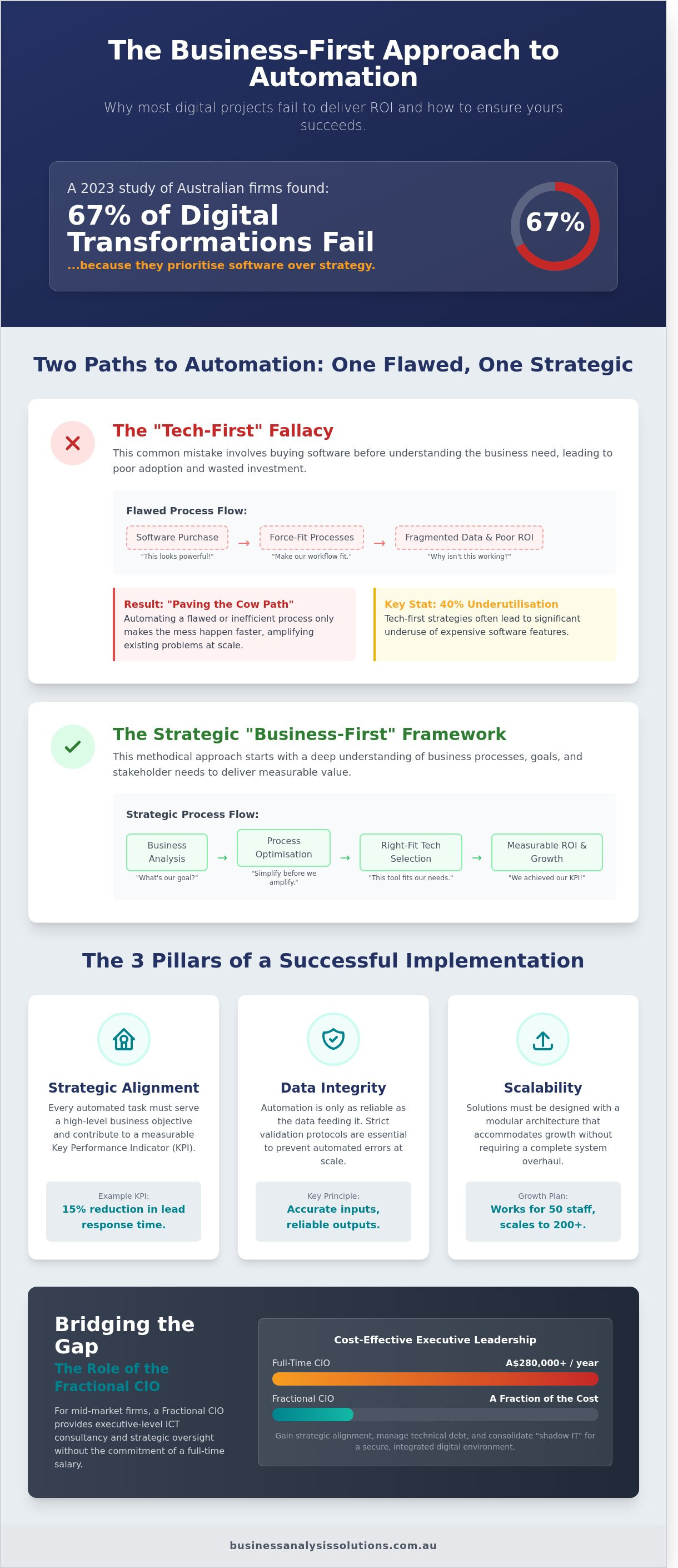
A 2023 study of Australian mid-market firms revealed that 67% of digital transformation projects fail to achieve their target ROI because they prioritise the software over the strategy. It's a frustrating reality that often leaves leadership teams managing even more fragmented data across legacy systems than when they started. You likely understand that a rushed approach to automation implementation usually creates more problems than it solves, often threatening to break the delicate balance of your existing workflows.
We agree that the primary objective is to eliminate the costly errors associated with manual entry while freeing your team from repetitive tasks. This article shares a methodical, business-first framework designed to ensure your technical solutions provide both operational clarity and a measurable return on investment. We'll examine how to align your stakeholder requirements with a scalable digital infrastructure that reduces overhead and drives sustainable growth.
Key Takeaways
Understand the evolution from simple task scripts to hyperautomation to ensure your process orchestration remains scalable within the 2026 business landscape.
Learn how to utilise a Business Efficiency Diagnostic to identify high-value candidates and avoid the common pitfall of accelerating existing process inefficiencies.
Evaluate the technical merits of RPA, API, and AI Agents to select a solution architecture that aligns with your current organisational maturity and legacy system requirements.
Follow a methodical 5-step roadmap for successful automation implementation that prioritises low-risk pilot selection and rigorous technical blueprinting.
Discover strategies for validating ROI and managing change to ensure technical solutions achieve strategic alignment and address staff concerns regarding operational shifts.
Table of Contents What is Strategic Automation Implementation in 2026? The Pre-Implementation Phase: Why Business Analysis is Non-Negotiable Selecting the Right Automation Framework: RPA vs. API vs. AI Agents The 5-Step Roadmap to Successful Automation Implementation Navigating Post-Implementation: ROI Validation and Change Management
What is Strategic Automation Implementation in 2026?
Strategic automation implementation is the systematic integration of technology to execute recurring business processes. It's no longer sufficient to view automation as a series of isolated tasks. In 2026, the focus has shifted toward creating a cohesive ecosystem where technology serves the broader organisational goals. As defined in the concept of Business Process Automation (BPA), this involves using technology to execute recurring tasks or processes where manual effort can be replaced to increase reliability and efficiency.
The evolution from "task automation" to "hyperautomation" marks a significant change in digital maturity. Simple scripts that once handled basic data entry have been superseded by end-to-end process orchestration. This modern approach combines AI, machine learning, and low-code platforms to manage complex workflows across multiple departments. Recent data from the Australian Bureau of Statistics indicates that 22% of businesses now use some form of AI or advanced automation; this figure has doubled since 2022 as firms look to combat rising operational costs.
Adopting a "Business-First" approach is now the standard for 2026. Historically, many Australian firms followed a "Tech-First" strategy, purchasing expensive software before defining their internal requirements. This often led to a 40% underutilisation of software features. Today, a successful digital strategy prioritises process mapping and stakeholder engagement before any code is written. It distinguishes between a tactical fix, which might temporarily patch a broken spreadsheet, and a strategic digital transformation blueprint that builds long-term equity.
The Core Components of a Successful Implementation
Strategic Alignment: Every automated task must serve a high-level business objective. If an automation implementation doesn't directly contribute to a measurable KPI, such as a 15% reduction in lead response time, it's likely a misallocation of resources.
Data Integrity: Automation is only as good as the data feeding it. Inaccurate data inputs lead to automated errors at scale. Implementing strict data validation protocols ensures that the output remains reliable for executive decision-making.
Scalability: Designing implementations that grow with the organisation is vital. A solution that works for 50 staff members shouldn't break when the headcount reaches 200. This requires a modular architecture that accommodates increased volume without requiring a total system overhaul.
The Role of the Fractional CIO in Automation
Bridging the gap between executive vision and technical execution is a common challenge for Australian mid-market firms. A Fractional CIO provides the necessary ICT consultancy without the A$280,000 plus annual salary commitment of a full-time executive. This role ensures that technical decisions align with the commercial reality of the business.
Managing the technical debt created by "shadow IT" is another critical function. When departments implement their own automation tools without central oversight, it creates security risks and fragmented data. A Fractional CIO brings a structured, methodical approach to consolidate these tools, ensuring a seamless integration that supports the firm's overarching goals and protects the integrity of the digital environment.
To execute this vision, businesses often rely on expert partners for the underlying infrastructure. For instance, SolaaS LTD provides the tailored IT and telecommunications solutions necessary to build a secure, scalable, and integrated digital environment.
The Pre-Implementation Phase: Why Business Analysis is Non-Negotiable
Automating a flawed process doesn't solve operational problems; it accelerates them. If a workflow is redundant or contains logical gaps, applying technology merely ensures that those errors occur at a higher frequency. We often describe this as "making a mess happen faster." A successful automation implementation hinges on the quality of the underlying business logic rather than the sophistication of the software itself. Without a rigorous pre-implementation phase, organisations risk wasting capital on digital solutions that fail to deliver a measurable return on investment.
Rigour during this stage prevents the common pitfall of "paving the cow path," where a digital tool is forced into an outdated manual framework. Instead, business analysis allows for the re-engineering of workflows to suit a digital environment. Logic dictates that we must simplify before we amplify. By stripping away unnecessary steps, we ensure that the automated state is leaner and more resilient than the manual predecessor.
Conducting a Business Efficiency Diagnostic
A Business Efficiency Diagnostic serves as the foundation for any strategic technological shift. This process involves identifying specific bottlenecks, such as a three-day delay in invoice approvals or manual data entry work-arounds that consume 15 hours of staff time per week. In the Australian market, where labour costs are high, quantifying these inefficiencies is vital. For example, if a manual process costs a mid-sized firm A$92,000 annually in lost productivity, the business case for a A$40,000 automation project becomes undeniable. The Process First rule: Always map the workflow before choosing the tool.
Stakeholder Engagement and Requirements Elicitation
Capturing the nuance of daily operations requires deep engagement with the "doers" of the organisation. These are the staff members who understand the exceptions to the rules and the edge cases that automated systems often miss. During requirements elicitation, we translate these practical user needs into technical specifications that the ICT team can execute. This prevents implementation blind spots that often lead to project failure. Organisations can reference structured frameworks like the Federal RPA Community of Practice to understand how to scale these governance and operational metrics effectively.
Balancing priorities is a critical component of this phase. Marketing might prioritise speed of delivery, while Finance requires strict audit trails and compliance with Australian Taxation Office (ATO) standards. We resolve these conflicting requirements by focusing on the overarching strategic objectives of the business. Identifying these nuances early is why many firms choose to partner with an experienced business analyst during the discovery phase to ensure alignment across all departments.
Detailed process mapping visualises the "As-Is" state, providing a baseline for performance. From there, we design the "To-Be" state, which represents the optimised, automated future. This transition is not merely about replacing a human with a script. It's about rethinking how value moves through the organisation. A 2023 industry report indicated that projects with high-quality requirements elicitation are 57% more likely to meet their original business goals on time and within budget. Precision at the start guarantees performance at the finish.
Selecting the Right Automation Framework: RPA vs. API vs. AI Agents
Successful automation implementation depends on matching the architecture to your current digital maturity. An organization using on-premise software from 2012 requires a different approach than a cloud-native enterprise. Evaluating the technical landscape is the first step in avoiding expensive misalignments. You must determine if your systems can talk to each other directly or if they require a digital intermediary to bridge the gap.
Robotic Process Automation (RPA) serves as a vital tool for legacy systems that lack modern interfaces. If your team manually enters data into a bespoke accounting package or an older ERP, RPA mimics human keystrokes to eliminate repetitive tasks. It's a tactical solution for technical debt. While useful, RPA is fragile; it can fail if a software vendor updates a button's location on the screen. This makes it a secondary choice when more robust options are available.
For businesses running on specific platforms like PeopleSoft, specialized expertise is often required to navigate complex processes; for a detailed example, you can visit PS WebSolution.
API-led integration is the gold standard for modern business. Application Programming Interfaces (APIs) allow platforms like Salesforce, Xero, and SharePoint to exchange data in real-time without human intervention. This method is approximately 40% more resilient than RPA because it communicates through structured code rather than visual interfaces. For most Australian businesses, an API-first strategy ensures that data flows remain consistent even when software versions change.
AI Agents and Microsoft Copilot represent the most recent shift in automation implementation. These tools don't just move data; they interpret it. A 2024 Microsoft Work Trend Index report indicated that 68% of users found Copilot improved their decision-making speed. By implementing intelligent agents, you move beyond simple "if-this-then-that" logic. You enable workflows that can draft responses, summarize complex legal documents, or flag financial anomalies before they become liabilities.
While AI can assist with preliminary tasks like summarizing documents, navigating complex legal frameworks, especially in foreign jurisdictions, requires specialized human expertise. For instance, English-speaking individuals and businesses dealing with matters in Israel can find practical guidance from the SALIOR Law Office.
For complex enterprise environments, firms often partner with specialists like Ethicrithm Inc., which leverage powerful platforms to deploy these intelligent systems at scale.
Beyond these general frameworks, it's also worth exploring solutions tailored to specific industries. Sectors like hospitality, for example, have unique operational needs that are often best met by specialized management software. To see an example of how this works in the restaurant industry, you can check out Benfatto.
Similarly, in heavy industry where compliance is critical, managing specialized documentation for processes like welding has been transformed by digital platforms. For those interested in a niche-specific case study on going paperless, SOCWeld offers a focused example of this kind of automation.
Comparing Automation Technologies
Low-code platforms like the Power Platform reduce development timelines by roughly 70% compared to custom-coded solutions. However, custom builds offer total control for highly specialized requirements. Security is a non-negotiable factor. Every automation must align with the ASD Essential 8 framework. This includes restricting administrative privileges and ensuring multi-factor authentication is active for all service accounts. Off-the-shelf solutions typically cost between A$20 and A$150 per user per month, while custom builds often require an initial investment exceeding A$45,000.
The Microsoft Power Platform Advantage
The Power Platform provides a unified ecosystem that maximizes existing Microsoft 365 investments. Power Automate acts as the connective tissue, linking over 1,000 different applications through pre-built connectors. This reduces the need for expensive third-party middleware. When you pair this with Power BI, the results of your automated data collection become visible in real-time dashboards. A 2023 Forrester study found that organizations leveraging this integrated approach achieved a 188% ROI over three years. It's a methodical way to scale without adding headcount.
Power Automate: Streamlines workflows across cloud services and desktop apps.
Power BI: Converts automated data streams into actionable executive insights.
Security: Inherits the enterprise-grade protection of the Azure cloud.
Choosing the right framework isn't about following trends. It's about selecting the tool that provides the highest reliability for your specific environment. Whether it's the precision of an API or the intelligence of an AI agent, the goal remains the same: creating a frictionless operational environment.
Once you have the right framework, a dedicated management platform can help tie everything together. For instance, a comprehensive cloud-based solution like TrackMyBusiness enables businesses to streamline and manage these new workflows, providing the visibility needed to ensure a truly frictionless operational environment.
The 5-Step Roadmap to Successful Automation Implementation
A structured approach ensures that automation implementation delivers measurable ROI rather than becoming a technical burden. Organizations that skip formal planning often face a 40% higher rate of project abandonment within the first 12 months. Success requires a methodical transition from conceptual design to operational reality. This five-step roadmap provides the necessary framework for a stable deployment.
Step 1: Pilot Selection - Identify a process that is high-frequency but low-complexity. Choosing a low-risk, high-visibility workflow Navigating Post-Implementation: ROI Validation and Change ManagementSuccessful automation implementation requires more than technical deployment; it demands a rigorous audit against the original Digital Transformation Blueprint. Once the software is live, the focus shifts from integration to validation. Organizations must determine if the system delivers the 15% to 25% efficiency gains typically projected in the initial business case. This phase isn't a final step but a transition into a cycle of continuous refinement. Business leaders should treat the first 90 days post-launch as a critical observation period where logic meets reality.Establishing a feedback loop ensures that the automated process doesn't become stagnant. If a workflow was designed to handle 500 invoices monthly but now processes 1,200, the underlying logic may require adjustment to maintain performance. Data from these loops allows for precise process refinement. Automation is a journey, not a destination. It represents a fundamental shift in how a company operates, moving away from static procedures toward a dynamic, data-driven environment.Change Management and Organizational ReadinessAddressing staff anxiety regarding job replacement is the primary hurdle in any digital transition. Research indicates that 48% of employees experience concern about technology-driven displacement. Leaders must counter this by communicating the "Why" with clarity. The goal isn't to reduce headcount but to eliminate the "drudge work" that leads to burnout. By training staff to work alongside automated systems, firms can repurpose human talent for higher-value strategic tasks. This approach transforms employees from data processors into system overseers, increasing their professional value within the Australian market.This shift from monotonous work to strategic oversight not only boosts morale but also fosters a culture of leadership and autonomy. When employees are empowered to steer projects, they develop the skills to navigate complex challenges. For leaders looking to reward their team for a successful transition, or simply encourage a hands-on approach to leadership outside the office, an experience like self drive boat hire melbourne can be a powerful metaphor in action.Calculating Real-World ROICalculating the return on investment requires looking beyond simple hours saved. A comprehensive post-implementation review analyzes metrics like error reduction rates and compliance accuracy. For instance, a 12% improvement in regulatory reporting accuracy can save a firm upwards of A$60,000 in potential non-compliance penalties annually. These tangible figures provide the justification for the next phase of the digital strategy. We help clients move from anecdotal evidence to hard data, ensuring every dollar spent on automation implementation correlates with a specific business outcome.Precision in business analysis is the difference between a system that works and a system that scales. If your organization is struggling to quantify the impact of its current processes or you're unsure where to begin your transition, professional guidance is essential. Ready to streamline? Book a Business Efficiency Diagnostic with our Perth consultants to secure a clear path forward. Our structured methodology ensures that your technical requirements always align with your commercial objectives, providing the stability your business needs to grow.Future-Proofing Your Operations Through Strategic AutomationSuccessful automation implementation isn't just about deploying software; it's about aligning technical capabilities with specific operational objectives. By 2026, the distinction between market leaders and laggards will depend on how effectively firms move beyond basic RPA to integrated AI agents. We've established that the foundation rests on rigorous process mapping and selecting frameworks that bridge the divide between legacy systems and modern ICT solutions. Ambiguity is the enemy of efficiency, so precision in the pre-implementation phase remains your most valuable asset.Business Analysis Solutions brings 20 years of experience to the Western Australian market. We specialise in providing Fractional CIO services and strategic business analysis that ensures your technology investments deliver measurable ROI. We don't believe in generic software rollouts. Instead, we focus on untangling organisational complexities through structured methodologies that prioritise clarity and performance. Our team has spent two decades bridging the gap between high-level business goals and technical execution for local enterprises.Ready to optimise your operations? Request Your Digital Transformation Blueprint and let's turn your efficiency goals into tangible results. Your path to a leaner, more agile business starts with a single strategic decision.Frequently Asked QuestionsHow long does a typical automation implementation take?A standard automation implementation typically requires 8 to 16 weeks from initial process mapping to final deployment. This timeframe includes a four week discovery phase where we define technical requirements and assess feasibility. More complex enterprise-wide integrations can extend to 24 weeks. We prioritise a phased rollout to ensure each functional unit maintains operational stability while transitioning to new, more efficient workflows.Is automation only for large enterprises, or can SMEs benefit too?Automation provides measurable value to Australian SMEs, with 45% of small businesses currently leveraging automated tools to reduce manual overhead. Scalable solutions allow organisations with fewer than 50 employees to automate high-volume tasks like payroll or inventory management. These businesses, from tech startups to tattoo studios, often see a 20% reduction in administrative costs within the first 12 months. It's a strategic investment that levels the playing field.As an example of a key supplier for such a creative industry, you can check out Tatt Lab.What are the most common reasons automation projects fail?Project failure usually stems from poor process mapping or a lack of clear stakeholder engagement during the requirements elicitation phase. Research indicates that 30% of automation projects fail because businesses try to automate inefficient, broken processes rather than optimising them first. Without a structured roadmap and executive buy-in, technical solutions fail to align with business objectives. Success requires a logical, methodical approach to change.How much does it cost to implement automation in a mid-sized business?Mid-sized Australian firms typically invest between A$15,000 and A$50,000 for an initial automation implementation. This investment covers software licensing, professional consulting fees, and staff training. Ongoing maintenance costs generally average 15% of the initial capital expenditure annually. While the upfront cost is a consideration, most clients achieve a full return on investment within 14 months through improved accuracy and reclaimed labour hours.Do I need to replace my existing software to implement automation?You don't need to replace your current software stack because modern automation tools use APIs to bridge the gap between disparate systems. We focus on seamless integration with existing platforms like Xero, Salesforce, or Microsoft 365. If a legacy system lacks an API, Robotic Process Automation can interact with the user interface directly. This approach preserves your previous technology investments while enhancing their overall functional output.What is the difference between automation and digital transformation?Automation refers to the specific application of technology to perform repetitive tasks, while digital transformation is a comprehensive business strategy. Think of automation as a tactical component that delivers immediate efficiency gains. Digital transformation involves a total rethink of your business model, culture, and customer experience. A typical transformation project includes several automation initiatives to achieve its long-term strategic alignment and market relevance.How do I ensure my automated processes are secure and compliant?Security and compliance are maintained by adhering to the Australian Privacy Principles and international standards like ISO 27001. We implement end-to-end encryption and strict access controls to protect sensitive data during every automated transaction. Regular audits ensure that your processes remain compliant with the latest Australian regulatory requirements. This structured framework mitigates risk and provides a stable foundation for your ongoing digital operations.



Comments